By Cassandra Balentine
Part 2 of 2
Compliance is often up to the print provider to ensure for its customers.
It is dictated by a combination of file setup, translation accuracy, material choice, and environmental durability, and the ultimate responsibility for local and legal compliance rests solely with the producer/print service provider, shares Todd Rhinerson, senior specialist, production planning, DGS Solutions Strategy, Canon U.S.A., Inc.
“To support our clients, Canon provides highly detailed, step-by-step technical procedures, tested software quicksets, and recommended material handling profiles to empower operators to produce tactile signage. Canon is highly transparent and consultative with our clients regarding the legal landscape of tactile manufacturing. We explicitly state that full ADA compliance is not guaranteed by the printer itself, the software, Canon, or our trainers. Canon does not provide legal advice or issue a formal compliance certification,” states Rhinerson.
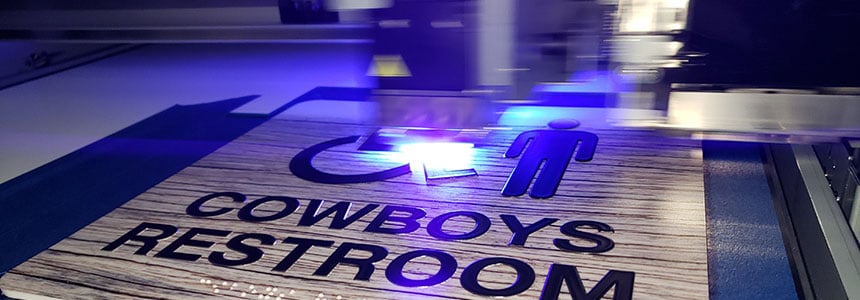
Above: Photo courtesy of Mutoh.
Mutoh helps ensure compliance through both training and proven production workflows. “Mutoh offers a training package called the StartRight Kit, which walks users through the process of designing and producing ADA signage while also providing a quick-reference guide to ADA standards and layout requirements,” says Emilio Rangel, UV product manager, Mutoh America, Inc.
On the production side, Mutoh printers utilize verified print modes, head heights, and layer counts that have been tested to consistently produce compliant braille dots and tactile elements. “This gives customers confidence that they can reliably produce ADA-compliant signage in house,” adds Rangel.
Corey Kelly, marketing director, Trotec Laser, says Trotec Laser systems are engineered to deliver the precision and repeatability required for compliant ADA signage production, and it supports customers with application expertise and workflow guidance. “While compliance depends on the full production process, the technology helps minimize variability and improve consistency.”
While ADA-compliance ultimately depends on proper design, workflow, and application, David Bistrovic, product manager, Professional Imaging, Epson America, Inc., points out that the SureColor V4000 and SureColor V1070 printers are engineered to support the precise requirements needed for braille signage production. “This includes advanced printhead technology for accurate dot placement, as well as the ability to consistently build raised, tactile layers using matte varnish to meet specified height and finish requirements. In addition, SureColor V-Series printers are designed to deliver consistent performance across a wide range of substrates, helping ensure reliable adhesion and repeatable results.”
Adam Tourville, CEO, Fluid Color, says Fluid Color works closely with ADA sign manufacturers to validate print performance, tactile consistency, and braille formation capabilities. “Our systems are engineered specifically for high-build tactile applications and are designed to maintain repeatable braille geometry and tactile heights required for compliant production workflows.”
Fluid Color also provides application guidance, workflow recommendations, ink profiles, and production support to help customers achieve consistent results. Tourville says ultimately, compliance also depends on the manufacturer’s design practices, substrate selection, and installation methods, so education and process control remain very important.
Kevin Currier, director of marketing, Direct Color Systems (DCS), explains that the production of a small set of samples will be enough to prove compliance in most cases. “DCS software and training includes guides specific to what is compliant and what is not.”
Hugo Gonzalez, senior segment specialist, Mimaki USA, Inc., feels that guaranteeing ADA compliance can be a tricky matter. “It is typically a marketing tactic that should state, ‘you can build a complaint sign with this printer,’ but there is no such thing as an ‘ADA compliant printer,’ unless regulations have changed very recently.”
There are many components to a compliant sign, and the portion that can be modified by a printer itself is a small percentage of the overall project. “Many of these requirements also vary by state, so what is compliant in one state, is not necessarily in the other,” says Gonzalez.
“What can be done, is to provide resources like basic federal requirements and encourage printers to communicate with their local municipalities. They also have the option of finding local ADA certified coordinators that would have more detailed information,” shares Gonzalez.
Sep2026, Digital Output