By Melissa Donovan
Traditional display and point of purchase (POP) applications are becoming more challenging to profit from. Print service providers (PSPs) are tasked with creating products that stand out from the crowd as banners, cutouts, and standees become commoditized. Their customers are asking for differentiation and one way to meet this need is through finishing hardware that works with a versatile array of materials, beyond sign foam and cardboard and branching out to aluminum and fabric. These machines address material diversity by incorporating multiple interchangeable tools.
“The ability to process multiple materials enables PSPs to diversify their offerings, serve a broader range of customers, and enter new markets. That flexibility not only creates additional revenue opportunities but also helps protect their investment by allowing them to adapt quickly as customer demand and market conditions change,” shares Keith Soya, business development manager, Zund America, Inc.
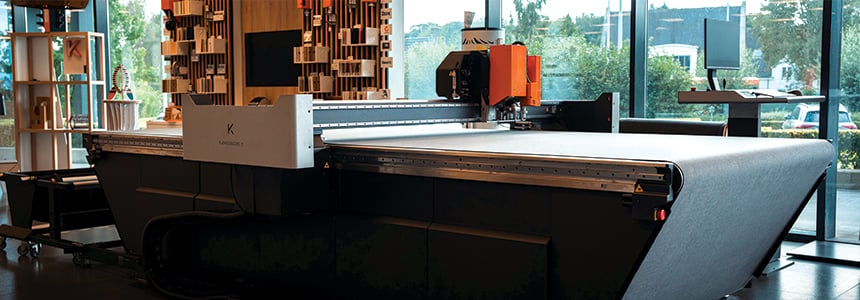
Above: The Kongsberg C series is a multifunction superwide digital cutting table for soft and rigid signage production. It’s ideal for protective packaging and handles a range of materials, from foam and plastics, flexible materials, folding carton, and all kinds of corrugated.
Changing Expectations
Buyer expectations related to display graphics and POP applications are changing. PSPs must be in a position to address needs like more localized personalization and an expanded range of printable materials that standout from the crowd.
Brand owners and retailers request more from PSPs than ever before. It isn’t simply producing printed graphics, PSPs deal with shorter production cycles, greater customization, and a wider variety of materials. “Today’s campaigns are often regionalized, personalized, or tied to seasonal promotions, making short runs and rapid design changes the norm rather than the exception,” explains Steven Leibin, president, Matik Inc.
“Over the past three decades, one of the biggest changes is that buyers are no longer looking for standard displays. They want solutions that help their brand stand out. At the same time, brands are asking PSPs to produce a wider variety of applications from a single supplier,” shares Pete Alsten, founder, Flatbed Tools.
A PSP’s objective is no longer to create the same display for mass distribution. “It’s to create one, or a few, that can be produced efficiently, shipped easily, assembled quickly, and disposed of or reused responsibly at the end of the campaign or life stage. As a result, modern display designers must now balance visual impact with practical considerations such as material usage, recyclability, ease of use, and cost efficiency,” shares David Newell, director of applications, Kongsberg Precision Cutting Systems.
Leibin points to designers heralding change. “They want more dimensional effects, intricate shapes, engraving, perforations, and decorative details that help products stand out in increasingly competitive retail environments. Finishing has become a strategic part of the production process rather than the final step.”
Sustainable media is more requested than ever before. “Customers are looking for more recycled or recyclable options. This trend is increasingly common as companies work to reduce their carbon footprint. Companies are also interested in materials that look and feel more premium. This creates a need for tooling that achieves tight tolerances and perfect edge quality,” notes Ryan Johnson, account manager, VTX Tools.
According to Soya, “advances in printing capabilities, combined with PSPs’ efforts to diversify since the pandemic, have expanded the range of materials used for display graphics and POP to include wallcoverings, acoustic materials, and other specialty substrates. This growing media diversity is driving demand for versatile digital cutting solutions that can efficiently and reliably process a range of materials while maintaining productivity.”
“These trends require PSPs to be more agile, producing a wider variety of applications efficiently, minimizing material waste, and maintaining the highest standards of precision and quality,” states Daniele Gallucci, president, Elitron America Inc.
Media Versatility
Media versatility is a competitive advantage for PSPs expected to produce a broader range of applications than ever before. Materials beyond traditional foam board and corrugated cardboard are commonly requested by media buyers.
Leibin sees increased demand for acrylic, PETG, polycarbonate, PVC-free sheet materials, wood, MDF, aluminum composite material (ACM), magnetic media, textiles, leather, paperboard, rubber, gaskets, adhesive films, and specialty composites. “Many applications also combine multiple materials into a single finished product, requiring exceptional cutting precision and flexibility.”
Paper-based rigid board standouts to Johnson as a common material. “It typically uses sustainably sourced materials and is fully recyclable. It’s very versatile and can be used for many applications including standard POP displays, all the way to heavy duty and even load bearing applications.”
“Recycled, paper-based sustainable materials can be more challenging in the cutting process due to their composition and structures. The ability to achieve high-quality, high-speed cutting or routing on these types of materials requires specialized tooling and dedicated features,” suggests Newell.
ACM is another material to watch. It is “growing in premium retail applications because it combines durability with quality. As it is a more dense material, it often needs appropriate tools, feed rates, and spindle speeds to avoid delamination,” says Newell.
An increasingly clear trend, according to Alsten, is PSPs being asked to produce a much wider variety of applications than they were just a few years ago. “Many are also expanding into retail décor, interior graphics, soft signage, wallcoverings, and architectural graphics. Customers want fewer vendors that can produce more types of products. Media versatility allows print providers to say yes to those opportunities while opening new revenue streams.”
“To remain competitive, PSPs need finishing solutions that can process this diverse mix of materials quickly, accurately, and with minimal operator intervention,” notes Gallucci.
Finishing Hardware Evolves
Finishing hardware evolves to support a wider range of materials and applications in a number of ways. These include tool variability, automation features, and software enhancements to power productivity and efficiency.
“Modern finishing systems have evolved from dedicated cutting devices into highly automated digital production platforms capable of supporting diverse applications with minimal operator intervention. Most systems address material diversity by incorporating multiple interchangeable tools,” says Leibin.
PSPs need the flexibility to move seamlessly between packaging, displays, signage, labels, and textile applications. “This has driven the development of high performance multi-tool cutting heads that allow multiple operations to be performed on a single machine without any manual changeovers,” explains Gallucci.
Executing routing, creasing, kiss cutting, through cutting, V cutting, plotting, perforating, and scoring all on one single platform by automatically switching between interchangeable tools, explains Alsten, eliminates any errors due to manual intervention.
“Rather than being designed around a narrow range of substrates, modern digital cutting systems can accommodate a range of tooling, including creasing wheels, V-notch tools, heavy-duty units, drilling tools, milling units, and oscillating knives. Each tool is designed to process different materials and their cutting requirements,” adds Newell.
Tooling options and material variety are growing at the same rate. To meet the individual needs of each substrate, the correct router bits and knife blades must be chosen to produce the highest quality products.
“Recent advancements focus on application-specific tooling. Specialized tools for materials such as honeycomb board and EVA foam, along with enhanced capabilities for cutting complex geometries and multiple angles, enable PSPs to take on more diverse and demanding work while maintaining consistent quality and efficiency,” says Soya.
There are better tool designs and coatings. “Stronger tip geometries are available for harder materials, asymmetric blades eliminate lips on plastics, and DLC coated bits run cooler and last longer. Down cut bits help with top surface finish when material wants to peel or fray. V-groove bits in multiple angles give more options for folding and detailing. Having a full range of specialized tools ready to swap in makes a huge difference,” adheres Johnson.
Laser technology is another method that addresses growing material diversity. “Unlike mechanical cutting systems, laser processing does not require changing knives, router bits, or dies for different materials. The same digital workflow can produce highly intricate cuts, engraving, kiss cutting, scoring, perforating, or marking across a range of substrates while maintaining excellent accuracy and repeatability,” shares Leibin.
In addition to tool variability, other parts of the process support more materials and applications.
Software evolves alongside the hardware. “Features such as automatic tool recognition, camera-based registration, material thickness measurement, and intelligent tool calibration reduce setup time while improving consistency across rigid and flexible materials,” says Alsten.
Automation advancements play a role beyond the cutting table. “Automated roll feeders, sheet feeders, and stackers allow PSPs to process larger production volumes with far less manual handling,” suggests Alsten.
Automation reduces the labor required to produce a job. “Automated material handling, combined with workflow software that prepares layouts, tool assignments, and cutting sequences before production begins, allows operators to focus on keeping work flowing instead of making manual production decisions. Fewer manual steps lead to fewer errors, greater consistency, and higher throughput,” continues Alsten.
Swiss Army Knife
Beyond allowing a PSP to finish a variety of media, switching between different tools on a single platform improves both workflow and productivity.
Before interchangeable tools, PSPs would use one system for cutting, another for routing, and another for creasing. Or, as Newell points out, might have outsourced some of these capabilities. Completing all of these processes on a single digital cutting platform is a big productivity benefit, reducing the need to move jobs between multiple technologies.
“Instead of moving materials between multiple machines or manually changing equipment for different applications, operators can complete a range of cutting, creasing, routing, and finishing operations on one automated system. This reduces setup time, minimizes production bottlenecks, and allows PSPs to respond faster to changing customer demands,” shares Gallucci.
Quick and efficient switching between tools maximizes uptime. “End users save even more time by choosing the right router bits and knife blades. When using the highest quality bits and blades, unnecessary or overly frequent tool changes are eliminated,” adds Johnson.
Further supporting productivity and workflow improvements, Newell says operators can create substrate-specific presets, which lays out the tool requirement and speeds, for example. “They can also prioritize tool management to ensure they are replacing tools before quality is impacted and dedicating tools to specific materials, as well as maintaining upkeep of the cutting tables themselves.”
“The ability to automate repetitive tasks while minimizing operator input reduces handling, minimizes errors, shortens turnaround times, and helps shops maintain consistent productivity throughout the day,” says Alsten.
Financial Advantage
PSPs that successfully process multiple types of materials gain in profitability and return on investment (ROI).
The most successful PSPs grow by expanding offerings, states Alsten. “Media versatility allows a shop to pursue opportunities in retail displays, packaging prototypes, interior décor, soft signage, wall graphics, acoustic panels, and other value-added applications using the same finishing platform. That increases machine utilization, reduces outsourcing, and enables shops to respond more quickly to customer requests.”
“Being capable of processing multiple materials creates the most opportunity and the fastest return on your investment. The more materials you can process, the more potential customers you have,” admits Johnson.
Material versatility directly impacts revenue potential. “The ability to handle multiple applications and materials on one scalable production device with advanced tooling increases ROI, compared to having to invest in alternative technologies for these new application opportunities,” notes Newell.
“Greater material versatility also helps print providers reduce waste, lower labor costs, and respond more quickly to customer demands. By offering more services while improving workflow efficiency, PSPs can increase their competitive advantage, generate additional revenue streams, and achieve a faster return on their technology investment,” states Gallucci.
Alsten believes one of the biggest misconceptions is that machine speed alone determines productivity. “In reality, reducing setup time, minimizing manual handling, automating workflow, and increasing application flexibility often have a much greater impact on profitability and ROI.”
“Ultimately, PSPs are investing not only in faster finishing, but in a platform that enables higher value applications, greater production flexibility, lower operating costs, and the ability to adapt as customer demands continue to evolve. The shops that view finishing as a strategic profit center—not simply a downstream process—are best positioned for long-term growth,” admits Leiben.
Positioned to Succeed
Finishing devices with the capability to cleanly and efficiently tackle a variety of substrates are a worthwhile investment.
“Digital cutting technologies have evolved to enable today’s operators to overcome challenges and achieve greater creativity. Customers demand faster turnarounds, more customization, and complex displays. The good news is that modern production technologies and workflows are able to meet their needs, offering compatibility with materials that previously were impractical and the ability to deliver complex designs,” shares Newell.
Oct2026, Digital Output