By Cassandra Balentine
Artificial intelligence (AI) is top of mind for all. It presents not only benefits but challenges. As marketing and promotional materials continue to don the familiar attributes of AI, when marketing needs go beyond social media, the question becomes, is it print ready?
Applications like vehicle templates must be accurate and reliable enough to print on several thousand dollars’ worth of material, “so there’s not much room for error,” admits Larry Lopez, owner, Art Station Vehicle Templates. “Most of what I’ve seen from AI so far are low-resolution raster images and they don’t give me much confidence when it comes to accuracy.”
However, while it may not be ideal for final template rendering, AI technologies can be helpful in the vehicle wrap template design process.
“Interestingly enough, customers of wrap shops are using this tool to provide a more detailed preliminary direction of what they are looking for. In conjunction with this, wrap designers also use AI to provide customers with initial mockups of potential designs. This saves a great deal of time and effort within the design process,” shares Michael Chramtchenko, chief of staff, sales and marketing, Fiery, LLC.
Like anything, it’s about finding the right balance.
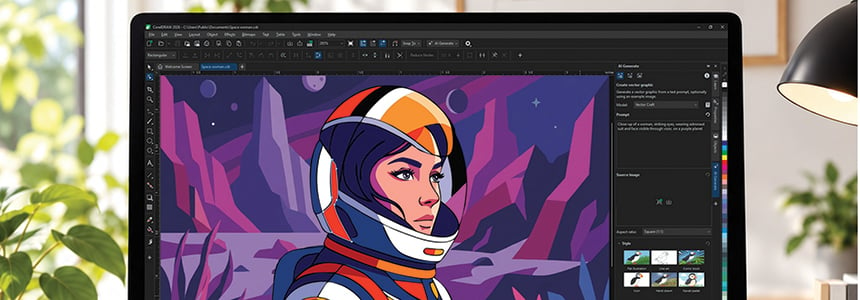
Above: CorelDRAW Graphics Suite 2026 offers a number of AI-powered tools specifically designed for a professional graphics workflow.
AI Growth
AI usage is growing in all facets of life and the graphic arts is not exempt from it.
Chramtchenko reports a notable uptick in the use of AI-generated graphics within the vehicle graphics market over the past 12 to 18 months. While he says there are certainly challenges associated with this, “using AI as a design tool is a rapidly growing trend.”
Chris Alegre, product manager, Flexi, SAi, agrees, noting that as more people gain access to AI tools the volume of AI-generated images coming into shops keeps growing. “I don’t always see that as a challenge. It’s a good baseline to start a project from, as long as the expectation is set with the customer up front. The final result may not match exactly what AI created, but it will be better.”
Alegre adds that AI gives customers an easy way to express what they’re looking for, which makes the conversation between the shop and the client far more productive than it used to be.
Chramtchenko views AI-generated graphics in vehicle graphics as an opportunity. “Certainly, there will be growing pains as the technology continues to evolve and find its way in various niche markets. But overall the introduction of more efficient processes will benefit wrap providers by being able to provide services faster, and will also benefit their customers by potentially keeping prices more competitive due to increased production efficiencies.”
Prakash Channagiri, senior director of product management, CorelDRAW, believes that like all creative work, a designer’s tool of choice is a personal decision. “It’s important to note that ‘using AI’ doesn’t mean one thing. There are many ways you can use AI in a wide format graphics workflow.”
A user’s level of expertise dictates how AI is integrated into the design process. With non-professionals “using AI could mean playing around and quickly generating an all-new design from scratch. Often, what you end up with may look nice, but without the right software, the output may not be the quality needed for a professional print project,” explains Channagiri.
For professionals, AI can be used as a valuable tool for rapidly reworking existing designs and projects, saving valuable time during production. “Time is money. They may want to take away the tedious rework. Or they may need to quickly repurpose last year’s design for the new fleet, and the client wants to see the wraps by 5:00 p.m. The right AI tools can make all of this possible, saving a professional valuable time without giving up their vision or creative control,” notes Channagiri.
Proper Processes
Ensuring a successful vehicle wrap starts at design. It is imperative that files are ready to print and install. This may include upscaling to print resolution, converting to the right file format, and adjusting colors.
Lopez points out that his expertise is creating vehicle templates and he still creates them manually. “When it comes to vehicle templates, I just don’t think AI is quite there yet.”
“Obviously requirements for print/installation-ready artwork have not changed. While AI-generated graphics are used both by the customer as well as in the wrap shop in the early design direction/mockup stages of the design process, most print shops still rely on popular software design applications such as Adobe Illustrator and Photoshop as well as CorelDRAW to complete the print-ready design files,” assures Chramtchenko.
Most AI tools generate low-resolution RGB images that need to be upscaled to CMYK print-ready files for quality output, recommends Channagiri. “The ideal graphics to work with are vector because they scale to any size, something that’s essential for a car wrap that’s typically viewed at close range and full scale. A traveler in a vehicle would immediately notice a bad print job sitting at a traffic light while looking at the car parked beside them.”
Alegre agrees that if you are using AI, upscaling is a must. “Most AI-generated images come out at low resolution and won’t hold up at vehicle scale. Color is the other big one, generated files are typically RGB, and converting those colors properly to CMYK really improves the output.”
“Color conversion is key. Moving from RGB to CMYK or spot colors needs careful proofing, especially if you’re working with an AI tool that may have selected colors outside of what’s actually printable. Plus, the designer is always having to adjust for the vehicle’s shape—with contours and panel breaks as well as adding the bleeds and safe zones needed to appear correctly on the road. It’s critical that the fine details come through authentically and view correctly at the final size,” explains Channagiri.
Chramtchenko points out that traditional software design solutions have begun to either integrate with or include AI engines.
“There is no question that in the very near future AI agents will be trained to prepare print-ready files based on the specific print requirements like resolution, color model, bleeds, contours, and panels. This will further reduce potential printing errors and reduce wasted consumables,” foresees Chramtchenko.
For those looking to expand software solutions to accommodate AI, Alegre suggests considering a solution that allows users to upscale directly in the software. “There are a lot of standalone AI upscalers out there, but going with a trusted company is always best. They did the research and already found the best one for you. The other feature I’d look out for is the ability to create print-ready generated vector files. That makes a huge difference in output, editability, and scale,” he warns.
Adhering to the same best practices whether AI is used or not is one way to ensure a quality vehicle wrap is achieved every time.
“Whether you create your final artwork with AI assistance or not, the same requirements apply. Am I creating clean vector art that will scale for my project? Are my raster images high enough resolution to look great? Will the colors print true, thanks to color management and industry-standard color support? Does the software I’m using support the professional print requirements I need for a quality wrap? Does it support car wrap templates? Those are the kinds of questions to keep in mind,” suggests Channagiri.
Chramtchenko stresses the importance of print shops becoming aware that AI technology will be very widely used within the vehicle graphics market and this will happen very quickly.
“They should ensure that if their design applications do not already incorporate AI that they have a clear development roadmap that demonstrates how they intend on leveraging the technology within the next 12 months. Print providers should also make certain that their vehicle template provider is also part of that roadmap and is able to support AI technologies as part of the company’s product offering,” recommends Chramtchenko.
AI for Vehicle Wraps
Whether or not you favor AI, it is coming for nearly every industry. “Without question, AI is shaking up the world of creative design. Nothing will replace human creativity and professional designers will be essential now and in the future. AI should be a tool that enables them to get their ideas to output, faster,” states Channagiri.
Already, designers have to find ways to work with AI rather than against. For vehicle wraps, the final design is best done manually at this point, but AI can be used to cut down on more time-consuming mechanical tasks generally encountered during the initial design stages between customer and print provider.
Nov2026, Digital Output