By Melissa Donovan
End-of-line automation includes anything that eliminates that extra worker at the end of a print job manually cutting or moving material. Using it frees operators up for other tasks. Fearing automation is common, but operators shouldn’t be concerned. Not only is implementation of automated solutions easy, the return on investment (ROI) is real.
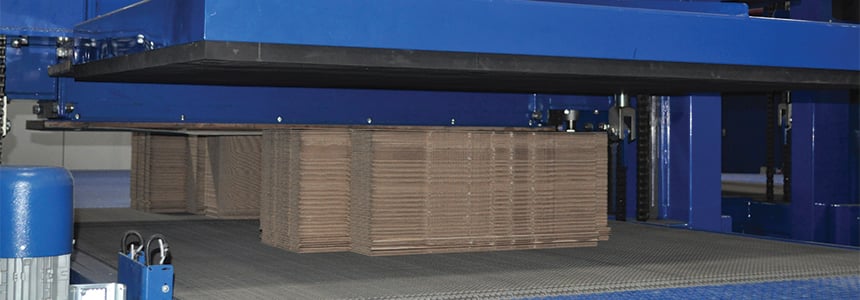
Above: SUN Automation is the exclusive sales representative and service provider for all PARA material handling systems sold and serviced in the U.S., Canada, Mexico, U.K., and Ireland.
Useful Options
Automation frees up press operators for other tasks. In a print shop, end-of-line automation options include mechanisms like material feeders and stackers, robotic arms, conveyors, and intuitive software.
“Automated finishing and material handling systems are essential for digital printers and finishers competing in sign, display, and corrugated. Feeders and stackers reduce labor dependency, enhance workplace safety, and eliminate inconsistencies caused by fatigue, human error, or skill differences,” explains Steven Lueders, co-owner, Infinite Motion Control (IMC).
Using automation, stronger ROI is achieved through higher output and reduced waste, states Lueders. Take for example IMC’s Vector Feeder. Adding it to a digital printing line increases production throughput up to 60 percent while maximizing equipment uptime, according to the company.
“Pre-feeders, stackers, conveyors, bundle forming, palletizing, and inline inspection keep production continuous, efficient, and consistent,” lists Rob Casella, technical director, SUN Automation Group.
Cutter extensions as well as robotic picking and sorting devices can keep material consistently moving and free up operators from repetitive handling tasks, shares Martin Thornton, packaging business development manager, Zund America, Inc. “This lets teams redeploy labor to areas where operators add the most value, while also improving process reliability, throughput, and overall equipment efficiency.”
Collaborative robot (co-bot) solutions designed for Zünd by Robotfactory includes the Robot PortaTable 130, which automates the removal of cut materials. This co-bot works side by side with the operator and takes on loading/unloading tasks, including picking and sorting, as needed. The Robot PortaTable 130 is extremely flexible. Thanks to its mobility, it can quickly and easily be repositioned around the machine or moved from one Zünd cutter to another.
According to Nimil David, product manager, robotics and automation, Kongsberg Precision Cutting Systems (PCS), automation is closing the gap when it comes to lost revenue. “In a print shop, true productivity is defined by how continuously the knife or blade of the digital cutting table is actually in the material. In other words, how long production is actually ‘live.’ If the machine sits idle while an operator loads or unloads a sheet, that’s lost revenue.”
Automation tools eliminate human error and ensure precision every cut, explains David. Kongsberg PCS offers end-of-line automation for cutting tables with its Feeder & Stacker and Robotic Material Handler. Also helpful, a vision system with top and under side cameras that simplify operations for print side down applications and scans registration marks or barcodes to automatically pull up correct digital files.
Automation is also useful for roll cutters, eliminating manual trimming of roll-type applications or even tying up a flatbed cutter with straight cut jobs. “For shops cutting square or rectangular media from a roll—wallpaper, posters, banners, magnetic film, direct to film transfers—an automatic XY cutter is the fastest and most accurate option,” states Chase Pender, operations, Supply55, Inc.
Supply55 distributes the KalaXY, which reads cut marks from a print file and handles both cross cutting and lengthwise trimming automatically. “This keeps your flatbed cutter free for jobs that actually need contour cuts, kiss cuts, and routing,” shares Pender.
Easy Peasy
Not all solutions are created equal. It’s important to work with reputable vendors when considering implementing an automation solution. The majority of the time these vendors have the staff, training, and tools available to minimize any downtime during installation as well eliminate most of the learning curve.
“The ease of implementing end-of-line automation depends on the equipment being automated, the automation options available for that equipment, and which part of the production workflow the customer wants to streamline,” advises Thornton.
David suggests shops considering an investment in finishing automation “ensure their tables integrate with their current systems and printer speeds to cause the least disruption to current operations.”
For example, Kongsberg PCS automation solutions are modular, which allow for ease in adding a loading or loading/unloading solution to an existing Kongsberg PCS cutting table. Installation and training is completed in a few days because the products are intuitive in nature.
Because of the modularity of Zünd systems, workflow automation—both in terms of software and hardware—can easily be added after the fact, even years after the initial installation. “This allows shops to scale gradually without having to purchase more than their immediate needs dictate, which helps reduce the initial investment in finishing equipment,” adds Thornton.
“Most automation is modular and easy to integrate, with operators typically up to speed in days. Brief downtime may occur during installation, but long-term uptime improves thanks to fewer jams and automated handling,” admits Casella.
IMC’s automation offers a scalable foundation for modular growth, allowing print providers to expand capacity gradually, one device at a time if desired. The printer or cutter can be upgraded with initial feeding, followed by a stacker, and potentially a flipper for two-sided printing or print side down cutting.
“With power and air drops already in place, IMC’s Vector Feeder is usually installed and ready to operate in under one day. Similarly, the Telestacker can be set up and functioning in less than half a day, with training completed the rest of the second day,” explains Lueders.
With Supply55 and the KalaXY, both onsite and remote installation and training is available depending on a print provider’s level of experience. Pender admits there is a learning curve, but it is manageable. “Once it’s built into your daily workflow, most wonder why they didn’t automate sooner.”
An Ally in Business
When we think of automation, many get concerned about machines taking over. However, it’s best to think of automation as a friend or ally.
“Automation should not be considered a threat but rather an ally that takes away manual, repetitive tasks so you can focus on more productive and skillful work. For instance, instead of being the worker who simply moves material, you become the person who manages the process and maximizes the potential of the equipment. This allows you to be more creative and engaged. Ultimately, automation helps you work smarter, not harder,” suggests David.
Thornton agrees. “Zünd automation is designed to support operators, not replace them. It tends to make their job easier and takes over the most repetitive, physically demanding material handling tasks so they can focus on quality control, fine tuning operations, and other higher value responsibilities. In most shops, this ultimately makes the operator’s role safer, less strenuous, and becomes essential in maintaining a smooth, consistent production workflow.”
“Automation enhances operators’ roles, replacing repetitive tasks with higher value work in setup, quality control, and optimization. Production becomes safer, less physical, and more technical,” attests Casella.
When automated feeding and stacking is integrated the possibility for workplace accidents is reduced, as is the risk of injury. Tasks like manual lifting of heavy or oddly shaped, oversized boards is likely eliminated, adds Lueders.
“In many cases, the real risk is waiting too long while competing shops are already investing in automation and gaining that productivity advantage,” states Penders.
It’s the Future
Automated stackers, feeders, conveyors, pickers, etc. integrated with finishing devices are considered the next generation of finishing for sign shops.
“Automation in finishing isn’t new, but it’s increasingly important for sign shops as rising volumes and persistent labor challenges make manual processes harder to sustain. For many customers, adding material handling automation to their Zünd systems is simply the natural next step in scaling production to meet higher demand, without continually adding more staff—or additional equipment,” says Thornton.
Print providers that automate end-of-line production are able to deliver applications faster, more accurately, and with greater cost effectiveness, according to David. This is imperative as printers reach higher speeds and labor becomes tighter. “Automation is no longer considered a luxury, but rather a necessary and logical step for any sign shop that wants to stay competitive and grow profitably.”
As printers get faster, it’s natural for finishing to become a bottleneck. This makes automation on the finishing side of things increasingly important, states Pender. “Automated feeders, cutting systems, and stacking solutions help keep production moving by reducing manual handling and maintaining consistent output. For many sign shops looking to scale production, these types of systems are becoming less of a luxury and more of a necessity.”
Natural Next Step
No longer a luxury, automating components of the finishing process is a necessity for print providers. Feeders, stackers, pickers, robotic arms, and much more push through the clutter and maximize productivity on the back end in a digital printing environment.
Jun2026, Digital Output