by Cassandra Balentine
Vehicle graphics and wraps come in many variations. From commercial printed graphics to solid color change, reflective, and pinstriping media, there is a product to transform any vehicle. Depending on the application, there is a range of available media options.
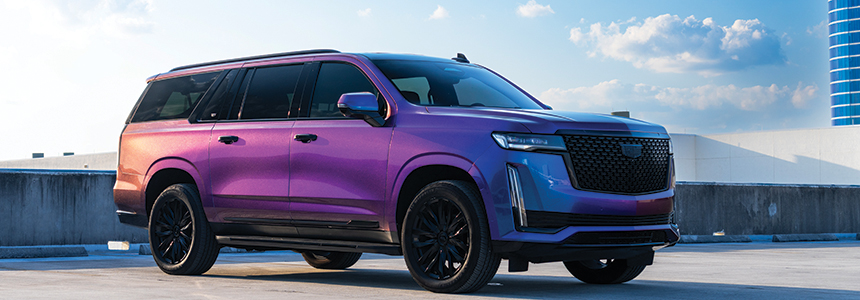
Above: Evolve offers a range of premium solid color change films with Italian manufacturing, advanced adhesive technology, unique color development, and excellent conformability.
Commercial Vehicle Graphics
Printed vehicle graphics and wraps are offered by commercial print providers.
Commercial wraps are effective for building a brand. “They are one of the most effective forms of advertising a business can have. Think of a commercial vehicle wrap as a moving billboard that can promote a business—its brand, location, and services,” shares Joey Heiob, East regional technical service representative, Avery Dennison Graphics Solutions.
Jay Kroll, director of product education, General Formulations, agrees, noting that businesses look to print vehicle graphics and wraps to build brand awareness with a relatively small investment to produce. “For any commercial vehicle that is regularly on the road or on a job site, a wrapped vehicle with good branding acts as a mobile billboard to promote the business.”
The popularity of commercial wraps comes from the ease of customization. “Designs, colors, and messages can be tailored to a specific audience or to promote a brand and business. Having a business name on the vehicle and creating mobile advertising is a great way to promote a business. There are instructional videos online that allow an easy, no-cost way to learn installation techniques—allowing a wider range of sign shops the capability to provide the service,” comments Nate Goodman, product manager graphics, Mactac.
Businesses use many types of vehicles for printed vehicle graphics, but the most popular are trucks, trailers, and service vans.
“Another more subtle example may be a local police department or emergency vehicle, and transportation graphics seen on buses and taxis displaying their branded livery through printed graphics,” adds Kroll.
When it comes to material selection, Josh Robertson, director of product management, Fellers, says most vehicle wraps are done with a cast vinyl film. “Cast refers to the film manufacturing process. This type of film is less susceptible to shrinking over time and is more conformable during installation.”
Cast vinyl with a repositionable adhesive where the bond increases over 24 hours and an air egress liner is a common type of media for printed, commercial vehicle wraps. “A clear cast vinyl overlaminate should be used to protect and enhance the print media after printing. This combination will last many years and should still be removable when the wrap needs to be changed. The repositionable adhesive allows for easier installation and the removal of wrinkles. The air egress liner imparts channels into the adhesive so bubbles can be removed from behind the graphics during the installation process,” explains Goodman.
Heiob also feels that the best and most used materials for commercial vehicle wraps are cast digitally printable films and cast overlaminates. “This combination provides the strongest durability and best conformability for today’s vehicles. These films usually include air egress technology that allows for fast and bubble-free installation. Some films employ adhesive technology that allows the film to be easily repositioned and slideable, which makes the install easier and faster, especially for smaller shops.”
Robertson cautions that while calendered films are typically cheaper, they lack the technology of a cast film. “In general, vinyl is by far more cost effective than other materials and remains the popular choice. Some applications require the introduction of urethane-based films to achieve the desired level of installation. Common applications include deep recesses, extreme curves, or extended life expectancy. Regardless of what film you choose, most wrap films come with air channels for ease of installation and repositionable adhesive to make positioning the vinyl much easier. A typical commercial wrap can last three to five years with proper care. Many factors like excessive use and lack of proper care will contribute to a shorter life span of the wrap.”
High-performance calendered films can be used for partial wraps. “A partial wrap refers to wrapping part of the vehicle, typically flat or slightly curved areas such as the center of a hood or the vehicle sides. It is important to understand the conformability needs and life expectancy when picking the material,” stresses Robertson.
There are many factors to consider with film and adhesive selection, including the desired lifespan of the wrap, complexity of the surfaces where it is applied, and even the skill of the installer who handles the films. “Wrapping race cars with frequent graphic changes, for example, may be best served using a premium calendered vinyl versus a cast vinyl. The exchange offers a lower price point when costs for a slightly less conformable film option and longer durability is not necessary. Fortunately, a good install method and clear understanding of the film and adhesive characteristics go a long way towards helping a film reach full potential,” notes Kroll.
Color Change
Solid color change graphics are utilized to wrap vehicles in a specific color, generally without printed designs. Color change wraps can be used for both commercial and private vehicles.
Solid color wraps are an alternative to paint and provide excellent color control, as well as speed and ease of application. “For two-tone trailer wraps with cut graphics, color change films are a more economical option,” offers Kroll.
Solid color change wraps remain popular for complete vehicle transformations, but the trend is shifting—color paint protection film is rapidly taking over this market segment. “Many car owners now prefer the dual benefit of a color change and paint protection in one product. Traditionally, solid wraps were most popular in urban areas, luxury car hubs, and among enthusiasts who value a distinctive, factory-quality look without a permanent paint job. They’re also favored in fleet applications for achieving a uniform appearance. The appeal comes from achieving unique finishes—matte, satin, gloss, metallic—while still protecting the original paint,” says Mattia Casarotto, area manager, Evolv.
Color change wrap films allow for a new, distinct look for the vehicle with generally a lower cost, shorter time period than painting. Goodman points out that these wraps are also much easier to revert back to the original look if desired. The wraps protect the paint and preserve the resale value of the car while allowing a customized one-of-a-kind look.
Color change wraps are popular in the automotive restyling or automotive aftermarket spaces. “It allows vehicle owners to customize their vehicle without the commitment of repainting. Vinyl also provides different finishes, textures, or color combinations that are hard to create with paint,” says Robertson.
Luxury and performance cars, high-end SUVs, and commercial fleets are the most common candidates for color change wraps. “However, personal daily drivers, motorcycles, and even specialty vehicles also use solid wraps to refresh their look or protect paint for resale,” adds Casarotto.
Robertson typically sees full color changes on specialty vehicles or sports cars. “Though this is not exclusively true, the ability to customize accent pieces with color change film remains very popular on everyday vehicles.”
According to Casarotto, cast vinyl is the go-to for full wraps due to its superior conformability, minimal shrinkage, and long-term durability.
“Color change films are generally cast PVC with solvent adhesive, relatively easy to install with the proper training and experience, and feature air egress and repositionability,” says Kroll.
“Like commercial vehicle wraps, color change should be cast vinyl with a repositionable adhesive with the bond increasing over 24 hours and an air egress liner for a bubble-free installation. It will last many years and should still be removable when the wrap needs to be changed,” recommends Goodman.
Robertson adds that the same technology exists in color change film as it does in printed vinyl. “Cast and calendered as well as repositionable, air release adhesive technology. It typically comes down to the application and budget.”
Reflective Graphics
Reflective media is also used on vehicles, offering special effects like shimmer or holographic.
Reflective films are popular among emergency management vehicles, police cruisers, and other municipal vehicles requiring easy identification in low light situations. “Though the technology exists for wrapping a full vehicle in reflective, it’s typically prohibitive to do so because of cost,” shares Robertson.
Heiob agrees, noting that full vehicle wraps aren’t generally done with reflective films, with the exception of oil tankers. “That doesn’t mean you can’t use reflective films as a full vehicle wrap. Typically—and most commonly—reflective films are used as accents on a wrap or as overlay graphics on top of a wrap. Reflective films and conspicuous tapes are often used for safety markings and increased visibility for fleet vehicles.”
These films are typically used to accent the most important part of the graphic or lettering. “Other finishes and textures such as carbon fiber are used to create unique accents to a vehicle’s hood, side mirrors, or interior,” notes Robertson.
Robertson points out that a lot of special effect films are sold but many do not come with the same outdoor life expectancy or adhesive technology for vehicle installation and removability. “It’s important to ensure a film is designed for vehicle wraps before ordering,” he cautions.
Mactac refers to this category as color shift wraps. “They are niche but really make the vehicle stand out. They have many of the advantages of color change but add extra bling. Special raw materials and pigments reflect light differently depending on the angle of approach. The color shift wraps are meant to catch the eye and draw attention to the vehicle,” comments Goodman.
“Typically, reflective films are applied on commercial wraps to highlight the business phone number or company logo to improve visibility at night. Reflective films from Avery Dennison are also applied to the rear doors of ox trucks, trailers, and emergency vehicles to also enhance nighttime visibility,” shares Heiob.
Goodman describes the media as typically cast vinyl with a repositionable adhesive with the bond increasing over 24 hours but with a PET liner so the adhesive is extra smooth and does not add a texture to the specialized film. “The durability is not as long as other types of wrap products because of the specialty nature of the materials and the tendency it has to show scratches and wear.”
Striping/Pinstriping
Striping or pinstriping media is used when only part of the vehicle requires a line or several lines of material.
Goodman says thin lines of film striping add character and color to a painted vehicle for a very low cost by highlighting its curves and providing a unique design. “Striping allows the owner to customize the vehicle and tailor it to their liking. Multiple stripes can be used as well as different thicknesses to add dynamic appeal.”
“Pinstriping is an easy embellishment for painted or wrapped vehicles that can be used to extend the detail of a partial wrap or spread graphic details to other areas of the vehicle, maximizing its visual impact while keeping the costs minimized,” adds Kroll.
Robertson feels that pinstriping is not as popular in today’s culture and many of the fine detail gets printed as it’s more cost efficient and faster to process. “However, some car enthusiasts may require a finish that is not possible with printing.”
Robertson points out that several films can be ordered in narrow widths that can be applied to the vehicle for the desired effect.
Pinstriping isn’t limited to specific uses, according to Kroll, and can be found everywhere from consumer vehicles to commercial fleets, scooters to semis, cars to cargo trains.
“Striping is popular in a few applications; probably the largest use of reflective and chrome films as accents is when you don’t want the entire vehicle to reflect when hit with light. You can see examples of this on U.S. Postal Service vans, fire trucks, and other emergency vehicles,” shares Eric Norby, product manager, FDC Graphic Films, Inc.
The most obvious applications are emergency vehicles like fire trucks, ambulances, and police cars, but you’ll also see them on semi-trailers and other fleet vehicles. “Striping is a cost-effective way to highlight your brand, especially if your company’s colors are recognizable,” shares Norby.
“Because striping tends to be less than six inches wide, and thus easier to install, there is not much needed for the advanced adhesive characteristics that are popular with color change and full printed wrap applications. The key aspects to look for are the material’s durability and its dimensional stability—you want to make sure the stripes you are applying last, or for it to have removability over time,” explains Norby. “If your application goes over rivets or complex curves, be sure that the material you choose has the conformability characteristics to be properly installed.”
Cast or calendared vinyl can be used with permanent blockout adhesive and a smooth liner, according to Goodman.
“Pinstriping can be done with either calendered or cast film and is generally a PVC film with a permanent adhesive. The application method differs depending on size of the feature, potentially being a small stripe that is applied freehand along a ridge or detail on the vehicle, or using premask and specific positioning for larger graphic elements,” shares Kroll.
Robertson adds that in his experience pinstriping is typically added for long-term use so removability is not necessarily required.
On the Road with Style
Vehicle graphics are popular among businesses and consumers alike. Printed graphics that enforce branding and company messaging to personal expression; color change for paint protection or to sport a new, temporary look; reflective media that stands out in emergency situations and night time viewing; or pinstriping for a low-cost flair—all of these vehicle graphic media options are abundant.
Nov2025, Digital Output Magazine