By Melissa Donovan
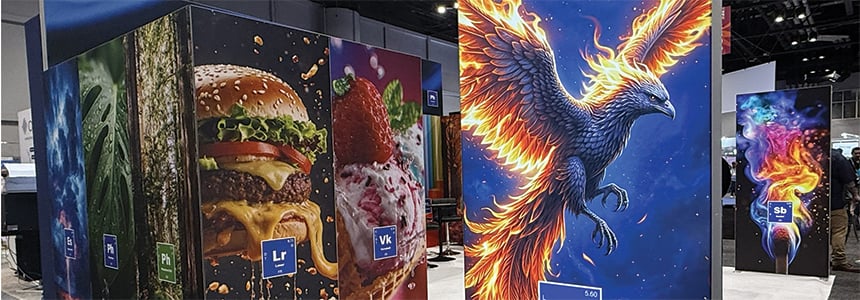
Fabric-based trade show graphics present opportunities for reusable signage. This yields sustainability, effective messaging, and ease of install—no professionals needed. It’s a no-brainer to offer soft signage to customers. However, there are certain things to look for when determining which fabric is right for trade show applications. These include opacity, white point, soft hand, elasticity, and weight. Taking all of these into account leads to an impactful graphic durable for multiple uses.
Above: BMG distributes Berger Textiles’ Lumina, a backlit fabric for dye-sub printing.
Key Points
According to Ken Bach, business development director, Aberdeen Fabrics, Inc., “when selecting fabrics for trade show graphics, performance, appearance, and reusability are critical. Print quality, durability, and overall presentation are directly impacted by opacity, white point, soft hand, elasticity, and weight.”
Typical fabrics print providers use for trade show graphics are blackback, backlit, and display stretch, lists Joel Willcock, director, UFABRIK. “Textiles that combine strong visual performance with practical handling benefits give reliable performance across display backlit and block out applications.”
Opacity
How much light passes through fabric, or opacity, is critical for proper viewing. A graphic that isn’t clearly read or seen defeats its purpose.
Larry Ulfig, channel manager, Berger Textiles, Brand Management Group (BMG), believes ample opacity is necessary to ensure that stray light does not effect graphics.
High opacity is preferred, according to Bach, to prevent show through from frames, structures, or lighting behind the graphic. It ensures consistent color density and enables double-sided applications without ghosting.
A completely opaque fabric effectively hides structures or storage behind the graphics. According to Andy Downs, GM, Berger Textiles USA, this is essential for a professional, eye-catching exhibit.
“Opacity is important, as a single layer fabric with good opacity allows you to reduce the number of layers. This helps to minimize shipping costs and the installation time,” shares Jeff Cheatham, VP of sales and product development, Fabric Printing Solutions.
White Point
White point involves brightness and neutrality.
“White point is important more so on the production side of trade show graphics; this is crucial for color management and consistency,” says Downs.
Using a spectrophotometer to measure ensures a high white point, which Ulfig says is best. “Calculating the LAB values with a spectrophotometer ensures the B value is between a -2 and -14.”
“An important aspect is maintaining consistency with white point across production runs and batches to ensure that similar graphics will more easily match without reprofiling fabrics and only running calibration steps,” suggests Kylie Schleicher, VP of business development and product management, Ultraflex Systems, Inc.
Cheatham believes a nice white point helps achieve the desired brightness of a rich color.
“A clean, neutral white point ensures accurate color reproduction, prevents color shifting—yellowing or blue tint, and enhances vibrancy and contrast in printed graphics,” says Bach.
The white point is also a big factor in custom-facing graphics that do not have full print coverage and show off a lot of blank space—think Apple or Samsung, suggests Downs.
Soft Hand
A softer fabric offers both practical and aesthetic advantages.
“A soft textile matters for premium display work, especially when the material is handled, folded, packed, tensioned, and installed on site,” explains Willcock.
Schleicher points out that not only are trade show graphics packed and unpacked constantly, but installed by non-specialist laborers. This means they need to be user friendly—crease and wrinkle free. “The materials need to have a good balance of softness and pliability while maintaining structure in the finished application.”
Folding and incidentally packing a softer fabric after use is easier and does not result in creases, notes Bach. “This presents a premium, wrinkle-free appearance and is particularly important for exhibitors who ship and reuse graphics frequently.”
“This translates into a more wrinkle-resistant product. Customers do not like wrinkles in their graphics,” stresses Cheatham.
Choosing fabrics that won’t retain wrinkles or creases once installed is one of the most important aspects of choosing the right product, suggests Downs.
“But even products that claim to be ‘crease free’ can still occasionally show stubborn creases, and this is where preparation is maybe the most important aspect—working with a reputable exhibit design company and print provider to ensure precise frame measurements for snug installation of your graphics, because graphics printed on the right textile that are installed properly should not show creases,” continues Downs.
Elasticity
A touch of stretch is helpful for fabrics used in trade show graphics. “Stretch is useful, but uncontrolled it can distort images, logos, and text,” admits Willcock.
A balance needs to be achieved. “It’s important to have graphics that are taut but not overstretched to the point of losing opacity or yarn breakage,” says Downs.
“Elasticity comes into play with how the print job interacts during every stage—from how the material to your printer is loaded to ink settings and printer codes to any calendaring in the end stages,” shares Leif Kristensen, print media sales consultant, TVF.
Elasticity is useful for silicone edge graphic (SEG) applications and other framing systems.
“Elasticity allows for tight, drum-like tension in frames, prevents sagging over time, and improves ease of installation and reinstallation,” adds Bach.
Ulfig points out that elasticity provides a little forgiveness in case the fabric panel is not the same size as the frame. Also, it helps the product stretch as well as rebound to its original size.
Weight
Fabric weight plays a role as well.
“Fabric weight impacts durability, handling, and print performance. Lighter fabrics are easier to ship and install. Heavier fabrics often provide better opacity and structure. The right balance ensures durability without sacrificing portability,” says Bach.
Ulfig cautions that if a material is too heavy it may sag over time.
Weight varies by application, but according to Cheatham most popular items fall into the range of six to 9.5 ounces per square yard.
“Textile weight has become less of a primary factor in trade show graphics, as developments in knitting and weaving, yarn construction, and different coatings have paved the way for lighter weight fabrics to accomplish or exceed the goals of traditional heavyweight fabrics, driving transportation costs down and reducing installation time and effort,” admits Downs.
Other Considerations
Opacity, white point, soft hand, elasticity, and weight are top features when considering the best fabric for a trade show graphic, however they aren’t the only things to think about.
Bach lists off sustainability, print consistency, durability, flame retardancy, and supply chain stability as additional factors.
Stretch in warp is another consideration. “Materials should not have too much stretch in the warp because this will cause tensioning issues on the printer. If the material does have a lot of stretch in warp, the fabric must be transfer printed,” recommends Ulfig.
Willcock warns of the potential for “bruising.” “Exhibition graphics are packed, shipped, then unpacked, handled, and sometimes reinstalled many times. They need to be able to resist bruising.”
Care and Cleaning
Trade show graphics are designed to be reused. Thus it makes sense the fabric offers some level of washability.
“Fabric trade show graphics are designed for multiple uses and can be cleaned with proper care. Proper care helps maintain color vibrancy, fabric integrity, and overall appearance across events,” shares Bach.
Tools like magic erasers or brushes with very soft bristles used very lightly are a great starting place, suggests Kristensen. “With any investment as visually prominent as your booth materials, speed is critical and starting as gently as possible is best.”
Beyond hand cleaning on site, care also includes placing the fabric in a washing machine on the gentle cycle with cold water, suggests Bach. Mild detergent is preferred—avoid bleach and fabric softeners—and air dry or tumble dry on low heat. Avoid high heat to prevent shrinkage or damage to the print.
“Depending on the size of the panel, you may need to bring it to a professional launderer or hand wash. It’s important to hang the fabric to dry to avoid mold or mildew, and to also avoid dryers with heat, as this can cause fabric to shrink and/or alter the performance of the material,” advises Downs.
Proper laundering depends on the ink sets used on the printed graphic. “Coatings designed for dye-based printing allow for completely permanent and washable textiles that can be laundered or dry cleaned normally,” explains Asher Katz, president, Jacquard Inkjet Fabric Systems, Inc.
“Dye-sublimation (dye-sub) printed graphics can be washed; however, there is a limit to how many times they can be put through a washing machine,” notes Ulfig.
Flame Retardancy
Flame retardancy (FR) isn’t optional—it is necessary in most venues and environments trade show graphics are installed in.
Requirements vary depending on location. Downs suggests checking with the venue ahead of time to ensure the graphics are compliant with local regulations.
In the U.S., certain states like CA and NY have more stringent codes, advises Kristensen.
“Compliance ensures safety, avoids installation issues, and meets venue regulations,” asserts Bach.
Common standards are TB 117-2013, NFPA 701, Title 19 – California Code of Regulations, CAN/ULC-S109 in Canada, and DIN 4102 in Germany.
“NFPA 701 is one of—if not the—most common FR certification to be aware of. It governs standards for outdoor materials ranging from draperies and curtains to tents and more. NFPA 701 is often required by fire marshals in almost every state,” shares Kristensen.
Fabric Options
Aberdeen Fabrics offers high-performance textiles engineered for trade show and display applications. Key differentiators include CleanRTex Technology, high-opacity solutions, soft knit construction, elastic performance for SEG, recycled content options, made in the U.S., and an end-of-life recycling program. CleanRTex Technology uses up to 80 percent less energy and over 90 percent less water in production, no wastewater discharge, and supports full end-of-life recyclability. These features combine to deliver consistent print quality, durability, and sustainability advantages over traditional coated or imported materials.
Berger Textiles offers several solutions for trade show graphics. Phantom is a versatile, soft fabric with a completely opaque black-backer with exceptional printability with transfer and direct dye-sub, UV, and latex inks. It is crease resistant. Lunar is a heavy-knit textile with a knit greyback for superior opacity, a soft hand, and a great white point. Xtend is ideal or geometric and three-dimensional frame systems, pillowcase frames, and hanging signage, thanks to its elastic composition, impressive opacity, crease-resistance, and stretch rebound. Lumina is backlit fabric for dye-sub—providing brilliant color reproduction, perfect light transmission, and crease-free installation.
BMG distributes Berger Textiles’ fabric. Its staple product for trade shows is blackback material because it is totally opaque. Phantom blackback is unique in that it has more stretch than most of the competitors’ products, allowing for an easier installation. Another product is backlit, Lumina. The light dispersion on Lumina is also best in class.
Fabric Printing Solutions’ blackback and white back coated fabrics offer consistent quality—allowing customers to engineer in a specific measurement and setting each time. LFT4000 Knit Vibe is a FR knit backlit fabric with light diffusing yarn construction, ideal for use in SEG light boxes.
Jacquard’s 6.5oz Canvas is ideal for trade show graphics. The company can also treat any fabric a customer sources and sends to the company for coating and/or paper backing.
TVF’s 8.5 oz. PureNight Pro 8668SDWGFS is a high-performance, eco-friendly blockout fabric made from 100 percent recyclable polyester—delivering excellent light blocking without the need for heavy coatings. Lightweight, yet durable, it resists creasing and meets NFPA 701 FR standards. It is dye-sub paper transfer and direct disperse printable and great for frame systems, trade show displays, event backdrops, window graphics, retail signage, and banners.
UFABRIK’s portfolio covers over 95 percent of applications required by the wide and superwide digital print industry. Its products are noted for their stretch, dimensional stability, color vibrancy, blockout, light diffusion, scratch resistance, and crease- and wrinkle-free features.
Ultraflex’s VorTex Backlit Event T202 is a woven lightweight backlit for trade show and event applications. There is no spider cracking, which allows the graphic to be folded and installed with ease. The fabric can be printed via dye-sub transfer and is available in widths of 63 and 126 inches. The company also supports its new 100 percent GRS-certified recycled fabrics through its ReSource soft signage line.
Super Graphics
While it’s true proper stretch, weight, and even soft hand make for an impactful graphic, other practical considerations like FR certifications and how a product will be washed are essential factors when choosing a fabric for trade show graphics.
Jul2026, Digital Output