By Cassandra Balentine
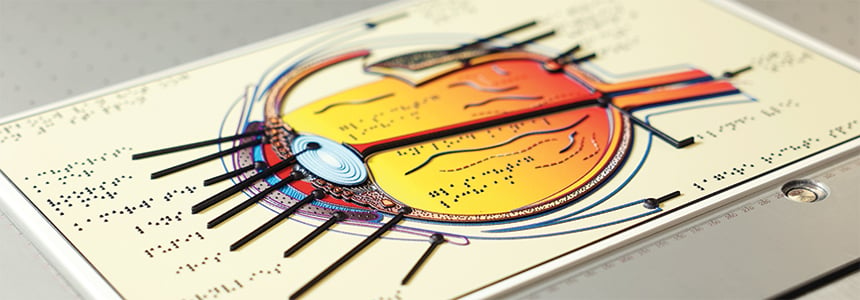
Flatbed specialty printers and laser engraving solutions—in both wide format and desktop-sized configurations—support everything from directional signage to office number plaques. Tactile print capabilities increase value as it enables print providers to transition to ADA-compatible work like braille.
According to Adam Tourville, CEO, Fluid Color, ADA and tactile signage represent a stable, specification-driven market that continues to grow alongside commercial construction, healthcare, education, hospitality, and municipal infrastructure development. Unlike some markets that are commoditized, ADA signage requires compliance expertise, precision manufacturing, and specialized production capabilities.
Tactile processes also create opportunities to expand into complementary signage and graphics applications for existing customers, points out Corey Kelly, marketing director, Trotec Laser. This tends to be higher margin work with less pricing pressure when compared to traditional banner or commodity signage markets.
Above: Canon’s premier hardware offerings for directional signage include the Arizona series flatbed printers.
Tangible Revenue
If they haven’t already, print service providers (PSPs) may want to consider adding specialty printing/laser engraving services to their offerings. Today’s newest UV and laser engraving devices—wide format and desktop versions—are affordable and practical options.
Creating tactile signage—including braille—can be completed using a laser cutter or UV printing.
With a laser, operators are able to cut the sign shape as well as create holes for a braille pattern. The holes are then filled with acrylic or metal beads/balls from the back so that they protrude from the front.
Alternatively, UV flatbed printers stack layers of ink to create dots that meet braille requirements, which are instantly cured.
Tactile signage that can be used as part of a company’s ADA efforts provides potential for point-of-business differentiation and a gateway to additional revenue. “While traditional flat signage is commoditized, architectural wayfinding and tactile signage may be necessary in public accommodations and commercial facilities. Because digital printing allows for on demand customization without tooling setup, PSPs can produce specialized, tactile signage,” offers Todd Rhinerson, senior specialist, production planning, DGS Solutions Strategy, Canon U.S.A., Inc.
Any type of custom, short-run work commands premium pricing and the more specialized the application, the more superior the price. “Digital UV platforms allow fast setup and print execution, extending the capabilities of decorators to match virtually any environment, and to do it quickly at a higher margin,” adds Lon Riley, founder/CEO, DPI Lab, LLC.
Kevin Currier, director of marketing, Direct Color Systems, points out that this type of signage offers access to a whole area that may be unknown to some producers at the moment. “It is generally part of very large projects and the profit margins remain high.”
“These projects are not typically isolated, they are a recurring need and part of a larger architectural, branding, or facility project, which can create many more opportunities for a print shop,” agrees Hugo Gonzalez, senior segment specialist, Mimaki USA, Inc.
Many customers prefer sourcing all signage from a single provider, “so offering ADA-compliant wayfinding systems alongside traditional graphics creates strong cross-selling opportunities and deeper customer relationships,” comments Tourville.
UV printing also requires less labor and setup compared to traditional raster or photopolymer methods for ADA signage, “making it a faster, more efficient, and more cost-effective way to bring ADA production in house,” shares Emilio Rangel, UV product manager, Mutoh America, Inc.
In addition to ADA/braille signage, David Bistrovic, product manager, Professional Imaging, Epson America, Inc., points out that flatbed UV printers support a range of signage applications, printing directly to acrylic, metal, plastic, and wood, as well as promotional goods. “This versatility allows print providers to expand their offerings and potentially increase customer reach.”
Rhinerson explains that hardware and software capabilities used to build ADA elements fall under a broader, highly creative category known as “elevated printing.”
When dealing with non-ADA signage, Rhinerson points out that print providers are “completely free from strict geometric rules, font limitations, and specific height constraints, allowing them to lean heavily into high-impact aesthetic applications. Software that automates the creation of elevated print is critical to success.”
Currier adds that most directional and wayfinding signage does not require braille, so it is important that a chosen system can perform just as well and have consistent results in scenarios where braille and non-braille signs make up the larger project.
Desktop to Wide Format
A range of devices create speciality signage, including ADA/braille. Desktop/benchtop-sized solutions offer a lower capital cost and a significantly smaller physical footprint compared to traditional wide format flatbed devices.
Desktop UV solutions are best suited for short-run production and highly personalized output, such as small-format ADA signage, nameplates, keychains, golf balls, pens, and decorative signage. “Desktop solutions offer efficiency and versatility for smaller, custom projects and are a good entry point,” notes Bistrovic.
Rhinerson admits that desktop solutions are restricted by narrow media widths, thin material tolerances, and lower throughput.
Currier sees benefits to doing this work on wide format devices. “Real production requires throughput and consistency.”
Gonzalez points out that while some signs can be completely unique one-ups, having a larger format machine can produce many unique one-ups and simultaneously save time and money.
Many desktop solutions are single- or linear-head configurations, which mean substantially longer print times. This is compounded by extreme textures. “Desktop printers are often used more for short-run prototyping or sample production. This can compliment production lines by allowing concept development to happen elsewhere, keeping the larger production equipment processing at scale,” says Riley.
Tourville feels that industrial platforms become more economical at scale due to automation, faster production speeds, and reduced operator intervention.
Wide format systems offer higher throughput and the capacity for larger materials, making them ideal for bigger shops, while desktop systems have a lower cost entry point for smaller shops looking to enter this market, agrees Kelly.
Wider printers enable high-volume manufacturing. Print providers can utilize nesting software to lay out and produce hundreds of office numbers or directional signs in a single run, which reduces finishing time and maintains variability, explains Rhinerson.
Bistrovic finds wide format solutions ideal for larger ADA/braille and specialty signage applications, including menu boards, wayfinding signage, wall graphics, and architectural elements. “They support larger substrates, higher production volumes, faster print speeds, and often include expanded ink sets for improved color accuracy and versatility.”
Precision and Control
Producing tactile signage requires physical precision and strict adherence to design parameters. Rhinerson says requirements include elements such as height control, dot size, distance, and layout.
When UV printing ADA-compliant braille signage, precision and control—including precise printhead technology—is required to ensure accurate dot placement and consistent formation of rounded braille dots at the required height, comments Bistrovic.
The ink needs to be rigid enough to withstand some physical abrasion and durable against solvents and cleaners, as signs can be regularly sanitized, especially in medical and educational environments, notes Gonzalez.
“Ink designed to meet many applications can often be a compromise and could cause issues in the future, involving redos and frustrated customers,” cautions Currier.
Consistency is critical because ADA signage must maintain uniform tactile readability across every sign. “ADA guidelines specify the height, spacing, and font style and it is important to be within those guidelines,” stresses Tourville.
UV flatbed printers must be capable of building durable, tactile layers—typically using matte varnish—to achieve the specified dot dimensions, strong adhesion, and a non-glare finish. “Together, these capabilities enable reliable production of compliant, high-quality tactile signage,” offers Bistrovic.
Most UV digital printers are able to build texture to the ADA compliant 0.032-inch level—the key is how the art files and the printer work together to create the right combination of size, shape and color. “The art file defines the size, separation of characters, etc., while the printer software defines the layering—how much ink is applied to achieve full compliance,” explains Riley.
Reliable software workflows and compatibility with ADA-approved materials are critical to maintaining production consistency, stresses Kelly.
Rangel agrees, noting that workflow/RIP software are essential but often overlooked. “Minimizing setup time and simplifying the production process allows shops to move efficiently from design to output without bottlenecks, which is essential for consistent and profitable ADA production.”
Software designed to generate the braille elements is a necessity for true production. “Some include built-in guides to ensure compliancy in font size, style, kerning, and auto-generation of the braille dots. In addition, the full range of languages and braille grades may be included,” adds Currier.
Critical Compliance
ADA compliance is the most important aspect of producing braille signage. ADA guidelines define specific requirements for tactile signage, including braille dot height, spacing, placement, and the use of non-glare surfaces, all of which are critical to readability and usability, notes Bistrovic.
ADA signage must provide accessibility for visually impaired individuals and meet strict federal standards for tactile lettering, braille formatting, spacing, and installation. “Achieving compliance requires careful attention to design, materials, fabrication accuracy, and installation guidelines,” cautions Kelly.
The ADA Standards for Accessible Design establish requirements for tactile lettering, braille placement, contrast, character sizing, and mounting location. “For example, ADA-compliant braille signage typically requires Grade 2 Braille, rounded or domed braille dots, non-glare finishes, and tactile characters raised at least 0.031 inches above the background surface. Character spacing, font selection, and sign mounting heights are also regulated,” explains Tourville.
Several requirements must be met before a sign is installed. “Contrast is critical, as tactile elements must stand out clearly from the background. In addition, ADA signage materials must have a non-glare finish to improve visibility under different lighting conditions,” offers Rangel.
Compliance is not simply about producing raised text. Manufacturers must understand the full specification requirements related to readability, durability, installation placement, and tactile usability. “Failure to meet these standards can create accessibility issues and potential legal liability for building owners and sign providers,” cautions Tourville.
Profit Talk
Often, PSPs produce ADA-compliant signage on systems that perform additional work.
In a generalized sense, Currier says users who utilize a system solely for braille are about 40 percent, while 60 percent partake in additional non-braille applications.
The breakeven between a dedicated device or a versatile printer/cutter largely depends on production volume, labor costs, and application diversity.
Rhinerson cautions against purchasing a highly specialized, single-purpose device designed for braille or small format plaques as it may introduce financial risk. “If local demand for ADA signage fluctuates, that dedicated asset sits idle. It may stretch the breakeven point out over several years and limit the business’ agility.”
Conversely, utilizing a versatile, production-grade flatbed can help accelerate return on investment (ROI) and lower the breakeven point. Rhinerson explains that industrial solutions can spend 85 percent of a shift running traditional, high-speed commercial graphic work—such as promotional banners, posters, window graphics, and retail point of purchase. “When a tactile or architectural signage contract is secured, the shop can seamlessly pivot the same machine to specialized tactile production. This hybrid utility allows the printer to keep generating revenue, maximizing shop capacity, and optimizing equipment amortization.”
For businesses focused exclusively on high-volume ADA production, Kelly says a dedicated system can provide a strong return through efficiency and specialization. “However, many shops achieve a faster overall ROI with a platform that supports ADA signage alongside broader graphics, engraving, and fabrication applications.”
By leveraging a single printer across multiple revenue streams, including signage, décor, and promotional products, print providers can maximize utilization, reduce idle time, and achieve faster payback compared to a single-purpose solution, adds Bistrovic.
Single application devices can be a good investment if the scope and scale of the work can support it. “They also have lower entry points compared to more versatile equipment. The breakeven point, in my opinion, would be unique to each case. Assuming we are talking about a shop that has a variety of printing products, adding application-dedicated equipment can be a real asset if they have enough work to justify it,” offers Gonzalez.
Finances might not be the only deciding factors. “Are outsourced applications meeting your quality standards or time requirements? Does it represent your shop well? Having more direct control over the process might be worth the investment of application-dedicated equipment,” believes Gonzalez.
The breakeven point depends on factors like production volume, application mix, and how the equipment is utilized. “Printers dedicated to ADA/braille signage may make sense for high-volume, specialized operations with consistent demand. However, many PSPs find greater ROI with versatile UV flatbed printers that can support both compliant signage and a range of additional applications,” says Bistrovic.
Rangel feels that in most cases the breakeven depends on production volume and the type of work being targeted. “A smaller desktop ADA-focused printer can often pay for itself quickly by bringing outsourced signage production in house, especially for shops regularly producing room signs, office numbers, or directional signage. Larger wide format UV flatbeds, however, offer a much broader ROI opportunity because they can handle ADA production alongside traditional graphics, promotional products, décor, and specialty printing applications. That flexibility allows shops to keep the machine utilized across multiple revenue streams rather than relying solely on ADA work to justify the investment.”
ADA and More
Tactile signage, including ADA-compliant braille, is produced using UV flatbed printers and laser engravers in small and large format configurations. While this specialized application has the potential to bring in work with high profit margins, it requires understanding and knowledge of ADA requirements to ensure compliance.
Machines used to produce ADA-compliant signage are often versatile and produce a broad array of customized, high-value signage solutions found across a range of industries.
Aug2026, Digital Output