By Cassandra Balentine
Productivity is defined in terms of speed, turnaround times, and throughput. Finishing is an essential part of the equation when it comes to print room efficiency.
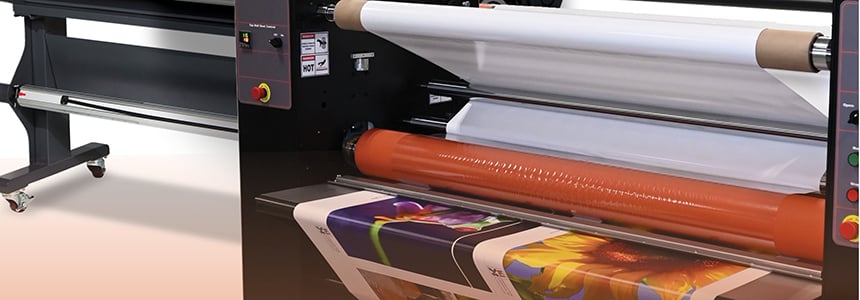
Above: All of AGL laminators fall under the category of high production; the company designs and engineers every piece of equipment to be operated five-plus days per week by multiple operators on multiple shifts.
There are many ways to measure productivity with lamination. For example, Sam Crosby, dealer manager, Graphic Finishing Partners, LLC, looks at the daily duty cycle, defining high-productive devices those in the five to eight or more hours of use per day range.
Nick Howe, GM, AGL, Inc., considers high-production laminators as purpose-built to be operated five-plus days per week, by multiple operators, on multiple shifts.
Michael Osman, president, CUTWORX USA, defines productivity in terms of throughput and repeatability rather than speed alone. “A laminator should run full-width media of at least 60 inches at sustained speeds of 30 to 40 feet per minute (fpm) while holding consistent nip pressure, tension, and temperature from the first foot of the roll to the last.”
Equally important, Osman says, is how quickly operators can get material on and off of the machine. “Pneumatic roll handling, minimal changeover time, and the ability to laminate and trim in a single pass are what separate a true production laminator from a machine that simply posts a high top speed.”
“In wide format graphics, a high-production laminator is a roll-based finishing system capable of keeping pace with today’s digital print workflows, especially fast-paced UV LED roll-to-roll production, while delivering consistent adhesion, clean output, and operator-friendly throughput. In practical terms, that means wide media capacity, fast processing speed, controlled heat assist, repeatable pressure, safe operation, and roll-to-roll handling that supports efficient finishing with minimal bottlenecks,” shares Rob Nelson, senior segment manager, Mimaki USA, Inc.
Chase Pender, operations, Supply55, Inc., says high-production laminators are machines built to run all day as part of the daily workflow instead of one job at a time. “For wide format that means roll-to-roll tension that stays put across the full width and all types of materials and a frame that’s actually built for the hours you’re going to put on it. Speed is a factor, but the real question is whether the machine can run fast with consistent output job after job, year after year.”
A high-production laminator should be reliable and use high-quality parts proven to stand up to high-volume, daily use producing high-end results fast. “They should be user friendly in operation and maintenance as well,” adds Steve Yarbrough, product manager, laminators, Colex Finishing Solutions, Inc.
The Race Against Inks
Wide format inks continue to advance, however many see a need for lamination into the future.
“Better inks help with fade and abrasion, but they don’t do everything an overlaminate does,” suggests Pender.
Lamination puts a physical layer over the print, protecting against scuffing, moisture, chemicals, and handling of the printed film. It also provides control over the finish—matte, gloss, satin, or textured. “For anything that gets walked on or handled constantly, like floor graphics or wraps, that protection is all film, not ink. Ink adhesion and abrasion resistance have gotten a lot better, but they haven’t replaced lamination,” notes Pender.
With newer ink sets, Yarbrough admits outdoor longevity has increased over the years. However, he says lamination can add to that longevity with protection from UV and elements like road salts. “Laminates with UV inhibitors can help extend the life of an outdoor graphic that faces south or has extended daily exposure to the sun.”
The necessity for lamination depends on the application, but Howe agrees that print shops continue to laminate to achieve the long-term UV protection and durability that is required for vehicle wraps and fleet graphics. “Some shops may be applying special laminates for floor graphics that require an anti-slip laminate. Other shops may be laminating simply to acquire a certain finish that isn’t achievable by printing on vinyl.”
Osman points out that after decades of watching ink sets evolve in this industry, the ink chemistry that makes modern printing fast also creates challenges that only lamination solves. “UV and UV-curable inks cure instantly on the surface of the media, leaving a slightly raised, textured ink film. When a pressure-sensitive laminate is applied cold to that texture, microscopic air pockets become trapped between the adhesive and the ink, producing the hazy, sparkly defect known as silvering. Heat-assisted lamination is the cure. Warming the top roller softens the adhesive so that it flows into the ink texture and wets out completely, eliminating silvering,” he explains.
Even as ink technologies have improved over the years, particularly UV LED inks that cure instantly, lamination still remains necessary whenever the application demands added durability, surface protection, cleanability, or a specific finish, adds Nelson. “Overlaminate films and liquid laminates protect graphics from abrasion, chemicals, UV exposure, detergents, dirt, debris, and everyday handling.”
This is especially important for graphics installed in environments where they will be washed, walked on, touched frequently, or exposed to outdoor conditions. Nelson says laminates help protect against scratches, scuffs, abrasions, direct human contact, sun exposure, precipitation, moisture, heat, humidity, and premature fading or peeling.
Eco-solvent inks may present a different issue. Osman explains that even after proper outgassing, eco-solvent prints remain vulnerable to abrasion, cleaning chemicals, and UV fade in outdoor and high-touch applications. “No ink set protects itself from a squeegee during installation, a pressure washer on a vehicle wrap, or foot traffic on a floor graphic. Lamination adds the scratch, chemical, and UV protection those applications demand. It is also how shops deliver the finish the customer actually ordered, whether gloss, matte, or luster, along with the rigidity and slip-rated surfaces that certain applications require.”
Crosby shares that laminators can be used for multi-tasking functions like laying down application tape, mounting adhesive-backed images onto a rigid substrate, and laminating flexible and rigid substrates. “A protective laminate film on top of any digitally printed image, regardless of ink type, extends the life of the image from harmful UV light, enhances and/or alter the appearance of the print with a variety of finishes, and offers chemical and abrasion resistance. Specialty laminates also add unique features like anti-slip, anti-graffiti, and dry erase. The added protection allows for smoother and easier handling during the installation process for vehicle and wall wraps as well as industrial labels.”
Highly Productive
Many wide format applications necessitate a high-production laminator, particularly those combining volume with full-width media.
This includes wide format signage and vinyl graphics, vehicle and fleet graphics, point of purchase (POP) and retail display programs, trade show and exhibit graphics, wallcoverings, and floor graphics. UV printed display work is a particular driver because of silvering. “Shops running UV flatbeds and roll-to-roll UV printers need heat-assisted lamination to finish that output cleanly, and eco-solvent shops producing outdoor signage and wraps need lamination for durability,” says Osman.
Packaging prototype and presentation-sample departments also rely on production laminators to turn short-run comps quickly. “Any print finishing department with a recurring lamination queue of daily jobs, rush work, and repeat programs will outgrow an entry-level machine quickly,” notes Osman.
Howe sees a need for durable, high-production laminators for fleet graphics.
“Vehicle graphics are a big business and require high-quality, fast production machines. A shop constantly producing wall or building wraps, or even event graphics meet the need for a high-production laminator,” agrees Yarbrough.
Nelson believes that the strongest “must laminate” applications are generally those with high-performance or safety requirements. Floor graphics, for example, may require a slip-rated laminate not only as a safety feature but also to provide maximum protection for the graphic in high-traffic areas.
Key Features
Every application may require different specifications, but there are a few key features specific to roll-to-roll lamination that are in demand, such as heated rollers, tension control, and adjustable speed.
When qualifying an opportunity for new laminating equipment, Crosby suggests a print service provider (PSP) start by addressing three questions. What printing devices generate the images the PSP wants or needs to finish? What are the applications these images are created for? How much volume will the PSP create now and in the next few years?
“Roll-based operation is important for long-run graphics, repeatable production, and efficient finishing. High processing speed keeps finishing from becoming the bottleneck of your workflow,” offers Nelson.
Nelson feels that PSPs should evaluate a high-production laminator around three priorities—throughput, output quality, and operator control. “Key features to look for include wide processing capability, roll-based or roll-to-roll operation, high processing speed, heat-assist capability, adjustable speed, pressure and temperature control, stability, take-up operation, foot pedal operation, and robust safety features.”
Pender feels tension is the biggest challenge, “holding it consistent across a 65-inch web keeps you from redoing work, and it gets harder the wider and faster you run.”
Consistent tension provided by reliable brakes and clutches is non-negotiable, agrees Yarbrough, while on-the-fly adjustability of tension, speed, and pressure remains a major operational asset.
Efficient roll handling is essential. Osman says pneumatic swing-in/out air shafts turn a two-person job into a one-person task.
“True roll-to-roll operation with powered unwind and rewind, plus consistent tension control, so that graphics come off the machine flat without tunneling or curl is an essential feature,” adds Osman.
In particular, “motorized roller lifts simplify webbing as well as adjusting gaps for rigid substrates,” offers Yarbrough.
Dual control panels, front and rear, with dedicated rear speed controls, allow machines to be operated from wherever the operator is standing, comments Osman. Adjustable speed paired with large-diameter silicone rollers is another helpful feature according to Osman, so that operators can match speed to media while maintaining even nip pressure across the full web.
Howe points out that process control feedback allows multiple operators to precisely dial each individual setting of a laminator to what has been proven to work for specific jobs.
Production monitoring that provides real-time temperature, speed, and lamination records for repeatability and job tracking is also a good option, says Osman.
Straight, concentrically ground nip rollers can be used to apply even pressure across the entire web of material, states Howe.
Heated nip rollers warm the adhesive up on the overlaminate.
Osman says a heat-assisted top roller is essential for defect-free lamination over UV, latex, and eco-solvent output and “the single most important feature for eliminating silvering.”
Yarbrough agrees, noting that a heated top roller helps eliminate silvering and increases production speed.
Another highlight is the frame. “That’s what the whole machine is built on, and it’s what tells you whether you’ve got a laminator that’ll run hard every shift and still be going years from purchase,” notes Pender.
Integrated slitting and trimming remove a separate finishing step from the workflow, adds Osman.
Inline slitting and cutting is a “real plus too if you’re looking to alleviate work in other departments,” agrees Pender.
Workflow Efficiency
Designed for high-volume environments, Nelson says production laminators help PSPs accelerate the transition from print to finishing and delivery while minimizing manual intervention and costly rework.
Nelson says the workflow advantage is especially clear in UV LED environments. “When paired with instant-cure UV LED printing workflows, heat-assisted lamination helps maintain quick delivery production while improving adhesion in addition to finishing quality.”
From a broader production standpoint, Nelson believes efficient laminators reduce the chance that finishing becomes the constraint after printing is complete.
“Lamination can be a bottleneck or headache with old worn-out or inadequate equipment,” admits Yarbrough.
High-production laminators should be designed to give years of consistent high-quality production at high speeds, and adaptable, according to Yarbrough.
Pender says it all comes down to getting more product out the door, faster. “You run at higher speeds, so lamination keeps pace with the rest of your shop instead of bottlenecking it. Bigger roll formats mean fewer changeovers and less downtime between runs. And running faster with fewer errors means not losing production time. It all adds up to more finished work per shift.”
Howe believes that purchasing a laminator that was built to be operated in a high-production environment is the key to workflow efficiency. A laminator that is difficult to operate and difficult to “dial in” when starting a new roll of material, only causes frustration and wasted materials in the long run. Wasted materials means reprints, which costs time and money. A laminator that has proven features that help mitigate wasted materials pays for itself in the long run.
Productivity Solved
Despite advancements in inks, lamination is often still required or preferred in many wide format applications.
While each shop’s criteria to find the right laminator differs, a few key features stand out when you’re in production territory, including heated rollers, tension control, and adjustable speed.
“A production laminator is no longer just an accessory at the end of the print workflow. For many PSPs, it is a key part of delivering durable, professional, application-ready graphics. The right laminator will support one-person operation and keep finishing moving at the same pace as print production,” concludes Nelson.
Oct2026, Digital Output