Part 1 of 2
By Cassandra Balentine
Finding the right laminator starts with the application mix you’re working with as well as thinking ahead to future needs.
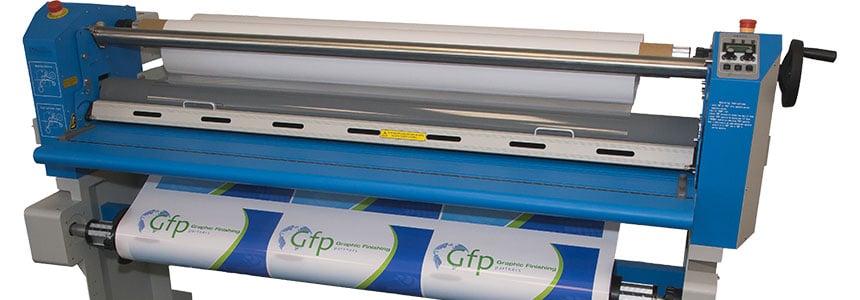
Above: Graphic Finishing Partners provides the 563TH-4RS and 663TH as production models with heat-assisted top rollers. Its 865DH-4RS is also considered high production but utilizes fully heated top/bottom rollers and used when thermal encapsulation is required.
Print providers should always start with their actual job mix and growth plans rather than buying on width or price alone. “The right laminator should match the shop’s production volume, printer width, media types, finish requirements, available floor space, operator skill level, power availability, and expectations for reliability,” comments Rob Nelson, senior segment manager, Mimaki USA, Inc.
Not all graphics have the same protection and finishing requirements. “Whether producing vehicle wraps, floor graphics, window displays, backlit applications, or outdoor signage, print service providers (PSPs) should select laminates/laminators based on the specific demands of the job. Key considerations include the print media and ink type, budget, film construction, adhesive balance, thickness, finish, and the temperature required to achieve a durable, long-lasting bond,” says Nelson.
Ink compatibility also plays a role. “Lamination requirements often vary by ink technology. UV LED, solvent, eco-solvent, latex, aqueous, and specialty inks each present different considerations for curing, heat application, and finishing workflows. Solvent and eco-solvent prints, in particular, require sufficient outgassing time before lamination, making workflow planning critical. Selecting a laminator that aligns with the shop’s primary print technologies can help improve efficiency, reduce rework, and ensure consistent finished graphic quality,” comments Nelson.
Michael Osman, president, CUTWORX USA, explains that a shop finishing UV or eco-solvent output needs heat assist, while a shop laminating thick boards needs nip capacity, and a shop doing its own trimming benefits enormously from integrated slitters.
Then look at volume honestly, “not at peak speed on the specification sheet but at how many rolls the machine can turn in a shift once loading, webbing, and changeovers are counted,” shares Osman.
Chase Pender, operations, Supply55, Inc., agrees, noting that it is important to be honest about daily and peak roll counts and know the media and films running, because those two things drive everything, the tension, heat, speed, and width required.
Shops producing long runs, vehicle wraps, point of purchase displays, or outdoor graphics need a laminator that can keep finishing aligned with print output without becoming a production bottleneck, suggests Nelson.
Floor space, installation, and scalability are other practical realities.
When it comes to floor space, Steve Yarbrough, product manager, laminators, Colex Finishing Solutions, Inc., points out that different models may fit better, for example lift out shafts may be a necessity over swing out with a limited space. “I always suggest purchasing a laminator that will meet the needs at least three years into the future and not your current workflow, so you have room for growth. You do not need to purchase the most expensive laminator, but buy what your production can afford as wasted time, ink, and materials is very expensive.”
“Buy the width and speed for the work you are quoting next year, not just the work on the floor today. A 64-inch heat-assisted machine covers virtually every roll-to-roll printer on the market, so it will not become the bottleneck as the shop grows,” suggests Osman.
Nick Howe, GM, AGL, Inc., advises that customers think ahead when purchasing a laminator. “We design our laminators to last for decades, and while many print shops may not know what process they’ll be running a few years from now, it’s good to consider what options are available, and whether or not you may need them in a laminator in the future.”
The best laminators are investments in both current production and future growth. “As shops expand into more profitable applications such as vehicle wraps, floor graphics, retail environments, dimensional displays, and outdoor signage, they need equipment capable of handling a variety of media and finishing requirements,” comments Nelson.
PSPs should prioritize laminators that deliver consistent pressure, precise tension control, reliable media handling, operator safety, and predictable results from job to job. “Features such as intuitive setup, easy heat control, accurate pressure adjustments, integrated take-up systems, and built-in safety mechanisms contribute to smoother, more efficient production. Equally important is the ability to maintain stable performance throughout long runs,” shares Nelson.
Oct2026, Digital Output