By Digital Output Staff
In the last few months, there have been multiple introductions in the three-meter roll-to-roll (R2R) printer space. Whether it be three, 3.2, 3.4, or 3.5 meters in width, these devices offer not only productivity, but high print quality, all past 100 inches.
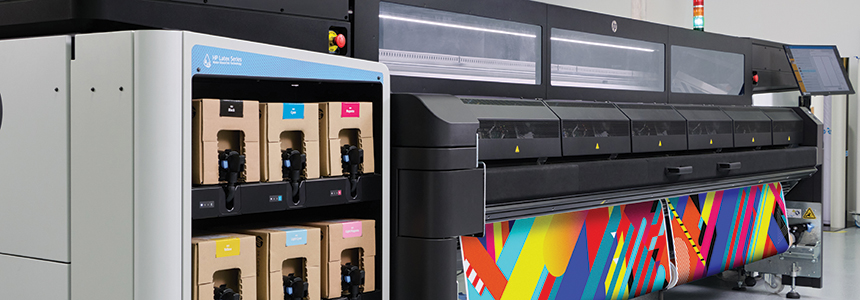
Above: HP’s R2R printers include the 3.2-meter HP Latex FS50/60 Printer Series.
Narrowing In
Three-meter R2R devices are popular right now for a number of reasons. Key factors include the ability to print on various substrates, which consequently means the capability to produce multiple applications on one device; consolidating production from several printers to one; and yielding quality prints at high levels of productivity.
“The momentum around three-meter R2R platforms is driven by market demand and economic forces for lower cost output through volume printing. Print providers consolidate equipment footprints while expanding application versatility. A 3.2-meter platform supports a range of substrates without the cost and space of five-meter systems or multiple printers like a flatbed and R2R,” says Adam Tourville, channel manager, Fluid Color.
Quality and consistency are addressed. “Retailers, brands, and event producers demand rich color, smooth gradients, and flawless surfaces, which this width supports well. At the same time, many print shops want to consolidate production on fewer, more capable devices. A high-performance system in the three-meter class provides versatility for a wide application mix while maintaining premium output quality,” shares Erik Norman, president, swissQprint America.
Demand for three-meter R2R printers derives from print service providers (PSPs) looking for greater control over print quality, notes Gabriel Crumpler, TA segment specialist, Mimaki USA, Inc. “Prompting many companies that previously outsourced printing overseas to bring production in house. This shift helps reduce production costs, mitigate risks associated with tariffs, and gain tighter control over turnaround times and quality standards.”
“Labor supply is a big challenge in the print industry specifically, and manufacturing broadly. High-speed unattended R2R printing delivers the highest productivity at the lowest labor required,” explains Ted Pierpont, national sales manager for large format, Durst Image Technology US.
Other reasons PSPs bring wide format work in house—which influences the demand for three-meter devices—include falling hardware and ink costs, combined with higher usable speeds. This is particularly true for mid-size shops looking to take on time sensitive or brand critical jobs,” suggests Mark Crawford, business and product development manager, Vanguard Digital Printing Systems, a Durst Group Co.
“Many PSPs see the need to expand form factor and capacity while adding burst capacity and application range. The most recent three-meter offerings deliver a solid solution to the PSP’s need of serving an existing customer base while also enabling them to attract new customers,” adds Thomas Giglio, HP Latex segment manager, North America, HP Inc.
Looking at things from an external perspective, “market trends like retail refresh cycles, experiential branding, and short-run customization drive demand for larger graphics and faster turnaround,” which plays into increased interest for three-meter devices, shares Katsuhiro Matsufuji, VP, marketing, client services group, Canon U.S.A., Inc.
Koen Steert, head of product management and applications, Agfa, believes “interest is largely driven by next-generation models from established players in the market that are introducing new features such as improved automation, rather than entirely new technologies.”
Expanding Applications
Applications also fuel adoption of three-meter printers. According to Tourville, the versatility of this platform’s width makes it “invaluable for shops expanding their service range.”
Norman lists retail graphics, backlits, soft signage, and interior décor as key application drivers, with window films, self-adhesive vinyl, and premium event graphics also significantly contributing. “Print shops want a single device that delivers exceptional image quality across all of these applications. The three-meter format allows them to cover typical campaign sizes efficiently.”
“PSPs use these printers for oversize work, but there is a shift into décor and event support, while a constant presence in fleet/vehicle graphics is also required,” notes Giglio.
With the need to remain competitive on pricing and turnaround times, PSPs are motivated to push what Matsufuji refers to as “bread and butter applications” like banners, wallcoverings, and wraps onto three-meter units. Furthermore, as some R2R systems can be upgraded to hybrid devices, he says “this opens the door to rigid applications like point of purchase (POP) displays, yard signs, and packaging.”
Other applications driving adoption, according to Crumpler, include banners, posters, indoor and outdoor graphics, and silicone edge graphic (SEG) fabric printing. “These versatile systems enable high-quality production across a range of large format display and textile applications.”
“Within the industry, soft signage and fabric-based backlits have moved firmly into the mainstream, with brands standardizing on 3.2-meter frames, SEG light boxes, and tension systems for retail, events, and corporate environments,” notes Crawford.
Bands of Ink
Printers in the three-meter width range pop up in every ink category from aqueous to latex and UV.
According to Crumpler, aqueous printers are well suited for printing on polyester materials and are often chosen for their more environmentally friendly ink formulations. They support high-quality output for both indoor and outdoor applications, making them a popular option for textile and fabric-based graphics.
Under the category of aqueous falls latex. For wider format R2R devices that utilize latex inks, it’s a perfect marriage of what the ink can achieve and the three-meter width. “Wall décor demands high quality in many cases with white ink and the vehicle segment demands flexibility and conformability. The thin film thickness of HP Latex inks meets both requirements,” notes Giglio.
UV LED is highly favored in R2R production. “These inks deliver excellent adhesion across a range of substrates and high color density for demanding applications such as backlits and retail displays. When paired with a controlled UV LED curing system the ink and hardware form a consistent, reliable production environment that supports long print runs and repeat jobs with stable results,” says Norman.
Steert maintains that UV is a dominant choice in most instances because “it offers the broadest media compatibility and application scope. This technology is used on everything from self-adhesive vinyls to textiles and flexible films, making it ideal for PSPs serving varied applications.”
“UV inks deliver durability and fade resistance sufficient for outdoor and long-term installations at quality approaching lithography. Fine text and details for closely viewed marketing pieces is achievable on the same platform that produces stadium banners and fence mesh. The breadth and volume of product that can be profitably made by a single worker is incredible,” marvels Pierpont.
There are efficiency gains related to UV LED. “LED curing reduces heat and energy consumption, allowing shops to run heat-sensitive materials more confidently and operate more efficiently, while still providing the durability needed for most indoor and outdoor applications, often without lamination,” explains Crawford.
“UV’s ability to print on diverse substrates without heat distortion or extended drying times makes it attractive for high-speed, high-quality production environments. Because they are non-evaporative, UV ink printers typically have a lower running cost than alternative technologies,” notes Matsufuji.
Where is solvent in all of this? “Solvent continues to fade from new three-meter investments due to longer turnaround times and environmental concerns,” says Crawford.
Popular Features
Three-meter wide devices can be equipped with effective features.
“Dual roll printing, loading two narrower rolls side by side on the same spindle, can be a significant productivity booster. On certain printers, dual roll mode allows simultaneous output on two rolls during each carriage pass. This reduces wasted travel time and increases square feet per hour efficiency without compromising quality,” explains Matsufuji.
Dual roll printing is essential, points out Giglio, because many substrates are not available in the 3.2-meter form. “Case in point, self-adhesive vinyl is most popular in 54- or 60-inch rolls, driven by finishing and installation practices where equipment and capability is less than two meters.”
Pierpont notes that certain media like wallcoverings are commonly printed at 64 inches or less, making dual roll printing advantageous here as well.
“Dual roll printing is increasingly popular for retail graphics, POP, and short-run campaigns. It doubles output without increasing footprint. In a high-volume shop dual roll is a must and multiple jobs can be printed together on the same rolls. This helps lower costs of production time and labor,” adds Tourville.
Three-meter systems may include automated cassette roll loading systems, vacuum handling for precise tension and alignment, and intelligent tension control, which reduce setup time and minimize waste. “These improvements support consistent output quality, shorten changeover times, and give operators confidence when handling complex workflows such as double-sided or multi-layer printing,” explains Norman.
Other advances that make three-meter R2R printers more appealing include “inline cutting features in both x and y directions, supporting more efficient finishing workflows; as well as smart solutions for mesh printing, enabling liner-free production with integrated ink collection systems to prevent contamination and waste,” adds Steert.
Three-Meter Spotlight
PSPs find wide format roll printers in the three-meter width range attractive for a number of reasons. Visit digitaloutput.net and read a web-exclusive article on roadblocks to implementing these devices in house as well as the newest available models.
Mar2026, Digital Output