By Melissa Donovan
Traditional PVC-based banner materials present long-term waste challenges. They’re not recyclable in most municipal systems, contain harmful additives, and often end up in landfills after a short-term campaign. In lieu of PVC, many PVC-free products are used for hanging banners, posters, billboards, and similar signage. These offer the same expectations in terms of durability, print quality, and tear resistance.
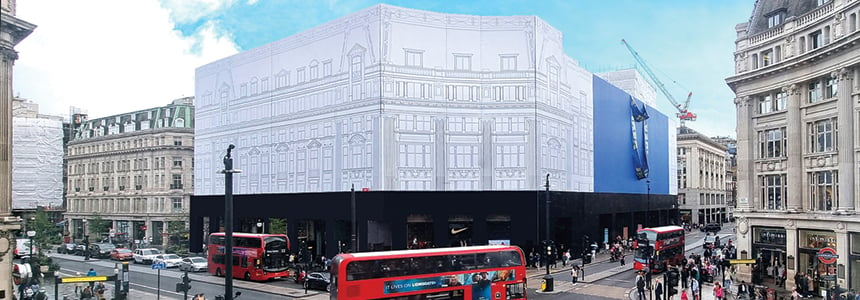
Above: Embrace Building Wraps delivered a 2,400 square meter building wrap for IKEA’s Oxford Street store in Oxford Circus, London, UK, demonstrating the durability and structural integrity of Kavalan PVC-free materials at scale, specifically Sunlight Weldable.
Meeting Customer Needs
Non-PVC materials used for hanging banners, posters, billboards, and other types of signage are popular options for a number of reasons. This is especially true when the customer or end user is particularly focused on eco-friendliness and/or sustainability.
Julie Brannen, director, sales and sustainable solutions, Monadnock Paper Mills, Inc., notices sustainability demands continue to rise across retail, brand, and print environments. “Many signage applications are inherently short term and commonly used for promotions, seasonal campaigns, or temporary displays, prompting greater scrutiny of material choices that rely on single-use plastics.”
“PVC has long been the default substrate for large format applications such as hanging banners, billboards, building wraps, and event graphics, mainly due to its flexibility and widespread industry familiarity. However, when assessed through a sustainability lens, PVC presents significant environmental and human health challenges that are difficult to justify,” admits Nova Abbott, head of marketing, Kavalan.
“PVC-free products are preferred over PVC-based because they eliminate the toxic chemicals released during PVC production and disposal, which pose environmental and health risks. PVC-based products release volatile organic compounds into the environment, making PVC-free options a more environmentally friendly, safer choice,” share Darren Speizer, VP of sales and marketing and Erica Wilton, channel marketing and training specialist, Sihl Inc.
Audrianna Manee, marketing manager, Ultraflex Systems, Inc., agrees that non-PVC materials are increasingly preferred due to their minimal environmental impact across the product lifecycle. While traditional PVC-based substrates can be difficult to recycle and may release harmful chemicals during disposal, non-PVC materials can be produced without phthalates or heavy metals and are easier to recycle.
“Over time, PVC materials in landfills also shed microplastics, contributing to soil and groundwater contamination. Non-PVC alternatives present a significantly lower environmental impact. Their manufacturing processes are cleaner and the materials themselves are recyclable, making them a more sustainable option overall,” shares Mike Maurer, marketing coordinator/account manager, XCEL Products.
With PVC scrim banners typically ending up in landfills due to the lack of commercially viable recycling options, Sean McDermott, director of Sycltex sales, The Nicholas Group/ANCI Global, says non-PVC products like ANCI’s Sycltex promote a true circular economy. It is 100 percent recyclable through the company’s take back program. “These non-PVC products appeal to brands and printers pursuing Environmental Social Governance (ESG) goals, EcoVadis certification, or regulatory compliance in regions that are phasing out PVC.”
Recognizing these challenges to the environment and human health, “brands and corporations increasingly seek signage solutions that align with their sustainability initiatives. Non-PVC banner materials offer a way to reduce environmental impact while maintaining performance,” adds Manee.
PVC-free materials support a cleaner environment and safer human exposure first and foremost. The bonus is in that they deliver high durability and strength, making them ideal for long-term projects, advise Speizer and Wilton.
What’s the Alternative
Non-PVC is a broad term, so what defines a non-PVC material—especially in terms of the applications discussed here, mainly hanging banners, posters, and billboards? At the top level, there are thermoplastics, divided into polyolefin and polyesters. Polypropylene (PP) and polyethylene (PE) polymers are types of polyolefin. Popular polyesters include PE terephthalate (PET). Paper-based products are also PVC free.
“Non-PVC banner materials are manufactured using alternative base fabrics and coating technologies that remove the need for vinyl altogether,” explains Abbott.
Manee says most PVC-free banner products are polyolefin or polyester-based constructions. This is because of their ability to offer a strong balance of printability, durability, weight, and cost. They are considered eco-friendly because they do not include chlorine-based plastics or phthalates.
Polyester-based fabric combined with a proprietary water-based coating system delivers flexibility, durability, print quality, and flame retardancy without relying on PVC, phthalates, or other hazardous additives. “What makes these materials genuinely more sustainable is not simply what they are made from, but what they deliberately eliminate. By removing PVC from the equation, Kavalan materials avoid the toxic chemistry associated with vinyl production, including carcinogenic precursors and endocrine-disrupting plasticizers,” comments Abbott.
Another polyester-based option is PET film, which display films and backlits might be made out of. “It’s a more sustainable choice because it’s recyclable, doesn’t contain toxic additives, requires less energy, and generates fewer emissions than creating new plastics,” say Speizer and Wilton.
Part of the polyolefin category is PP and PE. “These polymers are recyclable through standard recycling streams, making disposal and reuse more practical and environmentally responsible,” says Maurer.
Proprietary blends of PE polymers that are then reinforced with CLAF—an open mesh fabric—for superior durability and strength, are other examples, shares McDermott. These do not include any PVC, phthalates, or heavy metals.
Paper-based products are considered free of PVC. For example, certain portfolios offer options made from 100 percent post-consumer recycled tree fiber. Monadnock’s paper-based substrates are process chlorine free, so no chlorine or chlorine compounds are intentionally used during recycling and manufacturing.
How the product is manufactured helps define its sustainability. “Forest Stewardship Council standards support responsible forest management. Products can also be manufactured under a third-party certified ISO 14001 Environmental Management System, with environmental performance continually assessed through EcoVadis,” explains Brannen.
Another example is the production process for Kavalan’s PVC-free materials, which is inherently cleaner and less resource intensive, according to Abbott. “All Kavalan materials are compliant with international standards including REACH and RoHS, EN71 Toy Safety, and EN13432 for biodegradability and compostability, supporting safer handling and more responsible end-of-life pathways. Every Kavalan product has undergone independent Life Cycle Assessment, demonstrating superior environmental performance compared with both PVC and conventional textile substrates. These assessments show lower carbon footprints and significantly reduced freshwater consumption during production.”
No Compromises
While non-PVC banner materials used for hanging banners, posters, and billboards offer the advantage of eco-friendliness and sustainability it’s important they not compromise on other essentials like ink laydown, color gamut, durability, and tear resistance.
According to Abbott, “there is a common misconception that PVC-free banner materials compromise on performance or durability. In reality, modern non-PVC substrates are engineered to meet the same demands as PVC for large-scale, long-term outdoor applications. They offer excellent strength, weldability, and weather resistance, while providing a clear environmental advantage at end of life, as they do not release harmful toxins if incinerated or sent to landfill. This performance is proven in real-world applications.”
Most non-PVC banner materials are designed to perform similarly to PVC in terms of print quality and durability. “They support strong ink adhesion, vibrant color, and smooth ink laydown across ink technologies such as UV, latex, and solvent/eco-solvent. They also offer excellent tear resistance and strength, making them suitable for banners, billboards, and outdoor signage without sacrificing performance,” says Manee.
Brannen points out that depending on the material, for example paper-based substrates, a distinct visual and tactile advantage is offered—further enhancing the benefits. “The natural surface and texture of paper can enhance the look and feel of printed graphics in ways that uniform plastic films cannot, particularly in retail and display environments where material perception matters.”
“Depending on surface finish and white point, non-PVC banner materials often deliver superior visual results compared to PVC banners. PVC materials require an embedded fabric scrim for stability, which can be visible in the final print. Non-PVC constructions eliminate this issue, resulting in a cleaner, more refined printed image,” adds Maurer.
And while many PVC-free materials do meet—or even in some cases exceed—performance expectations, intended use must always be considered. “In terms of durability and tear resistance, expectations must be set on the intended use,” stresses Brannen.
Durability depends on the application, seconds Steven Verheul, category manager/technical skins, Walki. Products used indoors need to last over three years and outdoor applications should be rated for two years and up, especially when mounted onto a panel or tensioned in a frame with limited wind access.
Pricing Sacrifices
Non-PVC banner materials used for hanging banners, posters, and billboards typically cost more than their PVC-based counterparts. In an interesting economic climate, increased prices are difficult to justify. However, both print providers and customers find the sustainability aspect worth the added expense.
The first iterations of eco-friendly alternatives to PVC did carry higher price points, hard to verify sustainability claims, and were not comparable to PVC in terms of durability, weldability, and tear resistance, admits Abbott. “This combination created hesitation among print providers and buyers alike. That landscape has changed significantly. Advances in material science and manufacturing now mean PVC-free banner materials can meet—and in many cases exceed—the performance requirements of large format applications, without introducing a meaningful cost barrier.”
Today, “cost varies by application, performance requirements, and finishes. Some projects require a premium finish and inherently cost more, while others are comparable in price to PVC-based options. Overall, many customers do not find the difference significant, especially when compared with performance expectations and material requirements,” notes Brannen.
PVC banner materials are historically less expensive, points out Maurer, due to long-standing mass production. PE and PP resins are comparable in cost to PVC resins, he continues, but believes as demand for non-PVC alternatives continues to grow, production volumes increase, which steadily drives costs down and improves price competitiveness.
Manee agrees that demand for these products continues to grow as organizations prioritize sustainable solutions, which means availability is expanding and this in turn keeps pricing competitive.
“In today’s economic climate, customers prioritize ‘greener’ materials that reduce toxic chemicals and support sustainability initiatives. As a result, the demand for PVC-free materials is increasing, driven by customer preferences and companies working to meet ESG goals,” add Speizer and Wilton.
Regulation is accelerating the shift to non-PVC materials used in signage. “A clear example is Tallinn, Estonia, which became the first European capital to ban PVC-based advertising in public spaces starting January 1, 2026. Decisions like this, rooted in public health, environmental safety, and circular economy principles, highlight a growing reality—PVC’s true cost has never been accurately priced into the material itself. This is where the concept of hidden cost becomes critical. PVC may appear cheaper at the point of purchase, but its environmental and health impacts are externalized costs born by communities, ecosystems, and future generations. These impacts are effectively unaccountable on a balance sheet, yet they represent real economic and societal liabilities that are increasingly being addressed through policy, regulation, and procurement standards,” shares Abbott.
McDermott adds that while certain PVC-free substrates cost more upfront, the total cost of ownership is lower. “This is due to reduced shipping weight and higher longevity—fewer replacements. Brands and printers increasingly view it as a smart investment in brand reputation and ESG initiatives.”
“Interest in and demand for non-PVC materials is growing. Brand owners prefer recyclable advertising materials as this serves their corporate environmental strategy. The awareness that future legislations may prohibit PVC-based materials is fueling the interest,” says Verheul.
Higher Demand
The demand for PVC-free substrates, specifically those used for hanging banners, posters, billboards, and similar types of signage, continues to steadily rise. This is largely thanks to mandates from corporations and governments, consumer interest and preference as education on the advantages grows, and updated supply chains make it possible for mass production of various products.
May2026, Digital Output