By Melissa Donovan
No glue, no stickiness, no negating the adhesive if it’s touched prior to application—traditional printable magnets or magnetic-receptive media are popular options in the signage industry. Ease of install, repeatability—the attraction makes sense. However, printing directly to magnetic material is not without challenges.
“Magnetic media is still a problem child when it comes to printing it consistently. While magnetic media appears flat and stable at rest, its layered construction—typically a magnetic base laminated to a printable vinyl or polymer surface—makes it extremely sensitive to heat and uneven mechanical stress during printing,” explains Rob Nelson, senior segment manager, Mimaki USA, Inc.
Choosing a low-heat printing option as well as awareness of potential incidents that can occur along the process yield an effective signage product.
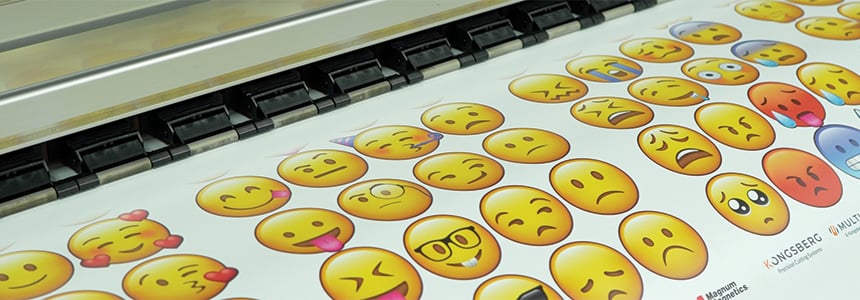
Above: Mutoh’s wide format printers produce magnets used for decals for promotional items like fridge magnets; car magnets in both business and personal use; and some limited directional, informational, or wayfinding signage.
Ink Preference
As print technologies evolve, magnetic media’s compatibility with various ink sets does too.
“There’s no single preferred print technology for magnetic media, as the best approach depends largely on material thickness and the production set up. Resin, eco-solvent, and UV technologies all perform well, as they adhere to smooth, non-porous surfaces while delivering durable, high-quality results,” notes David Bistrovic, product manager, Professional Imaging, Epson America, Inc.
Neil Hawkins, marketing manager, Magnum Magnetics Corporation, summarizes the processes. “UV printing is often preferred for bold, durable graphics and strong outdoor performance. Latex printing is another excellent fit because it combines high-quality output with flexibility and durability for a range of indoor and outdoor signage needs. Eco-solvent and screen printing still serve important roles as well, depending on the application and production setting.”
Overwhelmingly, UV-based technologies are used for magnetic media due to what Patrick Donigain, senior manager, large format printing solutions and Angel Georgiou, senior product planning specialist, large format printing, Canon U.S.A, Inc., say is their unique balance of durability and low-heat processing.
“Evaporative technologies require temperatures as high as 130 to 230 degrees Fahrenheit—whereas UV or UVgel cures at much lower temperatures. This is designed to limit the magnetic media from becoming brittle or losing its flat profile during the print process. Furthermore, the instant dry nature of UV and UVgel inks means the heavy rolls can be finished or applied immediately, minimizing the risk of ink smearing or the need for lengthy outgassing periods,” explain Donigain and Georgiou.
UV LED inkjet’s defining advantage is instant, heat-free curing, seconds Nelson. “UV inks polymerize under light rather than thermal energy, which minimizes expansion, contraction, and internal stress in the magnetic sheet. As a result, the material retains its original shape throughout the print cycle.”
Paul Wagner, solutions architect, large format production, HP Inc., believes that most of the widely used outdoor-durable ink chemistries, such as latex or resin, can print to magnetic medias. “Latex inks are compatible with traditional PVC-faced materials as well as polyurethane magnetic films. Latex inks create a thin film, are actively cured in the printer, and support easy lamination if needed—yet also are highly scratch resistant when overcoat is used.”
“Latex works well on magnetic-receptive films and flexible constructions, though curing temperatures must be considered. It is popular for indoor graphics where low volatile organic compound output and odorless prints are priorities,” shares Kylie Schleicher, VP of business development and product management, Ultraflex Systems, Inc.
Eco-solvent offers a durable, flexible and moderate heat curing process, shares Bistrovic.
For magnetic-receptive materials, “eco-solvent is a strong all-around performer for both indoor and moderate outdoor use. Inks penetrate the media’s receptive coating well, offering good ink adhesion,” notes Schleicher.
Some magnetic media portfolios are designed to handle all ink sets. The magnetic-receptive media line that XCEL Products, Inc. supplies is designed to print on UV, latex, eco-solvent, and solvent printers. According to Jesse Casady, operations manager – media, XCEL, the vinyl that makes up the magnetic material XCEL offers is engineered to work with most common printing technologies.
Several print technologies deliver excellent results—when paired with the right product, adds Hawkins. “The real key is not choosing one technology as universally best, but matching the print method to the magnetic construction, end use, and printer capabilities.”
For example, “UV printing is a fast, cost-effective method to produce small- to medium-batch promotional magnets with low durability, outdoor exposure, and post-treatment requirements, whereas eco-solvent may be better suited for outdoor use and/or longer/larger size runs,” says Tony Simmering, product manager, Mutoh America, Inc.
Curing Methods
The drying or curing of ink plays a key role in both dimensional stability and warping of media.
According to Nelson, the curing method is one of the most critical variables when printing magnetic sheets. “Magnetic media reacts quickly to heat because the magnetic layer and printable face expand at different rates. When thermal energy is introduced unevenly, as with heater-based curing systems, the result is often localized bowing, edge lift, or surface ‘oil canning.’ Even minor deformation can cause printhead interference or transport errors.”
“High-heat curing can cause non-uniform expansion and contraction, which can lead to ‘cockling’ or edge curling,” say Donigain and Georgiou.
Technologies like Canon’s cool LED curing system found on the Canon Colorado M-series printers ensure the magnetic media maintains a stable temperature throughout the process, which allows the material to remain flat.
“UV ink offers instant curing with low-heat exposure, making it a reliable option for magnetic material. This low-heat process helps magnetic substrates maintain the shape and integrity of the magnets,” adds Bistrovic.
For HP Latex printers, Wagner suggests heat signatures stay at temperatures between 160 and 185 degrees Fahrenheit to avoid media deformation. Today’s latex ink cures at much lower temperatures than previous generations, so temperature-constrained media is more compatible in general.
According to Bistrovic, eco-solvent inks cure primarily through evaporation with moderate thermal heat assisting with the evaporation process. Because temperatures are lower during the curing and offgassing process, eco-solvent inks cause less stress to the material and result in better stability.
“For magnetic media, the curing method is often the difference between a controlled process and a chaotic one,” notes Nelson. The material maintaining dimensional stability has production advantages including consistent printhead gap across the full sheet, reliable unattended printing, and immediate post-print handling without cool down.
Depending on the curing technology of a printer, a specific magnetic media may need to be purchased to avoid issues like cocking, curling, or warping. “The good news is that these challenges are manageable with the right media, proper handling, and well-controlled print settings. Choosing a magnetic product designed for a specific print platform can make a significant difference overall,” suggests Hawkins.
“Manufacturers engineer magnetic-receptive media with specific base materials and constructions to minimize risk across different print platforms. For example, a scrimless magnetic-receptive film may be prone to distortion when exposed to the elevated curing temperatures of a latex printer. In these cases, a product built on a polyester base is recommended,” explains Schleicher.
How to Handle It
Magnetic media is tricky, a few issues can pop up when it is running through the printer.
“The most common feed and handling issues usually come down to the fact that magnetic media is a specialty substrate. It is typically heavier, denser, and sometimes stiffer than traditional print materials, so it requires the right setup and expectations,” explains Hawkins.
Since magnets tend to be thicker and heavier compared to other types of media, loading and running these materials can be challenging, agrees Wagner.
“One of the most prevalent challenges when handling magnetic media is the material’s natural tendency to ‘grab’ or stick to the metal surfaces of the printer’s internal paper path. This can lead to friction-related jams or inconsistent media stepping, which can result in visible banding,” suggest Donigain and Georgiou.
Specialized kits are available to combat this issue. For example, the Canon Colorado M-series Magnetic Media Kit replaces standard sheet metal components with stainless steel guide plates and specific plastic stops to neutralize the magnetic pull.
Casady says the number one challenge is material running back on a printer if there is any metal found on that printer. XCEL can offer technical advice as well as manufacturer videos that show how to mask off the printer specifically for roll stock magnetic media.
“The largest obstacle for eco-solvent printers specifically is when they feature a magnetized platen; this can ultimately cause feed tracking issues or jamming when running magnetic material across the device during the printing process,” suggests Simmering.
Another element to be aware of, the added weight of the media roll. Combined with high density, accurate media step control is required, add Donigain and Georgiou. This involves advanced sensors that can accurately read the media’s movement.
“In some cases, operators need to account for the natural weight and pull of the material during transport through the printer. Other common issues include feeding consistency, sheet tracking, printhead clearance on thicker materials, stacking behavior, and handling challenges if sheets are not stored or conditioned properly before printing,” notes Hawkins.
The transport system is the main origin of media handling problems. “Most of the feeding challenges arise from roll-to-roll print technologies. The stiffness and weight of magnetic material can make it difficult to transport smoothly through a roll-to-roll system, heavier magnetic substrate rolls may exceed system limits, which can stress the feeding system and increase the risk of errors. When working with a UV flatbed solution, these issues are largely eliminated since these materials remain stationary on the print bed,” shares Bistrovic.
“Traditional roller-based feed mechanisms found on printers support media at linear contact points. With magnetic sheets, this creates several predictable problems like edge lift between rollers, especially on thinner gauges of material; skew caused by uneven resistance as the magnetic layer interacts with metal components found on the printer; and loss of traction when the sheet resists conforming to roller curvature. These problems are further magnified when heat introduces even slight warping,” attests Nelson.
Similar to the flatbed solution suggested by Bistrovic, Nelson believes vacuum belt transport systems found on these printing devices fundamentally change how magnetic media behaves during printing, addressing both mechanical instability and material memory.
“A belt transport system supports the sheet across a continuous surface rather than isolated rollers. This prevents the magnetic material from flexing between contact points, reducing edge lift and mid-sheet bowing, which are two of the most common causes of printhead strikes. Vacuum suction pulls the magnetic sheet flat against the belt, counteracting its natural tendency to curl back to its stored shape—which is a roll,” continues Nelson.
Varying Densities
Traditional magnetic media features a thicker density, which impacts feed reliability and end use durability.
While thicker media provides better long-term durability for outdoor applications like vehicle signage, Donigain and Georgiou say it requires more robust tension bars to prevent the material from sagging or sticking to the printer frame during the printing process. “Modern industrial printers now use specialized winding tension settings, such as locked tension bars, to counteract the stiffness of thicker magnetic rolls so that the media remains taut and accurate during high-speed production.”
Devices like the HP Latex R Printer Series support heavier medias, are belt driven, and accommodate rigid and flexible medias up to two inches thick.
Another important fact, thicker media reduces the amount of media that can fit on one roll, leading to more frequent roll changes, add Donigain and Georgiou.
Thinner magnetic materials are increasingly prevalent. “From a handling perspective, thinner magnetic materials are more common because they are lighter, easier to ship, and more compatible with roll-to-roll printers,” explains Bistrovic.
“Magnetic-receptive medias are lighter weight and more flexible than traditional printable magnets. The construction of magnetic-receptive media makes it easier for printers to handle and feed through the equipment,” says Schleicher.
Nelson believes thinner magnetic sheets are increasingly viable thanks to vacuum belt transport, which compensates for reduced stiffness and coil memory.
With the introduction of thinner magnetic material, certain challenges disappear—and new ones pop up.
“While the industry shifts toward thinner, lighter magnets for ease of handling, these materials are often more susceptible to curling during unwinding,” note Donigain and Georgiou.
Hawkins believes thickness is still part of the conversation, but it is more about application fit than limitation. “Thicker magnetic sheeting can provide a more substantial feel, stronger magnetic hold, and enhanced durability for demanding applications. At the same time, thicker gauges can require more printer accommodation in terms of feed path and clearance.”
On the other hand, thinner magnetic media has become an increasingly popular choice between both print providers and their customers. “This is because it is often easier to handle, easier to print, and more efficient for shipping and converting. For many modern graphic applications, thinner magnets perform extremely well and provide the functionality customers need without adding extra weight,” adds Hawkins.
To summarize, “thicker magnetic materials offer a stronger hold and greater durability, making them a better choice for outdoor applications and long-term use. Thinner magnets, while more versatile and easier to handle, are typically better suited for indoor applications,” says Bistrovic.
Common Uses
Digitally printed magnetic media is used in a number of ways, to promote a business with a graphic attached to a vehicle or easily swapped out to update a menu or schedule.
Magnetic media thrives in locations where temporary, interchangeable messaging is required, points out Nelson.
“Magnetic films are increasingly found in restaurant and retail environments, due to their unique ease of installation and removal. This is in addition to the traditional magnetic applications that include vehicle and refrigerator magnets,” says Wagner.
Vehicle graphics are another staple, “as they offer a non-permanent branding solution that can be removed and reused,” share Donigain and Georgiou.
Newlife Magnetics LLC offers Miracle-Mag High Energy PVC magnet with a matte white PVC print surface for direct digital printing. At 20 mil, it features a stronger holding force than a standard energy 30 mil magnet, which is the most common choice for vehicle signage. In addition to a stronger holding force, it reduces overall weight by 33 percent.
Beyond magnet material’s primary usage in retail signage and vehicle magnets, Casady also believes promotional pieces/giveaways is another application to consider.
“It’s also widely used for warehouse labeling and in educational or office settings for interchangeable signage,” points out Bistrovic.
There is continued interest in magnetic-receptive graphic systems. “These allow brands and retailers to refresh messaging quickly and cleanly. As more organizations look for adaptable display solutions, magnetic media continues to prove its value,” shares Hawkins.
“For magnetic-receptive media—in-store promotional walls, seasonal campaigns, price change and product callout graphics, end cap and point of purchase displays, exhibit and museum graphics, interactive displays, and menu boards” are all ideal applications, suggests Schleicher.
Magnets Matter
“One of the greatest benefits of magnetic media is its flexibility. It allows users to install, remove, reposition, and update graphics with ease. That makes it ideal for projects where changeability, reusability, and convenience matter,” says Hawkins.
This material, while not without challenges, is well suited for many applications. It prints well when using low heat and the proper handling techniques. Pairing the correct printer with a specific magnetic product makes for successful output.
Today magnetic media is successfully used for a host of application whether it is a sign placed on a vehicle, something for a retail store, or a menu board in a dining establishment. The attraction to printable magnetic media will only grow as more print providers and their customers understand the versatility of this medium.
Jul2026, Digital Output