By Digital Output Staff
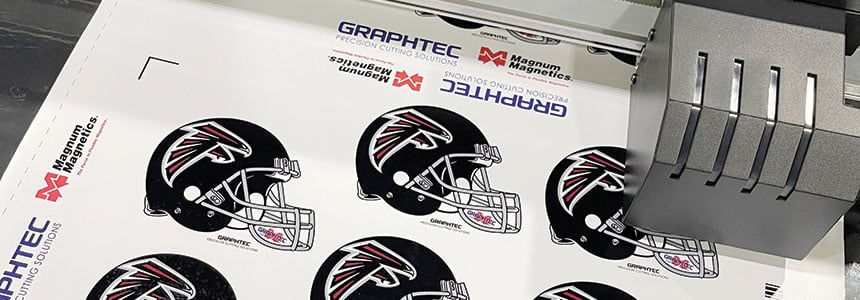
Selecting the right cutting tool for magnetic and magnetic receptive media is important for clean edge quality and production speed.
Choosing the correct cutting tool is critical in magnetic signage production because these materials combine flexibility with thickness variability and layered structures, which place specific demands on both cutting quality and machine stability, shares Daniele Gallucci, president, Elitron America.
“The right tooling directly impacts three key areas—cut quality, production efficiency, and tool longevity. Magnetic and magnet-receptive materials can be dense or abrasive depending on their composition, so using an inappropriate tool can lead to incomplete cuts, frayed edges, or deformation of the material. This not only affects the final visual quality of the signage but can also compromise fit and usability in applications such as retail displays or interchangeable graphics,” says Gallucci.
Equally important is process stability. “The correct cutting tool ensures consistent penetration across different material thicknesses, eliminating the need for manual finishing or rework. This is especially valuable in production environments where repeatability and speed are essential,” notes Gallucci.
Correct tool selection helps optimize overall system performance, reduces wear on the cutting head, maintains higher production speeds, and supports more efficient workflow automation. “In short, the right tool is not just about cutting but it’s about ensuring reliable, scalable, and cost-effective production,” adds Gallucci.
Materials such as magnetic sheets, magnet-receptive foils, and layered signage constructions require consistent cutting accuracy and reliable handling, especially when dealing with variable thicknesses and mixed media jobs, says Gallucci.
Selecting the right cutting tool for magnetic signage is key to producing clean, professional-looking results. The proper tool helps prevent torn edges, minimizes angled cuts caused by the material’s density, and reduces unnecessary wear on your equipment. By using the right tools for the job, you can keep production running efficiently, maintain precise cuts, reduce material waste, and consistently create high-quality, cost-effective magnetic signage, notes Mark de Guzman, marketing manager, Vision Engraving & Routing Systems.
Conversely, using the wrong tool can lead to rough edges, material stretching, inaccurate cuts, premature tool wear and inconsistent quality, comments Filip Van Bruaene, application specialist, Kongsberg Precision Cutting Systems (PCS).
Several finishing vendors offer powered solutions for cutting magnetic and magnetic-receptive media.
Colex Finishing Solutions Inc.
Colex is able to cut magnet material with both the Sharpcut digital flatbed cutter and the Fotoba XY cutter.
The Fotoba can cut squares and rectangles of material up to 40 millimeter thick.
The Sharpcut digital flatbed cutter offers multiple tool options for cutting many materials, which include magnet material.
“Our most popular tool is the Double Edge Knife, which can easily and accurately cut magnet material,” shares Keith Verkem, national sales manager and senior product manager, Colex.
Kongsberg PCS
Kongsberg offers a range of tooling options that are effective for magnetic and magnetic-receptive signage applications.
The Rigid Material Knife, for example, is commonly used for thicker, magnetic media because it provides clean, controlled cuts.
The Psaligraphy Knife tool on the other hand, is ideal for thinner magnetic sheets and flexible receptive materials.
For print-and-cut applications, the precise knife tools, combined with the accurate registration offered by our systems, ensures excellent repeatability and finish quality. Kongsberg digital cutting solutions are also designed to handle a range of substrates, including magnetic and magnetic-receptive media, from vehicle magnets to indoor receptive graphics, while maintaining accuracy and productivity.
Laguna Tools
Laguna Tools offers CNC routers—Swift MT/Smart Shop MT Elite—for cutting magnetic and magnetic receptive media.
Summa
Summa’s wide range of cutting options supports simple stickers, complex contours, creasing, routing, and more. It aims to offer customers one table to tackle many directions. This September it announced the extension of the F Series Vantage with the introduction of the F1832, F3220, and F3232.
Vision Engraving
Vision Engraving’s finishing tools for cutting magnetic and magnetic-receptive signage include an Oscillating Knife & Tangential Knife.
Both tools are available options for Vision’s line of CNC Routers.
VTX Tools
VTX Tools is in the business to sell and support consumables (blades, bits and mats) to a rapidly growing and always changing digital finishing industry. German-made tungsten carbide blades offer the cleanest edges for magnetic material. VTX offers the following in its portfolio—VTX-K16, VTX-K17, VTX-K46, VTX-K46S, VTX-K46R, VTX-K12, VTX-K13, VTX-K12S, VTX-K13S, VTX-K12R, and VTX-K13R.
Zund America, Inc.
For magnetic and magnet-receptive signage, Zünd recommends its Universal Cutting Tool (UCT) for clean, high-speed through-cutting of materials up to five millimeters thick.
Using drag knives, the UCT delivers excellent cut quality and efficiency, while remaining a cost-effective solution compared to motor-driven tools. “It is fully compatible across all Zünd systems—including dual-beam configurations like the D3—ensuring consistent performance and maximum throughput,” shares Keith Soya, business development manager, Zünd.
Sep2026, Digital Output