By Melissa Donovan
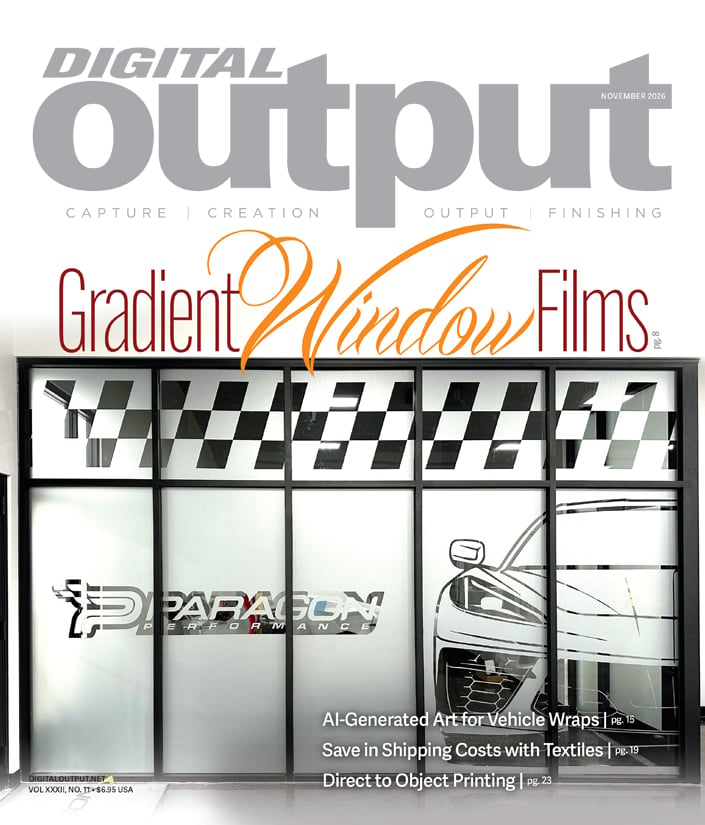
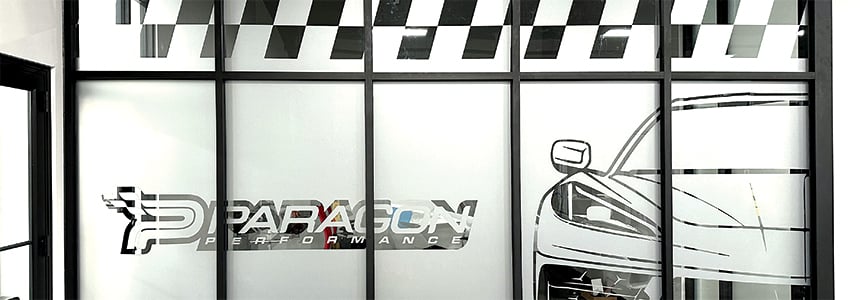
A gradient effect is achieved by either printing white ink directly onto clear media or using a pre-made gradient film. The result is commonly seen on glass-type applications including retail windows and commercial buildings.
Both options offer advantages. Printed white gradients are best when customization and branding are priorities. Pre-made gradient film is preferred when speed, consistency, and lower production costs are higher in importance.
Above: General Formulations GF 790 Light Etch is designed to give the frosted effect or an impression of etched, cut, or sandblasted glass.
Preference and Usage
While choice is always nice, it can be overwhelming. Window gradients fall under this category. Depending on the capabilities of the wide format printer, white ink is applied directly on the media—creating a custom gradient; or pre-made gradient films are available to purchase from various vendors.
When a print service provider (PSP) is capable of printing white gradient, benefits include full control over the pattern, opacity, scale, branding, and visual details—including how quickly or gradually the transition occurs across the intended glass, recommends Jay Kroll, director of product education, General Formulations.
“That control over opacity is particularly valuable when the goal is to balance privacy with natural light—something a pre-made film locks you into from the start,” continues Kroll.
Design flexibility is a top advantage when pritning a white gradient, agrees Jim Halloran, VP of sales and marketing, Lintec of America, Inc. “Customers create virtually any level of visible light transmission while incorporating custom messaging, logos, patterns, or other design elements into the graphic as well.”
Printed white gradients are preferred when a custom look or decorative effect is required. “This makes them a strong fit for environments like office fronts, conference rooms, hospitality dividers, and client-facing settings, especially healthcare and financial where both privacy and professional appearance matter. In those spaces, the glass isn’t just functional—it signals discretion and attention to design, and a printed solution can be tailored to reinforce both,” shares Kroll.
Another benefit to printing white gradient for window applications is that it is practical for smaller projects. “A full roll of pre-made frosted or gradient film can range from approximately 98 to 150 feet. If a project requires only 25 or 30 feet, digitally printing the desired gradient on optically clear film is a much more efficient option,” states Halloran.
“Printed solutions also offer greater versatility because the same printable clear film can be used for a variety of applications beyond gradients, including decals and other custom window graphics. This allows customers to use one type of media across multiple applications instead of maintaining separate films for each specific purpose,” recommends Paul Kwan, GM, Natura Media USA.
Pre-made gradient window media also has a place. Kwan says it is “generally preferred when quality, consistency, and production efficiency are more important than customization. When the same gradient needs to be applied across multiple windows, a pre-made film provides a simpler, faster, and more cost-effective solution while maintaining a consistent appearance from one window to another window.”
Pre-made gradient or even etched and frosted window media is used “when the film includes a finish that is difficult to replicate in print—such as a specific etched, frosted, or metallic appearance,” shares Kroll.
The length or scope of a project dictates the use of pre-made gradient film. It may “make more sense for larger projects where a consistent, repeating design is required across a significant amount of glass,” explains Halloran.
Not So Fast
Despite the benefit of design flexibility, printing white gradients presents challenges, especially for a print provider not familiar with the process.
Considerations include media handling, ink maintenance, and designing with gradient/white in mind. “Printing a white gradient involves several additional steps in the production process, including design preparation, media selection, printing, and curing. Each step must be properly controlled to achieve the desired result. As a result, printing can require additional time, labor, and production cost,” warns Kwan.
Kroll points out that “optically clear films are among the more demanding substrates to work with—fingerprints, dust, and handling marks are highly visible, and white ink adds another layer of complexity.”
White ink involves more maintenance than standard CMYK ink, which takes time and may lead to waste. “It needs regular agitation, careful purging, and consistent use to avoid nozzle issues. Shops that run white ink infrequently may see higher scrap rates until the process is dialed in,” admits Kroll.
Designing for a gradient also requires skill. “Controlling ink density, opacity passes, and the transition itself takes practice and process discipline to produce a result that looks intentional rather than inconsistent,” suggests Kroll.
Gradient quality and consistency can be difficult to achieve with digital print processes. “A professionally manufactured pre-made gradient film can provide a highly uniform and precise gradient that may be difficult to reproduce consistently through digital printing. This becomes particularly important when the application requires a seamless appearance and the film edge should be minimized or hidden. In fact, avoiding a visible film edge is one of the key reasons customers choose pre-made gradient film,” explains Kwan.
For both printed and pre-made gradient window materials, larger panels present challenges. “Printed panels require careful color and opacity consistency across the run, while pre-made films can be harder to pattern match across seams, depending on the design,” recommends Kroll.
Besides the aforementioned concerns, Kwan believes the primary disadvantages of pre-made gradient film are limited customization and material selection. “Customers are generally restricted to the available gradient patterns, dimensions, opacity levels, and transition characteristics. If a customer requires a unique design or wants the gradient to be integrated with other printed graphics, a printable clear film provides significantly greater flexibility.”
Price Effectiveness
Rising prices due to material shortages, tariffs, and slower time to market influence cost per square foot. These factors come into play when choosing between using a pre-made gradient versus a printed gradient for a window graphic.
“The better choice depends on the application, project volume, production requirements, and overall workflow. Ultimately, the most cost-effective solution depends on the specific requirements of each project and the customer’s overall intended production process,” explains Kwan.
When comparing material cost, Kroll says a printable clear film generally costs less per linear foot than a pre-made gradient film. However, printing incurs additional costs like the maintenance entailed by the white ink as well as additional production time.
Kroll also points out that film typically comes in full rolls. “If a job requires 50 square feet and the roll is 150 feet at 54 inches wide, you’re buying the whole roll. Factor in ink at roughly $0.50 per square foot and shop overhead during production, and the cost picture shifts—especially when there’s excess material that needs to find another job. A pre-made gradient film at $6 per linear foot for that same 50 square foot job has a higher material cost but zero production time and no excess inventory to absorb either.”
“The breakeven point moves based on volume, run frequency, and how efficiently a shop can use the remainder of a roll. For a shop printing wall and window graphics regularly, that roll gets used. For a one-off project, the economics may favor pre-made,” states Kroll.
The size and design requirements of the project play a role, agrees Halloran. “For larger installations, purchasing a pre-made frosted or gradient pattern may be more economical. For shorter runs, printing the desired frost or gradient on optically clear film is more cost effective because the customer can produce only the amount needed.”
“In general, pre-made gradient films are more cost effective than printing white gradients, particularly for large-volume projects where high quality, consistency, and repeatability are important. For short runs, highly customized projects, or projects involving multiple designs, however, printing can be more cost effective because there is typically no need to invest in customized film production,” says Kwan.
Furthermore, a printed gradient that also includes a brand color, logo, or message carries usefulness that isn’t reflected in the final numbers. “What that calculation doesn’t capture is the value of what print makes possible. When a printed gradient also carries a brand color, a logo, or a message, the glass isn’t just a privacy solution—it’s doing marketing work. That added value is harder to put a number on but worth including in the conversation with a client,” explains Kroll.
“Digital printing provides the added benefit of incorporating logos, messaging, patterns, and other custom design elements into the same type of graphics,” seconds Halloran.
Post-print processes are also something to consider. According to Kroll, both pre-made gradient and printed gradient window films “require careful handling, wet installation, and professional installation technique, so those costs are largely equivalent on either side of the comparison.”
Custom Grading
Print providers able to offer gradients on clear window media provide a practical and attractive solution for customers considering window applications.
“As digital printing technology continues to advance, customers can create increasingly sophisticated gradient designs while maintaining a high level of quality and consistency. We are seeing growing interest from customers looking to produce customized gradients directly onto clear window media,”shares Kwan.
Customized gradient designs are increasingly popular. If it is cost effective to print, this is a great service for any PSP that is able to do so. For those not ready to commit to printing gradients for window films, pre-made gradient options are available. These tend to present a lower commitment and provide an easy way to test customer demand.
Nov2026, Digital Output