By Melissa Donovan
Textile printing equipment falls into three categories—direct to print via inkjet technologies like latex or UV, dye-sublimation (dye-sub) transfer, and dye-sub direct. While it may be more cost effective for a print service provider (PSP) to print directly to a textile using an existing printer like latex or UV, sublimation remains the predominant method of choice.
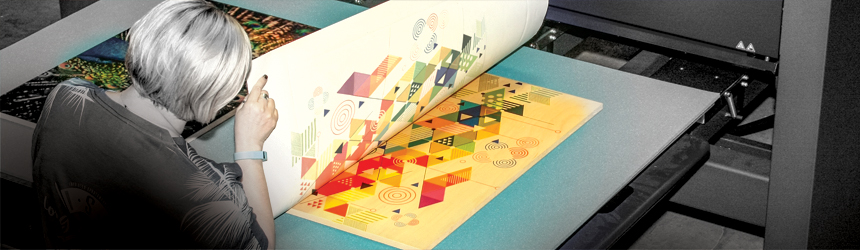
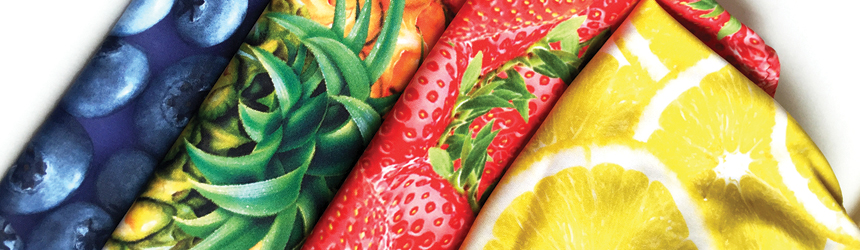
Graphics created via sublimation offer vivid prints and a high-quality feel. The act of sublimation requires heat. When inks are warmed, they turn into a gaseous state, and permeate the substrate. When direct dye-sub occurs, ink is sublimated directly onto the fabric. With transfer dye-sub, a graphic is printed onto transfer paper and then sublimated to the fabric through an external heat source.
Advancements on inkjet sublimation printers include build quality and width considerations, media handling, and ink. Demand is high as more PSPs become aware of the technology and what its adoption can do for their businesses. As the industry matures, these enhancements are a logical progression.
Build Quality and Width Considerations
New machines are introduced with higher productivity ratings to effectively handle larger runs, especially for those companies in the industrial fabric space.
For example, the Rhotex 322 from Durst Image Technology US is designed for heavy industrial use, with print speeds up to 1,506 square feet per hour (sf/h). EFI’s Reggiani portfolio of printers are also designed for high-speed, industrial printing. Inkjet Technology, Inc. recently announced its TX-3200DS printer, with a width of 3.2 meters and printing speeds of up to 1,300 sf/h in production quality mode. Mimaki USA, Inc. introduced in Spring 2016 the 3.2-meter TS500P-3200, developed for extra-wide textile applications in production transfer runs. It can print at speeds of 1,937 sf/h in four-color mode.
Wider width sublimation printers, some reaching five meters, create seamless prints and output at a higher capacity. Ryan Burton, digital printing specialist, Media One Digital Imaging Solutions, LLC, says wider machines eliminate the need to splice media together. This equates to less labor and minimizes the time it takes to complete graphics.
All applications benefit from the wider width. For soft signage, which also includes trade show exhibits, Keith Faulkner, president, Splash of Color, explains how demand for wider widths has increased. He specifically points to the introduction of silicone edge graphics displays, which require extra fabric to fit into the frame.
“Most exhibit and display builders require the ability to produce eight- to ten-foot panels without seaming for use as backdrops. In order to accomplish this, exhibit builders will select printers capable of handling fabric widths of 102 to 126 inches, providing sufficient fabric for eight- to ten-foot panels with finishing in mind,” he continues.
Interior décor also benefits from wider width devices. Similar to soft signage, these markets look for the opportunity to print efficiently, and this means with as little seams as possible. Ricardo Augusto Lie, partner managing director, Ampla Digital, cites wider devices as better accommodating applications in the bed and bath segment and curtains.
“The wider width print capability is also attractive to those serving the custom interior décor market as they can produce large, coordinated panels for window coverings and bed linens,” agrees Ryosuke Nakayama, manager, textile and apparel business development and marketing, Mimaki.
Media Handling
Fabric and transfer paper are tricky when it comes to controlling how they are run through the printer and then in some cases a heat press. Automated feeders and tension control tools all help stabilize the media at each end of the process.
“Stabilizing media is especially important in fabric sublimation printing. You are working with material that can wrinkle easily and with the cost of either fabric or transfer paper, customers need to ensure there is as little waste as possible,” recommends Mike Wozny, senior product manager, EFI.
According to Randy Anderson, product marketing manager, Mutoh America, Inc., the latest trend in sublimation is thinner paper, which requires finessing the media handling system a bit. To combat this, Mutoh created the ability on its printers to disable rollers in contact with the media to allow paper expansion outwards towards the sides rather than up, which causes cockling.
Robert Rychel, textile sales manager, Durst, stresses the importance of constant and consistent sensory measurement of the state of the media—weight, roll diameter, width, thickness, and actual tension. “The calculation of these measurements and then constant controlling of the right parameters allow the transporting of even difficult and dimensionally unstable media in a reliable and consistent way,” he suggests.
Weight is a challenge, especially as wider width printers are introduced. “As printers get bigger and faster, the rolls of media must also get longer and heavier, therefore needing more heavy duty methods to take up and feed,” shares Matte Gusse, VP sales and marketing, Advanced Color Solutions.
“Typically, the components in the machine need to be larger and sturdier to handle the stresses incurred from the width of the media. This includes the rollers transporting the paper, and the motors associated with unwind and rewind transport,” agrees Mark Sawchak, owner, Expand Systems, LLC.
For example, the Auto Media Feeder on the Mimaki TS500P-3200 applies calibrated tension to the media, maintaining stable and precise media feed and take up on rolls up to 286 lbs. “This also reduces telescoping of the media during take up and eliminates the potential for buckling or creasing during the calendar transfer process, thereby accommodating long run, full roll transfer,” shares Nakayama.
“Heavy-duty take-up systems that keep the paper wound tightly and evenly during roll-to-roll print are important because it allows users to move a printed roll of paper directly to a calendared heat press without having to make any manual adjustments. A tightly and evenly wound roll helps produce optimum results,” says Lily Hunter, product manager, textiles and consumables, Roland DGA Corporation.
Maintaining a constant tension across the entire print run is important. “More sophisticated systems use rubber-coated rollers to help grip the fabric and weighted dancing rollers to maintain constant tension regardless of how stretchy and dimensionally unstable the fabric might be,” shares Faulkner.
At Hollanders Printing Systems, according to Jaco Kramer, sales and marketing, Hollanders, its printers use two rubber rollers that keep the material in the print area with a specific amount of tension. The level of tension differs per material.
Fabric type effects the media feeding system. Juan Kim, CEO, Valloy Incorporation, says direct sublimation printers are generally equipped with a rubber roller feeding system, which works best for woven and non-stretchable fabrics. A silicone coated belt type is used for thin or stretchable textiles, but sometimes daily maintenance to recoat the belt is a challenge. Kim says some printers are now equipped with a belt consisting of hydrophobic plastic meshes with a vacuum as an alternative.
Ink Sets Evolve
Sublimation ink is also advancing. New ink sets provide higher quality with lower costs.
“New ink sets provide the highest quality prints and most value. These offer deeper, richer colors, greater gamut, more efficient yield, and higher resolution than previous formulations,” explains Jimmy Lamb, education manager, Sawgrass Inc.
For example, companies like Mimaki, Roland, and Sawgrass are introducing fluorescent inks, opening up more opportunities for digital print, as bright colors such as these are highly desirable in the sports apparel market.
Other new ink sets feature high density blacks. “These produce extremely rich blacks, improved color contrast, and use less ink in the process. High density inks have typically been prone to sedimentation, where if left in the printer for a period of time the ink solids will clump together and could potentially cause the printhead to fail,” shares Timothy Check, product manager – professional imaging, Epson.
Epson’s new UltraChrome DS with High Density Black encapsulates the ink solids, preventing them from clumping together and preventing any costly downtime if the printer’s ink channels clog.
“Economizing on ink usage is important. High coverage is fairly common in textile applications so it makes sense to save as much money as possible with ink costs. A patented ink circulation system on a printer can recover 95 percent of all nozzle outages without wasting a single drop of ink,” recommends Wozny.
Learn more about dye-sub ink in the August issue of Digital Output.
Demand from Many Markets
Demand for digitally printed textiles is increasing in different markets and it all comes back to the need for quick, quality prints that are unique and can help a company stand out from the crowd.
“The textile industry now perceives digital printing as an affordable option that will bring them flexibility and new ways of thinking in the manufacturing process of printed textiles that wasn’t available long ago,” says Augusto Lie.
Sawchak agrees. “The general primary drivers for the market demand of digital textile printing include the need for shorter runs, fast order response, more design options, and sustainability. These drivers are consistent across all of the markets, but the primary driver may vary per market.”
For signage, Rychel says usage is driven by the fact that fabric is “greener” and can help with sustainability targets. Also, being foldable and light allows for ease in shipping. “When you add the fact that fabrics also provide a better overall appearance, it is really no surprise that we are experiencing increased demand,” he continues.
“Apparel manufacturers are looking for solutions to turn designs into sellable goods in a minimal amount of time, while balancing inventory. With fashion products, some designs move slowly, while others have significant spikes in demand. With digital dye-sub, manufacturers are able to adapt and shift production to meet demand,” shares Check.
Hunter points to consumer demand as driving the use of sublimation in apparel. With performance wear mainly composed of polyester, dye-sub is ideal for uniforms, workout wear, and athleisure items.
“Changes in polyester fabric have made polyester the fabric of choice for sports and yoga by improving the look and feel of these fabrics, which spills over into fashion, plus the flood of products and specialty items that can be dye-sublimated make most applications limited only by the imagination of the designers,” adds Anderson.
Lamb believes that thanks to more knowledge of sublimation than ever before, appeal is more recognizable. “Customers see the quality of sublimated prints on all kinds of substrates and are increasingly buying these products. And where there is demand, you’ll find manufacturers designing products to meet those needs.”
The Logical Progression
Changes in build quality, printer width, media handling, and ink seem to be right on target when it comes to the evolution of sublimation printing technology and its place in the graphic arts.
“These changes are a logical progression in this industry. People are now able to produce applications that they weren’t able to do in the past with solvent and inkjet machines. They are able to have a higher margin when printing on different types of fabrics,” says Burton.
While he believes the advancements are on track for the industry as a whole, some believe the two separate segments—signage and apparel/décor—are at different points in their trajectories.
Check suggests that in the promotional goods and soft signage textile industries, growth is occurring in a logical progression because the companies involved are leveraging their experience with other sign products and applying it to dye-sub.
Conversely, “in the apparel industry, there are many purely analog producers today. These more traditional manufacturers recognize the need to transition to digital dye-sub, but the path to do so is unclear. I believe that we will see significant advancements in the apparel industry as the path to digital becomes clearer in the next several years,” he continues.
“I think sublimation is like electricity. Do you think Thomas Edison could see the logical progression? I don’t think so. I think we are really near the beginning. The markets that will benefit will likely be endless. Can you imagine ordering all custom furniture with exact patterns and colors? And having them delivered in two weeks or less? That’s the power of digital decorating,” concludes David Gross, president, Condé Systems, Inc.
Digital Sublimation
Enhancements in build quality, printer width, media handling, and ink all join together to achieve a common goal of advancing where and how sublimation print is used. Besides traditional markets like soft signage, trade show exhibitions, and backdrops, digitally sublimated print is now being seen in apparel and décor. Demand comes from the ever-present need to achieve cost-effective, quality print, and more markets are understanding digital’s integral role.
Click here to view the Textile Printers Target Chart – an all-inclusive information resource!
Jul2016, Digital Output