A Practical Experience

By Melissa Donovan

With the influx of wrap training and substantial growth in the market over the last ten years, print service providers (PSPs) continue to attend classes. The demand for wraps grows. New media and trends spark end user interest and consequently both inexperienced and experienced PSPs feel pressure to brush up on the latest information.

Most classes include a hands on element, which is something print providers respond to, as it allows them to get a true feeling for the process and media used. Choosing when and where to take a class shouldn’t be a light decision. There are considerations regarding travel, cost, and topic matter. In addition, more classes are going beyond install and instructing on how to sell the service, use the best tools, and design the most impactful wraps.

Train On
While vehicle wrapping is not a new application by any means. Many print providers are still looking to learn the trade or brush up on their current knowledge. Training classes continue to remain popular.

Demand for vehicle wraps is high as they move into automotive shops thanks to color change fi lms, which are more cost eff ective than painting. “Vehicle wraps are a standard tool in business marketing, as well as more popular for consumers, it’s no wonder there is a large spike for classes,” says Craig Campbell, market manager – graphic products, Orafol Americas.

With new market verticals being introduced, media portfolios consequently grow. Inexperienced and experienced PSPs are signing up for classes. “Because vehicle wrap designs must account for complex contours, curves, and rivets, there’s a level of complexity that constantly requires additional skill sets,” shares Jason Yard, marketing manager, Mactac Distributor Products.

Nate Place, technical service technologist, 3M Commercial Solutions, points out that the vehicle wrap community is very competitive. “The individuals who are truly committed and passionate about vehicle decoration and wrapping are continually trying to refi ne and polish their skills.”

Other reasons these classes have staying power, suggests Abby Monnot, marketing manager, Avery Dennison Graphics Solutions, are because they allow PSPs to network with other installers and share their experiences.

“Some attendees use these classes to learn how to better educate and train their apprentices as well,” adds Louie Calma, technical specialist – automotive, Arlon Graphics, LLC.

Class Type
Hands-on classes are fairly common, but some classroom instruction is typical. Structure varies between course type and topic, as everyone learns differently. How long the class is held is also an important consideration. “Sign shops and installers respond best to hands-on classes. Graphic installation is a tactile, manual profession and improving upon technique requires plenty of physical practice,” says Monnot.

Campbell suggests a two day class as a healthy balance of classroom and handson training, especially for newer installers.

Robert Rundle, viscom market manager, Ritrama, says the company has had great success with small training groups set up for print providers who specifically want to master an application like car wrapping, fleet installs, wet apply window applications, or rough wall graphics.

“Most people look for a comprehensive class that hopefully doesn’t take them out of day-to-day work for too long,” adds Yard. That’s why Mactac set up an online community like Application Nation, where installers can visit 24/7 to learn about best practices and trends using either videos or reading frequently asked questions.

Weighing All Factors
Print providers need to consider travel, cost, and topic matter when choosing a training class. It’s important to look into a class’ description well before so you are prepared for whatever will be occurring during the time it is held.

“Skill level and business model should be considered when choosing a class. The area a PSP focuses their business on should direct them to the classes that best suit them,” suggests Marcio Oliveira, senior technical service engineer, 3M.

Calma points out just how large the range of classes are. “From basic to advanced to certification level; commercial, digital print wraps, or automotive restyling; and from manufacturers, industry organizations, or local distributors. Some classes cover multiple product lines and others are more focused on general signage, walls, vehicle wraps, or automotive restyling.”

Besides looking at the content of a class and how it will better serve the PSP and its business model, it’s also important to do a little research on who is holding the class, explains Campbell.

“I would say one of the main considerations is if the class is either provided by or at least supported by a media manufacturer. If you are considering a class offered by a third party that may feature several different media manufacturers, I would make sure to ask if they have gotten a blessing by the company whose material they are featuring,” he continues.

Beyond the Wrap
Besides the act of wrapping a vehicle, today’s classes also teach how to sell a service, trends, tool selection, and even design tips. These added topics really give the print provider incentive to take a class and gain a lot from it.

“Pricing and design are just as important as the installation skills. If a new print provider is just learning wraps, it’s important to consider how they are going to charge for and manage their offering to remain competitive in the market,” says Yard.

Understanding the product warranty is an important topic to cover in training classes, adds Rundle.

For example, in 3M’s classes, which include one and three day options, other things taught besides install include a background on the different tools used for application surfaces. “We talk about new products that are introduced to the market, as well as discuss the new trends in the paint industry and how the low volatile organic compounds affect the adhesive properties of products,” explains Oliveira.

Arlon’s WrapItRight training classes take a universal approach by discussing concepts beyond wrapping. “We demonstrate tools that significantly improve the efficiency and quality of projects. We also share some selling and upselling tips we learned from previous classes shared by attendees themselves. Since vehicles have curves, channels, and other obstructions, we always remind our attendees of the importance of the collaboration between the designer and the installer,” shares Calma.

Avery Dennison wrap classes cover pricing and promotion for shops and installers on the second day of each session. “In a labor intensive industry like graphic installation, pricing is important in keeping print shops profitable. Knowing how to sell services to customers can set print providers apart,” recommends Monnot.

In all of Orafol’s educational sessions, it strives to provide a thorough understanding of the overall market. This includes, according to Campbell, the approach to market from a business aspect, the materials used, the correct procedures in preparing the vehicle, and the application of the material to the vehicle.

Classes Pay Off
Based in Muskegon, MI, Graphiti Wraps has been business since 2006. The company employs one to five people at any given time, acting as a subcontracted installer for large format digital print shops. Chad Parrish, owner/operator, Graphiti Wraps, has attended several different training classes over the years including 3M Preferred Graphics Installer, Arlon WrapitRight Certified, Avery Dennison certified, Lowen Certified, and XPEL paint protective films certified.

Over the years he’s found he responds best to classes that involve hands-on, specialized training. “Being an installer, I learn best if I can physically play with film, not only will I get a feel for that particular material, its aggressiveness and tack level, but the longer I play with it I will then start to learn what its capable of by pushing and finding its limitations,” shares Parrish.

Understanding how various media reacts during the adhesion process is essential to expanding his installation technique. “Each and every vinyl installs differently, whether it has more initial tack than another or whether you have to use different finishing/install techniques, like a cold stretch versus a pre-stretch. Understanding how each film reacts makes you a better installer and provides the customer with a quality job,” continues Parrish.

While some of the more obvious benefits of attending a wrap training class include learning about new trends and tools, Parrish finds that one of the more stand out reasons to attend is the opportunity to talk shop with various other owners and installers from across the country. Just speaking with peers presents additional learning opportunities, whether in a discussion recounting a difficult wrap experience and how the challenges were overcome or simply catching up on skill levels.

When it comes time to choose a wrap training class, Parrish almost always books one that is 100 percent offsite from his shop. He believes this allows him to focus on the training with no distractions. In addition, he prefers classes that are held for two to five days, which provides the appropriate amount of class and hands-on time with instructors.

“When I look at a training class, I look at not only how I can benefit, but how my company will benefit as well. Travel and cost stay back of my mind. I know the money I put forth for the training will pay itself off in the future,” explains Parrish.

Training Benefits
Businesses that invest the time and money in a wrap training class will almost always benefit from the experience. Today’s classes offer install and beyond to cater to all levels of professionals.

Sep2016, Digital Output

Mastering the Non Traditional

By Cassandra Balentine

Many print service providers (PSPs) can make a living with vehicle wraps, from coups to food trucks; businesses promote goods and services on the road, in parking lots, and everywhere in between. While vehicle wraps are a tried and- true method to generate revenue, a little creativity can go a long way. Non-traditional wraps cover items like instruments and decor, adding another dimension to an ordinary object or environment.

Skilled Wrapper
Established in 1998 and based in Arlington Heights, IL, Graphic Alliance Inc. works out of a 3,500 square foot facility. The full-service marketing firm specializes in print and digital media. With nearly 12 employees, the company offers a range of services including graphic and web design, digital marketing, large format printing, and vehicle wraps.

To produce its range of offerings, the PSP relies on several pieces of digital printing and finishing equipment, including a Roland DGA Corporation SOLJET Pro 4 XR-640 printer/cutter, a Graphic Finishing Partners LLC (Gfp) 563TH Top Heat Laminator, and another laminator from SEAL, part of Acco Brands.

Eric Grossman, CEO, Graphic Alliance, estimates that half of its business is signage, one fourth is wrapping, and the rest is split between menus, banners, displays, window, and wall graphics.

Boxed Art
Graphic Alliance’s wrap skills translate to objects other than vehicles. For instance, the shop once wrapped an antique refrigerator in purple and pink, donning the company’s name and other graphical elements. “The fridge was an eye sore. Matt Gorske is our creative senior level designer and came up with the idea for it,” says Grossman. Outside of internal use, the shop thinks outside of the box to go above and beyond for its customers.

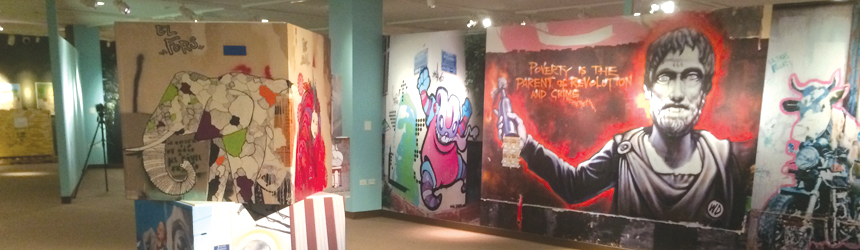
Recently, the team created an exhibit for the National Hellenic Museum, “The Street is My Gallery.” The exhibit showcases political-based street art from Athens, Greece. The Graphic Alliance team took photographs of the graffiti, enlarged them, and printed using its Roland SOLJET Pro 4 XR-640 and Mactac Distributor Products IMAGin ROODLE vinyl for wall graphics.

These were laminated with its Gfp 536TH and SEAL laminators using Mactac’s IMAGin RoughRAP with Permacolor Matte RAYZor laminate. The massive design covered three levels of the museum, which equated to 5,000 square feet over 16 rooms. In addition to the wall wrap, the museum curators wanted to complement the wrapped walls with 32, two- by two-foot boxes stacked in threes and scattered throughout the rooms. These boxes were wrapped as well, accenting the wall graphics.

Once the museum requested the boxes and Grossman suggested using a matte vinyl and laminate to eliminate glare. He says the turnaround was quick. “The client was five days late getting us the files, leaving us with three days to print and install 3,000 square feet,” recalls Grossman.

For installation, the team was divided into three units—printer and cutter, driver and extra hands, and two installers. “We worked straight through 60 hours,” he says.

Wrap MVPs
As previously noted, vehicle wraps make up a good portion—25 percent—of Graphic Alliance’s business. Of that, Grossman says that a majority—50 percent of that is printed vehicle graphics, while 48 percent is color, two- and three-tone accents, and the remaining two percent is color change wraps.

Because vehicle wraps represent such an important aspect of the business, the company has a dedicated division known as Elite Fleet Vinyl. When the shop wraps a customer’s vehicle, they become part of the Elite Fleet of custom wraps.

Grossman explains the company wants to take wraps to another level, offering vehicle wraps as low as $500 to entice consumers to buy and change them out regularly. Due to the amount of wraps done, it has enough extra materials to make these low-cost wraps a reality. “We’re trying to get it to a point where you can purchase a wrap as a gift for the person who has everything,” adds Grossman.

In addition to printed vehicle wraps promoting businesses, Graphic Alliance and Elite Fleet Vinyl have taken a step away from the traditional and create layered wraps that offer a three-dimensional effect. “We’re using four or five types of different materials together to produce accents. First we put Mactac IMAGin ROODLE down and use different thicknesses of satin chrome vinyl to give the effect of a raised textured surface,” says Grossman.

Success through Creativity
It is clear that Graphic Alliance marches to the beat of its own drum. Offering a range of services with a side of creativity is the key to success for this print provider.

Sep2016, Digital Output

New Products Debut

By Digital Output Staff

Continuing our preview of the Specialty Graphic Imaging Association’s (SGIA’s) annual Fall expo—the first part appeared in our August issue—here we share information from additional vendors exhibiting at the show. The 2016 event is held from September 14 to 16 in Las Vegas, NV at the Las Vegas Convention Center in the Central Hall. Use Digital Output as a handy guide to navigate the show floor.

Show Highlights
3M, booth 2039, holds demonstrations using 3M Knifeless Tapes; new non-PVC intermediate 3M Envision Print Film 48C; and 3M Scotchlite Print Wrap Film 780, a reflective film with enhanced conformability. While visiting the 3M booth, learn more about Advanced Installation Training and Testing programs.

Adams, booth 630, supplies wide format magnet sheet, magnet receptive material, magnet receptive paint, and all types of magnets, magnetic latches, and assemblies used in creating signs. Its magnets allow signage to be quickly updated with minimal tools and no training. The company offers a full selection of product configurations, strengths, laminates, thicknesses, widths, lengths, and custom shapes for almost any application. Adams has two converting facilities to ensure quick turnaround for custom requirements.

Agfa Graphics, booths 1551/1561, globally launches three new LED wide format UV inkjet printing systems. LED technology saves energy, increases system up time, and reduces operational expenses. Additionally, the Jeti Mira RTR, Agfa Graphics’ 106-inch true flatbed printer featuring a moving gantry, and the Jeti Tauro high-end, 100-inch UV hybrid printer with automatic scissor stacker, are demonstrated along with Asanti 3.0 Store- Front workflow software.

Aleyant, Tucanna, and Ultimate TechnoGraphics, booth 2577, feature the Automation Hub. Visit the booth to learn how the end-to-end workflow automation solution consisting of Tucanna’s tFlow, Ultimate Technographics’ Imposition, and Aleyant’s Pressero, eDocBuilder, and Print- JobManager help save time and cost, and improve overall productivity.

Aurora Specialty Textiles Group, booth 1485, launches Expressions, an exciting, new, comprehensive canvas line specially designed for optimal performance across a range of today’s latest digital printers, including latex, UV, and solvent. Expressions is available in matte, satin, semi-gloss, and gloss finishes, and in widths up to 122 inches and roll lengths from 25 yards up, plus custom sizes as needed.

Banner Ups, booth 3491, exhibits TexTape, a double-sided adhesive hemming tape that sticks to textile banner media. Banner printers use TexTape to hem textile banners and flags in house without sewing. It creates a clean, crisp edge hem or pole pocket on any textile banner or flag and is super-strong indoor and outdoor UV durable. No sewing equipment or labor required. Just peel, stick, and fold hem. Available in 3/8- and 3/4-inch widths.

Beaver Paper & Graphic Media, booth 3131, delivers a variety of TexPrint sublimation papers for water and solventbased digital inkjet print platforms. Widths range from mug and photo sizes to sheeted papers to grand format. A lineup of Tex- Styles graphic fabrics for sublimation direct, transfer, UV, and latex printing are available, as well as ProTex, a cost-effective protection tissue for calender heat presses. All products are compatible with OEM inks, printers, and heat presses.

Budget Inks, booth 154, develops a range of ink solutions for Canon, Epson, HP, Mimaki, Mutoh, and Roland printers. These plug-and-print solutions do not require any flushing or changes in color profiles. Run them side-by-side OEM or go back to OEM.

Caldera, booth 607, displays the V11 RIP—fast, efficient, and powerful. Armed with APPE 4, ready for the latest Mac OS, and available in multiple languages, V11 speeds up image processing, reduces ink and media use, and improves organization for wide format print businesses of all kinds.

Canon Solutions America, booth 1536, offers the Océ Arizona 2200 Series UV flatbed printers. These printers offer a compelling solution for print service providers looking to broaden their offerings, with high-quality results and wide-ranging capabilities. Explore a world of new markets, new margin opportunities, and grow business starting today.

Colex, booth 1426, announces its new model, the Sharpcut Flatbed Cutter 3232. The Sharpcut 3232 is the company’s most productive and value solution for automated finishing of media ten by ten feet and fabric/textile applications. The Sharpcut 3232 is designed to speed up the process of cutting soft to rigid boards, vinyl, fabric, and textiles by utilizing the automatic board feeder or the roll feeder allowing for faster production runs.

Contra Vision, booth 2125, offers printers products and ideas to create new opportunities with one-way window graphics, enabling those on the inside to see the view and what’s happening outside. This extends the places that graphics are welcomed by building or vehicle users. Contra Vision perforated window film features unique Contra Vision Grayliner.

Cooley Group, booth 117, showcases its environmentally conscious, PVC-free media, including lightweight substrates EnviroFlex PE Poster Frontlit for posters and banners, EnviroFlex PE Frontlit for outdoor billboards and banners, and the Enviroflex PE Backlit for indoor and outdoor backlit displays.

Coveris Advanced Coatings, Magic division, booth 727, offers an array of inkjet media sure to exceed all expectations. Continuously working diligently to stay ahead of industry needs, Magic introduced several new products this year. Discover new innovative products, RITETAC dry erase film, WRAPIT wrapping paper, RENEW 100 percent recyclable non-woven banner, ADHERE6.0 window film, and HILITE8.0 backlit film.

Curbell Plastics, booth 3331, supplies quality printable substrates to the screen and digital print industry along with diffusion materials to support lighting applications. The company stocks acrylic sheet, styrene, foamboards, Makrolon polycarbonate sheet and Makrofol film, SKC polyester film, Coroplast, Fome-Cor, Gator, and expanded PVC. Curbell offers full conversion and technical services, along with transfer adhesives, and very high bond tapes.

Denco Sales, booth 980, is a supplier of equipment and supplies in visual communications. Stop by the booth and take advantage of equipment promotions. Denco Sales offers great show specials on various pieces of hardware, including HP Latex printers; CWT flatbed laminating and application tables; Roland eco-solvent printers, plotters, laminators; and a variety of other equipment options.

DreamScape, booth 1981, demonstrates new Dream- Scape High Performance Suede, a premium new wallcovering base material, optimized for the highest level of consistency with modern inkjet printing systems. Enhanced temperature and mechanical stability means that DreamScape vinyl remains flat over a range of platen and media transport configurations. This results in more uniform printing with less concern about managing the delicate balance among temperature, tension, and vacuum to achieve print perfection.

Durst Image Technology US, booth 401, a global leader in inkjet innovation showcases best-in-class printing systems designed for high productivity, flexibility, and efficiency. Durst features the Rho 1300 Series, the Rho 312R, and its textile soft signage solutions. The company’s quality, precision-built equipment provides three-shift production output reliability.

Engineered Printing Solutions, booth 1931, showcases its fJETXL industrial inkjet printer. Features include a printable area up to 1,000 square inches, jettable varnish and primer, adjustments for parts up to 5.9 inches in height, and high-speed uni- or bi-directional printing.

Expand Systems, booth 2715, debuts DuraVibe Solutions. DuraVibe Solutions include fabrics specifically for latex inks and fabrics for other digital textile solutions, such as pigment, reactive, and polyester that are game changers in digital textile printing.

Fisher Textiles, booth 1769, highlights MoJo Backlit Fabric for direct and transfer dye-sublimation, UV, and latex printing. The wrinkle-resistant fabric features a slight stretch for a tight fit in silicone edge graphic framing systems. It is specially engineered for light dispersion and presents a vivid print that is amplified when backlit.

Fujifilm, booth 1119, demonstrates the Inca Onset X3, capable of printing over 9,688 square feet per hour. It features 3xCMYK ink channels plus white to print specialty applications, or orange to expand the color gamut to match a wider range of Pantone colors. The Onset X3 features Fujifilm Dimatix Q Class 14-picoliter printheads and Fujifilm Uvijet UV inks.

Gans Ink and Supply Company, booth 2181, brings its over 65 years of trusted experience to the wide format market. It highlights media, inks, and printers. Recently Gans became an authorized dealer for HP Latex printers, Graphtec cutters, and GFP laminators.

GBC & SEAL, booth 2473, offers some of the best in finishing. Featuring the GBC Spire III 44T, this 44-inch thermal wide format laminator packs in features including a two-inch mounting gap, easy load AutoGrip film shafts, running speeds up to 20 feet per minute, and a user-friendly control panel. The ideal solution for point of purchase, trade show graphics, and vehicle wraps with optional roll to roll, the Spire III 44T proves that performance doesn’t have to be expensive.

The Gilman Brothers Company, booth 3569, displays Infinity styrenefaced foamboard. It features a supersmooth, super-clean surface that eliminates pre-production preparation while increasing printing speed and efficiency. The smoother surface means seven percent less ink is required for complete coverage. Infinity’s foam is 2.5 times denser and 22 percent lighter than other foamboards and cuts cleaner and 30 percent faster on digital equipment. A cold-bend capability allows for printing, shipping flat, then cold bending to set up into a three dimensional presentation.

Ink Mill Corporation, booth 735, shows it custom tailored inks. The range of products that Ink Mill offers to OEM printer manufacturers and industrial inkjet integrators continues to expand and become more diverse. With the latest in inkjet ink technology, Ink Mill provides some of the highest quality inkjet inks on the market and made in the U.S.

INX International Ink Co., booth 1414, presents its Triangle RXV inks, designed to work with Roland printers, including the Roland VersaEXPRESS RF 640. Color and chemically compatible with Eco-Sol MAX 2 OEM inks, they are fast drying with low odor and offer high performance with a neutral balanced grayscale that is equal to OEM.

KATZ Americas, booth 1577, offers a 120pt KATZ Display Board product. It features a beautiful, low static 96 white point finish and a unique anti-warp and curl core. In addition to these benefits, the 120pt KATZ Display Board is aimed to be an ideal replacement for styrene and three millimeter PVC options at a price point that can’t be beat.

Kern Lasers, booth 321, provides its flagship HSE Laser System. The HSE is capable of cutting and etching a variety of materials, including wood, metal, and acrylic. It cuts at up to ten inches per second, and engraves up to 150 inches per second. Each system is custom built based on the customer’s unique needs.

Kernow North America, booth 1070, introduces the new Supreme range of high-performance, composite retractable banner, and pop-up display films. The Supreme range lays flat, resists heat distortion even on older latex printers, and prints great. Also shown is 201SGB glossy backlit display film for latex and solvent printers, plus MetaliK silver card for laser-printable luxury packaging and proofing applications.

KIP, booth 2231, exhibits color and B&W wide format systems and software. The KIP 800 Color Series provides solutions for tasks that require high levels of quality and performance. KIP systems are integrated with System K Software, a software suite providing powerful print control for production environments from a range of print submission applications, cloud printing, scan and copy, variable data printing, and fully integrated stacking and folding.

Leister Technologies, booth 3630, shares the SEAMTEK 36 welding machine. It is a versatile hot air welder with three different welding stations and a tape delivery system. Th e machine allows users to weld overlaps, hems, and pole pockets at various widths. In addition to a stationary welder, Leister exhibits its economical automatic welders, the UNIPLAN E and VARIANT T1.

LogoJET, booth 3860, reveals the UVx90 Printer, featuring an expanded imprint area of 24×36 inches and a flatbed that automatically adjusts to fi t products up to six inches thick. Logo- JET printers offer full-color decorating capabilities on virtually any substrate— natural or synthetic, rigid or flexible, flat or curved. Special effects such as textures and gloss can be added, and simultaneous white ink allows for printing on dark and clear substrates

Magnum Magnetics, booth 711, showcases its high-energy, double-sided printable magnetic media up to 48 inches wide for interchangeable graphic display applications. Th e magnetic media is made in the U.S. and works in concert with printed magnetic receptive pieces, featuring a super-strong, reversible magnetic base layer that’s up to 48 inches wide without seams.

MagX, booth 649, unveils the next generation of MagX printable magnetic sheeting. It offers up to ten percent greater holding power, a brighter white point for producing brilliant colors, a treated laminate that accepts a wider variety of inks, back coating to prevent scuffing and scratching, and a smoother and noticeably more flexible product.

Marabu North America, booth 1849, offers its ClearShield line of liquid laminates. ClearShield delivers proven protection and unmatched printability at a fraction of the cost of film. Formulated for a range of applications, ClearShield is ideal for billboards, prints, fine art, signs, banners, awnings, and fleet graphics. Th e liquid laminates offer superior UV protection and are Type II certified

Master Magnetics, Inc., booth 3541, invites attendees to view its magnetic graphic system. Create beautiful, easily interchangeable graphics with PrintMagnetVinyl and FlexIRON. Ideal for retail environments, this magnetic graphic system provides the cost efficiency of printing direct to magnet with solvent, eco-solvent, UV, and latex ink systems, coupled with the simplicity of easy change-out and install.

Mimaki, booth 1961, demonstrates the UJF-7151 UV LED flatbed printer, which provides opportunities to produce short-run/custom jobs in minutes; or it can be used in industrial/manufacturing applications. Its design and technologies enable specialty graphics companies to realize the benefits of digital printing with higher margins and lower production costs, without compromising quality. Th e print table moves the substrate under staggered printheads to reduce vibration and increase ink drop accuracy.

MultiCam, booth 2241, exhibits its versatile lineup of digital finishing systems including the Digital Express. Designed to bridge the gap between routers and knife cutters, these highly versatile machines eliminate bottlenecks that occur in the finishing stages of the production process. In addition, the new SignMaker Express is on display. Th is machine is a fully capable, turnkey CNC solution specifically designed for signmakers.

Mutoh America, Inc., booth 1815, encourages visitors to enter the world of textile printing with the new 75-inch dual-head ValueJet 1938TX direct-to-textile printer. With print speeds up to 918 square feet per hour, front and back tensioning, and Smart Printing technologies, entering the world of textile printing has never been so easy.

My Press Needs, booth 127, performs live die-cutting demonstrations on a clamshell platen press. It features its new 20×26-inch Crest Cell Clamshell model. With its compact size, the 2026 Crest is ideal for cell manufacturing environments. Attendees can watch the Crest die cut polycarbonates, Falconboard, and Gilman Brothers foamboard.

North America Display Corporation, booth 4516, highlights its fabric system that’s versatile, reusable, and environmentally friendly. Reusable textile prints and sturdy aluminum frames create signs that are easy to assemble and transform the look of any space. Th e system is assembled using connectors, teamed with high-powered LED lighting for bright, even illumination. Th e fabric prints feature a rubber lip that is easily inserted into the frame.

NuSign, booth 1395, offers supplies for all types of printing, including media from 24- all the way to 196-inch rolls. It is an authorized reseller for DGI, Epson, Gfp, Graphtec, HP, Mimaki, Mutoh, Oki Data, Seal, Roland, and Royal Sovereign.

OKI Data Americas, booth 2249, debuts the ColorPainter E-64s wide format printer, which incorporates OKI Data’s low-odor, eco-solvent SX inks and proven print technologies for color density and glossiness expected of the ColorPainter line. Also, participate in live education and vehicle wrap demonstrations presented by Troy Downey of APE Wraps using graphics printed on the ColorPainter M-64s.

Onyx Graphics, booth 932, showcases ONYX 12 software, which offers the ability to build an ideal print workflow to obtain maximum efficiency and lower overall production costs. It utilizes the complete 64-bit platform throughout, to harness full processing capabilities, delivering not just faster speeds but greater responsiveness. Specifically developed to make printing more predictable, ONYX 12 software features a simplified user interface and advanced finishing tools to help print operators produce jobs right the first time.

Pacific Coast Fabrics (PCF), booth 701, celebrates over 20 years of providing some of the finest and most innovative fabrics for digital printing. PCF offers a large selection of textiles for dye-sublimation, direct disperse, UV, latex, and pigment. The company stocks polyester textiles for light box and frame systems, flag, banner, performance and fashion apparel, as well as home furnishings. It showcases products manufactured by Georg+Otto Friedrich.

Perception Wide Format Media, a brand of Worthen Industries, booth 1190, displays PHOTOFAB ECO-Ultra with Repreve, a fabric laminated with a water-based repositionable adhesive and a stay flat liner; ideal for in-home graphics, decals, wall murals, and point of purchase retail graphics. Its greater opacity eliminates any see through of the surface to which it’s applied. Retailers and end users looking for an upscale look and feel appreciate the high print density, which provides photo-realistic imaging and fine line details.

Piedmont Plastics, booth 311, is a full-line plastics distributor with locations throughout North America. It features the Piedmont family of products including Alupoly ACM sheet, Supraflex Banner, and a full line of PSG print media and over-laminates.

Primera Technology, booth 2992, showcases the newest full-color desktop inkjet label printer, LX500, along with the LX2000 Color Label Printer. Primera also features the all-in-one digital solution CX1200 Color Label Press and FX1200 Digital Finishing System.

Redgiant, booth 531, announces new UV LED ink. It offers flexibility for curved surfaces, no banding or cracking, scratch and alcohol resistance, and a range of applicable materials. The ink is ideal for Mimaki, Mutoh, and Roland printers.

Ricoh, booth 1271, exhibits the RICOH Pro L4160, a wide format color printer capable of producing superior print quality and color matching for brilliant signs, banners, wallcoverings, indoor/ outdoor advertising, and point of sale displays. With its eco-friendly, aqueous latex ink, outstanding seven-color printing, and Ricoh software RIP designed to simplify printing graphics-rich output, users can produce output of up to 63 inches wide on a range of media including clear, plastic, vinyl, textile, and backlit substrates.

Roland DGA, booth 2661, features the TrueVIS VG and SG series printers. Both usher in a new era of color, quality, and performance, with the VG offering greater productivity and the SG available at an attractive price. Roland also showcases the new VersaUV LEF-300 and innovative VersaUV LEJ-640FT flatbed printers, the SOLJET EJ-640 high-volume printer, and Texart dyesublimation printers.

Rolinx/Kala, booth 3661, debuts a new line of Flatbed Applicators in North America. The AppliKator Flatbed Table raises the bar in safety, efficiency, and performance productivity—it’s more than just an application table.

Rollem International, booth 2915, shows the new Insignia5, a sheet-fed flexomagnetic rotary die-cutter capable of die cutting, kiss cutting, perforating, scoring, and hole punching card stocks, plastics, laminates, and films up to 24pt. thickness. Key features include ease of operation and quick changeover.

Rose Graphix, booth 1947, focuses on UV flatbed printers, laser engraving/ marking/cutting machines, and flatbed CNC cutters. It is dedicated to providing cost-effective solutions. This year, it brings high-speed UV LED flatbed printers with Ricoh Gen5 printheads and Onyx RIP software, in addition to entry- and business-level CO2 lasers.

S. Walter Packaging Corp., booth 3018, and its Industrial Papers division provides converted papers, tissues, and plastics to manufacturers worldwide. It showcases dye-sublimation protection tissues for rotary heat presses including calender tissues for heavy ink applications. S. Walter offers stock sizes from five to 130 inches, custom converting, and just-intime warehousing solutions.

SA International (SAi), booth 3520, debuts the new SAi DisplayGenie, a point of purchase display and box design software powered by SAi Flexi. Compatible with existing RIP software for flatbed printers and cutters, DisplayGenie features an extensive library of display and box templates. DisplayGenie eliminates multiple steps and streamlines the structural design of folding carton, corrugated cardboard, and sandwich material display units and packaging. Print businesses seeking to expand into the display or packaging markets benefit from this product.

Saw Trax, booth 805, offers the Saw Trax Sign Maker Series Panel Saw for a one-stop cutting tool for all cutting needs; users no longer need to buy a panel saw and a mat cutter. It includes three cutting heads—a circular saw, a pivoting knife, and an ACM cutter. Dust collection hook ups, a folding stand, and measuring guides are also available.

ShopWorks Software, booth 3425, specializes in developing business software specifically for the embellished product industry with OnSite 8. OnSite helps eliminate risk by showing business owners and employees the status of all orders and related information with just a few clicks of the mouse.

Splash of Color, booth 2124, provides the Guardian Calender, an affordable, easy-to-use rotary heat press for all dye-sublimation paper transfer and direct-to-fabric applications. The intuitive design makes for quick, easy use, maintenance, and cleaning, reducing production time. Easily produce athletic apparel, banners, home décor, and flags with brilliant colors on a sublimation system.

STS, booths 1001/2223, presents aqueous dye-sublimation inks that feature high color saturation and low vapor emission. The stable nano-particle dispersion and low salt content helps prevent clogging while extending printhead life. A wide gamut offers dense, brilliant colors. Inks are available for all major manufacturers’ printheads in bottles, bags, and cartridges in 19 colors including fluorescent.

Summa, booth 1460, demonstrates the newly released F2630 grand format professional flatbed finishing system. This latest addition to the affordably priced F Series is now available in a cutting area measuring 104.33×120.07 inches. Also on display is Summa’s DC5 and DC5sx printer/cutters, the advanced S2 Series vinyl and contour cutters, as well as the performance-priced SummaCut Series cutters.

Top Value Fabrics, booth 1885, delivers a wide selection of frontlit, backlit, blockout, PET, mesh, and textiles that are engineered for printing excellence. At the show, it features Supernova. This high-performance backlit exhibits a smooth, elegant drape and offers an illuminated quality that demands attention. The fabric is Reach Compliant and yields excellence in backlit graphics that is ideal in high-end retail and trade show settings.

Trotec, booth 3339, showcases its GS Series lasers for cutting and engraving high-volume print products. With its 19.7×19-inch working area, the SpeedMarker GS creates precise designs and cuts on an array of materials, and includes many configurations and automation options. The included SpeedMark software covers everything from data import to graphics processing to generating barcodes, and customizes the user interface and process data from external systems.

Ultraflex Systems Inc., booth 517, unveils a new, two-story booth featuring the launch of Signetics, the new magnetic-receptive media line showcasing traditional and double-sided magnetic-receptive material. In addition, Ultraflex highlights an array of HP Latex Certified Media offering ICC profiles for HP printers.

Vanguard Digital Printing Systems, booth 1285, exhibits the latest technology in flatbed UV printing. The VR5D 4×8-foot and VK300D 5×10-foot flatbed UV printers are capable of printing between seven to 30 4×8-foot boards per hour in sellable quality. Vanguard also debuts a robust and affordable dye-sublimation (dye-sub) printer. The VT3200 3.2-meter dye-sub printer is capable of printing direct to fabric or paper transfer at speeds in excess of 2,000 square feet per hour.

Visual Magnetics, booth 2531, presents VM-POLYeightPLUS, a highperformance product in the films family of MagnaMedia. A 13-mil, bright white magnetic-receptive polyester film with a satin print surface, VM-POLYeightPLUS is made from up to 25 percent pre-consumer PET plastic. VM-POLYeightPLUS is ideal for producing high-resolution photo and artwork reproductions, overlays, and economical point of purchase signage using most digital and analog printing technologies and features a patented Micro-Iron back-coating enabling displays to be effortlessly updated, easily installed, layered, transported, stored, or recycled.

VKF Renzel, booth 552, is a leading producer and supplier of innovative display and point of purchase solutions. It offers superior products for switching out displays quickly and easily with its Snap Base and Unico Sign Base. No matter the size or thickness, it has the stand for it. The Snap Base accepts inserts as thick as 3/16 inches, while the Unico Sign Base accepts inserts from 1/16 to one and 1/8 inches. Custom sizes are also available from VKF.

W2P Shop, booth 3780, specializes in online print solutions for print providers. Portals and websites can be created as B2C/ B2B portals, built to stand alone or complement other products. Multiple product template methods include HTML5, PDF, InDesign, and XMPie.

WSDisplay, booth 121, showcases its custom silicone edge graphics fabric frame line, Resort Extrusions—including the Tool-Free Vail. The company’s foldable and portable Origami Truss is displayed in addition to its new 30-foot RPL Fabric Pop Up Display.

Zünd, booth 906, launches the Zünd D3 high-performance digital cutting/ routing system. The new D3 series features twin beams—each carrying up to three different tool modules—which operate independently and simultaneously in one ultra-efficient production workflow. The dual-beam D3 integrates seamlessly in existing production environments and, depending on job specifics, can effectively deliver twice the productivity of a singlebeam cutter.

See You There!
Digital Output is located in booth 3955 at SGIA—be sure to stop by and say hi. We hope to see you at show, which promises to be full of product introductions and announcements. Visit Digital Output online at digitaloutput.net to keep up to date on the most recent news releases leading up to SGIA 2016. And, if you can’t make the show, read our November issue, where we will provide a full recap of all that went on at the expo.

Sep2016, Digital Output

The Widening World of the Graphic Arts

By Melissa Donovan

More than halfway through 2016, it’s time again to look at the state of the graphic arts. This year brought with it hot trends, new applications, and an increasing need for efficiency in the print shop. The winners of our annual Application of the Year awards perhaps best symbolize these three key points.

Congratulations to Swift Print Communications, Agio Imaging, Brush Stroke Sign Design, and Mister Print Productions. We’ve included images of their work throughout this feature article. To learn more about each print service provider (PSP) visit digitaloutput.net in August and search keyword “DOAOY1608.”

Hardware, ink, media, and software continue to evolve and these changes in turn affect application options, specifically the target audience—new and existing buyers—of these products. As more jobs—with unfamiliar expectations—are thrown into the mix, PSPs look for ways to increase efficiency in their shops to keep up with customer demand.

The Next Big Craze
Trends are common in any industry and the graphic arts is no exception. Product evolution—and its success or failure—is based on whether PSPs’ reception is positive or negative. Advancements met with open arms are those that save a print provider time and money, while still delivering the level of quality and reliability expected from the customer. In 2016, this was seen in printers, finishing devices, ink, media, and software.

Printers and Finishing Devices
According to Rick Scrimger, president, Roland DGA Corporation, technological improvements in eco-solvent, dye-sublimation (dye-sub), and UV printers made them more user friendly, productive, and efficient than ever before.

While user-friendly components can refer to features found on the printer, price is another characteristic that falls under the same heading. With increased availability of lower cost dye-sub printers, these devices have become popular in the last 12 months, admits John Coyne, sales manager, Lintec of America.

One example of a productive technological improvement is waterfall printhead technology, or solid position printheads. “These printers treat fairly large volume print jobs just like a small one-off print job since they print a very high speeds,” explains E. Tyler Reich, director of product development, Qué Media, Inc.

Increases in printing speed mean efficiency expectations rise, especially in regards to media loading and unloading. “With speeds in excess of 100 boards per hour it becomes impractical and expensive to manually feed media. New generation systems are more capable of handling a wider variety of media, but are also able to be set up in a shorter period of time,” says Larry D’Amico, director of sales – North America, Durst Image Technology US, LLC.

“Taking time and cost out of production continues to be a key driver for technology innovation. Hardware vendors are making printers that are easy and fast to load, incorporating high levels of automation,” agrees Oriol Gasch, director, large format printing, Americas, HP, Inc.

Automation is seen on both ends of the hardware spectrum, not only on the printer side but finishing. “One of the biggest trends is automation of printing and cutting; both physical and workflow. Vendors offer more efficient ways to provide materials handling to efficiently load and unload sheets. Ultimately, as time progresses, these same vendors will offer lights-out solutions,” foresees Steve Bennett, VP sales central and distribution, Esko.

Specific to finishing, “customers are looking for anything from automated tool set up to automated tool/bit changes, automatic loading/offloading, and even robotics. An obvious way to increase productivity and throughput is through more automated devices—with less need for human intervention,” adds John Cote, NA sales manager, Zünd.

Ink
Flexibility and versatility are two key characteristics of ink.

Ken VanHorn, VP, marketing and operations, Mimaki, USA, Inc., says UV-curable ink has generated the most recent interest because of the increased demand for flexible inks not only in the traditional signage market—think soft signage like banners, vehicle wraps, and point of purchase (POP); but also in industrial printing where inks are used to print on substrates like leather or thermoforming.

“The area of interest right now is flexible inks,” agrees Javier Mahmoud, VP of sales and marketing, CET Color. He specifically cites applications where clients actually form the object and the ink goes along with the form rather than cracking.

Media
“On the media side of things, ease of use is becoming more important. Clients, PSPs, and retailers want products that print well, install easily without the need for costly professional installers, and remove effortlessly,” lists Darren Speizer, VP, sales and marketing, Drytac.

Often it is ideal if these substrates are versatile. “Products that can be relied upon for a variety of applications allow PSPs to respond swiftly while maintaining a more efficient cost structure for their business. Instead of purchasing many different types of specialty media, print providers can streamline their inventory,” explains Jenny O. Kigin, marketing operations manager, 3M Commercial Solutions.

Kylie Schleicher, marketing manager, Ultraflex Systems, Inc., admits that “customers are looking for media forms that are versatile, but the message being displayed is equally as important as the media being used.”

Magnetic-receptive media is gaining traction. These substrates are becoming thinner and wider, which increases the number of compatible ink sets and printers. This allows print providers who once needed another printer to even consider printing to magnets use one already in house, hence the increase in demand. In addition, many PSPs recognize just how easy to use these graphics can be.

“Factoring in the time and cost savings of printing direct, the ease of installation and changing graphics, and durability that allows for multiple reuses of the same graphics, magnetic-receptive graphic systems are cost efficient and effective for graphics and signage that require frequent changes,” details Mike Gertz, marketing manager, Master Magnetics, Inc.

Jim Cirigliano, marketing manager, Magnum Magnetics Corporation, argues that there is no denying the rise in demand for magnetic-receptive media. However, “although the recent trend has been toward ultra-thin magnet receptive, some print shops are discovering that the glossy finishes on these graphics exaggerate flaws. For high-end glossy large format graphics, some companies opt for a thicker magnetic-receptive substrate that hides tiny imperfections even under a high-gloss finish.” To Cirigliano, the sheer number of magnetic-based options is the even bigger trend.

Fabric continues to grow. “Digital print textiles are available in increasingly wider widths allowing for more innovative installations. They are also being developed as more task specific such as light box, stretch with memory fabrics, and textiles with full blockout capabilities. New and improved coatings allow for fabrics with advanced water-, soil-, and stain-repel, and moisture management with wicking technology,” explains Jeff Sanders, digital fabrics sales manager, Pacific Coast Fabrics.

While many think of fabric in terms of eco-friendly, 2016 brought with it a trend of “green” rigid substrates. “There is a continued shift away from composite and plastic-based print media. Products can offer warping resistance, a smooth low-static print surface, and clean cutting edges without being a burden on the environment, or the customer’s wallet,” states Christian Nole, marketing coordinator, Katz Americas.

Beyond the material itself, many vendors see a major trend in manufacturing processes becoming more sustainable. “There’s a strong push towards holistic sustainability. The trend is to institute an enterprise-wide initiative where companies are implementing green efforts throughout its products and manufacturing facilities including the removal and usage of any harmful chemicals in the coating process,” continues Jim Tufts, business unit manager, Perception Wide Format Media.

Film and vinyl are prevalent and going through their own evolutions based an intended application. Robert Rundle, viscom market manager, Ritrama Inc., points to optically clear window films with wet apply characteristics as gaining a lot of momentum in the past year.

Molly Waters, senior technical specialist, Avery Dennison Graphics Solutions, believes overlaminates really emerged to the forefront in the last 12 months due to their abilitity of changing “the appearance of color change or chrome wraps by modifying the finish.”

Software
Software solutions continue to evolve by improving efficiency. Fully integrated workflow solutions and standalone products are mission critical tools in most print shops.

“Software solutions have made automation in the print shop easier, so as business increases there are fewer mistakes with less human interaction required. Technologies such as JDF and integration tools make it easier for different software solutions to work together,” explains Bryan Manwaring, director of product marketing, Onyx Graphics, Inc.

For standalone, Jessica Blevins, product specialist, S-One Holdings Corporation, looks to ecommerce websites, or Web to print (W2P) functionalities. “These have opened more opportunity for customization and on demand printing in the décor market. Existing or new print shops are using this business model as an entry channel into new markets.”

“I see more print providers building a stronger web presence and catering to customers outside their immediate geographic area. W2P in an era of increasing demand for personalization makes it very convenient for customers to now shop for their printing online and for print providers to promote new applications and services,” adds Randy Paar, manager, marketing – display graphics, large format solutions, Canon Solutions America (CSA).

New Spin on Old Tricks
While the graphic arts’ history is rich in banners and signs, its future looks to unique applications that print providers can offer both existing and new clients. Customization is prevalent in these newest applications, designed to generate more revenue for print providers.

Existing Clients
Traditional marketing and advertising buyers rely on PSPs to find ways to get their clients’ messages across in a media-rich world. “Unique applications provide print buyers with an effective way to communicate their advertising and promotional messages and leave a lasting impression on the end consumer,” shares Deborah Hutcheson, director of marketing, NAFTA, Agfa Graphics.

“Retailers are not only taking advantage of various signage applications that are now more cost effective to produce for shorter run promotions, they are also finding that print providers can help with store décor,” agrees Fabrizio Soto, VP of marketing for production printing and wide format, Oki Data Americas.

While floor, window, and wrap graphics aren’t new, today’s latest iterations catch a consumer’s eye in any retail environment—large or small.

“One of the fastest growing trends is floor graphic applications. There are more options now than ever, including carpet and concrete graphics,” suggests Jason Yard, marketing manager, Mactac Distributor Products.

Ultraflex’s Schleicher agrees that floor graphics are some of the more popular applications today because they “are easily customized and provide the foundations for a retailer’s identity. Retailers seek to immerse customers into the complete marketing environment and floor graphics help to achieve this.”

Window graphics are ever growing in popularity. Lintec’s Coyne says that since PSPs can now use existing print equipment to print to many of these vinyl or films, they see it as an attractive addition to their revenue source.

Wrap applications that involve color change media are trending. “The need for these applications is being driven by the increased demand for customized solutions, personal and corporate. Whether it is a retail location or a personal car, people and businesses want to stand out,” explains Chad Russell, VP of sales, Arlon Graphics, LLC.

Craig Campbell, graphic products market manager, Orafol Americas, believes the growth in solid color wraps is being driven by the everyday car enthusiast. “This is a good thing for the digital space as the companies who are providing these solid color wraps are also beginning to see why they need to incorporate digital equipment,” he continues.

Fabric-based backlit signage is another popular application attracting PSPs’ existing customers. “The momentum in fabric soft signage and banner applications is tremendous. Go to any trade show and you may notice how reusable fabric soft signage is being used prominently in booth construction,” recommends Ken Hanulec, VP marketing, inkjet solutions, EFI.

Kristina Devine, senior marketing and pricing specialist, Tamara Pitman, product manager, Coveris Advanced Coatings, cite ease of installation, foldability, ease in transport, light weight, and color pop generated from the dye-sub process as reasons this application is so successful.

“As demand for printing on fabric continues to grow, selecting outstanding backlit fabrics that are also proven to perform beautifully for targeted frontlit applications is one way printers gain efficiency in production. Managing less SKUs leads to tighter inventory controls, involves using one profile, and keeping the same roll on the printer for multiple jobs,” adds Karen Stuerenberg, marketing director, Top Value Fabrics.

New Clients
New clients enter the mix from apparel buyers and interior designers to corporate companies looking for reward collateral and promotional products; PSPs need to be ready to service them with digitally printed textiles and wallcoverings to statues or luggage tags.

Fabric optimized for digital print is propelling applications targeted toward new clients. “Up-and-coming direct to textile applications outside of the graphic arts include home décor, industrial applications, and clothing such as sportswear and high fashion,” suggests Brian Phipps, president, Mutoh America, Inc.

Customization is at play here as well. Interior designers have seen the benefits of digital and are adapting it into home and out-of-home jobs. “As digital technology advancements are made in a predominately analog world of textiles and wallcoverings, the consumer becomes closer to the product with the freedom to design, purchase, and install décor offerings for their home or office space,” shares S-One’s Blevins.

Orafol’s Campbell believes that “the interior, architectural, and environmental design community is pushing demand for specialty applications down to the PSPs to create even more opportunity to expand their business.”

“Wallcoverings are increasingly popular and there are now numerous products available that can be digitally printed in short runs and still be relatively cost effective,” explains CSA’s Paar.

Promotional products and rewards/trophies are finding new life in the digital space. UV-curable chemistries and smaller, easier to use flatbeds give PSPs complete control over production. “Previously, items to be decorated were often produced in one location, then taken to a second location for printing. Now they can be produced in the same environment, ensuring improved quality and decreasing manufacturing time,” says Mimaki’s VanHorn

Jim Peterson, co-founder, Vanguard Digital Printing Systems, also cites prototyping and engineering as two other applications that benefit from UV technology and open the door to new clients.

“People who were conventional digital printers are now printing on things they never dreamed would be possible to print on digitally, from cups and bottles to other promotional products. The brand owners that have production lines are incorporating digital printing into those lines for printing on fabrics, bags, saw blades, and brake pads,” adds Jim Lambert, VP/GM, digital division, INX International Ink Co.

Need it Now
Increases in efficiency are a primary concern for many print providers operating in a need-it-now world, especially as new applications may present learning curves that yield production processes. Industry leaders address this in a number of ways, from hardware and workflow solutions to educational classes and seminars.

“From our perspective, manufacturers in general have appeared to be a little slow to add additional efficiency hardware functions, and we have seen a growing trend of trying to push the boundaries of speed. Some manufacturers, however, have focused on improving upon established technology combinations and added capabilities that can address any technical concerns,” admits VanHorn.

INX’s Lambert believes one way to increase efficiency is to have a platform that prints to a wide variety of products. “This virtually eliminates the need of the print provider to have a machine that prints on only one thing.”

With finishing hardware, Zünd’s Cote sees a need for increased efficiency in the kitting aspect of a job. “This means configuring our cutting systems in such a way that human operators or collaborative robots can easily kit finished output right as it comes off the cutting equipment, without adding any extra steps in material handling or logistics.”

Software is an essential piece of the efficiency puzzle. “Print providers need to know—with confidence—that all orders will come out of production as expected and as fast as possible. Software solutions are now able to detect and even fix issues with files coming into production, automatically prepare files with print and finishing requirements, and drive equipment as fast as possible without needing much operator involvement,” explains Onyx’s Manwaring.

Reed Hecht, product manager, professional imaging, Epson America, Inc., gives examples of PSPs that use sophisticated barcoding systems, shop in a box software, and web platforms that integrate directly with RIP software as those successfully improving the speed of their business and minimizing the amount of manual touchpoints in their print process.

Perhaps the best way to create a streamlined print process from end to end is to ensure you’ve learned all the necessary tips and tricks for whatever application(s) you may be specializing in. “Education is the easiest way to clear so many of our market’s hurdles and to become more efficient in completing projects. By truly understanding the different types of media and what their applications—and limitations—are as it relates to your project’s budget can mean the difference in how much profit you can go home with,” recommends Campbell.

Into the Next Year
There continues to be an evolution of new products and services across all facets of the industry—from hardware, ink, and media to software. These changes give PSPs even more options to offer their clients unique ways to promote their businesses.

Aug2016, Digital Output

Wide Format Market Outlook

By Mark Hanley

The wide format market as a whole is not quite mature yet, but it feels as if it is getting there before long, in the sense of flat sales year over year. But, aside from the aqueous markets, it is not quite there.

In the way of invention and creativity, more of a super high end is breaking out at close to and above $1M. This is not just into high-volume graphics, but with a clear emphasis at drupa in May/June 2016 on packaging—corrugated in particular. There has also been steady growth in printing on three-dimensional (3D) substrates on flatbed systems.

Beyond that, point of purchase (POP)—the heart of the market—never stops finding new ways of embellishing the product to higher value, as the new phrase has it. Every year that goes by sees more productivity and functionality for less money. Users benefit from a truly competitive market.

Market Dimensions 2015 Status
Looking back, the wide format graphics digital print market worldwide had the following fundamental dimensions in growth rates in 2015. Vendor revenues in hardware and ink for wide format graphics in 2015 were $4,629,534,316. 38 percent of that number—or $1,761,000,509—made up vendor hardware revenues. The other 62 percent, or $2,868,533,808, comes from vendor ink revenues. With that being said, the vendor revenue compound annual growth rate (CAGR) to 2020 is -0.11 percent.

Also in 2015, the square meters printed worldwide in digital wide format graphics was 1,228,649,534. The square meters printed CAGR to 2020 is 7.68 percent.

Note, no Chinese demand or vendor numbers are included in these statistics. The result is the possible exclusion of up to 12 percent of revenues worldwide by not having access to the data. Otherwise, the global data is the composite product of information shared by vendors in the other minimally 88 percent of the market.
Projections to 2020

Chart A is a simplified statistical review for actual 2015 and projected 2020 of system units sold and the revenues they generated for hardware and ink by major sector. Once again, Chinese numbers are not included.

Chart B is a further simplified statistical review by major sector for actual 2015 and projected 2020 square meters printed. The growth of the print rate is a lot better than vendor revenue growth and units of sale in Chart A. This is a healthy function of an efficient market supplying under conditions of strong competition and more productive systems at even lower prices per unit of productivity. The square meters number is the best measure of market maturity and suggests that only the oldest aqueous market is mature. Again, numbers from China are not included.

The rest of the market is growing, with UV accelerating in its growth as it becomes more established as a technology of choice for larger users and super-important faster response times. This in turn takes place within a market, which is a direct and critical support of the retail market for sales of goods and services in major consumer economies. In other words, inkjet graphics at a more or less local level perform a critical and central role in the functioning of the consumer economy. In fact, conservatively estimated, print providers take all this inkjet technology and globally generate revenues of approximately $40B per year for printed and converted output very largely sold to retailers, suppliers, distributors, and manufacturers.

The printed area and revenue data presented in Charts A and B is also represented in Charts C and D for 2015 only, and includes the declining sector of aggressive solvent for comparison.

Market Highlights: 
Major Sectors
In summary, latex jumped ahead, eco-solvent sustained its dominance, and UV accelerated in production markets. Meanwhile, aqueous markets sustained a mild decline.

Chart E illustrates the projected growth for the three major sectors of aqueous, eco-solvent/latex, and UV for units of sales, hardware, and ink revenue, and square meters printed from 2015 through 2020.

Chart E says that the aqueous sector is now definitively mature, while the eco-solvent/latex sector is not mature in demand—printed output—terms, but is under heavy competitive pressure resulting in lower prices for more productive systems and depressed revenue growth. The UV sector is seeing better revenue growth partly driven by larger systems being sold into this production-oriented sector, but also by significantly increased rates of print.

Aqueous
In the aqueous sector there is a general mild decline in system sales and print rates, which indicates true maturity as in fewer users wanting the output. But the market remains fairly large and aqueous retains its preferred status among those demanding the very highest display print quality.

There is also a growing overlap between the separate and still large technical drawing market and graphics now that 3D rendering and digital graphic display is an integral part of engineering-driven illustration. Some users use aqueous where it isn’t expected. For example, users of large-scale continuous-feed aqueous inkjet document presses are printing posters in large quantities in reels at much lower costs than possible with a serial aqueous wide format graphics system. This does not mean aqueous is being revived, but that its decline continues to be slow.

Eco-Solvent/Latex
As always, latex and eco-solvent statistics remain together as latex stays an almost single vendor market. But latex and eco-solvent address fundamentally similar applications and users at least in the low end—systems less than $50,000. In the low end, this twin-technology market is the largest by some distance among all digital wide format graphics sectors as expected from technologies that are universal in the sense of being able to address indoor and outdoor graphics with a single chemistry at very low acquisition costs to the buyer.

On the eco-solvent side this is a competitive market. In the U.S. alone there are around 56 separate products available from a handful of vendors at price/performance levels. These have consistently climbed, allowing users to obtain 1,000 square feet per hour (sf/h) for less than $20,000. This is partly the result of competition among eco-solvent vendors, but also a conscious or unconscious unitary reaction by eco-solvent vendors to the threat of latex. The breadth of the eco-solvent offering makes its market coverage very tight and that is a good defense against latex.

As for latex, despite the massive eco-solvent competition and the wall-to-wall product coverage, it made significant progress in 2015 in its share of the graphic arts market.

UV
UV is a hard market to tie down with any accuracy. Its most basic and successful format is flatbed, which had a general familiarity to foregoing display graphics screenprinters. Once just a convenience printer to have when occasional rigid substrate demand arose, flatbed systems at the high and low end—breakpoint is $200K acquisition price—now print flexible as well as rigid substrates.

UV’s most obvious identity today is as the production sector of digital wide format graphics, meaning the ability to handle larger quantities for larger customers, large areas allowing lower conversion costs post print, and print a large quantity in a very short space of time. This fast response capability for larger customers usually on a seasonal basis is probably the most important single parameter of competition among print service providers (PSPs).

There are UV systems now that can print around 10,000 sf/h. There is also a specific sub-sector of production systems referred to as super high end, which often, but not always, cost over $1M. Super high-end UV flatbed is a subset of the high-end UV flatbed sector. The historical sales of these systems worldwide is depicted in Chart F.

UV roll-to-roll systems are also successful, though they’ve never definitively replaced the large volumes of output printed on old aggressive solvent systems. This is probably due to their relatively high ink prices compared to the open and commoditized aggressive solvent ink market. Even today, aggressive solvent printers in the install base in the U.S. and Europe are still part of the market, while in China and other non-developed markets they are still the norm.

A characteristic of the UV market is a growing preference by users for vendors with full product ranges at low and high ends. This reflects the difference between UV PSPs and their more numerous colleagues in the sub to $25,000 roll-to-roll low end of the wide format graphics market. The UV PSPs are production oriented and fairly consistently grow their businesses and need access to an evolving set of print systems as they get bigger, and they often want this from a single trusted supplier.

Most interestingly, an emerging trend is the UV sector’s marked evolution upwards of its print rates. This is reflected in Chart G.

Specialty Graphics
In wide format graphics, beyond simple print as a function, PSPs have consistently developed the capabilities in application of display graphics far beyond just print. The use of super-conversion techniques, special substrates, additional print with screen, imaginative installation techniques, and integrations all combine to raise the value of what starts as a printed product. This renders the market overall stable and margin rich, supporting in turn its sustained growth for suppliers and appliers. Last year in 2015 at a conservative estimate the wide format graphics market value for final printed, converted, and installed product reached worldwide a number of at least $42B.

Digital vs. Analog
Digital wide format graphics—which is one third the size in printed area, but three times bigger in revenues of the analog display graphics market—does not significantly overlap the analog display graphics market. However, it is more than likely that in the future the kind of standard brand-defense graphics provided with offset today will cede to some significant extent to a future model of customized branding by country and even by region for brand defense graphics. If that happens, it is probably the role of the super high-end UV flatbed to leverage the opportunity. In fact, that could be part of what drives that sub-sector today.

Soft Signage
The printing of textiles within the specific signage segment is undertaken to a small extent on latex, eco-solvent, aqueous, and UV, but it is mostly printed with dedicated dye-sublimation (dye-sub) systems. There is a high end and a low end in the growing application of soft signage. At the high end at a preliminary estimate up to perhaps 100 systems per year are sold at prices between $100K and $750K, yielding a market of about $100M for hardware and ink. While at the high end, in the majority other applications are served by dye-sub, the soft signage part is largely served by a separate dedicated set of vendors and products.

At the low end—less than $100K acquisition cost—there are thousands of dedicated systems sold each year with an install base of around 15,000, but they are only used now in the minority for soft signage. How many are just soft signage is debatable where apparel printing has become the majority application at the low end. The value of soft signage at the low end in hardware and ink sales to vendors is around $150M, though it is very hard to separate out where systems are sold for multiple applications and the divergence in application only takes place at the PSP.

Chart H separates out high- and low-end soft signage in terms of square meters printed in 2015. Soft signage as a display graphics application in total represents about ten percent of the total non-Chinese wide format graphics digital output worldwide. Soft signage’s annual growth rate is believed to be about five to six percent per year, possibly higher, with an increasing share going to the high end. That makes it one of the fastest growing wide format graphics sectors.

Editor’s Note
The team at I.T. Strategies depicts an interesting type of growth for wide format graphics. While traditional market sectors like aqueous, eco-solvent/latex, and UV are pillars of the market, it is the interesting use of these technologies that define the industry as a whole.

For example, the use of aqueous printers for creating posters versus the traditional practice of seeing them primarily in the architectural space. Or UV flatbed printers used for printing membrane switches and in production-level environments. The key to this industry’s growth, it seems, is reinvention of the usage of certain hardware.

Mark Hanley, president, I.T. Strategies, has over 20 years of experience in the electronic printing industry. He specializes in identifying new markets for digital color printing technologies. In addition to conducting research and consulting, he travels extensively around the world, facilitating partnerships and strategic alliances between manufacturers in Europe, Japan, and the U.S.

Prior to co-founding I.T. Strategies, Hanley organized the European operations of CAP International, subsequently known as BIS Strategic Decisions. From 1990 to 1992, he was services director at BIS, responsible for the management and growth of electronic hard copy information services in Asia-Pacific, Europe, and North America.

Aug2016, Digital Output

Heading Out to the Southwest

By Digital Output Staff

The Specialty Graphic Imaging Association (SGIA) holds its annual expo September 14 to 16, 2016 in Las Vegas, NV at the Las Vegas Convention Center. According to SGIA, the floor is sold out, ensuring an experience for attendees full of new products and worthwhile information. Here, we share input from some of the vendors exhibiting at the show.

On the Floor
3A Composites, booth 1941, exhibits the Gator line of heavy-duty graphic display boards—including Gatorplast and Gatorfoam. These Gator rigid substrates allow designers and fabricators to create high-performing graphic displays and signage—for installation both indoors and out—through both direct digital printing and screenprinting. Gatorplast consists of extruded polystyrene foam bonded between two high-impact polystyrene cap sheets. Gatorfoam—the original heavy-duty graphic display board—consists of polystyrene foam bonded between two layers of wood-fiber veneer laminate.

Advanced Color Solutions, booth 3581, showcases the Roland Texart XT-640, developed specifically for dye-sublimation (dye-sub) transfer printing. By combining Roland reliability with the latest technology, users can quickly and effortlessly create high-volume sportswear, fashion, soft signage, interior decoration, and promotional merchandise. With its rugged construction and dual printheads, the XT-640 dye-sub printer is built to meet the most demanding production and quality requirements.

AGL, booth 3563, demonstrates it popular Patriot as well as the newly redesigned Encore SH model laminators. These laminators are designed to specifically address the issues associated with finishing UV, latex, and solvent printing technologies. With AGL’s proprietary nip roll design and one of the industry’s best heating and nip pressure designs, this laminator solves the problems associated with poor laminate adhesion and silvering. AGL also highlights its full line of media, adhesives, PSA vinyls, and laminating films.

Arlon, booth 3769, introduces a new Cast Digital Wrap Film, DPF 6100XLP. This product features a smooth finish and low-profile air egress liner making it ideal for commercial vehicle wrap needs. The most notable feature of DPF 6100XLP is its superior bond in channels and compound curves. DPF 6100XLP features a low initial tack making it highly repositionable. This product is compatible with various print systems including latex, solvent, eco-solvent, and UV printers.

BRDR Hansen AS, booth 3869, offers Rollover Flatbed Applicators. According to the company, they generate ideal results obtained in a minimum of time.

Breathing Color, booth 753, highlights Allure Photo Panels, a new metal product that can be printed on directly using Epson or Canon printers and OEM inks. This allows printmakers to sell metal prints without investing in all of the expensive equipment that’s used for dye-sublimation (dye-sub) metal prints, as well as eliminating the waste typically associated with the dye-sub process. Allure is the ideal solution for producing extremely high-quality metal prints at a better cost.

Chemica US, booth 317, presents DuoFlex—a patented puff effect. The heat transfer vinyl requires one cut and one press; yet results in two colors. This allows users to get the perfect outline every time. Stop by the booth to see this and more amazing heat transfer films not found anywhere else.

Continental Grafix USA, booth 143, shows Walk&Wall, a textured vinyl with fabric backing and repositionable adhesive. It is ideal for trade show, retail point of purchase, and wall murals. It applies to concrete, carpet, tile, metal, doors, and even painted walls, indoors or outdoors. Walk&Wall is compatible with solvent, eco-solvent, UV-curable, and latex inks. In addition, it is ASTM wet-slip C-1028, dry-slip D-2047, as well as E-84 fire certified.

CRC, booth 2219, provides a comprehensive business management software created specifically for the graphic arts. Nucleus is designed to maximize a business’ profitability. It provides the core around which a business revolves and includes customizable dashboards, industry-specific estimating solutions, extensive management reports, integrated browser-based CRM, easy-to-use navigation, extensive accounting tools, drag-and-drop production scheduling, comprehensive inventory management, and a complete e-commerce suite.

Drytac, booth 335, features its lineup of print media that keeps you on top of your graphic game. Specialty solutions for window, wall, and floor applications are featured, including high-quality SpotOn, ReTac, and ViziPrint brands. Hands-on demonstrations show how vibrant graphics can be applied and removed with ease and how simple it is to transform any environment.

Eastsign, booth 427/527, displays its entry-level rotary heat press SOT series for sublimation heat transfer. It handles small production of roll-to-roll or cut piece heat transfer. Moreover, the machine occupies small workplace and requires only one operator. It reduces expenses in terms of power and labor. Standard width is 48 or 54 inches. The diameter of the oil drum is eight inches.

Edward Segal Inc., booth 100, creates a smaller platform, fully automatic grommet machine. The 3PGW is fully pneumatic and installs grommets in a range of light- to medium-duty materials. 3PGW is affordable, priced just over 30 percent less than the company’s larger machines.

Epson, booth 1137, showcases its full lineup of digital imaging solutions, including the new SureColor P-Series high-performance printers. Available in 44- and 64-inch models, the SureColor P10000 and P20000 printers leverage an enhanced PrecisionCore MicroTFP printhead, newly developed media feeding system, and reformulated Epson UltraChrome PRO nine-color pigment inks to provide unmatched print quality and unparalleled production for print-on-demand providers, fine art reproduction houses, and indoor display graphics printers.

Esko, booth 954, brings together the entire finishing operation, boosting throughput and unlocking table capacity while taking tasks away from operators. Esko demonstrates two new table families—Kongsberg X and Kongsberg C—each with a range of sizes and configurations. The company’s automation innovations include robotic loading/unloading for non-stop finishing production, feeders for automated loading of board materials, multi-zone operation to keep tables running continuously, and Device Manager software to maintain control over the entire finishing workflow.

Flech Paper Products, booth 3518, invites attendees to see the company’s extensive offering of paperboard substrates for high-quality, eco-friendly printing and mounting boards.

FLEXcon, booth 3751, works closely with customers to provide solutions. Collaborate and draw on the company’s 60 plus years of experience in the pressure-sensitive film and adhesive industry to gain a sharper competitive edge. Whether it’s creating unique self-adhesive products or sharing our experiences with your sales team, we’ve got your back.

GCC, booth 3315, exhibits its complete range of products and applications. Especially, the latest JF-240UV, the innovative A2+ flatbed UV printer. With dual lamps and a one-liter bulk ink system, JF-240UV is the best tool for short runs and on demand printing. With the capability of working on a maximum of 30-centimeter tall object as well as pass through printing ability, the GCC JF-240UV eliminates the limitation of printing and ensures utmost printing possibility.

Gfp, booth 974, previews a new addition to the 300 Series entry-level top heat laminator line. The new 363TH is a 63-inch version of the 355TH introduced last year, featuring integrated rear rewind, quick-grip supply shafts, and a new metal allow tubular heater. Also on display is the new 563TH-2 ProMax Top heat machine with swing-out shafts and new quick-grip shaft design.

GMG Americas, booth 2123, demonstrates GMG ColorServer, which helps achieve automated color management workflows to the highest quality standards. GMG SmartProfiler is a step-by-step software wizard that allows any user to calibrate, recalibrate, and profile digital and large format printing systems easily and without advanced knowledge of color management—with useful presets for different ink types.

GPA, booth 546, shows its comprehensive offering of substrates for wide format presses designed to help customers expand into higher margin specialty applications. Its growing product line is available in a variety of options including Concept pressure-sensitive synthetics and window cling, banner materials, printable fabrics, canvas, AlumiGraphics aluminum foil media, ClingZ wide format UV, and mounting films and laminates.

Graphtec America, booth 1185, displays its full line of flatbed cutters, high-performance FC8600, and professional CE6000 series roll feed cutting plotters. i-DesignR Pro II software for signmaking, print/cut, and garment decoration is also featured. Visit the booth to see high-quality cutting in person and take advantage of technical support experts.

GTI Graphic Technology, Inc., booth 1869, is a leading manufacturer of lighting systems for critical color viewing, color communication, and assessment. Designing a variety of viewing systems based on proprietary daylight fluorescent lamps, GTI helps companies concerned with accurate and consistent color appearance and color reproduction make visual judgments with 100 percent confidence.

HP Inc., booth 1149/1161, highlights its large format sign and display portfolio, featuring the latest HP Latex technology. The new 64-inch HP Latex 560 and 570 Printers enable medium to large print providers to manage a variety of jobs and peaks in production at a low upfront investment. Also on display, the 126-inch HP Latex 1500 Printer offers a robust and affordable superwide format solution, delivering fast turnarounds on a range of indoor and outdoor applications.

ImageOne Impact, booth 1596, introduces new Table Frames and Media Racks to improve production and organize media. The table frames come complete with all the tools to assemble. Media racks for the wall or floor or both to hold every type of roll media. Come see everything to make your job faster, safer, and easier.

KAPCO Graphic Products, booth 3523, encourages attendees to inquire about its laminate and digital media for solvent/UV/latex printers—Canvas Textured Laminate and Printable Vinyl.

Kornit Digital, booth 2261, brings the Kornit Allegro, a single-step solution to printing on rolled textiles. In addition, the company launches a new direct-to-garment platform.

Lawson Screen & Digital Products, booth 1779, exhibits screenprinting presses, dryers, exposure systems, computer-to-screen imaging devices, direct-to-garment printers, and related screen and digital items. Featured products include multi-color automatic printing, flatbed presses, take-off systems, ultra-violet and hot-air dryers, along with auxiliary items.

LexJet, booth 1448, is the one-stop source for wide format printers and media, offering a variety of products for printed applications from windows to walls and beyond, such as LexJet WallPro by York, LexJet Simple Grip Backlit, LexJet Print-n-Stick Fabric, and panoRama Walk & Wall.

Mactac, booth 535, features new and improved products including IMAGin B-free GRUV Cast, PERMACOLOR FloorGRIP, and IMAGin PrintVinyl Gray. GRUV Cast ultra-conformable cast vinyl media for vehicle applications offers stretch and forgiveness. New adhesive options mean PrintVinyl Gray remains ideal for any wide format print application, and FloorGrip is a slip-resistant overlaminate that meets new industry standards.

MCT, booth 716, debuts a number of major improvements to its single-platform VersaTech digital finishing solutions including improved speed and overall quality, improvements to TigerVision software products—TigerPrep for job layout and TigerPack for cutting packaging and point of purchase displays, and a next generation laser belt technology.

Miller Weldmaster, booth 101, holds live demonstrations of its 112Extreme, which has large production capacity for any size job to the Digitran System, an all-in-one sewing and welding solution designed specifically for silicone edge graphics systems. The Automated Solution Center is loaded with samples, products, and specialists.

Mohawk, booth 1597, shares samples of its expanded Wide Format portfolio, which features over 30 different products engineered for vibrant color and durable print quality across a range of applications and ink types. Get more information on the company’s unique tear-resistant fabric, silver, black and clear films, and a variety of lightblock, backlit, and adhesive materials.

NECAL Corporation, booth 3545, is a pressure-sensitive adhesive product manufacturer located in Sparta, WI. NECAL products can be found nationwide and have been used for 40 plus years in major appliance, automotive, consumer electronics, cosmetics, signage, and point of purchase applications. NECAL offers each adhesive at alternative cuts and formats.

Neenah, booth 3415, unveils a more robust wide format portfolio including new Neenah Photo Satin, a bright white photo realistic paper with a smooth, satin finish. Neenah’s Wide Format Portfolio now includes a complete range of paper-based, recyclable rigid board and flexible solutions for all types of retail and marketing solutions. End use applications include signs, posters, banners, murals, wallcoverings, photo papers, blockout banners, and backlit displays.

Newlife Magnetics LLC, booth 861, announces Miracle-Mag along with its standard line of magnetic wide format printable materials. Miracle-Mag is the next generation of magnet materials that combine different technologies to achieve superior holding forces.

Novus, booth 1836, demonstrates the ULTRA UV LED flatbed—affordable, innovative, and upgradeable. ULTRA features UV LED technology for low-temperature curing at sellable print speeds of up to 32, 4×8-foot boards an hour. Dynamic variable dot technology produces vibrant, true grayscale images, with an auto masking bed that saves hours of set-up time.

Orafol Americas, booth 149, invites attendees to see Oracal 970RA Premium Shift Effect Cast with RapidAir technology in action. Series 970RA is engineered with cutting-edge technology that produces mesmerizing multi-color effects. Shift your view and the color change begins. It’s ready straight out-of-the-box with proven quality, superior conformability, and long-lasting results. It is ideal for long-term fleet and motorsport applications.

Orbus Exhibit & Display Group, booth 2773, features many of the most popular product lines from its 2016 Exhibitors’ Handbook catalog. These include Embrace Push-Fit Collapsible displays, Merlin and Solo retractable banner stands, Formulate fabric banners and monitor kiosks, and four new Slimline LED lights, among others.

Panel Processing, Inc., booth 3273, showcases its printable substrates and now you can be environmentally responsible and replace plastic substrates with Eco-Finish Rigid Print Media. Eco-Finish is a specially formulated coating that provides a crisp, vibrant, bright, white surface for high-definition digital printing. Also showcased is Liquid Chalkboard, ideal for digitally printed menus and signs.

Photo Tex Group Inc., booth 752, debuts a new exhibitor booth with the new patented Photo Tex Opaque Block out self-adhesive fabric and GlassADhere Frost, White, and Optical Clear window media. GlassADhere uses a micro-suction technology that outperforms clings and static versions.

Royal Sovereign International, booth 3141, is a leader in the manufacturing and distributing of narrow and wide format laminators, electric and textile trimmers, pressure-sensitive films, banner welders, the flatbed multi-applicator by Bobis, and an extensive line of dye-sublimation (dye-sub) calenders. This year’s highlights include the PX-180 dye-sub calender, which offers the functionality of roll-to-roll, piece, and piece-to-roll production.

Sawgrass, booth 3791, highlights its Virtuoso 25-inch eight-color HD product decorating system featuring the VJ 628 printer with new SubliJet-HD expanded gamut inks. This latest eight-color set adds orange and blue ink cartridges, delivers a significantly wider gamut of colors, and is designed for product decorators who have color-critical applications, such as sports and corporate logos, school colors, flags, and banners.

swissQprint, booth 359, exhibits its flagship UV printer Nyala 2. This Swiss-made precision printer is versatile when it comes to applications. swissQprint now has a subsidiary in the U.S. The new team is at the show, demonstrating and explaining the features of Swiss printers.

Tara Materials Inc., booth 1068, manufactures Fredrix Print Canvas, made in the U.S. It offers digital canvases for aqueous printing, as well as solvent, eco-solvent, UV-curable, and latex. 24 to 64 inches wide for aqueous and 30 to 126 inches for solvent and latex. Tara also manufactures wood stretcher bars, both in a standard and gallery profile.

Verseidag US, booth 601, offers seemee Premium Backlit B4400, which is developed for LED light boxes and backlit applications using direct and/or transfer dye-sublimation print outputs. With unmatched printability, a tight woven weave, and wrinkle crease resistant yarn, this product is an ideal solution for high-end interior retail, point of purchase, and exhibition applications.

Next Issue
This is a few of the exhibitors attending SGIA. Check back in our September issue for a second preview.

Aug2016, Digital Output

Expanding the Gamut

By Cassandra Balentine

Dye-sublimation (dye-sub) printing, using either transfer or direct methods, is a popular process for printing to certain textiles and rigid media. For textile printing, dye-sub involves turning ink into a gaseous state with the use of heat to infuse the fibers of the media. With the increased demand for digital textile printing, the spotlight on dye-sub attracts new developments in terms of printing and finishing equipment, media selections, and ink.

Dye-Sub Ink Trends
The dye-sub process is known for its soft hand and brilliant output. However, there is always room for improvement. Tweaks in ink formulation and the development of new color options, like fluorescents and high-density blacks, enable higher quality, expanded gamut, and new application possibilities.

Ink manufacturers and their chemists continue to find new ways to spread innovation with the help of the latest technology. Matt Gusse, VP sales and marketing, Advanced Color Solutions, Inc., says a rebirth of optional colors, such as fluorescent/neon, spot colors like violet or orange, light blacks, and high-density black, seem to be making more of a push than in the past.

“A decade ago, fluorescents were very tough to find. They were used in limited applications such as costumes, safety, and entertainment,” he recalls, adding that today, bright colors are requested more. “Sublimation shops around the country and globe are requesting sample prints and information on how to obtain or hit these colors and what they have to purchase to do so. The requests result in the ink manufacturers delivering a quality, stable product.”

Michael Pender, president, Supply55, Inc., admits to a small but growing demand for neon dye-sub ink, noting that pink and yellow appear to be the most popular colors.

High-density black inks are another innovation. “The recent introduction of rich, high-density black ink plays an important role in production of apparel and signage products,” says Tim Check, product manager, professional imaging, Epson. Not only do they produce better blacks and richer tones; the increased contrast makes colors appear more vibrant.

Improvements in RIP software enable a range of dye-sub inks such as lighter shades of black for better shadow and mid-tone detail; light cyan; and light magenta in six- and seven-color systems, explains Ed Michaels, product manager, dye-sub textiles, STS Inks. “Orange and green are also available for nine- and ten-color systems. Fluorescent inks are reemerging as spot and brighter colors integrate into eight-color systems producing vivid light greens and bright pinks,” he offers.

According to Jack Papaiacovou, VP/GM, Hilord Chemical Corporation, a six-color system is beneficial to achieving smooth transitions and high resolutions at the lower tone areas. “In the same fashion, the use of light black in the system would allow the generation of smooth transitions in the gray areas where pure black is required.”

Improvements in dye-sub ink dispersions and carriers also have a substantial impact on the stability, continuous jetting, and the overall performance of dye-sub ink currently being used, says Michaels. “New formulations meet the demands of printer manufacturers and different printheads,” he explains.

Marco Girola, marketing specialist, Kiian Digital, points out there is also increased attention on eco-friendly products in terms of inks and fabrics, but also a waterless process with lower energy consumption.

Advancement Benefits
With advanced inks, print service providers (PSPs) offering dye-sub applications benefit in a variety of ways, including improved productivity, a wider color gamut, and efficiency. High-density ink options help improve productivity.

Tony Cox, business manager, Sun Chemical Corporation, suggests that the new generation of dye-sub inks give brighter and stronger colors complemented by black inks with a higher density. “These features can allow the printer to use shorter sublimation times, which increase productivity. They can also be used on reduced weight transfer papers, which offer significant cost savings.”

Lily Hunter, product manager, textiles and consumables, Roland DGA Corporation, adds that because high-density dye-sub inks have less water in their formulations, they dry quickly on the transfer paper to speed up workflow.

Rob Almstrom, founder, American Print Consultants LLC, agrees, adding that high-density inks facilitate faster printing by reducing the amount of liquid being deposited on the carrier, reducing ink drying time, and preventing issues with stamping and artifacts caused during media take up.

He says the inks can also decrease the amount of cockling in the paper during printing, reducing the need for maintenance and lowering rework rates. “The same properties can also help reduce manufacturing costs, allowing lighter weight and less expensive papers to be utilized more effectively.”

The availability of fluorescents, spot colors, and light inks expand the print gamut, leading to different applications. Michaels believes that a varied ink palate allows users to expand into markets once only served by eco-solvent or pigment-based printing systems. He says dye-sub has expanded into grand format banners and backlit display products and that better and darker black dye-sub inks have helped the transition away from solvent.

Tommy Martin, product manager, textile and apparel business development and marketing, Mimaki USA, Inc., says expanded ink sets augment the dye-sub color gamut, enabling an end product with a more photorealistic look. However, he admits that these expanded colors have a specific purpose that not every customer needs. For example, if a customer is producing active sportswear and the like, they will be looking at fluorescent colors and possibly spot colors, while someone producing photo throw blankets might need light colors to help reproduce an image more like the original photo when transferred.

Advancements also help to improve the dye-sub process in terms of efficiency and lower costs. “This is partly due to the fact that technologies in both equipment and consumables have become more refined as a result of the rapidly growing demand. Also spurred by this growth are innovations such as inks with higher dye loads and new pigments for fluorescent and other special effects,” explains Almstrom.

The characteristics of improved ink for transfer printing include fast drying on paper, higher prismatic color performance, and better ink jetting performance—specific to the type of printhead, suggests Martin. “Printing with inks that are optimized to the specific type of printhead means fewer maintenance issues, less downtime for service, and fewer printhead replacements,” he adds.

Application Focus
Regardless of ink trends, the digital dye-sub process is well suited for particular applications, but not a fit for others. Apparel, furnishings, and soft signage are among those primarily targeted by dye-sub. However, the process is not limited to textiles and works well on rigid materials as well.

Check says applications that benefit most from high-density black inks include fashion apparel, because the increased contrast with a bolder black results in colors appearing more vibrant; sports apparel, since a rich black produces sports jerseys that are easier to see and identify team logos, numbers, and names; and backlit signage, because with darker blacks, less light is transmitted through the fabrics, resulting in a graphic with more vibrancy and pop.

Expanded gamut offerings also allow for better fine art and photographic quality output with dye-sub processes. “When properly profiled and used with your RIP software, adding light blacks or even light-light blacks create flesh tones and photo-realistic imagery with results once thought unachievable with dye-sub,” adds Gusse.

Michaels adds that the availability of 104-inch dye-sub printers paired with 125-inch calender presses allows for the production of grand format signs and banners as well as photographic-quality backdrop scenery for theatrical productions and trade shows.

While a variety of applications are suited to digital dye-sub, it is important to remember that the process is limited in terms of material capability and durability.

Hunter adds that you still need to use 100 percent polyester fabrics for dye-sub applications. “Different types of ink work best with different types of fabrics and the unique chemistry of dye-sub inks requires transfer to 100 percent polyester materials for optimum results.”

Paul Leh, VP, Rainbow Pigment Co., Ltd., comments that digital dye-sub inks are not suited for outdoor advertisements, due to poor light resistance that may cause the color to fade.

“Sublimation is not ideal for outdoor use due to the outgassing, dye migration, and UV fade,” agrees David Gross, president, Condé Systems, Inc. “In the coming years, I think significant progress will be made to provide a solid three-plus year product. This will be done by improving the sublimation inks and coating used on substrates. Polyester fabric will also benefit from these changes,” he says.

Juan Kim, CEO, Valloy Incorporation, believes that digital dye-sub technology is mature enough for both direct and indirect applications. “So, there will be minor variations like fluorescent and spot colors or low temperature sublimation. However, low temperature sublimation requires shorter chains of polymer, which makes washing/UV durability poorer so it is only applicable for direct sublimation of short-term soft signage.”

New Ink, New Applications
As digital dye-sub inks continue to advance and color gamut expands, applications benefit from the vibrant output produced. New fabric introductions further expand dye-sub’s appeal.

Aug2016, Digital Output