By Melissa Donovan
Many print shops aren’t interested in maintaining a vast media inventory. Stocking materials specifically designed to work for one application can take up unnecessary space on the shelf. To combat this, print providers rely on wide format media designed for multiple applications. This means that the same material used on the wall, can also be placed on the floor.
“Multifaceted wide format media offers significant advantages for print service providers (PSPs) looking to simplify operations while expanding capability,” notes Laura Slovensky, segment manager – graphics, Nekoosa.
Floor graphics’ popularity continues to grow. It’s used in both temporary and more long-term scenarios, and the ability to offer this service to customers is important. Committing to a multipurpose media that not only performs well on floors but walls and counters helps cut down on inventory costs and labor. The newest iterations feature updated adhesive technologies and other enhancements that allow for material to be used across multiple surfaces.
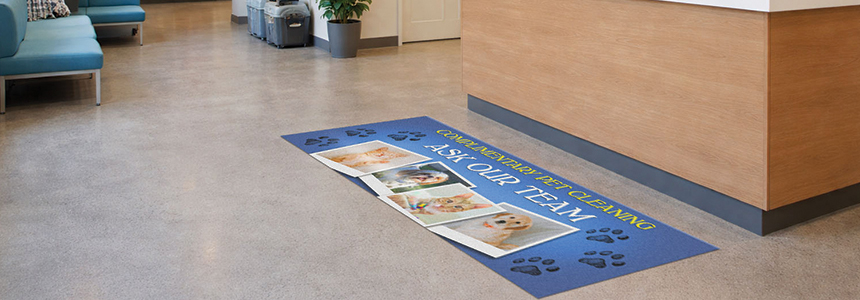
Above: Better Life Technology’s G-Floor Graphic is available in a range of thicknesses and textures, which allows print providers to select the right product based on traffic level, duration, and environment, while maintaining consistent print quality across applications.
Look at the Positives
There are advantages to materials designed to work well on multiple surfaces, specifically in terms of floor graphics. These include cost savings, minimizing physical inventory space, and increased printer/ink compatibility.
According to Karen Peppel, product marketing manager, GBC & SEAL, “wide format media engineered for multiple applications—especially those that can serve as floor graphics, wall decals, window signage, and even short‑term outdoor pieces—gives a print shop a surprising amount of leverage. When a shop doesn’t want to maintain a huge inventory, these multifaceted materials become a strategic advantage rather than a compromise.”
Choosing wide format media that can cover different surfaces minimizes the number of substrates needed in inventory. “This not only saves physical space, but also reduces the risk of scrap since the same material can be used across many surfaces and projects,” suggests Seth Bullock, product manager, branding, Avery Dennison Graphics Solutions.
“When you reduce the number of stocked SKUs, savings occur in other areas like lower overhead, labor, and media profiling. In addition, there’s the potential to gain efficiencies in purchasing via volume discounts,” adds Laura Antenucci, marketing director, Continental Grafix USA.
The operational benefits extend well beyond inventory, states Mike Richardson, business development manager, Jessup Manufacturing Co. “When one material is compatible with a shop’s primary ink platforms and established color profiles, operators spend less time swapping rolls, recalibrating output, or troubleshooting unfamiliar constructions. Jobs can move seamlessly from wall murals to floor graphics to event signage with fewer changeovers and more consistent results.”
PSPs strive for minimal management of their printers and inks. “When more jobs can be printed on the same media/ink combination, profiling, color management, and testing are simplified, which lowers setup time, reduces misprints, and supports consistent floor graphic performance,” explains Michelle Oczkowski, product manager, Brand Management Group.
“Multifaceted materials are typically engineered to print reliably across a range of wide format machines. This reduces the need for press-specific materials and allows shops to standardize workflows, profiles, and finishing processes; save time; and reduce errors,” shares Slovensky.
Kristin Swartz, national account manager, Better Life Technology – G-Floor Graphic, believes that “one of the biggest advantages of working with multifaceted wide format media is flexibility without sacrificing performance. Instead of stocking multiple specialty products, print providers can rely on a single material that performs across different surfaces and use cases.”
Antenucci points out that the choice between one- or two-step floor solutions enhances that media’s level of flexibility even further. One-step medias are ideal for use as not only floor decals but also wall murals. Two-step systems—which include a base material and overlaminate—means that the base material might be appropriate for other surface applications like walls or windows.
“There’s no arguing there are advantages to limiting the number of materials a shop keeps on the floor for organization purposes, however, substituting materials for technical applications is less than ideal. Floor graphics will see more physical abuse than most flat graphics. Having a material that could lift prematurely, damage the surface, or that requires heavy equipment to remove can be avoided by choosing the right material for the application,” cautions Jay Kroll, director of product education, General Formulations.
Floor Work
Certain floor graphic applications may benefit more from a multipurpose media versus a floor graphic-specific product. The environment, foot traffic, and surface play a role in deciding which solution to use.
“When you look at real world floor graphic work, there’s a clear divide between the jobs where a versatile, multi‑application media shines and the ones where you truly need a purpose‑built floor graphic product. The distinction usually comes down to surface type, expected durability, safety requirements, and environmental conditions,” lists Peppel.
Kroll provides a great example. “We regularly see semi-rigid 6-mil materials with a low-tack removable adhesive used for temporary, large, custom printed dance floor graphics on hardwood and smooth floors. For short-term decorative applications, these films are easy to apply and are easily removed a few hours later. Those materials were designed for window and smooth surface graphics and do not include any non-slip warranty, but their thickness, removability, and ease of handling make them ideal for dance floor applications.”
Conversely, that same semi-rigid 6-mil material with a low-tack removable adhesive would not be advised for use on a concrete floor outside. “Understanding the surface type, duration of install, and characteristics of the media can help determine when it’s okay to use a multifaceted product for an atypical application,” explains Kroll.
Retail promotions, pop-up events, seasonal campaigns, and trade show environments where the same message appears on both floors and counters is where multifaceted media excels, “short-term promotions, dual-surface campaigns, or temporary installations where consistency across multiple touch points is important,” lists Swartz.
“Museums, stadiums, and corporate campuses often require graphics that flow from floors to walls to wayfinding elements. Using one material simplifies quoting and scheduling while ensuring consistency in color, finish, and overall appearance,” says Richardson.
“A convenience store running a promotional campaign could use the same material for a floor graphic in front of a refrigerated case and a cut-to-size counter mat at checkout. The material is strong enough to withstand foot traffic, yet flexible enough for countertop use,” suggests Swartz.
Longer term or higher impact applications benefit from a purpose-built floor graphic product. “In environments with extreme foot traffic or long-term use, such as airports, stadiums, or industrial spaces, a dedicated product is the safest and most durable option,” advises Audrianna Manee, marketing manager, Ultraflex Systems, Inc.
“Floor graphic performance is heavily contingent on foot traffic,” seconds Antenucci, citing the need for a floor graphic-specific product in certain scenarios.
Thicker options designed to handle sustained heavy foot traffic provide extended durability and performance over time, notes Swartz.
“Some dedicated floor products remain essential when the job involves long-term, high-traffic areas; exposure to moisture or harsh cleaning; demanding surfaces; or when safety/compliance risks are high and must be clearly documented,” explains Oczkowski.
Industrial settings with heavy mechanical wear or environments with aggressive chemical exposure may require specialized constructions or multi-layer, purpose-built floor graphic systems. “Facility standards or regulatory requirements may exceed what a single, all-in-one product is designed to address,” says Richardson.
Updates Made Possible
There were once disadvantages to using multipurpose products, but this is not a concern today thanks to improvements in adhesives, material composition, and surface textures and topcoats.
“Earlier generations of ‘all-in-one’ films often required compromise. A material might adhere well to one surface but lift at the edges on another, or provide adequate traction on floors while proving difficult to remove from painted walls,” notes Richardson.
The shift didn’t happen overnight, claims Peppel, “one material for many applications” is now a reality thanks to better adhesives, smarter engineering, and more reliable surface performance testing.
“Advancements in vinyl formulation, material thickness options, and surface textures expanded how media can be used across different applications. Improvements in dimensional stability, print adhesion, and durability now allow a single product to perform reliably on both horizontal surfaces and high-traffic floors,” adds Swartz.
Combined, these improvements enable materials to perform reliably on walls and floors, says Manee. “These balance strong wall adhesion with the durability and slip-resistant finishing needed for pedestrian traffic.”
New adhesive technology presents features that were previously not possible. “Earlier adhesives lifted at the edges or failed under repeated traffic; newer materials and adhesives are now engineered to stay in place over a longer period. Older adhesives worked on a narrower range of surfaces, left residue, and had poor repositionability,” shares Oczkowski.
Another advancement pointed out by Slovensky is the range of available finishes and patterns. “Print media manufacturers offer a wider variety of finishes, including canvas, sand, and linen, allowing print providers to balance aesthetic preferences and functionality.”
Richardson discusses face stocks and topcoats. “Modern, fabric-reinforced face stocks offer improved dimensional stability, resisting stretch and shrinkage while still conforming to light textures such as stair risers or interior walls. Slip-resistant, cleanable topcoats are designed to withstand real-world maintenance routines using everyday cleaners and disinfectants.”
Flexibility and Efficiency
Multifaceted media that works well on floors for shorter term installations is an option for PSPs looking to minimize product inventory but take advantage of lower overhead and less scrap. While it is not well suited for all floor graphic applications—long-term, heavy foot traffic—it does check the boxes for a majority of the work being performed by PSPs today.
Apr2026, Digital Output