By Cassandra Balentine
Finishing is an essential step in producing display and point of purchase (POP) signage. Certain tasks are necessary for this type of work, while others offer added value. Versatility is a top consideration when investing in finishing.
Display producers are under more pressure than ever and digital technologies support them to meet their customers’ needs efficiently and profitably. “However, more than that, customers are shifting toward closer collaborations with their cutting and finishing suppliers to help them navigate new materials. It is this combination of technology and support that enables producers to deliver faster work with a broader range of materials and formats, meet expectations for quality without increasing costs, and expand capabilities. The same provider can diversify to deliver short-term corrugated displays, temporary paperboard signage, structures and displays, textile signage, and wayfinding with braille—all with the same equipment,” attests Dimitri van Gaever, marketing director, Kongsberg Precision Cutting Systems.
“Having the right machine and software that allow for easy completion of repeated and special request jobs is crucial in order to compete within the industry,” agrees Maureen Damato, senior director of channel sales, Colex Finishing Solutions.
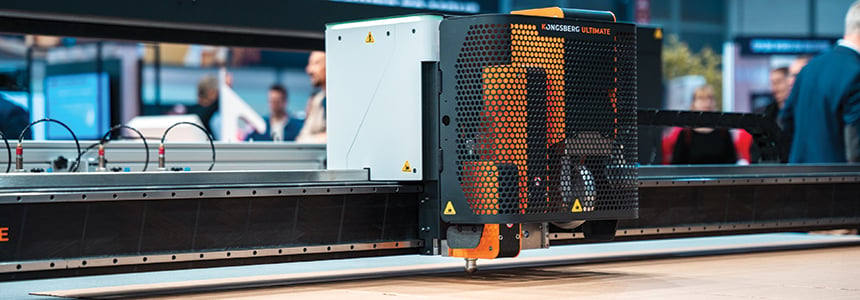
Above: The Kongsberg Ultimate is built to meet the high-speed demands of modern display production.
Popular Applications
A variety of POP/point of sale (POS) applications are trending.
Corrugated displays, standees, contour cut signage, promotional packaging, and short-run retail or event graphics remain among the most produced POP, admits Beatrice Drury, communications manager, Zund America, Inc.
“There is an increase in digitally printed, short-term corrugated freestanding and countertop displays, as well as indoor signage made from white-faced corrugated, solid paperboard, or corrugated display board. For longer term displays, paper core board materials—such as re-board or honeycomb board—are gaining traction, replacing signage, which was traditionally made from PVC or styrene,” according to van Gaever.
POP applications that include floor displays are popular. “They are often made of cardboard or corrugated material. Small signs on shelves highlighting special promotions, new products, or benefits is one example. Cardboard dump bin boxes, which allow customers to grab products easily for high-volume item sales is another,” shares Mark de Guzman, marketing manager, Vision Engravers.
Angela Harrison, direct sales account manager, X-Edge Tools, sees POP floor graphics, shelf talkers and shelf strips, end cap signage, and die-cut standees as production trends. “Hanging signs, window graphics, and backlit displays are also common, especially for seasonal and promotional campaigns.”
Flexibility is important in retail environments. “Display and POP applications often require complex shapes, fast turnaround, and frequent design changes. Digital die cutters allow operators to move quickly from file to finished piece, making it easy to handle variable designs, rapid revisions, and one-off jobs,” shares Drew DiPirro, sales and marketing support, Graphic Whizard Inc.
Corey Kelly, marketing manager, Trotec Laser, highlights the popularity of backlit elements and layered, dimensional signage. “Print-and-cut applications play a major role in this market. Having precise registration for accurate print-to-cut alignment can make a difference in the quality and consistency of your displays.”
Textile-based displays and soft signage continue to grow, says Drury, thanks to their lightweight, portable nature and the need for fast, easy setup.
Drury also notes strong momentum behind eco-friendly display materials—including recyclable boards, PVC-free substrates, and, increasingly, acoustic felt—as brands seek more sustainable and multifunctional solutions for retail and interior environments.
Solutions for a Material Mix
In almost all scenarios, a cutter is necessary. Straight cutters, digital flatbed cutters, CNC routers, laser cutters—options abound. Common tools for cutting include drag knife, tangential tool, single- and double-edge tools, creasing and scoring wheels, kiss-cut tool, pen tool, V-cut tool, and routers.
“For display and POP producers, a versatile, multifunctional digital cutting system is essential—one that can handle both rigid and flexible materials with reliable precision, speed, and repeatability,” shares Drury.
Large format flatbed cutters that handle both rigid and flexible media are versatile finishing solutions for POS work. “These cutters handle foamboard, corrugated plastic, Gatorfoam, acrylic, vinyl, and magnetic sheets with high accuracy. They enable complex shapes, kiss cutting, perforations, and routing—while increasing throughput and safety compared to manual cutting. Tight integration with UV flatbed printers makes them critical for retail display production,” explains Matteo Muto, product manager, Summa.
Harrison adds that one of the most important finishing investments is a hybrid system that combines knife cutting and routing, whether that’s a router with a knife cutter or a digital cutter with routing capabilities. “POP jobs often mix rigid materials like PVC, ACM, acrylic, and wood with corrugated, foamboard, and flexible media, and a hybrid system allows all of it to be cut, routed, or creased on one table without moving between machines.”
Flatbed cutters with roll-to-roll capability are essential for shops producing rigid displays and flexible graphics. “Roll-to-roll support keeps large graphics straight and wrinkle free during finishing and accommodates heavy rolls and oversized sheets. This is ideal for banners, wall graphics, wraps, and sign faces often paired with POS campaigns,” says Muto.
Flatbed cutters for packaging and fulfillment that are suited for POS displays often require custom packaging for safe transport. Cutters configured for packaging tasks—boxing, inserts, labels—speed fulfillment, reduce damage, and protect margins. Offering display production plus packaging as a turnkey service adds value for retail clients, suggests Muto.
Similar to a flatbed cutter, a CNC router is ideal for print providers regularly producing display and POP applications. “A CNC router can repeatedly do quick and accurate work. Expediting production time and enhancing the caliber of the finished product,” advises de Guzman.
For CNC router finishing versatility, essential bits include 0.25- and 0.5-inch downcut spiral bits, for a clean top surface 60 or 90 degree V-bits are used, and for detailing/engraving and for clean cuts on both sides of laminated materials compression bits are preferred.
Vendors like X-Edge Tools as well as Flatbed Tools are well-known bit suppliers.
Kelly feels that laser systems are necessary when intricate cuts, fine details, and premium finishing is desired. “A laser system offers the ability for intricate details as well as crystal clear, flame polished edges without the need for post processing.”
Automation is increasingly important. As digital printing speeds increase, automation in the cutting process is imperative for facilitating longer run digital production, reducing errors, boosting productivity, and extending production capacity, shares van Gaever.
Finishing systems are designed to manage high mix, quick turnaround POP production with minimal setup time. “Automated registration, precise cutting and routing, and reliable material hold down help maintain accuracy. Workflow automation streamlines job preparation, tool selection, and parameter settings, reducing the need for human intervention and, when paired with automatic or robotic material handling systems, enabling autonomous, lights out operation,” states Drury.
Multifunction, Multipurpose
Multifunction devices, like routers with interchangeable tool heads, benefit those producing POP/POS work.
“Having an interchangeable tool head is integral when working on complex projects. Sometimes we see companies having to work with various materials within the same job. Removing the time it takes for a machine operator to change bits, lessening the need to move materials on and off the machine, and mitigating the time spent making changes in the software are all game changers,” says Damato.
Multifunction devices—especially routers and digital cutting tables with interchangeable tool heads—are ideal for display and POP production, “because this work demands variety, speed, precision, and flexibility. Instead of dedicating separate machines to each task, one platform can handle many operations end to end,” explains Muto.
A multifunctional cutting machine can switch between routing for acrylic, PVC, ACM, and wood-based media; drag or tangential cutting for foamboard, corrugated, paper, and folding cartons; kiss cutting for decals and labels; creasing and scoring for POP structures; perforating for tear-away elements; and V-cutting for folded box displays.
POP displays are made with various materials that require specific tooling. “A router head for example can be used with rigid materials such as PVC, acrylic, and Dibond. An oscillating knife can cut foamcore, cardboard, and other soft to semi-rigid materials,” explains de Guzman.
The fast-paced, temporary nature of display and POP applications mean that applications produced on recycled, paper-based materials are not easy to finish. “The ability to achieve high-quality, high-speed cutting on these materials requires specialist tooling and dedicated features, which are not commonly available on all finishing solutions,” offers van Gaever.
On systems with an automatic tool changer (ATC), workflow becomes even smoother because the machine can automatically switch between the routing tools commonly used in POP and display work, like moving from a cut-out bit to an engraving or V-groove bit, says Harrison.
Knife cutting is handled by a separate knife tool, while the ATC takes care of the routing side without stopping the job or requiring manual changes. “This makes it easy to profile, engrave, and add detail in a single setup, saving time and keeping results consistent. Paired with knife cutting on the same table, ATC-equipped systems help keep POP production moving quickly and efficiently,” adds Harrison.
“Multifunctional cutting tables enhance creative opportunities for graphic designers and operators, enabling display producers to expand their capabilities and take on a broader range of jobs. Adding interchangeable tools can also open up new application opportunities without the need for investment in a new piece of equipment,” notes van Gaever.
Modular solutions allow print providers to tailor their tool sets to their specific needs. “That same modularity also enables providers to easily add tooling later on as needed,” shares Drury.
Versatility for POP
When it comes to finishing for POP/POS, versatility wins. Systems that cut rigid and flexible substrates while easily handling custom shapes, short runs, and rapid prototyping are ideal.
Apr2026, Digital Output