By Melissa Donovan
Print service providers (PSPs) like choice—printing on materials they pick and with their preferred ink type. Luckily, a number of ink sets are available in the digital space. Digital Output divides the digital ink segment into the following categories—aqueous, with latex/resin included; bio; eco-solvent/solvent; textile, which includes acid, disperse, reactive, pigment, and sublimation; and UV.
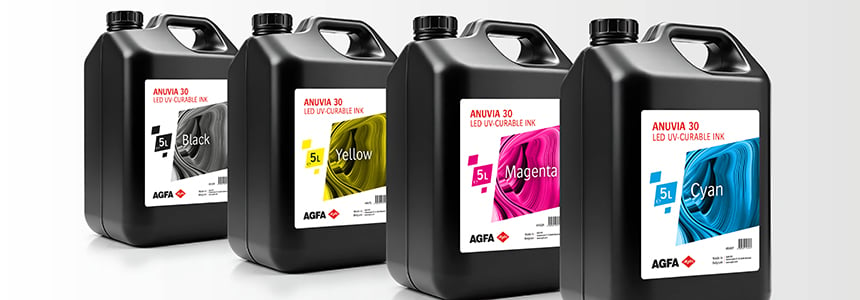
Above: Agfa offers LED UV-curable ink for wide format printing.
Maturing and Waning
The major categories of ink—UV, aqueous, bio, and textile—all experienced upheaval over the last 12 months. There is demand for certain types of ink over others as compositions mature and box out legacy configurations.
According to industry data supplied by Fluid Color, the global UV-curable ink market exceeded 2.2 billion dollars in 2024 and is projected to grow at approximately five to six percent annually through the mid-2030s.
“Over the last 12 months, UV-curable inks, specifically LED curable UV, have seen the strongest growth and adoption across wide format and industrial digital printing. This growth is driven by production efficiency, instant cure, and lower energy consumption. These capabilities align directly with current demand in signage, packaging, décor, and industrial applications,” admits Adam Tourville, channel manager, Fluid Color.
It comes as no surprise that iterations of UV ink are continually in demand. In sign and display, Marie Lehéricey, inkjet application manager inks, Agfa, believes UV remains a dominant ink technology due to versatility and performance. “These inks enable printing on virtually any substrate, from flexible materials to rigid boards, supporting the diverse application range demanded by PSPs.”
Water-based ink, Digital Output includes latex/resin in this category, is an interesting segment to watch as it matures.
Pedro J. Martínez, CEO, AFFORD INKS, believes aqueous inks continue to grow in popularity. Mainly because resin and dispersion technologies continue to improve, which make them suitable for printing onto certain non-porous materials.
“There has been some growth in the proportion of latex inks in this application area, yet not as rapid as expected. Although water-based inks are regarded as ‘green’ and sustainable due to having water present, we are not seeing as many new printers entering the display graphics market,” admits Paul Edwards, VP of the digital division, INX International Ink Co.
Bio-based inks are relevant, mainly for their sustainability benefits. “However, their market share remains small and bio-based ink applications are currently somewhat limited. There is no doubt that interest in aqueous and bio-based inks will grow as feasibility for applications now employing eco-solvent or UV inks is demonstrated,” suggests Martínez.
In the textile ink space, Alfredo Cruzat, ink business manager, Mimaki USA, Inc., says that acid and reactive are two technologies in the end stages of use.
“In the U.S., there is no significant use of acid, reactive, or disperse dye-based inks, although there has been continued growth in Asia and lower cost manufacturing regions in relation to the amount of digital production,” states Edwards.
Usage of sublimation inks, on the other hand, have remained steady over the last 12 months, observes David McLean, president, Conde Systems.
Edwards agrees that the sublimation market in the U.S. is relatively stable; it’s not growing or rapidly declining. Thanks to direct to garment (DTG) and direct to film (DTF) technologies, pigment-based ink is seeing growth. “It is mostly due to the sustainable aspect of the product compared to dye-based inks. DTG growth continues, although some of that market at the low end is being replaced by DTF. DTF continues to develop rapidly as a technology.”
Scott Donovan, North American commercial leader, Dupont Artistri Digital Printing Solutions, admits that the continued demand for customization, on demand production, and short-run manufacturing favors pigment inks due to their versatility, simplified workflows, and compatibility across a range of fabrics.
“With the advent of DTF, DTG and dye-sublimation inks have seen a decline, with DTG being all but a relic of the past. DTF simply performs better in many aspects like machine maintenance costs, piecework margins, startup investment, and final output quality,” attest Emilio Rangel, product manager, and Tony Simmering, product manager, Mutoh America, Inc.
Part of the reason certain inks are in more demand than others, according to Lehéricey, is customer requirements for sustainability and regulation. “With tightening legislation, expanding Corporate Sustainability Reporting Directive (CSRD) obligations, and brand owners demanding transparency and responsible sourcing, the move toward certified sustainable inks is accelerating.”
“Demand for full solvent inks continues to decline in favor of more user- and environmentally-friendly options. Demand will continue until solvent-based printers are retired and print users convert to other options like UV for non-porous substrates,” adds Martínez.
Cost Rises for All
Cost is subjective. Despite ink type, factors like tariffs and raw material shortages play into higher costs for all.
As a whole, Martínez says that ink pricing per liter has increased due to higher prices for petroleum, which impacts supply chains. For example, “certain new UV ink ingredients designed to comply with evolving regulatory changes such as the removal of TPO—a specific type of photointiator—from UV ink formulas are more expensive.”
According to Simon Daplyn, product and marketing manager, Sun Chemical, advanced UV and aqueous solutions can demand a premium price due to the value added by regulatory compliance, color gamut potential, and reliability. “It is important to ensure chemical compliance, country registration, and maintenance costs within the purchasing decision.”
2025 presented unusual circumstances in terms of pricing. Edwards cites the impact of tariffs. “The industry generally has attempted to pass on the tariffs to the customers, although not all customers accepted the full tariff impact hikes. Therefore, there was a general increase in ink prices due to this significant impact of raw material costs.”
Lehéricey says pricing is dependent on two factors—raw material dynamics and increasing regulatory demands. “Stricter chemical safety regulations, CSRD reporting expectations, and requirements for traceable, compliant ingredients influence formulation costs across both UV- and water‑based technologies. At the same time, fluctuations in pigment, monomer, dispersant, and resin availability can drive cost variability.”
Another point to consider, packaging. “Some solutions only had 220 or 440 milliliter options, with modern systems allowing for one or 2.2 liter capability. The ability to manufacture in bulk brings the cost down,” note Rangel and Simmering.
It is important to remember that cost is not just the measure of the ink itself. “It is a mix of what the market needs, the cost to print for an end user, the cost of the raw materials, as well as the cost to import and distribute. In addition, newer printhead technologies are able to push less ink to do the same image than before so the end user benefits by just adjusting to newer presses,” admits Cruzat.
Ink of the Future
The digital ink market continues to grow and develop. It’s no surprise that UV ink and other water-based technologies lead the charge due to their more environmentally friendly nature.
Apr2026, Digital Output