By Digital Output Staff
Eco-friendly rigid media is a popular choice for sign applications where environmental initiatives are a focus, but they are also gaining traction as a viable option due to their appearance, durability, and print quality. Demand has evolved considerably over the years as hardware manufacturers adapt their devices to work with nuances like warping, bowing, and curling; lower surface energy levels; and thicker materials. Print service providers (PSPs) are far more aware of what to expect when it comes to printing to eco-friendly rigid materials, whether they be recyclable, compostable/biodegradable, or made from recycled content.
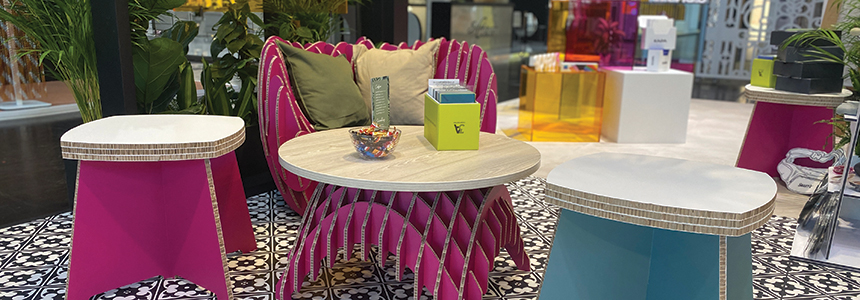
Above: 3A Composites’ SWEDBOARD FIBRE utilized for unique furniture displays in a trade show booth.
Defining It
The term eco-friendly rigid media is broad. Depending on the vendor the definition varies. Most include recyclability, whether the material is made from recycled product or can be recycled after use.
“Eco-friendly rigid media refers to solid, printable substrates made from renewable, recyclable, or repulpable materials, designed to minimize environmental impact across their lifecycle. These materials are often used in place of traditional rigid substrates like PVC, MDF, or foam board,” explains Rowan Maher, CMO, Xanita.
We should look at the term eco-friendly media holistically, says Chuck Kunze, director product management and marketing, 3A Composites USA. This means “considering not only the lifecycle of the finished product, but the materials and processes used during the manufacturing of the product.”
Similarly, Fluid Color defines eco-friendly media as any rigid substrate that reduces environmental impact throughout its lifecycle, from raw material extraction to post-use disposal. “These materials are engineered to meet both print performance and environmental compliance standards,” notes Adam Tourville, channel manager, Fluid Color.
Xanita classifies eco-friendly rigid media as sustainable, fiber-based boards or engineered paper boards—depending on the structure and composition. This includes “low environmental footprint, often made from post-consumer recycled content and/or responsibly sourced virgin fibers. No harmful additives, such as volatile organic compounds (VOCs), formaldehyde, or synthetic plastics are involved,” adds Maher.
“Eco-friendly rigid media is any rigid substrate made from natural fibers and designed with environmental responsibility in mind. This includes rigid substrates made from materials that are natural, recycled, and recyclable, such as paper, cardboard, bamboo, and wood,” shares David Bistrovic, product manager, Professional Imaging, Epson America, Inc.
Recyclability is a primary consideration when discussing eco-friendly rigid media. “A key characteristic of eco-friendly rigid media is recyclability or repulpability, allowing the material to re-enter the paper or fiber recovery stream after use,” asserts Maher.
Supplier sourcing is also part of the “green” equation. For example, 3A Composites prioritizes sourcing from suppliers with a Forest Management Certification as well as those that participate in sustainable forestry practices.
Printing to Rigid Media
Depending on the type of material there are considerations to take into account during the printing process.
“Each substrate has its own surface energy, porosity, and structural integrity, which directly impacts how ink behaves during application and curing. At Fluid Color, we emphasize the importance of understanding the nature of the media before running a job,” asserts Tourville.
Paper-board based rigid media is sensitive to temperature fluctuations. “We recommend letting the panels acclimate prior to printing for at least 24 hours, which should be done in the same room conditions as where the printing takes place,” recommends Kunze.
Another way to anticipate change in paper board is to store it in a flat, dry, indoor area with regulated temperature and humidity. “This ensures that the boards are as flat and stable as possible during the printing process to avoid costly printhead strikes or ink misplacement, achieving the clearest, most vibrant print possible,” suggests Kunze.
“If any bowing occurs, flatten them before printing. An uneven surface can lead to ink misting, blurred lines, or even nozzle damage,” adds Maher.
Compared to paper boards, recyclable foam board materials are less sensitive to changes in temperature, notes Kunze, which leads to minimal acclimatization prior to printing.
Due to the nature of fiber-based media, Tourville notes it can shed particulate matter during handling and printing. This means that a printer’s vacuum table and print carriage be meticulously cleaned.
Static can be an issue in regards to recycled plastics. “Static control can greatly affect the quality of the print. Using an ionization control system helps to mitigate static thus giving a higher quality,” recommends Mark Crawford, product and business development manager, Vanguard Digital Printing Systems, a Durst Group company.
Bioplastics derived from renewable resources present surface energy challenges. Tourville says a dyne pen is helpful to determine the surface energy. “If the surface energy is under 40 dynes the substrate will have poor adhesion. An adhesion promotor or flame treatment helps increase the surface energy and provide better adhesion. In my experience, some bioplastics also have a film on them that do not allow the ink to adhere properly. Cleaning with an IPA is very important,” suggests Tourville.
“Eco-friendly materials like corrugated board, fiberboard, or recycled plastics can often have differing dyne levels. This can lead to issues like chipping, poor color, or reduced durability unless primers or adhesion promoters are used,” adds Crawford.
Another caveat to be aware of is the porous nature of certain eco-friendly rigid board. “I recommend always testing the media prior to printing the job to ensure proper ink adhesion. Some eco-friendly materials, such as cardboards, are more porous, requiring adjustments to the ink lay down or curing settings to achieve the best results,” advises Bistrovic.
Ink Sets
Common ink sets used in rigid board printing include UV and latex. When it comes to eco-friendly rigid boards, there are pros and cons to working with each.
UV inks offer several advantages. “Excellent adhesion to uncoated liners, fast curing, and vibrant color reproduction, making them suitable for structural or decorative applications,” lists Maher.
Tourville says “one primary advantage of UV LED inks is their ability to cure instantly at low temperatures, making them safe for use on substrates that might otherwise deform or discolor under traditional curing systems. Another critical benefit is the absence of VOCs, which support environmentally responsible printing practices.”
Disadvantages of using UV ink vary by ink set and how they behave on each eco-friendly rigid material. “For example, porous media may require adjustments in ink density and curing parameters to achieve optimal color fidelity and durability. Additionally, gloss levels may appear more subdued compared to high-density PVC substrates, and the color vibrancy may need fine tuning,” warns Tourville.
And remember adhesion. “Adhesion can sometimes be a challenge on low surface energy materials like recycled polypropylene unless primers or surface treatments are used,” notes Crawford.
Maher says some UV ink sets can become brittle when bent, so a flexible option is recommended for foldable or structural pieces.
“A semi-flexible ink set that is designed to adhere to both rigid and flexible materials can withstand slight bending or handling without cracking or flaking, increasing media and substrate versatility for print shops,” recommends Bistrovic.
Water-based latex inks feature low VOCs, which make for an excellent pairing with already green material. “They also offer flexibility, strong color output, and minimal odor,” states Maher.
There are limitations when working with latex ink, however, with drying being the biggest issue. “Latex printers typically use heat-assisted drying, so care must be taken not to overheat or warp lightweight boards. Boards should be flat, and drying temperatures may need adjustment depending on thickness,” advises Maher.
Run Smooth
Flatbed printers need to take a few things into account when printing to eco-friendly counterparts. Maximum print height and vacuum system hold down are two important considerations.
Many of these boards are lighter in weight, this requires a vacuum hold down across the bed that is strong to keep the board flat. “Many sustainable boards—such as corrugated, fiber based, or wood composite panels—are more prone to warping or bowing. This makes a strong, responsive vacuum hold down system critical,” notes Crawford.
In this instance, it is ideal that the flatbed printer features zoned vacuum control, “allowing the print provider to activate specific quadrants to match the media size and thickness. This ensures proper media loading and prevents printhead strikes, improving overall image quality,” states Bistrovic.
Maher suggests “adjusting vacuum zones to match the sheet size and position, and making sure the vacuum strength is high enough to pull the board flush to the print bed for optimal print quality and printhead clearance.”
Printhead height is another concern. “Eco-friendly boards can vary in thickness—often six to 16 millimeters, so the printhead carriage must be adjusted accordingly. Setting the correct gap between the printhead and media helps maintain print quality while preventing printhead strikes—especially if the board has slight bowing,” recommends Maher.
“Having a UV flatbed printer with an adjustable print height is critical to achieving a high-quality print. Eco-friendly rigid substrates vary in thickness, so the printer must be able to accommodate these differences with precise height adjustments,” seconds Bistrovic.
The carriage mechanism is also a consideration. It must be able to traverse the media smoothly and accurately, explains Tourville. Servo-driven systems help ensure dot placement, even when boards are perfectly flat.
A flatbed printer that features white ink is important. “White ink creates vibrant prints on non-white rigid substrates, such as wood. For any colored or natural toned eco-friendly rigid substrates, printing a solid white base layer first then layering the colored image on top is best, to ensure the print is vibrant and eye catching,” recommends Bistrovic.
Taking Advantage
Today’s flatbed printers are equipped with tools that yield a successful print to eco-friendly rigid board. While these materials offer challenges like warping or curling and low surface energy, features like zoned vacuum systems and printhead height detection combat—if not eliminate—them from occurring.
“Advances in printhead technology and substrate mapping have made it possible to achieve outstanding print quality on these alternative materials,” explains Tourville.
In this way, PSPs regard eco-friendly rigid board in a positive light, and enjoy not only the sustainability benefits but also leverage the natural, smooth appearance to portray a high-end aesthetic.
Oct2025, Digital Output