By Melissa Donovan
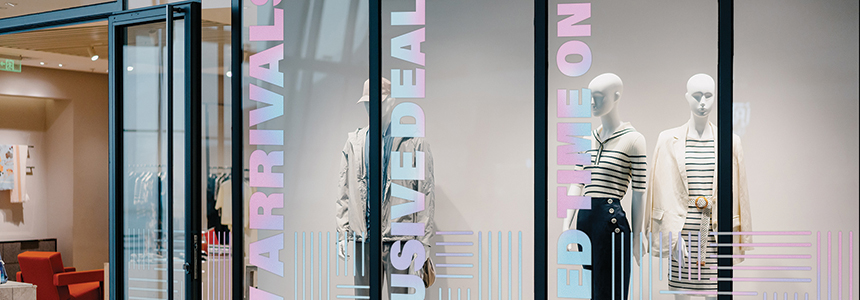
Glass decoration for display and point of purchase (POP) is one of the first things a consumer sees, whether outside of a shopping mall or directly on the windows of a retail store, restaurant, or commercial building. There are a number of media solutions for print service providers (PSPs) with customers requesting POP displays that catch passerby’s eyes.
One option is printable dichroic film, which changes light and creates an eye-catching effect. This particularly stand-out material is ideal for display and POP for a number of reasons. “In a visually crowded world, eye-catching films—like dichroic etched glass effect materials—create instant intrigue through light, color, and reflection,” explains René Bourgeois, VP Sales North America – ASLAN brand, ASLAN Selbstklebefolien GmbH.
Other media substrates are trending when it comes to display and POP in windows. “Every storefront window offers the opportunity to communicate a message, brand, or call to action to passersby and there is a myriad of solutions that achieve those goals,” shares Michelle Kempf, VP, sales and marketing, Continental Grafix USA, Inc.
Clear and frosted printable films, dry apply materials, perforated one-way vision, and optically clear products are also used.
Above: ColourShift Etched ASLAN SE 77 is a 120 µm PET/PVC film with a solvent-free, semi-permanent adhesive that creates instant intrigue.
Catching Passerby
Retail, restaurant, and commercial spaces turn to glass structures to promote sales, advertise services, and much more. Windows are prime real estate and provide endless opportunity.
“Window media feels as timeless as a swinging sign on the general store porch or hand painted lettering across the glass of a local bakery or hardware store,” states Jay Kroll, director of product education, General Formulations.
The difference is, while window graphics still take advantage of the prime real estate and timeless branding space, window media is advanced—with more sophistication than just a paint and brush, continues Kroll. “Window media has advanced to printable films with adhesive technology and decorative finishes to offer a versatile range of options for PSPs.”
“Trends like experience-driven retail and fast-changing campaigns demand flexible, high-impact solutions. Window films allow quick updates without major renovations and help brands stay visually relevant. Storefronts are a brand’s first impression. Using them creatively is essential—not optional,” says Bourgeois.
Windows are a great way to capitalize on some of the trends seen in pop-up shops and even pop-up restaurants. “If you look at how the industry has evolved, windows have become one of the fastest, most effective ways to broadcast a new promotion, seasonal change, or brand message. The push for retail pop-up shops and restaurants has further pushed windows as premier marketing spaces. These are shops and cafés that take advantage of short-term existence then move out. You might call it ‘experience-first’ retail, but at the end of the day, if you aren’t using your window to tell your story, you’re missing out on one of the simplest, most direct ways to connect with your audience,” advises Dan Lawellin, business development manager – global, Kernow North America Inc.
Printable Dichroic Film
A number of materials are used to decorate glass. As previously mentioned, one option is printable dichroic film, which comes in finishes like etched, frosted, and translucent variations.
“Printable dichroic films are eye catching and especially effective in high-contrast spaces like glass doors, entryways, and product displays,” says Kroll.
Etched versions, according to Bourgeois, instantly grab passerbys’ attention with “shifting colors and an etched glass look. It adds depth and movement to glass surfaces, creating a premium, modern feel.”
Clear options of dichroic films are also possible, which Bourgeois says still “deliver striking dichroic effects without an etched finish, offering even more creative flexibility for designers.”
In recent years printable dichroic film has evolved, with media advancements making it more user friendly to print to and install.
“Recent advancements offer more stable base films and print-friendly coatings, allowing compatibility with latex, UV, and eco-solvent systems. Enhanced liner and adhesive systems also reduce static, improve handling, and make alignment on glass surfaces much easier,” shares Kroll.
Other Trending Materials
Other media options for windows include clear and frosted printable window films, dry apply materials, perforated one-way vision, and optically clear products.
“The range of options continues to grow—clear, dusted, frosted. All less expensive options for the print-for-pay providers and the end client,” says Angel Georgiou, product marketing specialist, senior, Canon U.S.A., Inc.
According to Kroll, “each offers a unique combination of privacy, vibrancy, and light control, depending on the application.” In many of these options, Kroll notes advancements in ink adhesion, improvements in lay flat liners, and refinements of the adhesive systems, which allow for ease of repositioning in install without sacrificing clarity to edge stability.
“Printable films have come a long way from static cling and adhesive-based solutions that many people think of. The newest innovations allow for fast and easy installation by both professionals and DIYers alike. In other words, the headache factor has been dramatically reduced. Whether you’re installing a huge graphic for a chain retailer or a single decal for a small café, modern films are built for quick turns and everyday use,” adds Lawellin.
Amanda Smith, marketing communications manager, graphic and signage solutions, Mactac, says overall user friendliness has significantly been enhanced, providing improved outcomes in both printing and installation.
Clear and Frosted
Clear printable window films now offer more in terms of design with the advanced capabilities of white ink.
“Printers with white ink now have the option to print on clear media, replicating these looks for another customization option,” shares John Coyne, sales manager, Lintec of America, Inc.
Frosted printable window films serve a dual purpose—decoration and privacy. Coyne notes that these are available as either cast vinyl or polyester films and mimic etched or sandblasted glass.
Dry Apply
Dry apply materials are favorable because the install process eliminates water. “No water, dry apply films offer removable and repositionable adhesives with micro-grooved/air egress releaser liners that evacuate air without fluid,” explains Coyne.
Without water, dry apply “reduces mess and speeds up the process without requiring changes over time,” adds Bourgeois.
“Air egress liner technology has evolved to make install easier because it gives a channel for air bubbles to escape and negates the need for a wet install, which is the traditional method for clear window films,” adds Kempf.
Focus on dry apply air egress systems is also a goal of Kernow’s. “Traditionally installs would need a wet application to get a truly bubble-free install. With our new air egress options, decorative films can go up and be smoothed out with the back of a hand, resulting in flawless results,” explains Lawellin.
Perforated
Perforated window film continues to be popular, “as it allows those inside a building to see out while people outside see a solid, vibrant graphic,” says Shaun Jaycox, product manager, Brand Management Group.
“Perforated window films allow for bold, full coverage graphics from the outside while maintaining a clear view line of site from inside,” notes Kempf.
Optically Clear
Optically clear printable film is a solid consideration, especially polyester-based options.
“Optically clear allows printed graphics to appear as if they are printed directly on the glass while maintaining full transparency on unprinted areas,” notes Jaycox.
When properly designed and installed, viewers can’t tell if the graphic is an original part of the glass or a separate material. “Logos, patterns, or graphics look like they’re floating with no visible film around them,” shares Lawellin.
PSPs ahead of the curve use optically clear media to replicate one-way vision film. “Printers reverse printing lines instead of perforations. This allows for complete customization of the outside print image and the see-through visibility range. The see-through visibility can be easily adjusted on the same optically clear media and even on the same image,” explains Coyne.
It’s also a good substitute for traditional cut vinyl. “Optically clear PET window film is a great replacement for more traditional cut vinyl that allows for intricate spot graphics with easy installation and removal,” suggests Kempf.
Even More
Another innovation is two-way vision film, available from Continental Grafix, which is preferred for day-to-night viewing. “Unlike optically clear options, panoRama TwoWay Vision prints like a standard front lit film and doesn’t require white ink so it integrates into the production process of almost any printer,” says Kempf.
PSPs look for a perfect balance of quality and cost effectiveness for many POP displays, notes Heather A. Strong, marketing communications manager, FDC Graphic Films, Inc. Lumina by FDC 7204 Print Media: Promotional is one such option. “Its glossy white finish is bright and visually appealing, while its clear, permanent acrylic adhesive makes graphics adhere well to the surface for a short-term promotional period,” notes Strong.
Holographic films are another alternative. ASLAN Holographic ASLAN SE 72 and HoloStripe ASLAN SE 74 bring vibrant, eye-catching effects to glass, which Bourgeois suggests as ideal for bold, modern brand expressions.
Environmental Focus
Print providers and their customers look to media vendors to address environmental claims. Using “green” materials can help in building processes, for example in achieving LEED credits. This is becoming more common.
“The wide format film market is shifting from PVC to recyclable PET, lower volatile organic compound adhesives, and sustainably sourced polymers tailored for greener POP and display graphics. This shift is expected to expand as environment factors become increasingly more important to suppliers, printers, and end users,” explains Coyne.
For example, polyester or PET film is replacing PVC due to better optical clarity, environment friendliness, and clean removability, suggests Coyne.
“More brands are asking for greener choices, and now there are polypropylene and polyester-based films that are both high performing and more eco-friendly,” agrees Lawellin.
Storytelling Surfaces
“Retailers and commercial spaces use window media more than ever because windows have become valuable storytelling surfaces,” admits Bourgeois.
In response, media manufacturers up the game in terms of options by offering printable dichroic, clear and frosted printable window films, dry apply materials, perforated one-way vision, optically clear products, and more.
Oct2025, Digital Output