
By Melissa Donovan
Protection is an important consideration when it comes to offering buyers a well designed, printed, and installed graphic—no matter the application. However, it’s safe to say that some applications are exposed to the elements a bit more than others.
“Vehicle graphics get to experience so much more of the world than a static yard sign or window decal. Their interaction with abrasive airborne particles blowing in the wind, the harmful effects of direct sunlight, washes with harsh cleaning chemicals, constant movement, and the stress of regular wear and tear, all end up requiring high-performance durable wrap films,” explains Jay Kroll, director of product education, General Formulations.
Today’s vehicle wrap media options—paint protection, color change, or printable films—are engineered to perform on a visual level while also protecting a vehicle’s factory paint. The material composition as well as adhesive technology are prominent factors when determining the specific substrate for the job at hand.
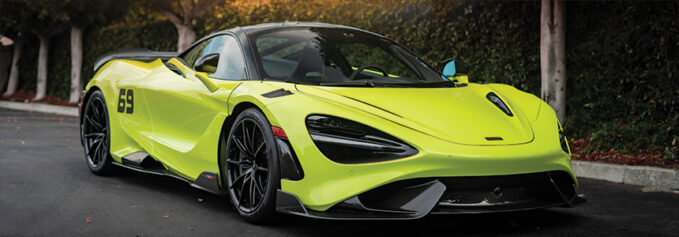
Above: Avery Dennison Supreme Defense Gloss PPF is a high-grade TPU film, engineered to conform beautifully around complex curves while providing a near invisible protection that enhances the OEM paint finish.
Environmental Factors
Many obstacles are thrown at a vehicle daily—from weather and sunlight to debris from the road.
Hitting some of the main points at a high level, Mattia Casarotto, area manager, EVOLV, says “a vehicle’s exterior is constantly exposed to UV radiation, road debris, chemicals, weather extremes, pollution, bird droppings, tree sap, and improper washing techniques. Over time, these factors cause paint fading, oxidation, etching, chips, and swirl marks, even on high-end factory finishes.”
“A vehicle’s factory paint is constantly under attack from a variety of environmental stressors, leading to dullness, fading, and damage,” confesses Brittany Folino, senior product manager, automotive, Avery Dennison Graphics Solutions.
The single largest factor is UV radiation or sunlight. “UV rays break down the chemical bonds in the paint’s clear coat, leading to oxidation—dull and chalky appearance and color fade over time,” continues Folino.
Craig Sykora, research and development director – global application engineering, 3M Company, notes “moisture and road salt—and salt from nearby oceans in some climates—can cause rust and failure of exterior surfaces. On top of that, just driving your car to work or to run errands puts your vehicle at risk from roadway debris like rocks and sand, which can cause damage at roadway speeds.”
Temperature fluctuations are another environmental factor that affects a car’s appearance. “Continuous heating and cooling can cause materials to expand and contract at different rates resulting in stress that can cause cracks to paint and seals,” explains Kaitlyn Porter-Lewis, product manager, Fellers Inc.
How to Protect
Protecting a vehicle’s paint job is a priority. Luckily, it can be done a number of ways with vehicle wraps, whether through paint protection, color change, or printable films, however the experts agree—paint protection film (PPF) is the product of choice.
“It delivers the ultimate paint protection for your vehicle. Color change vinyl has lower protective qualities, but it does allow for the simplest way to switch up the color of a vehicle,” admits Porter-Lewis.
PPF “creates a physical barrier between the environment and the paint. Unlike traditional wraps that are primarily cosmetic, PPF is engineered specifically to absorb impact, resist chemical damage, and block UV exposure, while maintaining a flawless, premium appearance. This makes it ideal for owners that want both aesthetics and long-term preservation,” explains Casarotto.
Traditional PPF is clear, but color is now an option—operating as color change films that include the benefits of PPF, referred to as protection wrap films (PWF) or protective color change (PCC) film.
Casarotto believes color PPF is “the most complete solution available today,” as it combines the optical clarity and finish quality of premium wraps with true paint protection.
3M’s PWF takes colored PPF to the next level by combining the color into the urethane layer—instead of a laminate construction that many other films use. “The film and adhesive combination of PWF gives installers the ability to install the film dry, making installation faster and easier, while giving the consumer the look of OEM paint,” notes Sykora.
Porter-Lewis refers to color PPF as PCC film, noting that the product offered from Fellers is thermoplastic polyurethane (TPU) and pre-ceramic coated, which allows it stand up to environmental conditions as well offer paint protection.
“PPF is not just a thick vinyl decal; it is an engineered protective shield whose structure—especially when built with TPU—offers multiple advantages like impact absorption, self-healing capabilities, and long-term integrity,” adds Folino.
Material Technicalities
While all film materials are designed to excel in appearance, hitting the right combination between appearance and protection is more challenging to achieve.
According to Sykora, “calendared films do not stretch well and have limitations for installation into recesses such as door cups. Cast films don’t have these challenges.”
“Cast films last longer and look better than calendered films due to the way they’re manufactured. While both types have similar chemical makeups, calendered films are heated, stretched, and run through rollers to create their final form where cast films are mixed with a solvent and coated onto a liner to create the film. It still sees heat as the solvents are flashed off and the polymers are fused, but the cast film process lacks the physical stretching that is part of the calendering process. This allows the film to stretch farther, but it also maintains the integrity of the individual components that much better,” explains Kroll.
All that being said, “while cast vinyl offers good conformability and appearance for color change or graphics, it was never designed to stop rock chips, scratches, or abrasion,” notes Casarotto. “From a performance standpoint, urethane-based PPFs deliver the highest level of protection while still achieving a luxury finish.”
The advantages of urethane or TPU films include self healing, impact absorption, increased surface tension, hydrophobic qualities, and stability against UV light.
In regards to self healing, “the top layer of TPU-based PPF features a specialized self-healing top coat. This unique polymer structure means that when the film sustains light surface scratches or swirl marks, exposure to heat—such as warm water, a heat gun, or even direct sunlight—causes the polymer chains to re-flow and repair the damage,” explains Folino.
Combating impact absorption, Folino says a premium PPF is usually 7- to 10-mil thick, which is thicker than most color change vinyls at 3- to 4-mil thick. “The elastomeric nature of the TPU core allows it to absorb and dissipate kinetic energy from small high-speed impacts, like rock chips and road debris. When a stone hits the film, the TPU flexes and rebounds rather than puncturing, preventing damage to the clear coat underneath.”
Porter-Lewis shares that “TPU’s increased surface tension allows stronger adhesion to the film without the need for a prime coat and it reduces adhesive residue when removed. The hydrophobic qualities repel moisture.”
TPU is highly stable against UV light because its chemistry is inherently aliphatic. “This prevents the film from oxidizing, yellowing, or cracking over its long warranted lifespan, which is a common failure point of older, less-advanced protective films,” comments Folino.
Protect with Style
Car owners shouldn’t have to choose between a high-end finish and long-term durability. Protecting a vehicle’s paint job can be done through paint protection, color change, or printable films. PPF is preferred for many projects, especially as color PPF also known as PWF or PCC continues to grow in popularity. Visit digitaloutput.net to learn more about vehicle wrap media primed for protection.
Mar2026, Digital Output