By Cassandra Balentine
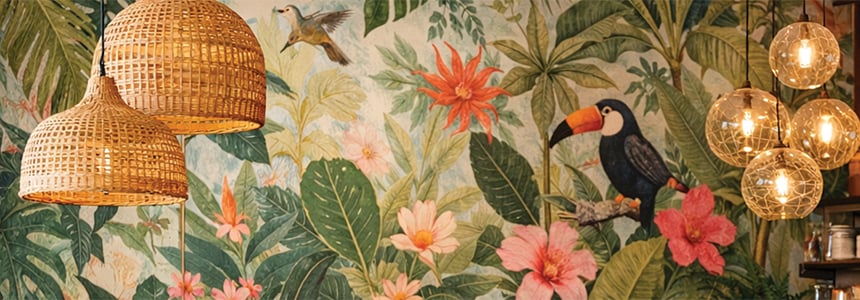
Indoor retail and point of purchase (POP) environments use wallcoverings and wall graphics for both aesthetics and performance.
“Vinyl is the industry standard for achieving both; you have flexibility to customize a solution for your brand while also providing durability from scuffs and scratches,” shares Alex Wixted, commercial innovation platform manager, Avery Dennison Graphics Solutions.
However, demand for PVC-free films as well as fabric-based and paper-based options is growing. When selecting wallcovering media, sustainability is a consideration, as well as the adhesive system and durability requirements.
Above: Drytac’s ReTac Smooth 150 polymeric PVC film enables install, removal, and repositioning of graphics without leaving residue on the surface.
Media Mix
The two main categories for wallcovering media include printable PVC vinyl wall media and PVC-free/non-woven or polypropylene (PP) alternatives.
“Both categories are engineered for performance, but each comes with tradeoffs related to things like sustainability, disposal, and long-term environmental impact,” comments Julie Brannen, director, sales and sustainable solutions, Monadnock Paper Mills, Inc.
Traditionally a high percentage of pressure-sensitive vinyl is utilized with a balance of traditional Type I and Type II fabric-backed vinyl in retail environments. “Lately we have seen interest in evaluating PVC-free options across the market, along with an interest in non-woven backed commercial products that increase the efficiency and quality of installation,” shares Jamie Riley, technical director, Faze 3 SMS.
Vinyl-based wallcoverings are still widely used due to durability, print quality, and their ability to handle a variety of surfaces, explains Mike Richardson, business development manager, graphics media, Jessup Manufacturing Company.
Jay Kroll, director of product education, General Formulations, says vinyl is a workhorse when it comes to indoor retail and POP wall graphics. “It checks every box that matters—cost effectiveness, durability, flame resistance, and excellent printability.”
“At the same time, PVC-free options such as non-woven paper fleece and PP are gaining traction, especially where sustainability goals or softer interior décor aesthetics are a priority,” summarizes Dennis Leblanc, senior product and business development manager, Drytac.
Fabric-based materials are growing in popularity, especially where ease of installation and removability are important. “Fabrics tend to be repositionable and are often chosen for short-term campaigns or where installers want a more forgiving application,” notes Richardson.
Walter Gierlach, president, Photo Tex Group, Inc., says the shift to fabric-based materials is driven by stricter fire rating requirements, advancements in paint and ink technologies, and a growing emphasis on low toxicity, environmentally friendly materials.
Fiber-based substrates also gain traction as advancements in material engineering improve durability, print performance, and versatility. “In retail applications, these materials serve as a drop-in replacement for traditional vinyl, delivering comparable print quality, opacity, installation performance, and recyclability without relying on PVC,” comments Brannen.
Additionally, fiber-based substrates support broader sustainability initiatives by using renewable, FSC-certified fiber, reducing reliance on plastic, and offering more favorable end-of-life pathways than synthetic materials. “For brands with ESG goals, material selection is becoming a paramount part of the decision-making process,” adds Brannen.
More Sustainable Solutions
Traditional PVC contains chlorine, plastics, and other additives like volatile organic compounds that can release harmful chemicals into the environment. “By choosing PVC‑free materials retailers remain cost effective while still choosing to reduce toxic materials and support their ESG and sustainability goals,” share Darren Speizer, VP, sales and marketing, and Erica Wilton, channel marketing and training specialist, Sihl Inc.
Brannen sees a growing interest in PVC-free and paper-based alternatives for wallcoverings as brands look to align material choices with broader sustainability achievements.
In many cases, this shift is driven internally by brand values. “Retailers want materials that reduce environmental impact while still delivering the print quality and performance environments required,” states Brannen.
Brand perception is another driver. “Retailers are paying closer attention to sustainability messaging, not just in what they sell but in how their spaces are presented. PVC-free and more environmentally conscious materials help support those initiatives,” offers Richardson.
Leblanc agrees, noting that retailers are under more pressure to align store design with broader sustainability objectives, so material choice is attracting more attention. “PVC-free products help brands reduce reliance on traditional vinyl, and they are often selected for projects where environmental messaging matters just as much as visual impact.”
Consumers are more aware of their impact on the environment and how buying decisions can influence this impact. “PVC-free alternatives are a great way to reduce carbon footprint and chemical exposure within the manufacturing process,” shares Wixted.
There is also a practical side. Richardson says many of these newer materials are lighter, easier to install, and simpler to dispose of, which aligns with the fast-paced nature of retail campaigns.
Non-PVC solutions like PET also offer benefits like higher dimensional stability, meaning less shrinkage and expansion over time. “Solutions with high dimensional stability can offer quicker turnaround when it’s time to change out the graphics. These products can likely be removed in one piece rather than multiple pieces,” explains Laura Antenucci, marketing director, Continental Grafix USA.
Advancements in paper-based substrates yield opacity, durability, and print fidelity, particularly for shorter term and seasonal campaigns. Brannen says this opens the door for specifiers to reconsider materials that historically defaulted to plastic-based solutions.
Riley finds increased interest in PVC-free alternatives is driven by a combination of factors, including a new generation of interior designers more focused on environmental sustainability. “In fact, some of the larger interior design firms have told us that some new graduates are even declining to work on PVC featured projects. When you combine the focus of today’s designers with the increased performance envelope available with modern PVC-free alternatives, along with product cost parity and improved installation efficiency as well as the potential supply chain advantage, it becomes an even easier choice to go with a PVC-free alternative.”
It is important to note that some traditional PVC materials are more sustainable than PVC alternatives “so we have to educate about the difference,” claims Richard Collins, global senior product markets development manager, Metamark.
Cleaning Chemicals
Exposure to cleaning and disinfecting chemicals is a crucial factor in selecting wallcovering media for retail interiors because repeated cleaning can degrade ink, coatings, adhesives, and the base substrate. “Areas that are cleaned frequently—such as checkout counters, fitting rooms, restrooms, and food-adjacent spaces—require media that can tolerate both mechanical scrubbing and chemical exposure,” explains Riley.
Richardson feels cleaning protocols should play a big role in material selection. “Many retail environments are cleaned daily with a range of chemicals, including disinfectants. If the media cannot handle that, you can see premature failure or degradation,” he stresses.
Antenucci believes identifying this detail at the specification stage is critical. “When you know cleaning chemicals are going to be used to clean media after installation, you can make an educated selection from the start. There’s the potential to choose a media that can handle these chemicals for the length of time of the graphic installation. We see this in short- to mid-term wallcovering quotes. If the media needs additional protection, there’s the potential to add an overlaminate. But the key is knowing that cleaning chemicals will be used on the wallcovering so you can plan for and choose the right media or combination of medias to meet the requirements.”
Speizer and Wilton say wallcovering material should be able to withstand regular cleaning, wiping, and general maintenance without fading, peeling, or deteriorating. “It’s important to choose a material with good moisture resistance and strong stability so it holds up well and keeps its quality over time. Type II materials are ideal for this because they are suitable for scrubbing and wiping while offering stain resistance and durability.”
Leblanc adds that cleaning can affect both the print surface and the adhesive performance of wall graphics. “For routine care, graphics should be cleaned with a soft cloth and water or mild detergent, avoiding harsh chemicals that can degrade the media or adhesive over time. Take care around exposed edges, as liquids can migrate under the film and affect adhesion. If a graphic is unlaminated, the ink technology plays an important role in how well the print withstands cleaning and abrasion. In areas with frequent cleaning, a protective overlaminate can help extend the life of the graphic.”
Adhesive Systems
Adhesive solutions are another consideration for wallcoverings. Permanent or high tack and removable adhesives are available for wallcovering media, along with standard wallpaper paste.
Brannen feels that it’s also worth noting that some wallcovering systems use water-activated adhesives, which can offer a different installation profile and clean removal benefits depending on the application.
Pressure-sensitive adhesives are common. “Within that category, you will see a range from removable and repositionable adhesives for short-term graphics to more aggressive, permanent adhesives for longer term installations. The key is matching the adhesive to the surface and the expected duration of the campaign,” offers Richardson.
Leblanc says removable systems are preferred for seasonal campaigns, promotions, and brand refreshes because they allow cleaner removal and easier repositioning during install and permanent or repositionable-permanent systems are more common when the installation is intended to stay in place for longer periods.
Speizer and Wilton explain that there are two types of wallpaper paste—clear and clay adhesives. Clear adhesives are used for a more lightweight wallcovering and non-woven materials, whereas clay adhesives are used for heavier wallcoverings like a Type II wallcovering.
In addition, the evolution of dimensionally stable, non-woven backing materials laminated to non-woven facing stocks has opened the door to using the paste-the-wall technique first pioneered in Europe, according to Riley. “The choice really depends upon the skill of the installer, the scope of the installation, and the intended duration of the message.”
In any scenario, Kroll points out that the goal is simple—a graphic that goes up easily and stays put for the life of the project.
Wallcovering Considerations
When selecting media for a wall graphic or wallcovering, many considerations apply. Adhesive systems and how the material will be cleaned are important features that every print provider should think of prior to print and install.
Jun2026, Digital Output