Healthy Demand Tough Competition

By Mark Hanley

The wide format graphics digital print market as a whole still satisfies a persisting and growing demand for color graphics supporting retailing, merchandizing, event marketing, and specialist decorative markets. Digital shows great strength as a means of diversifying businesses’ communication to customers.

Vendor revenues for hardware and ink reached $4.4B and grew year over year (YOY) just under two percent by a conservative estimate, which given competitive pressures in this highly efficient market, is not a bad performance.

An increasing share of that number is going to non-OEM ink suppliers. The market eats up over 77,000 systems in a year—undercounting up to ten percent small and local non-mainstream suppliers. That number is replacing a part of the 270,000 installed of systems worldwide. This is with fewer, more efficient systems at a lower unit cost to cover the existing and new demand for output.

Inside the overall market in terms of technology sectors the most action in terms of growth and innovation is coming from the UV sector, which addresses the market’s needs for above-average growth in production volumes. There is growth at the high end in flatbed systems within this sector, but above all there is growth in low-end roll-to-roll (R2R) systems where the economic and price gap between low-end flatbed systems and high-end eco-solvent/latex systems is being progressively filled.

Topline Number Analysis
The statistics in Chart A depict the overall size of the wide format inkjet market—excluding soft signage—worldwide with some projections to 2022. The revenue data is measured at the level of pricing from vendors or dealers to users according to the different channels used. Retail graphics, followed by event-related specialty graphics, is finding a newer creative outlet thanks to the beneficial and enormous diversity of the highly fragmented print provider base of up to 200,000 sites worldwide. This allows for a truly localized offering everywhere.

Furthermore, there is now a clear linkage between print color graphics and a wider deployment of digital communications in other modes. Full marketing campaigns based on the backbone of live social media-fed data allow advertising, retail graphics, events, packaging, labeling, and print/digital communications functions to be increasingly integrated. That in itself boosts growth. This development is in its early, not-very-efficient days, with the prospect that maturation of the process of integration is a further spur to growth.

Chart B illustrates projections from 2017 through 2022 and provides a snapshot of YOY 2016 to 2017 development of the statistics presented. The difference between the projected five year growth rate and the YOY number shows above average YOY growth rates. Remember that the wide format graphics market cannot be measured accurately just from year to year. Acquisition cycles and technology adoption rates are longer than a year, resulting in a growth rate that averages out over time—something more like three to five years.

Chart B refers to units of systems sold and ink and hardware revenues. Underlying these statistics is information around square meters printed in total—in turn driving ink sales for vendors. Output statistics are a truer measure of final market demand and the numbers show this in chart C. Chart D provides an updated graphic representation of the relative sizes of each wide format sector in terms of vendor revenues for hardware and ink and square meters printed.

Aqueous Market
In 2017, aqueous markets gave us more of what was in 2016, which is to say slow but clear decline in YOY sales. Even though at a total of around 40,000 sales in this ink lucrative and largely print quality-driven market, this is by most measures still healthy.

The relatively high sales numbers to some extent reflect the relatively low cost of aqueous systems, and therefore the relatively low cost of replacing older systems. Added to that is the fact that aqueous systems are rooted in core functions like proofing and photo-quality output needs, which only aqueous is perceived to be able to fulfill.

There are some product re-classifications between the professional or print for pay and corporate or print for use parts of the aqueous market, some of which are vendor driven. The upshot is that aqueous corporate as a sector is declining in significance. This may be driven by the fact that CAD systems with graphics capability have eaten into the sub-sector just by being more prevalent and available at lower costs.

Eco-Solvent and Latex
Eco-solvent puts up around 70 different competitive products against latex. That was an effective way of flooding markets in the past and distracting from the latex offerings of a single vendor. Additionally that single latex vendor spent its early market years with an indirect competitive positioning to eco-solvent. Now the lurking disadvantage of such a wide eco-solvent offering from three to four major vendors—being the cost of development of so many products and the increased competition among eco-solvent vendors it promoted—is coming home to roost. Eco-solvent vendor performance is beginning to look a little tired, especially economically speaking.

On the latex side, HP has always pursued a dual strategy of low- and high-end products. Low end is a big competitive target while high end is a vehicle for developing beyond graphics into decorative markets. Decorative markets started out small, but HP believes that they have more than average leveragability in the future by digital uniqueness in providing diversity of print content. In this area latex is perceived to have a certain drying time and odor advantage over eco-solvent.

Aggressive Solvent Market
Similar to last year, aggressive solvent systems are still out there in the install base, and Asian vendors still sell them, but they are as good as gone as new systems in Europe and North America.

UV Market
UV is a sector that now pays a relatively high acquisition cost for systems capable of true burst-speed seasonal response to demand at factors of up to 20 times demand over average seasonally. UV is also a focal point for technology and platform development and just growth. It is mostly a separate sector from the low-end R2R aqueous, eco-solvent, and latex markets, though newer sub-$100K UV R2R systems are pushing down towards the upper end of the eco-solvent/latex market.

The statistics around sales units of UV systems YOY growth is exceptional from 2016 to 2017. Chart E depicts 2017 sales compared to 2016 by UV sub-sector. Chart F is the same analysis but for print output by UV sub-sector. UV is certainly growing and is healthy, but caution is advised in reading too much into annual growth rates since—especially in high acquisition cost markets like UV—the sales cycle is often spread over three to five years. So the real longer cycle rates of growth are probably significantly lower than YOY would suggest.

All of this data together suggests that UV is growing into its own identity from starting as a convenience flatbed format, progressing to volume capability, and now developing into a highly flexible large-scale realization format. UV’s ability to generate large volumes fast—which sometimes translates to very large areas of print fast—contributes to the real development of new markets especially around sports franchises and events.

UV is beginning to go beyond just display graphics and become the platform for development of new markets derived from wide format platforms. An obvious example is the nearly-half-billion-dollar market for deep plated decoration flatbed systems from companies like EPS, Inkcups, Mimaki, Mutoh, and Roland. There are also interesting crossover-type products from Inca Digital in conjunction with Fujifilm, which are greatly enhanced print quality systems with relatively low cost positioned for commercial printers who want to do micro runs of book covers, test marketing of packaging, or print of rigid displays. Then there are the UV-based corrugated packaging systems from vendors like Durst and EFI. It goes beyond just applications into real enhancement of the UV digital print function for a range of potential markets.

At the very high end of the high-end flatbed UV market there is the sub-sub-sector, super high-end (SHE) systems, which are close to $1M or over and generally print around 5,000 square feet per hour or more. Chart G illustrates the history of sales of those systems. Sales of SHE systems are healthy and separate from ordinary high-end flatbed systems. Year to year sales fluctuate, but again a longer cycle must be understood as driving the underlying growth rate.

The SHE market projected forward to 2022 and compared to the standard install base by 2022 of high-end flatbed systems without the SHE components is in chart H. This is a good illustration of the importance of really high-end UV systems. This sub-sector can be seen as a component of the convergence of UV technology’s capabilities for new markets in the future.

Soft Signage
As an application, soft signage is definitely part of the inkjet wide format graphics market. But some of the most important low-end systems used for soft signage are primarily sold as apparel and home furnishings printers.

Soft signage is not new, but it has seen a spurt in growth in the last five to six years to the point where its output now represents around 20 percent of all the rest of inkjet wide format graphics output. It has a high end $100K plus acquisition price and a low end $100K and under acquisition price. Its analysis is complicated by the fact that while the high-end systems are soft signage dedicated, and can be counted cleanly, the larger low end is made up of systems which are sometimes sold for soft signage but are much more often sold as apparel printers. So it is hard to sort out usage at print provider level on the simple basis of placements.

The technology used for soft signage is dye-sublimation printing, which allows for a very high quality, brilliant color gamut on synthetic fibers. This is uniquely attractive to signage users. But additionally soft signage is very light, easy to transport, store, and recycle. As a result of these factors, there is not a print outlet in wide format anywhere that does not now want to have this technology as part of their offering. There is still much latent demand in other words. A smaller amount of soft signage is and has in the past been generated by UV and latex systems, and even sometimes eco-solvent.

Chart I offers an analysis of the soft signage market in 2017 and projected forward.

Regionality of Systems Sales
In the case of nearly all sectors mentioned in this report sales to North America and Europe are over 60 percent. This pattern is elsewhere in newer digital print production markets. Underlying this weighting to North America and Europe is the fact that the benefits of wide format graphics to users relate to the high level of development of modern consumer economies such as how often people buy goods, what goods they buy, the relative cost of those goods, and where they are buying them. These unique factors open themselves to leveraging the uniqueness of digital output.

In China and second-tier economies wide format graphics are indeed also used, but supplied by vendors largely out of China—and in large numbers. These largely Chinese-supplied systems sustain their economic existence on the basis of a very different economic envelope and physical specification compared to the systems which are supplied in the majority to the first-tier economies. For example, aggressive solvent systems are still very important in those markets where in Europe and North America such systems are almost no longer sold and the install base is diminishing dramatically. This may start to change as more Chinese vendors are driven into UV systems due to Chinese government regulation around the use of hard solvent systems and inks.

Print Rates into the Future
UV systems are the leading indicator of production demand in wide format graphics and as illustrated in Chart J there is a clear trend to higher volumes of print. It should be understood that these systems do not print at constant high volumes, but are rather procured to allow print providers to undertake very high volumes seasonally or event related when maybe ten to 20 times normal print volumes are needed in a very short space of time. This ability to respond fast in a last-minute retail world is the critical factor. But even so, the occasional high rate of print still raises the average over time considerably.

In particular, the high-end UV flatbed number is heavily influenced by the SHE sub-sector. This is like saying from a vendor perspective, getting large numbers of systems in place now guarantees you a growing ink market at much higher profits down the road coming out of the ever-growing installed base of ever-faster systems.

Mark Hanley, president, I.T. Strategies, has over 20 years of experience in the electronic printing industry. He specializes in identifying new markets for digital color printing technologies. In addition to conducting research and consulting, he travels around the world, facilitating partnerships and strategic alliances between manufacturers in Europe, Japan, and the U.S.

Prior to co-founding I.T. Strategies, Hanley organized the European operations of CAP International, subsequently known as BIS Strategic Decisions. From 1990 to 1992, he was services director at BIS, responsible for the management and growth of electronic hard copy information services in Asia-Pacific, Europe, and North America.

Aug2018, Digital Output

Digital Print

Wide Format

Premier Canopies Stays Sharp

By Melissa Donovan

A common occurrence for many print shops looking to gain efficiency is that once outfitted with the latest wide format printers, another challenge related to productivity occurs. The dilemma—how can the finishing department keep up with the printers?

For some print service providers (PSPs) the answer to that question is outsourcing. While demand remains steady or increases, this bides time before committing to the purchase of a digital cutter.

Premier Canopies, based in Huntington Beach, CA, recently brought its finishing capabilities in house with the purchase of a Colex Sharpcut digital flatbed cutter. The company, founded in 2012, offers dye-sublimation, digital printing, point of purchase, trade show display, flag, and vinyl banner services. 22 employees work in a 12,000 square foot printing facility offering the company’s services nationwide to more than 1,300 distributors.

Above: Premier Canopies of Huntington Beach, CA recently purchased a Colex Sharpcut SX-1631 digital flatbed cutter to improve finishing speed and accuracy.

Not Planned
In 2016, the company added its first digital printer—an Epson SureColor S50675—for printing to vinyl. According to Craig Tucker, owner/co-founder, Premier Canopies, the machine was integral in helping get his feet wet in digital printing. As the service took off, the PSP realized the need for higher production capability so it researched larger machines.

Meeting with representatives at Grimco Inc., Tucker and the rest of the executives decided to grow the digital printing side of Premier Canopies with the purchase of an HP Inc. HP Scitex FB750 flatbed printer. Four months later a second HP Scitex FB750 was added. Both printers soon reached full capacity, so an HP Latex 1500 was brought in. With a full digital print facility—which was never in the original business plan, admits Tucker—it was time to address the next issue. A huge backlog in finishing started to occur.

Premier Canopies realized that the next investment, while focused on productivity, had to address other objectives as well. “The main goal was to not only improve finishing speed, but improve accuracy on each and every job,” adds Tucker.

Enter Colex. Working again with Grimco and asking other vendors and partners about digital flatbed cutter options, Premier Canopies chose the 5×10-foot Colex Sharpcut SX-1631 digital flatbed cutter.

“We first learned about the Colex Sharpcut through one of our partners that would help us cut large jobs. Jobs that would take us three to four days to cut would take them a few hours to turnaround. We realized very quickly that we needed to come up with a plan to add a machine like this at our facility,” explains Tucker.

500th Customer
In early 2018 Premier Canopies placed an order through Grimco for the Colex Sharpcut SX-1631. It was integrated into the shop at the beginning of June with technician training occurring around the same time. With a month of operation under its belt Tucker says the machine already exceeds expectations.

“It is easy to operate and precise on all of the cutting and routing applications. We have several staff members trained on the Colex Sharpcut that can fill in and operate it at any time, which is huge for a small- to mid-sized shop like ours. This machine increased our production and reduced lead times dramatically, allowing for a better customer experience,” he shares.

In the short time Premier Canopies’ device has been in use its cut through a range of materials. These include wood, acrylic, vinyl banner, PVC, sintra, foamboard, and coroplast. With the versatility of blades, each of these substrates are easy to cut and a high-quality finish occurs every time.

Currently, Premier Canopies sends as many jobs as possible to the Colex Sharpcut SX-1631. Tucker estimates that about 60 percent of its products are cut on the device.

Unbeknownst at the beginning of the process, Premier Canopies’ purchase was the 500th Colex Sharpcut placed into production. The vendor provided the PSP with a number of perks for being a milestone owner including a $500 gift card to put towards bits, blades, and consumables.

Eye to the Future
By 2020 Premier Canopies hopes to be into a new 30,000 foot facility. The Colex Sharpcut SX-1631 is poised to play an instrumental role in this growth.

Aug2018, Digital Output

Digital Print

Flatbed Cutter

Positively Devoted

By Cassandra Balentine

Digital textile printing is complex, but versatile. Several methods are used to print to textiles, including dye-sublimation (dye-sub)—either direct dye-sub or with the use of transfer paper—as well as direct digital printing.

The market is growing. According to recent research published by Research and Markets, Digital Textile Printing Market by Printing Process (Roll to Roll, Direct to Garment (DTG)), Ink Type (Sublimation, Pigment, Reactive, Acid), Application (Textile & Décor, Industrial, Soft Signage, DTG), and Geography – Global Forecast to 2023, the digital textile printing market is expected to be worth 2.3 billion USD by 2023—up from 1.76 billion in 2018—at a compound annual growth rate of 5.59 percent from 2018 to 2023. The study finds this growth due to demand for sustainable printing, increased demand for digital textile printing in the garment and advertising industries, shortening lifespan and faster adaptability of fashion designs, development of new technologies in the textile industry, reduced per unit cost of printing with digital printers, and growth of ecommerce.

To meet growing demands for fabric printing, print service providers (PSPs) are interested in obtaining the technology. However, they have many options. Several dedicated textile printing devices are on the market in both dye-sub transfer and dye-sub direct options. Additionally, some UV or latex printers are capable of printing directly to textiles as well as other materials. The question becomes whether or not it is time to invest in a printer with the sole purpose of printing to textiles. This article discusses considerations for a dedicated textile printer.

Above: Kornit offers DTG and direct to fabric digital inkjet printing technologies.

Deciding on Dedicated
As with any new investment, it is important to consider the options and choose the solution best suited to meet a PSP’s unique fabric printing requirements. Regardless of the specific printing method chosen, a dedicated solution may be the right decision.

There are normally two break points for specialty equipment purchases, advises Randy Anderson, product marketing manager, dye-sub and textile line, ValueJet, Mutoh America, Inc. One is when the volume of purchased fabric is great enough to justify the equipment costs and the other is when a better lead time is needed for delivery.

While some limited fabric selections are printable with UV or latex printers, the bulk of textile printing is output on dedicated devices, comments Larry D’Amico, director of sales, large format, Durst Image Technology US LLC. He says the decision to invest in a dedicated printer is a difficult one. “Do you buy a low-end device that gets you in the market but offers limited throughput to deal with significant opportunities, or should you invest more up front so that you have a machine with the bandwidth to address larger applications?”

The point at which to consider adding a dedicated printer is when textile applications become a regular part of work produced and the financials make sense. “This will vary for each PSP significantly,” suggests Tim Check, product manager, professional imaging, Epson.

“In my experience, a PSP only purchases a dedicated printer when they have enough work to keep that machine running all day or during their busy time if they have too much work and can’t run behind on that particular substrate,” explains Nick Buettner, director of technical sales, Advanced Color Solutions.

While a business may be doing soft signage work on a roll-to-roll UV or LED inkjet printer along with other graphics work, Mike Wozny, senior product manager, EFI Inkjet, shares that it is such a hot growth market that businesses often see a need for a dedicated printer just to keep up.

“It’s hard to say what volumes justify a dedicated machine,” comments Buettner. He suggests two schools of thought, the first being whether or not there is enough extra work for the machine to pay for itself, and the second determining if there is a bottleneck that a dedicated machine could be used to remedy.

Greg Lamb, CEO, Global Imaging, says another road to investing is the knowledge that the digital textile market is growing faster than other markets in the industry. “For a business to keep growing and become profitable, they need to look for revenue sources and product offerings that aren’t commoditized and should look to capture market share when the field is still fairly wide open.”

Application and Volume
One major consideration for textile printing is the application and volume needs.

According to D’Amico, the math varies according to the application, but basically PSPs need to calculate the volume and the potential profit and weigh that against the initial equipment purchase and running cost. “It’s a simple calculation that determines the justification for a dedicated device and also help determine the level of investment you can support.”

Figuring out when to invest in a dedicated machine for textile printing is a complicated question. “If you are already outsourcing to another person who is doing your fabric printing and the volume is significant, then you may be ready to invest right away,” offers Lamb. “Of course, what one perceives to be a significant volume versus the entry cost of the platform will vary and really requires a deeper dive into the numbers.”

Wozny says any shop approaching three to five hours of textile work on a roll-to-roll printer will want to switch to a dedicated textile printer. Businesses that do a lot of work in the trade show/event space have already seen the demand shift away from vinyl signage and many—if not most—have moved to dedicated textile equipment. “But the same type of transformation is coming to the point of purchase space as well, as backlit signage provides a high-end look that is preferred now in many retail establishments,” continues Wozny.

Lily Hunter, product manager, textiles and consumables, Roland DGA Corporation, believes investing in a dedicated dye-sub printer makes sense for those planning on creating decorated apparel and accessories, soft signage, décor, and/or promotional goods. “As far as volume is concerned, in order to justify the investment in the equipment, the PSP should anticipate being able to do a minimum of 1,500 square feet per month.”

Juan Kim, CEO, Valloy Incorporation, thinks using a dedicated printer for a specific substrate is required if production volume per batch is large enough. Different inks are required for each substrate, so ink replacement for every one can be a challenge for PSPs when considering ink waste.

Mike Angel, sales manager, Western territory, North America, Kornit Digital, points out that whether producing on demand orders with no minimum requirements or traditional bulk orders with minimum unit requirements, a dedicated textile printer can be implemented to ease production backlogs or create additional revenue channels. “Digital production provides agility and scalability. Once a dedicated textile printer is in place it can be utilized both ways.”

Single Pass vs. Multiple Pass
Traditionally, multiple passes are used to improve output quality. Single-pass textile printers are emerging to improve speeds, however the technology comes with advantages and disadvantages.

“Speed is the biggest advantage of single- over multi-pass printing. Cost, physical size, and the length of the material needed to initiate printing are the biggest disadvantages of single pass,” admits Anderson.

Michael Maxwell, senior manager, Mimaki USA, Inc., points out that single-pass technology often provides faster speeds that fall victim to media feed calibrations. Each time media advances it must be done with exact precision in order for the next pass to match up appropriately. With single-pass printing, the drops are only produced over the area once, leaving no margin for error. Multi-pass technology offers more versatility in that each pass covers an area several times, which can be useful in overcoming feed rate variances. It also allows for more ink, giving tighter control over the density and expanding the printer’s capabilities.

Unlike scan printing, where the multiple passes of the printhead can be used to hide the effect of a nozzle dropping out, single-pass printing does not have this luxury and needs a way to overcome this problem, recommends Kim.

Check explains that the main benefit of single-pass printing is high-speed printing for a specific type of application. “However, the downside of a single-pass printer is the lack of additional applications. There is little flexibility to change print quality and compatibility with different materials and media.”

Hunter says it is common to see a business pair a large, single-pass printer with one or smaller, multi-pass textile printers. “This gives the operation the ability to handle both short runs and longer production runs efficiently and cost effectively.”

Single-pass technology is also expensive. This is due to the requirement for a significant number of printheads to cover the imaging width of these printers. Extremely high volumes are typically needed to justify this type of investment, according to D’Amico.

“Multi-pass printers have greater flexibility to address a variety of applications and can dynamically balance quality and speed. The equipment cost is lower to the point that several multi-pass printers may offer greater productivity and lower cost than a single, high-speed single-pass printer,” offers Check.

Angel says technology now enables producers to control print speed, print quality, and hand feel by adjusting ink coverage. “One or two passes is not a matter of equipment limitations or needs, but based on the producer’s sell quality requirements.”

Lamb feels the future is bright for single-pass technology. “The reality is that today there are only a couple of players in the textile space offering single-pass technology and the cost of entry is astronomical in comparison to scanning or multi-pass technology.” In his experience, the majority of these devices have been placed in traditional textile production countries such as Italy and Turkey.

Feature Sets
Dedicated textile printers offer unique feature sets that make them well suited for a variety of fabric applications.

Angel points out that dedicated textile printers give producers full control of production needs. “They can be specific as well as variable data driven without comprising throughput.”

In general, textile printers feature a system for handling a variety of fabrics, the simplest being non-stretch or two-way stretch to the more elaborate sticky belts and systems for handling the full range of fabrics, explains Anderson.

Fabric presents specific challenges, especially when it comes to wrinkling and stretching. “Pinch rollers and tensioning systems that provide control over these elements are critical factors enabling proper printing on fabrics. It is critical that the materials used for the application are tested on any machine considered. Figure out how many times the machine has to stop to make adjustments during printing,” offers D’Amico.

Textile printers are usually in environments where fabrics are being cut, suggests Check. The printers need to be able to operate in environments with high levels of dust and lint.

“Other useful features are high printhead gaps that compensate for higher pile fabrics. Higher printhead gaps also allow for thinner papers to be used in dye-sub environments. Some machines offer belt drive systems that can be used for more difficult fabrics, such as ones that are dimensionally stretchable. These dedicated machines enable customers to produce goods without distorting the image due to stretch,” explains Maxwell.

Kim says post-processing methods can be fixed and combined or built in together for dedicated textile printing. “Dry heat fixation and a fume collector can be added for an all-in-one machine in the case of pigment or disperse dye ink. Pretreatment chemicals and methods can also be fixed in advance for a specific substrate and ink, so this can be included in an all-in-one dedicated machine.”

Devoted to Textiles
When demand for printing to textiles meets a certain point, PSPs consider adding a dedicated device to support growth and reduce bottlenecks. While there are many options when it comes to fabric printing, key factors like intended application usage and volume levels help determine when it’s time to invest in this technology.

Jul2018, Digital Output

Dedicated Textile Printer

Digital Print

Textile Printing

Accessibility to the Textile Opportunity

By Olivia Cahoon

A variety of textiles are constructed for and used in the digital printing process. With advancements in today’s print technologies, substrate composition, and ink and coating chemistries, print service providers (PSPs) looking to dabble in fabric printing can work with their existing UV or latex device thanks to fabric optimized for these ink sets.

Fabrics designed for UV and latex printing technologies are found in applications like décor and garments. Advantages of using these fabrics when paired with UV and latex ink include UV resistance, durability, and a soft hand when treated with a coating.

Above: Example of a UV/latex printable fabric from Agfa Graphics portrayed in a trade show environment.

Advantageous Reasoning
Every ink set offers its own benefits and printing to textiles optimized for UV or latex printers is no different. These fabrics are designed for fire resistance, weatherability, and sustainability while requiring minimal preparation.

In several cases, PSPs work with fabrics optimized for UV and latex printing to achieve a decreased turnaround time on specific applications. “The continuous growth for print on demand with 24 hours or less turn time on finished products can be easily met with latex and UV inks printed on properly coated fabrics achieving beautiful results,” says Mike Compton, product marketing manager, Top Value Fabrics.

Compared to two-step dye-sublimation processes, “it’s easier to produce short runs with UV and latex inks, and it takes less time to produce finished goods in small quantities,” agrees Gary York, wide format product manager, Agfa Graphics.

With UV and latex, PSPs can print directly to the fabric—saving time and money, explains Jason Amato, print production manager, Dietzgen Corporation. UV ink dries quickly, requires low energy to cure, and produces precise images. “Virtually any material is printable with UV technology. The inks are lightfast and as a bonus, they are UV resistant,” he adds.

“One of the great benefits of printing with UV inks is the quality of backlit graphics they can produce. UV inks tend to create more vibrant, colorful backlit images.” explains Paul Grider, director of product development, Dazian.

Latex is an environmentally friendly option that dries quickly and produces no hazardous vapors. Amato says it also resists solvents used in cleaning products and adheres to a variety of textiles for indoor and outdoor use. This is especially important for products that require regular washing, like garments or bed linens.

Pigments in latex ink offer improved lightfastness compared to dyes. According to Ann Sawchak, partner, PremEx Solutions, this is beneficial for items like curtains and outdoor cushions exposed to prolonged natural lighting.

Fabric Options
A variety of fabrics are used with UV, latex, or UV and latex ink technologies depending on the fabric’s end use. Polyester is a popular choice due to the variety of applications it can be utilized for. However, other fabrics like canvas, cotton, and linen are also compatible.

“UV-curable printers have the benefit of printing to a range of media, and therefore both coated and uncoated polyester fabrics are compatible with this print process,” shares Sharon Roland, advertising and PR manager, Fisher Textiles. Polyester is often selected for outdoor applications and retail signage that requires added durability.

UV and latex printers work well with polyester, poly/cotton blends, and natural fibers. According to Amato, the only limitation of UV fabric printing is the ink’s decreased flexibility and increased brittleness after drying. “An ink set should be flexible enough to print on textiles without flaking or cracking when creasing the material,” he suggests.

When printing with latex ink, Kara Work, product manager, S-One Holdings Corporation, recommends a full polyester fabric specifically optimized for latex inks.

Fabrics with a considerable amount of stretch can cause challenges with UV or latex technology. “They have issues going through the output feed and take up rolls and can cause improper imaging,” warns Eric Tischer, president, Verseidag US. Stretchy materials, like knit fabrics, are prone to curling during printing and may require the use of a sticky belt or print blanket.

Performance Coatings
Coated textiles are preferred for latex printing to optimize the ink’s performance. Fabrics used for UV printing don’t necessarily require a pretreatment. Most manufacturers use a proprietary coating on textiles to ensure compatibility across various ink types, explains Amato.

“Most fabrics designed for latex or UV inks are coated as the inks are applied directly to the fabric and need a flat, firm surface to bond to. Uncoated fabrics tend to be too soft and can move or shift during the printing process,” advises Grider.

Kylie Schleicher, product manager, Ultraflex Systems, Inc., says that while fabrics for UV ink typically don’t require specialized pretreatment, fabric used with latex ink does need a proprietary coating. “The specialized coatings are needed for latex printable fabrics to ensure maximum durability and scratch resistance,” she adds.

Fabrics designed for latex inks are typically treated with a technology proprietary to the manufacturer that binds the latex ink to the fabric’s surface, shares Work. “It provides an enhanced bond between the latex ink and the fabric, allowing for crisp lines, fine text, and beautifully nuanced images.”

With a pretreatment, Sawchak says fabrics optimized for latex printing offer improved results for both wet and dry crock ratings, preservation of the fabric hand throughout the process, and an expanded color gamut that broadens an achievable color range. “The pretreatment is not always necessary if the fabric is for one-time use, or if the product will not be sat on, washed, or rubbed against,” she adds.

Jeff Mills, TexStyles fabric manager, Beaver Paper & Graphic Media, Inc., finds most polyester and natural fibers are pretreated for durability although natural cottons, burlaps, hemp, and bamboo feature adhesion without coatings. For the most accurate results, he suggests testing fabric by latex media certification teams.

Compton advises against woven fabrics not specifically coated for UV or latex technology. Most woven fabrics differ from coated knit fabrics and don’t stretch with the inks or fray on the edges, which requires hot knifing or laser cutting to seal the edges. He also recommends PSPs work closely with fabric suppliers to understand the characteristics and coating technology for their print process and applications.

Coatings also enhance the graphic’s quality to ensure the image is sharper and clearer, continues Edwin Ramos, national sales manager, SEAL & GBC Wide Format, ACCO Brands. For example, some coatings enhance and protect for indoor and outdoor applications while providing wrinkle resistance, a soft drape, and precise images.

Grider points out that coatings can also mimic the soft hand typically associated with dye-sub transfer processes. PVC or silicone coatings in particular, in addition to the mount of coating used can create a soft hand feel.

Finally, other coatings like acrylic and polyurethane can help with light diffusion for backlit graphics and light blocking for blackout graphics, suggests Grider.

Feel Good
While print providers invest in digital printing to produce customized short runs of textiles, fabric quality and wearability is just as important as appearance. To achieve maximum wearability, a number of features are necessary in regards to the fabric and the ink set.

According to Amato, pre-coated textiles are more receptive to ink, withstand multiple washes without losing color, and offer increased wearability. Ink formulation also plays a large role in wearability with some OEM ink sets containing additives to improve durability and feel. “For example, UV inks must contain a flex agent to achieve a soft feel and remain durable. The flex agent allows the material to curl without flaking or cracking the ink,” he explains.

Fabrics optimized for latex ink offer a soft hand and produce high-quality graphics while UV printed fabrics can be printed at high densities and create eye-popping graphics, says Schleicher. She shares that UV optimized fabrics can lose their softness since the UV ink sits on top of the surface and isn’t absorbed into the material.

Fabric softness typically depends on the fabric’s quality and coating. “Fabrics optimized for UV and latex inks can offer both fantastic visual quality as well as a soft hand,” agrees Compton. “The newest generations of UV and latex inks offer much more flexibility, stretch capability, and softness when printed on properly constructed and coated fabrics.”

To ensure a quality feel and appearance, PSPs should avoid fabrics not optimized for printing with UV or latex inks. “Without the coating, colors are likely to bleed and will not result in very high-quality graphics,” admits Ramos.

Application Dependent
Applications play a large role in the selection of fabric for UV and latex printing. This is especially true for fabrics requiring a long life expectancy outdoors. “You need a fabric that stands up to UV rays and the elements,” explains Ramos. Fabrics optimized for UV or latex inks typically have properties to safeguard against the outdoors including water resistance, UV resistance, anti-wrinkling, and protection against wear and tear.

Technology and fabric pretreatments also rely on the application’s end use and finishing needs. According to Compton, fabrics specifically coated to the PSP’s immediate need are critical, especially based on end uses like backlit, front lit, or dimensional stretch for silicone edge graphics (SEG) framing systems. For example, in fine art reproduction, poly/cotton canvas blends are selected for the stretchability required for framing.

Latex inks are traditionally used for banners, wraps, and retail signage, but are also a cost-effective solution for short runs of blended and cotton apparel. Recently, Tischer sees latex inks widely used in interior décor and window treatments. Due to the ink characteristics and lack of odor, he believes latex inks are ideal for interior applications and can be used for window fabrics and wallcoverings to décor.

In Style
Digital print is making headway in a variety of fabric-based applications like apparel, home décor, and SEG graphics. PSPs use UV and latex inks to create eye-catching printed fabrics without the need to purchase a separate printer and utilize transfer paper or heating presses. This allows them to save time, costs, accelerate speed to market, and try their hand at textile printing.

Jul2018, Digital Output

Digital Print

Fabric

Latex Printing

Textiles

UV Printing

The Value of Textiles

By Digital Output Staff

Texprocess Americas took place May 22 to 24, 2018 at the Georgia World Congress Center in Atlanta, GA. It is co-produced by Messe Frankfurt North America and SPESA. Throughout the three day event, exhibitors displayed equipment and technology for the development, sourcing, and production of sewn products. In addition to vendor booths, the event included educational sessions located both on and off show floor.

Co-located with Techtextil North America, the show floor consisted of over 500 exhibitors, hailing from 32 countries Together, the joint trade show attracted more than 8,000 visitors, which is roughly a four percent increase over the last combined event in 2016.

“It was clear that everyone, both visitors and exhibitors, could feel the energy and excitement on the show floor,” states Dennis Smith, president/CEO, Messe Frankfurt Inc. “We are proud to serve as the platform for furthering the growth and development of the North American technical textile and sewn products industries.”

Texprocess Americas, celebrating its fourth iteration, represents the entire value chain in the process of sewn products. With digitally printed textiles a growing method in the creation of apparel, fashion, and décor, the solutions and products available at the show are of interest for print service providers (PSPs) considering entering into this segment.

Above: Examples of garments printed off a Kornit Allegro in the Gerber Technology booth.

Automation is a Hot
Two topics in particular stood out as important components—computer software/information technology and cutting systems. Both further automation in a traditional textile workplace. Several companies offering these services have customers involved or plan to be involved in the digital printing of textiles.

Both Gerber Technology and Lectra identify computer software/information technology and cutting systems as a pivotal part of the market. At Texprocess Americas they exhibited these products in addition to a number of other solutions in their portfolios.

In Gerber Technology’s booth it showcased the recently announced AccuMark Platform V11. It is an end-to-end solution that includes the automation of 2D/3D pattern design to product lifecycle management (PLM) and cutting software.

On the floor, the company showcased a microfactory, displaying the process of digitally printing a textile on a Kornit Allegro printer and then bringing that same fabric over to a Gerber Z1 cutter for finishing. The cutter is powered by Gerber ContourVision, which scans the fabric in one pass based on a black line placed around the graphic. This is saved in the CAD program for future jobs.

The cut out fabric was brought over to a partner booth by Gerbie the robot and sewn into a pillow. This process illustrated the important influence of automation in the workplace.

Lectra, on the heels of its 2017 company-wide rebrand, showcased Cutting Room 4.0 for the made-to-order furniture industry. On the fashion end, its surface design software is a 2D/3D pattern making solution that focuses on fit. It is part of its PLM end-to-end workflow solution, which moves a user from design to the cutting room. Lectra is focused on Industry 4.0 and the vision of a fully connected textile production system from the fabric, machines, and software to human interaction.

While not involved on the cutting side of things, EFI Optitex exhibited its ODev 2D design and 3D visualization solution. With a full demonstration of the product, it was easy to see how it can help automate a digital print workflow, aiding in faster decision making in the product development lifecycle.

Two Years
Texprocess Americas takes place again in 2020, returning to the Georgia World Congress Center May 12 to 14. We look forward to visiting the show and witnessing digital printing, finishing, and software being further integrated into this industry segment.

Jul2018, Digital Output

Digital Print

Textiles

Thin Is In

By Elizabeth Quirk

Magnetic signage is used in a number of ways, whether it’s in retail, restaurants, or on vehicles. Since the market responds positively to new and innovative trends, the debut of thinner, lighter materials are a popular feature of magnetic signage.

As with most product developments, there’s an ongoing evolution towards being the most cost efficient, while providing ease of use and functionality. In some applications, there are distinct advantages to using thinner, more high-energy magnetic products in place of thicker traditional magnetic materials. Thinner magnets are often easier to print on a large variety of inkjet printers, they’re also lighter in weight. This allows for less lifting for operators, less stress on machines, and lower freight costs.

Above: Adams Magnetic Product uses a higher energy ferrite powder that is stronger than the standard powder historically used in flexible magnet sheeting.

Two Options
Magnetic media is printed directly while magnetized, or printed on then magnetized. Alternatively, magnetic-receptive media works as part of an overall magnetic display system, in which a magnetic base is installed and magnetic-receptive graphics are printed and attached to the magnet. Although magnetic-receptive sheeting is not a magnet, it adheres to the base material like a magnet to metal.

Kylie Schleicher, product manager, Ultraflex Systems, Inc., argues first and foremost that magnetic-receptive media solves issues with existing solutions. “This type of product is a replacement for self-adhesive vinyl, which requires a professional installer, installation fees, and de-installation fees whenever a graphic needs to be changed. With magnetic-receptive media, there are usually no installation fees since the graphics can be installed by store employees wherever the end product is used,” she explains.

“Magnetic-receptive materials are six times lighter than standard magnet sheeting and come in wider widths than any magnet,” explains Joe Deetz, CEO, Visual Magnetics LP.

Driving Trends with Benefits
Thinner magnetic materials for either magnetic-receptive or magnetic media are poised to greatly improve business opportunities and profitability for commercial printers, sign shops, and other businesses.

Stephen S. McLevey, customer service and product manager, Flexmag Industries, Inc., a division of Arnold Magnetic Technologies, states that traditional magnetic signage material is a 30-mil standard energy magnet, plus a 4-mil vinyl, which makes the thickness a total of 34-mil.

According to Clay Reierson, director of operations, Xcel Products, Inc., a trend is traditional 20-mil magnet users reaching for 15-mil magnet more often. The company has even had requests for ten- to 12-mil products.

A main driving force behind thinner magnetic materials is related to today’s large format printing technology. Darrell Adams, VP – North America, Newlife Magnetics LLC, points out that ten-foot wide printers are ideal for seamless graphics, but ten-foot rolls of traditional magnetic media are too heavy to manage.

With magnetic sheeting, strength has always been determined by the thickness of the magnet—the thicker the magnet the heavier it is. By reducing the thickness from 30- to 15-mil, the total weight can be cut almost in half, making the thinner material much easier to load and feed into a wide format printer. It is also easier to install when used as signage.

Reducing the weight of material so that it can be made into a wider sheet is a contributing factor to this trend. Mike Gertz, marketing manager, Master Magnetics, Inc., argues that utilizing high-energy manufacturing technology to make magnetic sheeting thinner, while maintaining or exceeding the strength of regular-strength sheeting—and at a comparable cost—has many benefits including being easier to work with, to print, and costs less to ship. With a lighter weight, thinner magnetic material reduces freight costs and the likelihood of damage during transit.

Thinner magnetic materials present options when it comes to type of printers used. They are considered easier to print to because they don’t require as much of a gap between printhead and substrate. With regard to printer compatibility, Shane Colvin, director, business development, Magnum Magnetics Corporation, says it is really a tossup amongst the more popular ink systems.

“For instance, UV printers have no issue running thick material so thinner isn’t better in this case, however in the case of some of the new latex machines thickness is a huge concern. Not to mention when a high level of heat is applied in the print process very specific types of magnet may need to be utilized,” continues Colvin.

Price is another contributing factor. Because magnetic materials can be expensive, having less material makes it easier on your bank account. There are also options to create high-energy versions as well, as to not sacrifice the performance of the magnet.

Similar, but Different
Despite how thin today’s magnets are, they can provide the same or similar strength as a denser alternative. This all has to do with the manufacturing process.

In order for the magnetic strength of thinner materials to match traditional magnetics, Alice Martin, director of marketing, Adams Magnetic Products, explains three methods. The first is to increase the thickness, since magnetic strength is a ratio of total magnet material mass. Another option is to orient the magnet material particles so that most or all the magnetic domains within the material are oriented in the same direction—this is referred to as anisotropic or high-energy magnetic material. The third option is to use raw materials that produce a greater number of magnetic flux lines.

The manner in which each vendor manufactures and achieves strength in its material differs. Adams Magnetic Products uses a higher energy ferrite powder that is stronger than the standard powder historically used in flexible magnet sheet. “The higher energy powder is more expensive, but we can use less of it,” admits Martin.

According to McLevey, the high-energy or anisotropic powder has a well-defined crystalline structure compared to standard energy or isotropic powder, therefore providing a similar magnetic output or strength with a thinner magnet.

Newlife Magnetics recently introduced a new patented magnetic material that uses two holding technologies to increase the holding force. “Micro-suction technology combined with a magnetic holding force results in a thin, light magnet material with strong holding capabilities,” shares Adams.

Price Comparison
The difference in the cost per square foot is similar to that of the magnetic force. Basically, you get what you pay for. This makes the pricing dependent on several factors.

Colvin states that it’s not a one-to-one comparison in the magnetic world. “For example, since Magnum Magnetics creates various thicknesses and cut sheet dimensions it really depends on every project,” he adds.

Adams argues the standard 30-mil printable magnet sells at $0.75 to $1.00 per square foot. Whereas 20-mil printable magnet made from anisotropic/high-energy materials may have ten percent more holding force than a 30-mil standard material but costs about the same.

“The benefits indirectly related to cost are a 30 percent reduction in weight per square foot making it easier to manage in printing and installation, and reducing the shipping cost by around 30 percent to printer and the end user,” explains Adams.

Thin is In
Overall, there are some distinct advantages to using thinner, lighter magnetic materials. This includes a reduction in weight so that the eventual graphic is easier to handle on and off the printer, reducing shipping costs, and minimal lifting for the end user or installer. The need to produce the most cost efficient, innovative, and productive products is a continuous driver of thinner, lighter magnetic materials.

Jul2018, Digital Output

Digital Print

Magnetic Signage

Magnets

Media

Controlling it On a Different Level

By Melissa Donovan

Converting equipment is traditionally used by media manufacturers and distributors. However, there is a shift in the wide format end user community where roll or log slitters are purchased by print providers to convert media before and after production runs.

Slitting involves cutting a roll of media into narrower widths. Converting and slitting are similar terms, however converting can also include rewinding. Rewinding equipment involves transferring media from one roll to another. There are separate rewinding devices, and rewinding is a feature sometimes included on a roll slitter.

Bringing slitting or rewinding in house allows print service providers (PSPs) to better control inventory. “Implementing a converting center allows the print provider to rewind, trim, and slit media to the exact size required for the job. This eliminates stocking different widths and lengths of print media and provides more control over the total media used for each job—as only the required amount of media needed is delivered to the operator for printing,” explains Chase Pender, marketing manager, Supply55, Inc.

Once implemented, a roll slitter converts many types of materials. This includes banner material, heat transfer vinyl, film, perforated window media, magnets, photo paper, canvas, and VHB tape. In each case, larger rolls purchased directly from the manufacturer are easily converted or slit to compact, more manageable sizes.

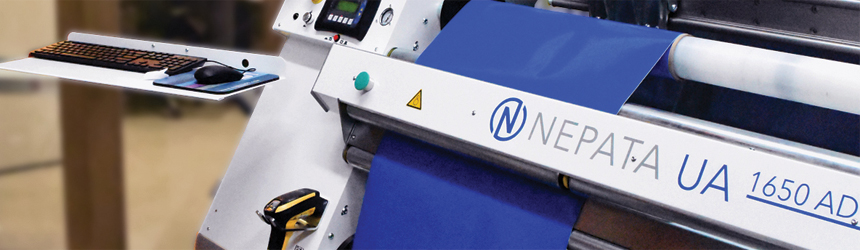
Above: Many types of material can be converted on NEPATA UA Series converters from self-adhesive, sandblasting, masking, vehicle wrap, flex, flock, and window tint films to banner material, photo paper, papers, wallpaper, mesh, dye-sublimation transfer paper, and digital magnetic. NEPATA converting systems are distributed in the U.S. by Supply55.

Translating into ROI
According to Pender, the cost to implement and own a converting system ranges from $25,000 to $50,000 depending on the equipment. Return on investment (ROI) is based on the volume of media processed. In Pender’s experience, customers typically see ROI during the first year of operation.

“As with any new project, time should be spent properly training staff on the use of the equipment. The benefits of in-house converting outweigh the challenges, as users see an immediate payback through better inventory management,” he adds.

A number of market share players make up the converting space. We’ve included some roll slitter vendors here, sharing their converting equipment suited for PSPs in wide format.

Roll slitters can be equipped with one or multiple cutting blades and can also handle one or even two rolls on one device. Also to note, there are manual, semi-automatic, and fully automatic converting equipment. For this article, we’ve tried to focus primarily on fully automatic roll slitter options.

ALS specializes in the design and manufacture of precision roll slitters. The S-Tec line of slitters automatically slits logs or rolls of non-woven textiles, vinyl, technical tapes, pressure-sensitive tapes, self-adhesive materials, foil, PVC, polyester, and polyethylene. Using a hydraulic slitting action and servo indexing system for accurate slitting, the device is compact and offers a user-friendly control system. The system is able to cut up to four different widths per cycle. It is available in widths of 63, 72, or 83 inches and diameters of 12, 16.7, 20, 24, and 28 inches.

Cevenini USA LLC, with its parent company based in Italy, offers the TNF 7 automatic log slitter with a toothed blade cutting system. The machine is ideal for cutting polyethylene, coated and non-coated plastic films, protective tape, and silicone paper. Fully automatic—with the exception of loading and unloading the material—a scissor lift allows the roll of media or log to be raised to the same height as the shaft on the machine. Its working width is 70 inches, however Cevenini does offer customization for all customer requests.

Lever Manufacturing Corporation makes automatic single-knife lathe slitters. These machines use a single circular blade to cut rolls of material on a core into smaller rolls, allowing for fast, accurate slits of varying widths. Its LS-1500 model is an automatic single-roll slitter designed to convert foam, tape, foil, rubber, non-wovens, textiles, and laminates. A maximum roll diameter of 16 inches and maximum roll width up to 90 inches is ideal for continuous production environments with minimal maintenance requirements.

Ribamatic’s newest roll slitter is the Top 50, a fully automatic converting system. The roll cutting device includes one cutting head with the ability to slit up to a diameter of 20 inches and a length of either 120 or 200 inches. A wet blade device means the blade is kept cool throughout the converting process. The machine includes an automatic blade sharpener. It is recommended for slitting fabrics and textiles, polyester, PVC banners and mesh, vinyl, banners, magnetic material, tapes, and paper.

SmartSlitters, a division of Rosenthal Manufacturing, Inc., offers the Enterprise automatic log slitter. Its cuts a variety of materials from adhesive tape, banners, fabric, and window film to magnetic and reflective tape. This is thanks to the PowerBlade—a variable speed, circular blade. Enterprise can be equipped with a rewinder option, allowing the user to transfer material from a jumbo log onto a recovery core. It is available in a maximum roll width capacity of 62 inches.

Supply55 is the master distributor in North America for German manufacturer NEPATA GmbH’s converting equipment. The 65-inch NEPATA UA1650 ADWS is a converting center for film media with high-precision rewinding and automatic cross cutting. It features a rewinding speed up to five feet per second with 99.9 percent rewinding accuracy. The NEPATA UA1650 ADWS is ideal for processing self-adhesive films, masking films, vehicle wrap films, magnetic films, banner material, photo paper, wallpaper, and mesh.

In April 2018, Supply55 in partnership with NEPATA, released the new NEPATA UA770 30-inch smart rewinder/trimmer. Capable of trimming up to 30-inch widths, it features QuickMOUNT mandrels for efficient loading and increased production capacity. Types of material processed include self-adhesive vinyl film, vehicle wrap film, magnetic film, banner material, photo paper, wallpaper, and mesh. According to the company, the converting system offers a productivity gain of over 40 percent compared to analog methods.

Convert Away
Not a new or complex technology by any means, converting equipment—both roll slitting and rewinding—is another step in the process to fully automate a PSP’s production workflow. Adding a log slitter into a wide format print operation controls inventory and material waste. It’s another level of efficiency to streamline a business.

Jul2018, Digital Output

Converting Equipment

Digital Print

Roll Slitters

Slitting

Wide Format

Seamless Hospitality

By Olivia Cahoon

For textile printing, digital print technology is a unique alternative to traditional equipment like rotary screen machines. It offers a cost-effective solution for producing custom, short runs of fabric like cotton, polyester, and even leather. An investment in digital offers print service providers (PSPs) the opportunity to enter new markets while providing existing clients with value.

Above: Suntex Printing of Woodruff, SC printed on Tana-Tex’s proprietary mesh base cloth using a Mimaki TS500P-3200 printer. The finished product was used as privacy curtains in pediatric healthcare facilities. The client, Tana-Tex, develops specialty fabrics for healthcare applications sold domestically and internationally for trade only.

Printing to Perfection
Suntex Printing, Inc. began in 1995 as a fabric transfer service for the hospitality market. While it still offers transfer services, it also provides design, digital printing, fabric treatments, large format printing, and small yardage orders out of a 75,000 square foot location in Woodruff, SC with 20 employees.

When the company started, customers purchased printed transfer paper and fabric, which was shipped for a commission fee to Suntex Printing’s 50,000 square foot facility. The print provider primarily served the East and West coast with 15 employees. Finished products included bedspreads, draperies, and shower curtains for hotel, industrial, and healthcare.

“The hospitality industry would create designs, which were printed with disperse inks by offset means to transfer paper,” says Tiffany Dill, COO, Suntex Printing. At the time, the print provider used multiple 135-inch wide heat transfer calendars to finalize the jobs for its customers.

Suntex Printing’s market share grew fast and soon it transferred 15,000 to 20,000 yards per day. In the mid 2000’s, Dill noticed a drastic change in the market caused by trade acts with China and Mexico. “The American textile industry was devasted and over 400,000 jobs disappeared in just a few years. Large transfer orders were lost to offshore companies and we needed to find another solution to survive as a business,” she explains.

Soon after, the company investigated opportunities for small yardage orders used in sample rooms, catalogs, and orders too small to fill a shipping container. In 2009, Suntex Printing partnered with Sawgrass Inc. and invested in a Mimaki USA, Inc. JV33-160 printer, Sawgrass ink, ErgoSoft RIP software, and Beaver Paper & Graphic Media, Inc. transfer paper products.

Pleased with the printer’s performance, the PSP continued adding Mimaki printers to its portfolio as order requests rose. As they became more familiar with digital printing, Suntex Printing’s customers began to appreciate the technology even more. “After they saw the quality, turnaround times, and ease of ordering, they slowly transitioned to printing complete productions,” explains Dill.

Worldwide Services
Today, Suntex Printing uses several Mimaki digital printers and including a recently added Mimaki JV5-320DS—a superwide direct and dye-sublimation transfer printer. With an investment in digital printing, its capacity is currently 3,200 linear yards per day with 80 percent of its work considered digitally printed textile applications.

The print provider offers a variety of services for textiles including fabric treatments, five styles of stocked blockout fabric, fabric sourcing, and printing to cotton, leather, and vinyl. Suntex Printing produces backdrops, bedspreads and bed runners, barstools, carpet, curtains, fabric and vinyl upholstery, headboards, large soft signage, pillows, privacy curtains, roller shades, shower curtains, tablecloths, theater curtains, and offers specialty printing on substrates like wood, stone, and plexiglass. Its services are available to Bangkok, Dubai, New Zealand, Singapore, and the U.S.

For fabric printing, Suntex Printing relies on Mimaki inks for compatibility, quality, and low cost; ErgoSoft RIP software; and transfer paper from Neenah Coldenhove for improved paper handling and reduced ink consumption. The company offers single- or double-sided fabric printing for widths from 45 to 135 inches in blackout, dimmer, non-woven, polyester, poly/cotton blends, shear, and woven synthetics.

In 2014, Suntex Printing added an additional company, Coloronik, to pursue different markets and materials like acrylic, glass, leather, and vinyl. Coloronik uses a Mimaki JFX500-2131 flatbed and several direct to fabric printers for acoustic panels, acrylic ceiling tiles, ceramic tiles, custom t-shirts, decorative light panels, fine leathers, leather upholstery, LED backlit prints, outdoor banners, and window graphics. Recently, Dill says the company added pigment inks to print cotton, silk, and other natural fibers.

For digitally printed textile applications, Dill notices many trends including large designs not limited to traditional repeat screen sizes, gradients/ombre, watercolor paintings turned into digital print files, denim textures on blackout fabric, and double-sided curtains. With these in mind, Suntex Printing aims to provide the most cost-effective and high-quality digitally printed textile solutions.

Pediatric Privacy Curtains
Recently, repeat customer Tana-Tex Inc. in Chicago, IL approached Suntex Printing for seamless privacy curtains used in pediatric healthcare facilities. Tana-Tex develops specialty fabrics for healthcare applications that are sold domestically and internationally for trade only. The client selected its in-house base cloth for the privacy curtains.

“We manufacture a proprietary integral mesh base cloth that offers twice the durability as a typical privacy curtain fabric,” says Michael Cook, president, Tana-Tex. “Digital print design and capacity offers a wider range of color, repeat, scale, and composition options that elevate our design options beyond the typical—allowing us nearly endless creative license.”

Tana-Tex requested 24,300 square feet of seamless privacy curtains printed on a Mimaki TS500P-3200 3.2-meter sublimation printer using OEM inks. According to Cook, the absence of vertical and horizontal seams on the privacy curtains creates greater dimensional stability and less opportunity to harbor microbes. He adds, “print production is virtually flawless once a color or pattern standard has been approved. Suntex Printing’s knowledgeable staff and fast turnaround times meet today’s fast paced expectations.”

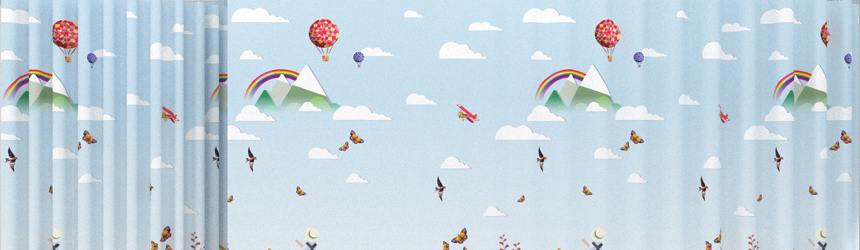
The printed curtains feature cartoon images of birds, hot air balloons, rainbows, and rivers. Cook says the bright colors and whimsical content are a fun departure from Tana-Tex’s typical pattern work. “Digital printing allowed us to create two related patterns—the front is more active and is intended as the visitor side while the patient side is more serene,” he shares.

Due to a long sales cycle in the architectural and design specifications market, from concept to installation the process took approximately one year. Each curtain was four yards in length, at 900 yards total. In total, the job consisted of 225 curtains.

Tana-Tex was pleased with the final privacy curtains and continues to work with Suntex Printing. Cook offers, “this pattern work on a privacy curtain lifts the spirits of patients, visitors, and staff. The power of good design combined with exceptional print range and quality positively affects the healthcare interior.”

Design As You Please
Addressing the need to remain revelant in a changing industry, Suntex Printing turned to digital printing technologies. These solutions present print providers and fabric manufacturers with a variety of design possibilities and fast turnaround for textiles. With its Mimaki printers, Suntex Printing continues to keep clients satisfied and expand its digital textile offerings into new markets like healthcare with client Tana-Tex.

Jul2018, Digital Output

Digital Print

Fabric

Textiles