Unlimited Designs

By Olivia Cahoon

Digitally printed wallpaper provides homes, retail, and office spaces with custom décor. In addition to print service providers, wallpaper manufacturers use digital printing technology to create short runs of wallpaper, reducing the need for inventory.

Instead of working directly with the consumer, these products are typically sold through distribution channels. Designers partner with wallpaper manufacturers using digital printing to cost effectively bring intricate, custom creations to life.

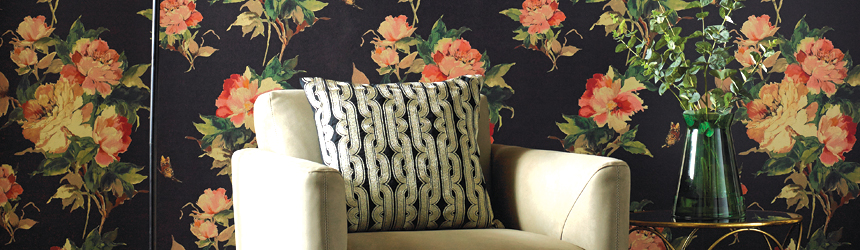
Above: Lancashire, England Surface Print’s Madama Butterfly, released in September 2017, is a large scale floral design available in six colorways—shown here, Ebony—and printed with an HP Latex 3500.

Color Innovation
Founded in 1990, Surface Print is a fourth generation, family-run business in Lancashire, England. The company started with 25 employees and originally offered wallpaper surface printing in a 15,000 square foot work area.

Today, it manufactures and distributes worldwide from a 55,000 square foot facility with over 80 employees. Surface Print uses a range of printing techniques including surface, Sur-Flex, flexographic, flock, beads, emboss, and digital.

Surface printing is one of the oldest automated printing methods still in use today. A machine lays down heavy amounts of ink onto paper from engraved rollers, creating the design, with no drying time in between rollers. The Sur-Flex process was developed in house at Surface Print. The hand painted effect of surface printing is mixed with the fine details of flexographic printing to create unique designs with a 3D feel.

As a wallpaper manufacturer for brands worldwide, Surface Print also has its own product line, 1838 Wallcoverings. The collection is sold on Surface Print’s website, through U.K. retailers, and international distributors.

Surface Print started using digital technology in 2013. It now houses the latest range of digital printing presses in a purpose-built room in its Lancashire facility. “Innovation is very important for the wallpaper industry and there is a large demand for digitally printed wallpaper,” says Abigail Watson, marketing director, Surface Print.

Wallpapers are designed and prepared with AVA CAD/CAM software and printed on HP, Inc. Latex 3500 printers, which handle single-roll sizes up to 126 inches and print up to 1,290 square feet per hour (sf/h). The presses include inline slitters and dual-roll split spindles for single-operator roll change. According to Watson, the company selected the HP Latex 3500 because it was the best and newest technology at the time.

Currently, ten percent of Surface Print’s wallpaper offering is digitally printed—including its most detailed and complicated designs. “Designing digitally printed wallpaper offers the opportunity to use as many colors as the design requires and produce tones and marks to the artwork without compromising the design,” explains Watson. “With digital printing, there are no repeat limitations.”

The company recently experienced an increased demand for wallpaper panels. As an alternative to traditional wallpaper, wallpaper panels are separated panels wider than standard roll wallpaper for easy application. “Wallpaper panels are a rising trend allowing people to create extraordinary effects in their home,” continues Watson. “Fewer joints are visible and creativity is unlimited. They are ideal for large scale and mural designs.”

Surface Print’s most popular wallpaper offering is Madama Butterfly, released in September 2017. Madama Butterfly is a large scale floral design available in six colorways—Blush, Coral, Denim, Ebony, Ivory, and Teal—and printed with an HP Latex 3500. According to Watson, it is often requested by home owners, interior designers, U.K. retailers, and international distributors.

Designs by AIRE
One interior designer using Surface Print’s digital wallpaper services is Lancashire, England-based designer AIRE. Founded in 2016, it is operated by one employee that designs and creates wallpaper artwork, which is then manufactured locally by Surface Print. 100 percent of AIRE’s wallpaper offerings are digitally printed.

“I print solely with digital print technology due to the flexibility it offers me as a small brand,” says Claire Williams, CEO/founder, AIRE. “In terms of developing a range in a cost-effective way, it allows for experimentation of work on a small budget and developing artwork that has the potential to be printed onto a variety of substrates.”

AIRE sells its wallpapers directly through websites, agents, and distributors. Wallpapers are printed on HP Latex 3500 machines in Surface Print’s facility. “Digitally printed wallpaper allows for achieving more complex coloration of artwork,” offers Williams.

The HP Latex 3500 prints on non-woven paper coated with Surface Print’s traditional methods in a variety of ink bases to achieve pearl, silver, and gold/silver finishes. Designs and edits are made with Adobe Photoshop and Illustrator and sampling and striking is completed with AVA software.

With its digital printers and software, Surface Print samples and modifies AIRE’s artwork to produce accurate colors and designs. “However, the printers and associated software are still have occasional blips, which can cause technical issues,” admits Williams.

One reason designers opt for digital printing technology is because the design and printing process is much faster than traditional printing methods. According to Williams, this enables bolder and braver designs. Additionally, the investment and overall cost is lower, which allows designers to test more innovative products.

“Printing without the need to repeat—so in panel form and at a wider width—allows for wall murals that reference larger scales of directional designs in non-repeat to become more evident in the market,” says Williams.

AIRE’s most popular wallpaper offering is the Papillon Collection, released in September 2017. It offers 48 individual SKUs based on six designs. The Papillon Collection is produced with non-woven paper in silver, mica, and foil and printed with HP Latex 3500 printers. Requested by high-end residential industries, according to Watson, the wallpaper collection is a nostalgic reference to floral bygone designs with an air of modernity.

Bespoke Business
Petronella Hall started in January 2014 in Kent, England with two partners that printed original fabric designs and cushions. The company also offered a bespoke service for custom and re-colored designs.

Today, it employs three and outsources several workers. Petronella Hall provides custom wallpaper, fabric, and a selection of cushions in addition to its bespoke service. The company also creates designs for large multinational wallpaper companies.

Wallpaper designs are sent across the U.K. to individuals, interior designers, and retailers in East Sussex, Kent, London, and Scotland. “We have sold to various states in Australia, Germany, Spain, and the U.S. At the moment we are setting up retailers stocking our product in Canada and Russia,” says Petra Hall, founder, Petronella Hall.

Hall, the designer, works from home to keep the overhead down. “The money I save on rent I can put into new designs,” she explains.

Since its inception, Petronella Hall uses digital printing for wallpaper, fabric, and cushions to avoid restrictions with color and to continue hand drawing and painting designs. “Digital printing allows the beauty of the inky line to be perfectly represented,” explains Hall. “It also means I can change designs quickly for a bespoke client.”

The designer sells its wallpaper directly to customers through its website and social media accounts. Petronella Hall participates in trade and retail shows including Tent London and The Country Homes and Interiors Show in the U.K.

Currently, Wallpaper Direct, based in the U.K., is the company’s main vendor. Wallpaper Direct is an online retailer that carries over 4,000 different wallpaper patterns. According to Hall, it allows for efficient distribution in the U.S. “We added wallpaper books, so we are expanding into interior design shops both home and worldwide,” she continues. Recently, one of the company’s wallpaper books was sent to Hong Kong.

For digital printing, the designer outsources its work to John Mark Ltd. and Muraspec Wallcoverings. “They are great companies to work with, very flexible, and the digital product is consistent and good quality,” says Hall.

John Mark is a fourth generation wallpaper manufacturer based in Lancashire, England that uses HP latex technology to print its wallpaper. According to the company’s website, John Mark uses only water-based, environmentally friendly inks for its durability, colorfastness, and ability to be printed on a range of papers. Muraspec celebrates over 135 years in business. A production facility in Kent, England includes digital printing capabilities for wallpaper manufacturing.

“Digitally printed wallpaper allows the beauty of the artwork to be visible on the printed surface and there is no limit to the number of colors I can use,” shares Hall. “It is also faster to create with no waiting for screens to be produced or rollers to be engraved.” With access to digital capabilities and printing in one run, the designer has never experienced challenges for matching wallpaper.

However, Hall points out that screen to print color can vary, which makes the sampling process expensive. “Digitally printed wallpaper is relatively expensive in comparison—but then you have unlimited colors.” With digital printing, the company also produces new collections much faster and has small amounts printed—allowing Petronella Hall to avoid warehousing stock.

Its latest wallpaper, Conkers, was released in November 2017. Available in fog, snow, and midnight blue, Conkers is printed on matte non-woven paper to avoid light reflection on nearby windows. “It’s popular because of the hand painted squirrels and wrens dotted about the design, also hidden in the foliage are caterpillars for kids to find,” offers Hall.

High Percentage of Digital
Established in 1991, Astek Wallcovering Inc., started as a wholesale wallcovering and fabrics distributor in Van Nuys, CA. With one employee, the company originally used silk screen printing methods in a 5,000 square foot workspace and distributed its products to the West Coast. Its clients mostly consisted of Hollywood set designers, art directors, and production designers seeking in-stock wallpaper for television shows and feature films in greater Los Angeles, CA.

Today, Astek operates in a 22,000 square foot facility with 50 employees. The company is a wallcovering manufacturer that sells directly to designer and retail locations. “We still sell Sherwin Williams nationally including many smaller retailers. But now we cater to architectural and design communities,” says Aaron Kirsch, president, Astek.

The wallcovering manufacturer ships its projects worldwide to China, England, Mexico, North America, and South America. Besides wallcoverings, the company also offers custom digital printing services for banners, ceiling applications, decals, flooring, labels, magnetic walls, murals, and window films. “We print many jobs for Hollywood feature films and television back drops,” adds Kirsch.

In the early 2000s, the company invested in digital printing technology to meet demands for short runs and customization as a distributor. Soon after, Astek started to produce its wallcoverings in house to gain full control of its product. “Digitally printed wallcoverings provide the flexibility of unlimited colors, no minimums, and printing large single image murals,” says Jeff Dey, director of business development, Astek.

Today, 75 percent of the business is digital with products intended for mid- to upper-end markets. Many of its wallcoverings are proprietary to Astek and are developed exclusively and in close partnership. According to Dey, the wallcoverings are designed to work for the company’s needs and its clientele base, which mostly demand type II vinyl wallcoverings.

Astek still offers silk screen printing methods but according to Kirsch, digital is taking over. “Digital gives flexibility for designs and short runs and UV provides a durability factor,” he explains. “The older method of rotogravure and machine printing is needed for larger runs to make it cost effective.”

The company uses Rho 512R Plus and Rho 312R Plus printers from Durst Image Technology US LLC. The Rho 512R Plus is a five-meter wide, 12 picoliter, UV inkjet printer with Variodrop technology. It prints up to 4,150 sf/h and offers up to 1,200 dpi. The Rho 312R Plus is a 3.2-meter device that outputs up to 2,900 sf/h. “The speed, print quality, resolution, durability, and level of support gives us the competitive edge we need to thrive in this industry,” says Dey.

A variety of substrates and materials are printed to including decorative film, foil, linen, matte vinyl, paper, and PVC. To produce clearer graphics, the company prefers to print images in matte. “Most of the time wallcoverings need a matte finish as some of the other printers create a gloss finish which, for high-end prints, will not work and looks inexpensive,” offers Kirsch.

Finishing capabilities include kiss cutting and CNC routing with a Zünd cutting system. The Zünd device allows the company to cut up to an inch of acrylic, aluminum, plywood, and rigid media.

Astek’s most recent wallpaper line is the Ukiyo collection, released in March 2018. It’s available in ten patterns and three colorways each. The wallpaper is created with various proprietary, Astek-exclusive, type II wallcovering substrates. Printed on the Durst presses, the Ukiyo collection is often requested by interior designers in residential, commercial, and hospitality industries.

Dey offers, “using the ancient Japanese marbling process of suminagashi, Ukiyo is a contemporary take on the floating ink technique.” The designs are handcrafted in house with traditional ink, water, and paper, then digitally printed on proprietary type II wallcovering substrates. “Like its namesake, each composition is a suspended microcosm, captured before it dissipates,” he adds.

Astek constantly experiments with technology. For example, at the end of 2017 it announced its Haptic printing technique, which allows for printing raised surfaces to create dimensional wallcoverings. “It gives us the ability to create textures for commercial and residential projects,” says Kirsch. “With our design team, we have created files that look and feel like machine-printed textured goods.”

Walls Only
Advancements in digital technology allow for the unlimited creation of custom décor items. Digitally printed wallpaper offers designers the opportunity to cost-effectively produce unique, one-of-a-kind pieces. Wallpaper manufacturers keep pace with the latest design trends while simultaneously maintaining a low, inexpensive inventory.

Jun2018, Digital Output
Digital Print

Wallcoverings

Wallpaper

Tried and True

By Cassandra Balentine

Flatbed printers enable users to print to a range of materials. From foamboard to metal and wood, these workhorses provide versatility. However, while the conversation often shifts to what new and unique items the devices can print to, it is important to recognize their reliability on traditional mediums that make up much of the workload for many print service providers (PSPs) like foamboard, PVC, styrene, polycarbonate, and acrylic.

These devices are well equipped to handle a variety of substrates due to features like a strong vacuum, fast curing, and registration pins.

Above: Traditional signage material printed with a Canon Oce Arizona flatbed.

Targeting Traditional Material
PSPs primarily use dedicated flatbeds to print to traditional substrates, but enjoy the ability to expand services by printing to more untraditional materials.

Michael Maxwell, senior product manager, Mimaki USA, Inc., says PVC sheeting, foamcore, acrylic, and composite metal continue to be popular materials for flatbeds.

“From our point of view, PSPs are printing on both traditional and non-traditional substrates,” shares Deborah Hutcheson, director of marketing, Agfa Graphics. She says the most commonly produced inkjet graphic applications include posters and point of purchase (POP) displays, and the markets for these product categories have become very price sensitive.

Kaz Kudo, associate marketing manager, Fujifilm North America Corporation, Graphic Systems Division, estimates through its customer demonstrations and demands that about 80 percent of users are focused on traditional media while 20 percent of work done on flatbeds is non-traditional.

Jay Roberts, product manager, UV printers, Roland DGA Corporation, believes PSPs are equally printing on both traditional rigid stock and untraditional materials. “Some shops tend to focus on traditional stock while others print more on three-dimensional objects, but in general, most operations are printing on both types of substrates regularly.”

Printing to traditional materials is an easy and consistent business for PSPs to obtain, which can cover the machine and operation costs as well as create the foundation for the return on investment, offers Mark Swanzy, COO, Xanté Corporation. “These traditional jobs may be lower profit margin, but higher volume. However, printing to non-traditional materials typically has much higher profit margins due to these jobs being lower volume or one-offs and more unique and customized, allowing for higher sales price.”

Kudo believes PSPs initially invest in flatbed equipment with the intent to print on traditional materials, but also try to print on non-traditional materials to help expand their business.

“In general, the focus is still on traditional materials, as they are versatile for a number of end uses. However, as the market becomes more competitive, PSPs are stepping out of this zone and moving into some unique materials such as wood, doors, tiles, and flooring to expand offerings and grow the business,” adds Tom Wittenberg, large format segment manager, sign and décor, HP, Inc.

In addition to new investments, PSPs generally look to upgrade to flatbeds with features that support both traditional and non-traditional media. “When it comes time to upgrade, it is usually for the right combination of production and image quality to better serve the market the PSP is in, which is usually traditional materials, suggests Kevin Currier, business development manager, Novus Imaging, an M&R Company.

Randy Paar, marketing manager, display graphics, Canon Solutions America, points out that conventional substrates can require higher volume devices as PSPs grow. He often sees customers upgrade or add more productive or larger bed size flatbed printers. “When acquiring stationary flatbed printers, the added benefit is that PSPs can easily print onto both the traditional and untraditional substrates,” he adds.
Hutcheson says the key is to evaluate what customers will buy, in what volumes, and how to sell them. “PSPs looking for profitable growth may want to consider high-margin applications on non-traditional materials if the extension makes sense for their business.”

Swanzy shares that based on customer feedback, PSPs upgrading existing flatbeds are typically looking for more production speed, higher print quality, or more features than their current flatbed offers. “Many are looking to expand into new markets such as printing to non-traditional materials. For example, if their current flatbed is CMYK only, they may want their next UV flatbed to have spot channels, white, or clear varnish for added capability. They may also want a printer to accommodate thicker materials or allow many non-traditional materials to be printed.”

Customers typically have a particular business case in mind when looking into a flatbed equipment purchase, whether it is to serve a large account for POP signage, or a specific décor application. It could be a business that already has some sort of roll-to-roll printing capability. “Our customers can really hit the ground running taking on the types of traditional jobs and applications that fit within their existing signage and graphics offering. Once they do that, they have the opportunity to develop and sell new applications on unusual substrates,” says Ken Hanulec, VP, inkjet marketing, EFI.

Traditional Features
PSPs consider several factors when searching for or upgrading wide format flatbed printing capabilities, including cost, media handling, registration, curing speed, versatility, and quality.

“The first thing to consider are consumable costs, because that impacts profitability in the long run,” says Hutcheson. She explains that when pricing a job for a dedicated flatbed, knowing the ink usage and cost is half of the equation.

Sophisticated media handling, including a strong vacuum hold and registration pins that ensure accurate printing on double-sided jobs help enable quality output.

Hanulec shares that dedicated flatbed printers are ideal for applications that require an extra-high level of placement accuracy and material hold down. This includes lenticular graphics, photographic backlit displays, art reproductions, membrane switches, graphic overlays, and other specialty applications.

Flatbeds used for high-speed applications should have a strong vacuum to hold the material in place, which will achieve accurate and reliable dot positioning. Lighter weight and thinner gauge rigid materials will sometimes lift, curl, or skew, causing the potential for a variety of printing issues including image quality changes and printhead strikes, cautions Hutcheson. She says vacuum strength and multiple vacuum zones increases suction for live print areas and are important features for double-sided printing or different sized jobs in the same print run.

Sufficient vacuum/hold down is critical to hold materials in place without lifting or curing. “The hold down should be strong enough for the thinner materials as well as the thermally sensitive plastics,” comments Currier.

Since flatbed printers allow material to lay flat on the table during the printing process, this enables precise dot placement on the media. “With a dedicated flatbed printer, multilayer printing as well as double-sided printing is possible since the material can be registered precisely. Additionally, jobs can vary from a series of matchbox items to large standard boards,” explains Mike Kyritsi, president, swissQprint America.

Paar says true flatbed printers offer perfect and repeatable registration of the image. “Double-sided printing in perfect register is also more practical with a stationary flatbed design as the media is held firmly with a vacuum while only the print carriage moves,” he explains.

According to Roberts, dedicated flatbeds are well suited for printing on traditional rigid materials due to their ease of set up and enhanced production capabilities. For example, many dedicated flatbeds feature a print gantry design that simplifies working with larger substrates. “In addition, true flatbeds make it easy for the operator to make multiple passes or create layers on the board without moving the substrates, which is especially important when printing multiple layers of gloss or white ink.”

Similar to hybrid design board printers, stationary flatbeds are capable of printing common graphics substrates. Paar believes stationary table design shines when it comes to printing pre-cut, non-square, or rectangular pieces of the same substrate. “This reverse, cut-and-print workflow can be especially useful in situations where a contour cut job that is reprinted on a regular bases can be pre-cut, reducing future finishing bottlenecks and/or improving turnaround times,” he comments.

Table size also plays a role. “You want a table size large enough to handle at least a 4×6- or 5×10-foot sheet coming out so you don’t need a person to stand as it comes out to catch it,” suggests Wittenberg.

Flatbed tables are fit to standard sizes like 4×8-foot sheets and vacuum zones to help keep the substrates in place, suggests Kudo. “Speeds normally do not affect printing on these types of materials, but the ability to print various thicknesses of material is important, with most flatbeds being able to print on a maximum of two inches.”

Maxwell adds that the large flatbed format with depth variability combined with the ability to set up an image and print quickly allows printers to be open to most types of materials. However, he points out that the chemistry of some materials require an adhesion promoter.

The ink set of the printer must be optimized to print to traditional materials. “Many companies now offer soft, hard, and hybrid UV inks. Customers should choose a printer with inks that are the most compatible and durable for the substrates they would use the majority of the time,” shares Swanzy.

For example, if the material will be processed or cut after printing, it’s necessary to choose an ink that will not easily chip when cut. If the material will be mounted in a curved frame or folded after printing, it’s necessary for the ink to have flexible properties to prevent cracking or potential adhesion issues.

Maxwell believes that ink advancements are broadening flatbed flexibility. “Most UV ink in flatbeds is limited to a few years of life expectancy for indoor applications and outdoor life expectancy is generally calculated in months, but that is changing as ink advances,” he explains.

He adds that even a few years ago, flatbeds were limited to materials that were not heat sensitive because of the common use of halide lamps for curing. “As technology progressed and created UV LED lamps, the ink chemistry advanced with it and was modified to cure via LED.”

LED curing can go a long way towards relieving some of the issues introduced by heat on sensitive sheets, agrees Currier.

Hutcheson recommends considering lamp replacement costs. LED curing systems are much easier for an operator to use and don’t require frequent lamp replacement, which results in jobs that don’t cure when missed.

“You want to be able to operate the unit faster without sacrificing quality. In today’s fast turnaround environment, this is key,” shares Wittenberg. Materials should come out dry and ready for post processing. “In order to respond quickly, waiting for inks to fully dry is a problem. One wants to be able to move on to post printing as soon as possible,” he adds.

Media Challenges
While many challenges are continually addressed by flatbed manufacturers, there are concerns.

“The print buyer continues to want faster, better, and cheaper, therefore PSPs need to answer that demand as do we as manufacturers,” says Hutcheson. “Our customers have told us they want their flatbed engines to provide them with low-cost ownership, high throughput, and high-quality output. Versatility and ink color gamut are also important factors in deciding which engine to purchase.”

UV can present limitations in terms of the substrates available to print to. However, LED-cured solutions combat this challenge. Hanulec says removing heat from the curing process with cool-cure LED is important for thin and specialty materials that can warp under high heat.

Currier says material hold down, while not as difficult as on hybrid systems, can still be an issue if the material is not shipped, stored, or stacked correctly. “This can cause a range of issues including printhead strikes and lost sheets, as well as a decrease in image quality due to a wider print gap for safety reasons,” he explains.

Improved vacuum beds and reduced heat from LED systems have helped make improvements in this area. “The holy grail for flatbeds is corrugated sheets. They are notoriously known for poor sheet quality and upturned corners. This puts a great deal of stress on the system. A flatbed that can allow this material to be printed with confidence is a sign of a flatbed system that can be relied on to perform almost any task asked of it,” continues Currier.

Javier Mahmoud, VP of sales and marketing, CET Color, believes challenges are low. “More new media is coming out to accept UV ink and the adhesion is great,” he offers.

Flatbed Features
Here we highlight dedicated flatbeds on the market today.

Agfa’s flatbed engines offer six colors plus white ink. A multi-layer printing feature enables printing several colors and white ink layers in one run, saving time. The company’s flatbeds are equipped with UV LED lamps, which provideseconomical, ecological, and financial benefits to PSPs. One of its newest dedicated flatbed printers is the Anapurna FB2540i LED with a maximum print width of 100 inches.

Many features are added into Canon’s Océ Arizona flatbed models that aid PSPs in optimizing productivity, ease of operation, as well as maintaining high levels of print quality. For example, the Canon Océ Arizona XT or XTS 8×10-foot table configurations allow for continuous, two-up 4×8-foot board printing. Additionally, the flatbed line leverages Océ’s VariaDot imaging technology. Pneumatic registration pins make it fast and easy for operators to accurately line up boards on the table for precise registration.

CET flatbeds provide automatic printhead height, pin registration, and a strong vacuum, which are attractive options for PSPs printing to traditional materials. Its K2 1000 Everest is a 5×10-foot dedicated device designed with a true flatbed architecture for double-sided, full-bleed prints.

The new EFI Pro 24f is ideal for applications requiring discerning image quality and absolute dot placement accuracy. It offers a true 4×8-foot flatbed architecture with a multi-zoned vacuum system designed to eliminate masking while ensuring accurate registration for multiple overprints or panels. EFI’s cool-cure LED technology features low power consumption, minimal waste, and compatibility with thin and heat-sensitive substrates.

Fujifilm flatbed devices feature table sizes, vacuum zones, registration pins, and different ink options, which are well suited to printing on traditional media. Its Acuity F Series is specifically designed for volume sign and display PSPs with a high demand for rigid media.

HP’s flatbed devices focus on speed, media thickness capability—achieving up to 2.5-inches thick, rollers that prevent damage to the edges of the media, three liter ink supplies, and the ability to run up to four sheets at the same time with a full bleed. This includes the company’s HP Scitex portfolio, which consists of both dedicated flatbeds and hybrid devices.

Among Mimaki’s flatbed offerings is the JFX200-2531, which is an extended-bed UV LED flatbed printer featuring UV LED lamps. Users can print on two, 4×8-foot boards or one oversized sheet up to 98.4×122 inches. Twin independent vacuum pumps enable user-controllable media switching.

Novus Imaging offers its Ultra large format dedicated UV LED flatbed series available three models. It provides the ability to auto-mask the vacuum table, which allows the vacuum to focus where it’s needed and shut down where it is not.

The Roland VersaUV LEJ-640FT flatbed is designed for easy rigid material placement on the printing surface. The printheads on the device move to the front or back of the bed, enabling the operator to easily maneuver the large, 4×8-foot substrates. It also features a 64×100-inch bed size and a multiple zone vacuum system.

All swissQprint machines—including the Oryx LED, Impala LED, and Nyala LED—come with a unique pin registration system, which is ideal for printing on traditional boards, for example 4×8- or 5×10-foot boards or on smaller pre-cut sheets. The swissQprint system also offers a flip function, which in combination with the registration pins, produces double-sided prints with perfect register accuracy even if the material dimensions are subject to tolerances.

Xanté offers the X-32, which features a 24×36-inch vacuum bed that advances substrates through the printer. This allows the media to advance consistently and precisely while being held as flat as possible to enable consistent printhead height above the media.

Functional Flatbed
Traditional rigid substrates represent a majority of many PSPs’ workloads. It is important that basic feature sets are offered to ensure high-quality, efficient production of these applications.

Jun2018, Digital Output

Digital Print

Flatbed Printers

Lights, Camera, Action

By Olivia Cahoon

Custom signage improves attendance and promotes special occasions for retail, televised events, and trade shows. With digital printing, print service providers (PSPs) offer personalized signage, accurate brand promotions, and custom-built displays that attract attention. One such designer, Spacios A Design Group Inc., invests in digital printing to take its event signage to the next level.

Established in 1985, Spacios started as a family-run business in Miami, FL. It operated in a 15,000 square foot facility with a small crew of carpenters and fabricators as a traditional carpentry shop.

“We built everything ourselves and employed painters and artists to create the design templates for our clients,” says Danny Lopez, GM, Spacios. Lopez is the third generation of his family to manage the company’s day-to-day operations.

Today, Spacios is an event signage PSP with over 40 employees. It employs digital printing as a means of expediting the production process to create high-resolution, decorative designs in the exact styles and color templates customers demand. “The advent of digital printing allows us to complete the process in a fraction of the time it would take traditionally,” offers Lopez.

Spacios ships its finished products across the U.S. and throughout Latin America from its 40,000 square foot facility in Miami. Since its inception, it has been a studio set design, trade show, and retail display business. The company works with customers to create the perfect atmosphere and ambient environment to highlight events and products.

Above: Miami, FL-based Spacios used Neenah DigiScape Stick-R and printed on the Mimaki JV150-160 12,000 square feet of signage for the 2017 Latin Grammy Awards broadcast event.

Digital Innovation
Ten to 20 percent of Spacios’ output is digitally printed signage with the majority being trade show and retail display work. Ten years ago, the PSP started using digital print to create decorative designs with pressure-sensitive vinyl and a matte overlaminate to reduce surface glare and provide enhanced image durability.

“We typically get involved in the overall set design that usually entails producing colorful or color coordinating panoramas to complement a product or event,” explains Lopez. He believes the benefits of digitally printing event signage are cost, speed, and installation efficiency.
Spacios uses a Mimaki USA, Inc. 63.3-inch JV150-160 printer, purchased two years ago, with standard OEM inks. According to Lopez, the print shop purchased the JV150-160 because it needed to improve efficiency and enhance print quality. “The Mimaki JV150-160 printer meets our high-performance expectations as well as our equipment budget while providing a big boost in overall output,” he adds.

In 2017, the PSP decided to replace its traditional pressure-sensitive vinyl material with a matte pressure-sensitive adhesive-backed alternative. Using a matte base product removes the extra step of a matte overlaminate, which eliminates camera glare during televised and recorded events.

Shortly after, Spacios was introduced to Neenah Wide Format’s DigiScape Stick-R by a Mac Papers representative in Miami. DigiScape Stick-R is a 9-mil, reinforced non-woven wallcovering. It features a removable pressure-sensitive adhesive and is compatible with eco-solvent, solvent, latex, UV, and offset technology. DigiScape Stick-R is FSC certified and PVC free.

An ideal printable matte surface requires no post-printing lamination. Other advantages include the media’s dimensional stability, which eliminates the steady tug and pull experienced with typical pressure-sensitive vinyl.

Efficiency and ease of installation are also an advantage of DigiScape Stick-R. “It allows us to install in the shop or at the show site with minimal labor,” adds Lopez. The product sticks cleanly and completely to just about any surface, including the raw finished plywood Spacios uses to build sets and displays. Today, DigiScape Stick-R is Spacios’ go-to product for decorative surface imaging.

Latin Grammy Awards
In 2017, Univision approached Spacios for the 2017 Latin Grammy Awards broadcast event. Univision is an American-Spanish language broadcast television network that partners with Spacios for event signage. The Latin Grammy Awards event required 12,000 square feet of digitally printed signage.

For this project, Spacios used DigiScape Stick-R and printed on the Mimaki JV150-160 with OEM inks. DigiScape Stick-R was selected for its flat matte texturized print surface, dimensional stability, adhesive compatibility, and overall superior value.

It took Spacios four weeks to build the set and two days to print and decorate. The graphics were installed by two employees using a hand roller and a soft cloth technique in one day. “The speed and efficiency of the installation were fantastic, and the soft matte finish of the product eliminated the need for an overlaminate to cut the studio glare,” shares Lopez. “Most importantly, it was a much ‘greener’ solution and the studio welcomed that option.”

Univision and the Latin Grammy Awards coordinators were pleased with the final display. Univision loved the finish of the printed product on Spacio’s hardwood laminate walls. “It had a nice matte texture finish and when the light hit, it was beautiful,” says Lopez.

In addition to its work with Univision on the Latin Grammy Awards, Spacios developed Univision’s studio backdrop and set for the 30th anniversary event of Premio Lo Nuestro, held in February 2018 at the American Airlines Arena in Miami. The PSP also created large and fully decorated displays for this year’s annual South by Southwest held in Austin, TX.

On Air
Spacios uses digital technology to create custom-built sets and displays that meet clients’ demands for quality. With its Mimaki JV150-160 and Neenah’s DigiScape Stick-R the company continues to produce digitally printed signage for retail, television broadcasts, and trade shows. In the future, Lopez says Spacios hopes to provide more sustainable solutions, particularly within the broadcast community.

Jun2018, Digital Output

Digital Print

Event Signage

Wide Format

Defining Industrial Print

By Digital Output staff

The Mack Brooks Exhibition Group held its InPrint USA Industrial Inkjet Conference in Chicago, IL, May 1 to 2, 2018 at the Palmer House, a Hilton Hotel. The organization’s goal is to inform, inspire, and educate. Co-founders Frazer Chesterman and Marcus Timson led the event with opening remarks that addressed the growing popularity of inkjet printing in manufacturing and the need to educate potential users on its capabilities.

Above: Co-founders Frazer Chesterman and Marcus Timson led the InPrint USA Industrial Inkjet Conference with opening remarks that addressed the growing popularity of inkjet printing in manufacturing settings and the need to educate potential users on its capabilities. Mark Hanley, president, I.T. Strategies, held a presentation on industrial printing

Industrial Continues to Be Defined
Timson took the time to define industrial print. Still in its infancy, there are varied points of view on what it entails. For InPrint, industrial print is print part of the manufacturing process, whether functional, decorative, or packaging.

Mark Hanley, president, I.T. Strategies, furthered Timson’s definition of industrial printing during his presentation. It is a product that is manufactured or semi-manufactured and is also printed. Hanley stressed that print is only part of the manufacturing process in this instance.

Digital Print in Automotive
A portion of the conference included case studies. Steven Calov, Omnifire 4D product manager, Heidelberg USA, shared the story of Ritzi Automotive, a 100 year old company based in Germany. Working with Mini Cooper, it prints on the interior ring of the car’s speedometer. When pad and screen printing didn’t work, it turned to digital.

Two years into the digital process, which while fruitful was labor intensive, Mini Cooper increased volume and Ritzi knew it was time to move onto a more industrial printer. At the InPrint USA trade show in Orlando, FL in 2017 it happened upon Heidelberg, and more specifically the Heidelberg Omnifire 1000 4D direct to shape printer.

Ritzi took the plunge and implemented it into its production facilities, specifically using it for Mini Cooper. What was taking 25 minutes to print on the old digital device now took six minutes with the Omnifire 1000. Increased labor savings per shift was the result of one touch point instead of multiple. Mini Cooper’s capacity and deadlines were met.

While five percent of what Ritzi does today in house involves digital printing, the company sees potential in the technology, with a long-term goal of 25 percent of its work involving digital print. The Omnifire 1000 provides opportunity for further business beyond Mini Cooper as well.

Direct to Shape
Direct to shape printing was a topic focus at the conference. Ron Gilboa, group director, InfoTrends’ production technology advisory service, Keypoint Intelligence, addressed it in his talk. He identified two segments this hardware serves—high-end production in large volumes and smaller niche products. Where smaller niche products might involve chachkies like key rings or luggage tags, high-end production of bottles and cans is where large volume comes in.

Printing direct to bottles and cans presents a huge opportunity for manufacturers. Jim Lambert, VP of digital sales – ink and hardware, INX International, furthered the point in his presentation.

Looking Ahead
Advancements in printheads, ink chemistry, and single-pass technology make digital printing a viable option for manu manufacturing environments.

InPrint USA is slated to follow up its Orlando 2017 trade show with the event moving to Louisville, KY in 2019. Held April 9 to 11 at the Kentucky International Convention Center, we hope to see you there.

Jun2018, Digital Output

Digital Print

Inkjet

Silky Smooth Cuts

By Melissa Donovan

Laser cutting is constantly used in digital printing environments. It offers a number of advantages compared to traditional blades.

For the purpose of this article, we refer to two types of devices, dedicated laser cutters and finishing hardware with multi-tool capabilities including laser cutting as an option. Both are found in print shops. Recently, with the advent of digitally printed textiles, laser cutting is more prevalent in traditional print environments as well as manufacturing facilities.

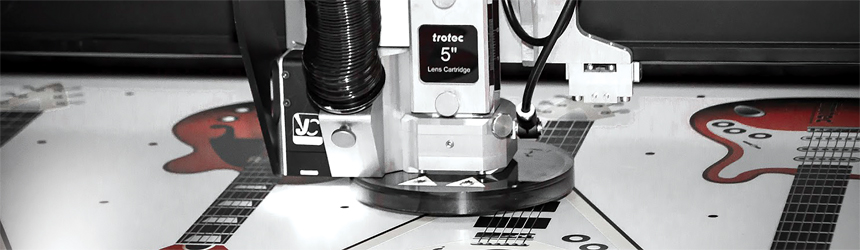
Above: Trotec offers the SP Series of large format CO2 laser cutting machines ideal for acrylic, paper, cardboard, plastics, wood, and textiles.

Simplicity or Versatility
Two types of laser cutting devices are used in the graphic arts—dedicated laser cutters and cutters with multi-tool capabilities including laser cutting as an option. There are benefits to both.

Dedicated laser systems are ideal for production-based work, according to Heather Roden, strategic account manager, graphics/packaging, Zünd. “These are scenarios that are predictably geared toward high volume in one particular area. For example, small format applications that require greater laser power than available on a multifunction finishing machine,” continues Roden.

“A dedicated laser cutter offers high cutting speed and low running cost because it scarcely needs consumables,” adds Devin Huang, representative, GCC.

A benefit to owning a dedicated laser cutter is the simplicity, as it only has one function. “There are no other fabrics or tools to switch to, or possible new workflow to learn. There are no blades to replace or stock, or the need to remember what tools do what. Generally, dedicated tools simplify workflow and increase production all while decreasing cost,” says Matt Gusse, VP sales and marketing, Advanced Color Solutions (ACS).

Certain laser cutters are specifically designed to cut fabric. “A dedicated solution will handle fabric in the best way possible, because that’s what it’s been designed to do. Fabric moves, shrinks, and stretches—the cutter needs to take that into account and not make it worse while handling it,” suggests Christina Lefebvre, area sales manager North America, Matic.

Conversely, cutters with multi-tool capabilities offer flexibility. “Smaller PSPs, who have room and need for only one olution like this capability as it allows them to do more work for an existing customer and to more easily gain new ones. The critical issue is having full conveying and automation for both kinds of tools so that a PSP can use the cutter with equal facility for whatever kind of job customers desire,” explains Steve Aranoff, VP business development and marketing, MCT Digital.

“Multi-tool processes minimize non-productive station to station time, as well as eliminate additional overall stack error caused by re-fixturing,” adds Kris Scherm, product group manager, fabrication, MultiCam Inc.

“Dedicated laser cutters are optimized for specific cutting applications, so their speed and efficiency are higher. However, they are not as versatile as cutters with multi-tool capabilities,” admits Shuming Zhang, GM, BesCutter.

Making the Right Choice
While both types of technologies offer benefits, certain print providers and print operations are better suited for one over the other.

In general, Josh Stephens, applications specialist, Trotec Laser Inc., believes any print provider with the need to transform printed materials to specific shapes—known as print and cut—should invest in a dedicated laser cutter. “Adding a dedicated laser cutter opens the door to expanding into new markets such as all segments of the signage industry, prototyping, point of purchase, and apparel.”

According to Roden, a dedicated laser cutter is for businesses with highly specialized and/or predictable product offerings, with little deviation into other applications or product offerings.

“If a PSP already has a satisfactory router/cutter and is looking solely for cutting and/or engraving of smaller pieces, or has a need for higher power—than a standalone laser may be sufficient,” says Aranoff.

Lefebvre recommends print service providers (PSPs) investing in a dedicated fabric printer should also invest in a dedicated laser cutter. “Textiles are alive and need to be handled differently than any other substrates. That’s why the PSP buys a dedicated printer—the same applies to cutting.”

In the apparel industry, Gusse suggests companies outputting in the range 200 to 400 jerseys or garments per day or 300 to 400 yards of cut fabric can benefit from a dedicated laser cutting system. These are generally small to medium sign and display shops or print on demand businesses struggling to keep pace with their printing.

For print providers looking to offer customers a range of options and keep all jobs in house, a cutter or router with multi-tool capabilities is a better fit. “Multi-purpose systems are ideal for businesses whose portfolios are centered on meeting all of their customers’ printing and finishing needs while avoiding the problems associated with outsourcing. They are also ideal for those in urban or other settings where real estate and floor space is at a premium and any equipment installed must meet multiple demands, producing nearly continuously,” shares Roden.

Common Concerns
A print provider can encounter challenges during the initial stages of working with either a dedicated laser cutter or multi-tool device with a laser option. In most instances, it is the common hurdle of becoming familiar with the technology.

“Print providers should expect the same challenges with a laser cutting device as any other large format tool. It is a larger, often very heavy, delicate, technical device,” explains Gusse. He suggests PSPs ask certain questions prior to purchase like what can it cut, how fast can it cut, how much wattage is required, does the laser use a glass or metal tube, how long is the laser good for, and where can it be replaced?

“Systems can be offered with a CO2 or fiber laser source, and each type has its own set of advantages and limitations. Consumers are often not aware of the many available accessories that can enhance an application or make processing materials easier, such as cutting tables or camera registration,” recommends Stephens.

According to Zhang, an initial concern with a dedicated laser device is setting up the laser beam alignment. Once this is accomplished—correctly—setup and everything that follows is much easier.

Roden admits that one of the biggest challenges is knowing when a laser makes sense versus a different tool. Sometimes it is difficult to determine the better and more productive option. “There are many materials and applications for which laser, and the burning process it entails, are less than ideal because of discoloration or other potential issues with the sealed edges, the cut pieces need to be sewn anyways, or their chemical properties do not lend themselves well to laser cutting.”

Fabric Popularity
With a growing number of PSPs adding digital textile printing to service offerings and garment manufacturing settings expanding into digital printing, it’s logical that finishing be addressed. Laser cutting is highly beneficial when it comes to cutting textiles.

“Modern laser—in addition to knife—cutting allows flexibility in design, full customization, and one-off processing at volume pricing,” says Scherm.

Textiles are challenging materials to work with. The less they are touched throughout the production process the better. Laser cutting eliminates a touch point. “It is a cutting technology that limits or eliminates touching the fabric. There is very little stress put on the fabric, hence it will not be stretched or tensioned out of the measurement,” shares Lefebvre.

A device with an extended table is important, whether it is a dedicated or multi-tool capability laser cutter. “Digitally printed fabric presents a larger table need compared to typical signage. Fabric rolls require accurate cutting and the final size may be longer than a traditional table length,” explains Aranoff.

Laser cutting prevents fraying. “Because of the burning and melting process involved in laser cutting, it has the advantage of both cutting and sealing the edge of commonly used polyester. PSPs who benefit most from adding laser to their tool palette are those working with woven polyester media making products where sealed edges are ideal for keeping the material from fraying,” explains Roden.

With no blades, dies, or punching, no fabric is wasted from cutting or fibers floating around the production area. Also, no blades eliminates blade cleaning or wearing down of the blade, so less ongoing maintenance and cost, cites Gusse.

Other Substrates
While textiles are popular, other digitally printed materials can be laser cut—from foam to wood, plastic, and paper.

“Laser systems can process thousands of different types of materials ranging from fabric and textiles, plastics, glass, and food. Many technologies use a physical knife blade or bit to cut printed materials, but a dedicated laser system utilizes its beam of light for processing, allowing for more intricate cuts compared to a physical blade, which is limited to a tight radius,” explains Stephens.

Scherm also points out that many if not most materials can be cut with the laser, and the “as cut” condition right off the machine can be used as the final product—no additional finishing required.

This includes acrylics, which are cut via laser frequently, according to Zhang. The final product offers smooth and polished edges—coming off of either a dedicated laser cutter or a multi-tool device.

“Many applications use laser cutting after print, for example, a dedicated laser cutter can cut the contour of printed labels, while a multi-tool device with lasers can crease and cut a printed paper box,” offers Huang.

And while materials such as ceramic or rock can’t be cut, they can be etched with a laser, expanding even more possibilities for a PSP’s customer, according to Aranoff.

Models in Motion
Here, we share information on popular models of dedicated laser cutters and finishing hardware with multi-tool capabilities including laser cutting as an option.

ACS distributes the Golden Laser series of dedicated laser cutters. They use conveyors and auto feeders to keep cutting continuous. Systems are produced in widths up to 3.2 meters and lengths up to eight meters or more. All models are equipped with a camera vision registration system. Various cutters are designed for specific applications including sublimated clothing and fabric, sportswear, flags, banners, and soft signage.

BesCutter offers a 150W dedicated laser model featuring a 52×36-inch table. The device includes both a honeycomb and a knife blade worktable. The table height can be automatically adjusted to accommodate rotary attachments and tall objects. The clearance is up to seven inches.

Eastsign Inc. provides four different models in its Mark Point line of dedicated laser cutters. With variations in cutting area, each model in the portfolio offers cutting speeds of ten to 50 meters per minute. Accurate camera positioning provides cutting correction for stretching and distortion. The cutters are equipped with automatic feeding devices to handle challenging materials such as fabric.

G.U. Eagle America, Inc.’s G-1325 CO2 laser cutting machine offers high precision cutting for acrylics, wood, and cardboard. It features a working area of 49×98 inches. The G-1325 is equipped with optics produced in America in order to produce a high quality and consistent laser beam across the entire working area. This achieves a better cutting and engraving quality.

GCC offers its dedicated LaserPro T500 laser engraver and cutter. It cuts through one-inch thick acrylic in a single pass with a smooth finish. For graphics, the AAS contour cutting device is an optional feature that provides accurate and faultless contour cutting by automatically tracking the position of graphics.

Kern Laser Systems’ OptiFlex series of large format dedicated laser cutters are powered by the HyperDual motion system. It features a rack and pinion design and powerful servo motors at each side of the laser table. An improved down draft vacuum bed holds down material. Four standard work area models are available, but custom sizes are also an option.

The Matic Helios Plus laser cutter is a dedicated textile solution. It recently became available in a five-meter wide format, joining the pre-existing 3.3-meter wide version. Designed based on the customer’s requirements, each laser cutter differs in pricing depending on the level of automation and options added into the model.

MCT’s VersaTech2 is an all-in-one solution. MCT is now shipping the third generation of its laser belt technology. Utilizing a unique three-ply architecture, the lightweight aluminized belt system is made up of replaceable laced panels, and a zippered connection allows for easy removal and re-installation. With these capabilities, the VersaTech2 incorporates full conveying for laser, router, and knife cutting in one system. MCT also recently announced a new entry-level flatbed laser solution that while starting as a dedicated laser device can be field upgraded with routers or cutters.

MultiCam’s dedicated laser cutter, the Magnus CO2 Laser, offers several cutting head options and a range of optic choices to suit cutting or engraving. It is ideal for laser cutting acrylic, ceramic, coated metals, corian, fabric, fiberglass, leather, melamine, and paper.

Trotec offers the SP Series of large format CO2 laser cutting machines ideal for acrylic, paper, cardboard, plastics, wood, and textiles. The portfolio includes models with work areas of 49×28, 59×59, 66×98, and 87×126 inches. Maximum material height varies from 2.2 to 11.8 inches.

Zünd offers its Laser Module – LM 100W compatible with the Zünd G3 series. It can be paired with the Zünd Over Cutter Camera system for one-shot registration mark capture and a tension-free unwind unit for wrinkle- and distortion-free advances. The entire solution is ideal for cut and seal polyester fabric applications, but as a multi-tool system, also offers blade-based alternatives. Zünd cutters are modularly designed and field upgradeable.

Software Drives
While digitally printed textiles benefit from the physical act of laser cutting, they also gain advantages from the robust software driving it.

The software used on a traditional optical registration system isn’t necessarily designed to handle all of fabric’s nuances. “Fabric shrinks, requiring excessive dots or registration points to ensure accuracy. It takes time for the operator to add each individual dot and for the system to read each one. There are cases where this is very time consuming, especially when you have sensitive fabrics,” explains Matt Gusse, VP sales and marketing, Advanced Color Solutions (ACS).

Christina Lefebvre, area sales manager North America, Matic, agrees that working with the software on a dedicated laser cutter is ideal when considering fabrics because it is generally designed with only fabric in mind. “Printing on fabric is not limited to 4×8- or 5×10-foot measurements that fit nicely on top of the bed of a cutter. Fabric print jobs might be continuous graphics of 30 to 50 feet long. The software needs to be able to account for shrinkage, stretch, banana effect, and accurately line up your graphic if it’s being cut in multiple passes.”

Vision Laser software, found on Golden Laser devices distributed by ACS, uses one or more HD cameras mounted above the conveyor cutting bed to scan the printed fabric or materials on the cutting area. The software recognizes the outline of the pattern and then generates the cutting data.

“It identifies the printed sublimation pattern, then creates the cutting path data automatically and completes the cutting process so as to perform continuous recognition cutting for the entire roll of printed fabrics with minimal manual intervention,” shares Gusse.

Matic’s Helios Plus dedicated laser cutter is equipped with software that compensates automatically for shrinkage and distortion, eliminating the need for manual measurements.

Zünd’s Over Cutter Camera is an intelligent optics system for fully automated digital capture of registration marks. The camera is mounted above the center of the cutter, either on a support frame or suspended from the ceiling. It automatically captures all registration marks within the working area of the cutting system in a single image in a matter of seconds. The data processing functions are integrated into Zünd Cut Center software and algorithms analyze the data captured by the camera and simultaneously compensate for any distortions.

Laser Cutting
Efficient and cost effective, both dedicated laser cutters and multi-tool finishing devices with laser options are available for PSPs considering adding laser cutting to their shop. Depending on the type of service/application planning to be completed, one type may be a better option over the other.

Dedicated laser cutters are ideal for very specific projects that occur repeatedly, and if cutting textiles in particular, a dedicated textile laser cutter is ideal. Conversely, if printing to multiple substrates and space is at a premium, a multi-tool router/cutter with laser cutting as an option may be the best choice.

June2018, Digital Output

Digital Print

Finishing

Laser Cutting

Breaking Tradition

By Olivia Cahoon

Traditional analog printers still exist but digital printing continues to advance into these facilities. By adding a digital press to an analog-only print shop, print service providers (PSPs) improve printing processes with faster turnaround times while expanding their offerings into point of purchase (POP) displays and posters when a wide format digital printer is added.

Above: Ross Printing of Spokane, WA integrated digital printing capabilities into its lithography/flexography shop in 2001. Today 50 percent of the shop’s work is digitally printed using HP Indigo presses.

Analog-Only Printing
The wide format market is over 25 years old and includes PSPs with digital as well as analog technologies. For some print shops, this includes digital-only capabilities and a mixture of digital and analog.

“The earliest wide format graphics systems offered to the commercial printer population were more or less turned down as being so far out of scale as to what they did,” says Mark Hanley, president, I.T. Strategies.

For nearly ten years, Hanley says those same surviving commercial printers saw the errors of earlier assumptions and became an important channel for digital wide format graphics—expanding digital printing into local shops in various locations. “Commercial printers globally take in $7 billion of revenue from wide format digital graphics at a conservative minimum,” he offers.

In the wide format business, 80 to 90 percent of printing establishments use digital printing equipment, says Tim Greene, research director, hardcopy solutions, IDC. “That’s not to say that 80 to 90 percent of production is digitally printed, but that the penetration of digital equipment is at the 80 to 90 percent level,” he explains.

According to Greene, the primary reason analog printers go digital is to respond to customer demands for short runs and fast turnaround. “Fast turnaround drives a lot of the investments in ever-faster equipment,” he says. “I think this is one thing that surprises analog printing companies at first. They need to continually reinvest in equipment to meet these customer requirements.”

Going Digital
Analog-only shops add digital printers and finishers to their production for a variety of reasons including customer demands and cost-efficient short runs. PSPs with little to no knowledge about digital print technology or its investments may be discouraged about the possibilities of implementing digital due to the shop’s size or services.

A PSP’s shop size typically doesn’t impact its ability to invest in digital technology. According to Greene, the investment in digital printing equipment is often low so that shop size isn’t a significant barrier to entry into the digital printing business. “I believe any sized shop can go digital,” he offers.

For PSPs concerned about costs—especially when considering wide format devices, latex and water-based digital printing capabilities offer an affordable entry to digital printing. Steve Urmano, director of wide format, Keypoint Intelligence, offers, “any size shop can add digital printing—aqueous and latex wide format printing is the most affordable that it’s ever been.” Water-based technology is often used for applications like fine art, indoor posters, photography, and POP displays.

However, using a water-based device typically restricts users to indoor signage unless the print is laminated. This is because aqueous and water-based inks are susceptible to UV fading and the ink sits on top of coated media.

As an alternative, latex technologies offer outdoor durability and are used for banners, soft signage, and signs. “Today’s latex wide format printers are quite affordable, less than $5,000, and can be used for unlaminated outdoor signage,” says Urmano.

Analog-only printers that invest in wide format digital technology broaden their services to applications like billboards, garments, outdoor floor graphics, packaging, POP displays, trade show signage, vehicle wraps, wallcoverings, wayfinding signage, and window graphics.

According to Hanley, printers originally did not understand the appeal of wide format digital graphics as a driver for enhanced POP sales based on a local supply of micro quantities at high cost. “Not only have digital wide format graphics offered high margin, new business to printers who already serve the same users, but it has further opened the door to enhanced retail print and communications support services to printers beyond the graphics themselves,” he explains. “Retail is not the only source of business of wide format graphics either, but it is one of the biggest.”

Application types typically don’t impact how analog printers implement digital printers and finishers. However, Greene believes it helps if the shop experiences demand for a variety of applications rather than one digitally printed application.

“Shops investing in digital printing equipment typically use it for a variety of applications,” he offers. “We do find shops that have dedicated wide format printing equipment but often print shops new to digital have one wide format printer that produces whatever jobs their customers ask for.”

Analog PSP Concerns
One primary concern of analog printers moving into digital printing is how a company that goes digital can fight commoditization and maintain margins. Greene believes this is the same battle faced across many segments of the graphic arts. “Companies need to look at what value they can add and consider digital printing just one of the necessary tools to enable that value to be applied,” he explains. “The more companies embrace that digital transformation, applying digital workflows, big data, analytics, and other tools, the more value they will be able to apply.”

According to Urmano, implementing a digital press into an analog-only printing environment isn’t a difficult task. “Most printers whether they are analog-only or digital have learned desktop publishing techniques long ago,” he explains. “All they have to do is setup the equipment, install the drivers, select an image, scale it to size, and print it.”

Additionally, wide format digital printers typically require minimal cleaning and maintenance. Greene believes this shouldn’t affect the PSP unless their press room is in a dirty environment. If so, he says the wide format printer needs to be placed in a clean environment with a comfortable temperature and regulated humidity. “Remember, if it’s comfortable for you, it’s comfortable for the printing device.”

Digital Considerations
Analog-only printers considering digital printing technology should be aware that digital printing is a necessary tool in today’s signage and graphics market, recommends Greene. “It is not a panacea—great relationships with customers and high standards for quality and service are still required.”

On the more practical side, Greene suggests PSPs research prospective digital print investments due to the variety of sizes and shapes available. He offers, “many shops don’t get all that they could if they haven’t planned out their investment along with technical aptitude and sales and marketing capabilities.”

Urmano agrees and advises PSPs to take time when selecting a digital device. “Buy a name brand device as there are many available based upon width, price point, and indoor and outdoor printing applications,” he advises. “Speak with your peers, they are probably printing wide format digital already.”

101 Years of Printing
Founded in 1917, Ross Printing Co. started as a forms and business papers provider for local businesses, financial institutions, and healthcare in Spokane, WA. The company operated with six employees in a 5,000 square foot work area with a two square mile market area. In the early 1920s, the company entered pharmaceutical packaging, primarily labels.

When lithography evolved as the main reproduction process after World War II, Ross Printing became a vendor for full-color lithography advertising and promotion opportunities. In the late 1970s, it created a flexographic division to accommodate more efficient production of pharmaceutical packaging, supplements labeling, and food processing requirements. This led to integrating digital roll printing in the early 2000s.

Today, Ross Printing is a full-service print provider with flexographic, lithographic, and digital capabilities. The company offers folding cartons, labels, marketing materials, packaging, POP displays, posters, and sample pouches. With 25 employees, it operates in a 40,000 square foot facility and ships its products worldwide with most of its volume sending to CA, OR, and WA.

In 2001, Ross Printing entered the digital space with an HP, Inc. Indigo press to achieve rapid cycle time, improved color fidelity, short runs, personalization, and scheduling flexibility. “The company was typically an early adapter of both on-press and prepress digital technology as it became available,” says Eric Smith, GM, Ross Printing.

With digital printing, it produces pharmaceutical, supplement, health/beauty, and food/beverage applications. According to Smith, the digital print process has opened many new customer relationships for the company around the region and the U.S. “It buffers us well from the diminished market demand for lithographic products,” he explains. “It also complements our lithographic and flexographic offerings to create a unique value proposition few providers in the U.S. can provide.”

Currently, 50 percent of Ross Printing’s work is digitally printed using its HP Indigo presses.

According to Smith, the marketplace for simple four-color labels is becoming commoditized over time. “The higher margin opportunities require unique finishing to add value to the label,” he reveals. Demands for films are also increasing as well as the replacement of conventional pressure-sensitive solutions.

With over 100 years of printing experience, Ross Printing maintains a positive outlook on the future of print. “Digital machines are becoming faster as time goes on, which raises the efficiency or breakeven for analog machines to compete,” explains Smith. “The remaining benefit for analog-only printers would be longer runs where digital continues to struggle with speeds or other online capabilities unique to conventional flexographic machines.”

A Digital Tomorrow
By investing in digital technology, analog-only print shops expand services while improving current offerings with short runs, quick turnaround, and customization. Before investing in digital printing, print providers should research prospective investments and applications. Adding wide format digital printers, for example, allows for moving into new markets.

June2018, Digital Output

Digital Print

Wide Format

In-Store Fabric

By Melissa Donovan

The combination of a textile printer that delivers stunning graphics, material constructed with the purpose to exhibit beautiful imagery, and a display system that holds up in high-traffic environments is a recipe for success. Many print service providers (PSPs) have one or more of these components. Companies offering all three are poised to capture business from notable and recognizable brands like those in the Fortune 500.

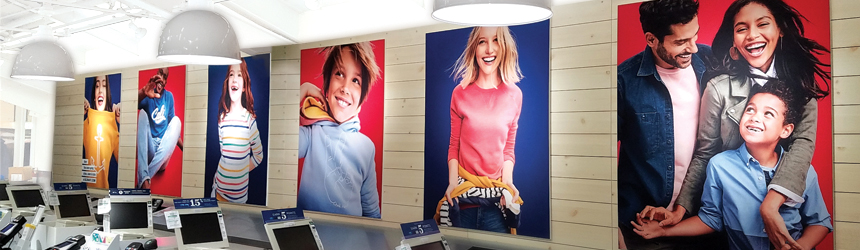
Above: An EFI VUTEk FabriVU 340 helped Cypress, CA-based DVC complete work for clothing retailer Old Navy–SEG Fframes with Fisher Textiles’ GF 4017 Soft Knit.

Visual Impact
D’Andrea Visual Communications (DVC) began in 2005 as a boutique lithographic print shop. While it still offers lithography services, it also provides design and fabrication, grand format printing, cold foil printing, digital storefronts, installations, bindery, fulfillment, and distribution out of a 55,000 square foot location in Cypress, CA with 100 employees.

A significant amount of DVC’s work consists of digital fabric printing. When the PSP first introduced digital textile printing, it used a PressVU with UV ink from VUTEk—later purchased by EFI. In 2008, it switched to printing on fabric using dye-sublimation (dye-sub) on a Durst Image Technology US, LLC Rhotex textile printer.

Its newest printer is the EFI VUTEk FabriVU 340. A 3.4-meter or 133-inch wide dye-sub device, it offers ultra-high resolution up to 2,400 dpi. Color vibrancy, quality, speed, and water-based inks are key attributes. Combined, these features reduce DVC’s environmental impact.

“It is our duty to provide our clients with the highest visual impact possible. With the EFI VUTEk FabriVU 340, clients are getting graphics never seen before,” explains Scott Powers, founder/VP of sales, DVC.

In addition to the EFI VUTEk FabriVU 340, DVC also works with two EFI VUTEk ten-foot flatbeds, two 16-foot EFI VUTEk GS5000r roll-to-roll printers, a ten-foot HP, Inc. Latex 3600 device, and a ten-foot EFI VUTEk TX3250r dye-sub printer. This equipment lineup allows DVC to offer everything from the traditional banner, pop-up display, or vehicle graphic to unique wallcoverings and printed carpet.

Versatility with SEG
A popular application produced on the EFI VUTEk FabriVU 340 are silicone edge graphics (SEG) placed in aluminum frames. The printer provides the graphics with an unmatched visual quality and the framing systems used offer a polished finished look.

Fisher Textiles’ GF 8880 Opaque White, GF 4831 Heavy Knit, and GF 4017 Soft Knit product lines are preferred by DVC for this application. All are 100 percent polyester wrinkle-resistant fabrics.

SEG extrusions are offered from DVC. The company carries eight custom extrusions to guarantee the ability to meet customers’ specific graphic needs. They are available in 20-foot lengths or cut and built from 16×20 inches to 16×100 feet.

Powers says SEG frames—backlit and front lit—continue to gain in popularity. To combat market saturation and distance itself from the competition, DVC presents customers with options. For example, its latest endeavor is a wood pattern sublimated onto aluminum frames. The frame’s appearance resembles wood—ideal for high-end environments—but retains the durability and strength of aluminum.

Flagship Status
One recent job produced by DVC was for Gap Inc. brand Old Navy. The clothing retailer requested large graphics with a “stunning” and “high-end flagship” look executed at a reasonable price point with options for graphics to be changed out.

SEG frames hit all of the criteria. Creating graphics for Old Navy stores throughout the U.S., Powers estimates the company printed around 7,500 square feet of media. It used its EFI VUTEk FabriVU 340 and Fisher Textiles’ GF 4017 Soft Knit.

The printer allowed DVC to meet the customer’s quick turnaround and produce high-quality images that almost looked three dimensional, according to Powers.

Serving Customers
DVC offers its customers high-quality graphics with its arsenal of digital printers. The EFI VUTEk FabriVU 340 allows for a range of fabric-based applications, including SEG framing systems used in retail, exhibit, event, and corporate interiors.

May2018, Digital Output