Do Not Disturb

By Cassandra Balentine

Window media transforms windows into canvasses for creativity. Depending on specific environments and the needs of the end user, these substrates are used to promote brands or products, manipulate vision and light in and out of the window, or provide privacy.

In addition to window media used for printed graphics, print service providers (PSPs) should consider window media for privacy applications. A range of options are available, including solutions created specifically for the purpose of adding privacy as well as general use medias printed in a way that provides privacy in addition to graphics. A combination of these options can present a practical solution with an appealing look.

Above: SEAL Easy Dot Clear/Matte is a printable vinyl that does not require any special tools or training to install.

Privacy and Print
Privacy media and printed materials complement each other in logistical and creative ways.

“Depending on the effect that the customer or interior designer wants to achieve with a space, a digitally printable graphic, frosted glass design, translucent effect, or privacy film is an ideal solution,” says Jeff Losch, North America marketing director, Avery Dennison Graphics Solutions.

Jessica Stone, marketing specialist, Ritrama Inc., suggests that non-printable window materials offer a subtle privacy with elegant appeal and glass décor. “This look works nicely applied alone or can be complemented by a printable material that supports a need for more privacy,” she states.

“By incorporating printed materials and privacy media, you can create a mixed media design that sets your display apart from all the others while still achieving the desired privacy,” recommends Lily Hunter, product manager, textiles and consumables, Roland DGA Corporation. She says for retail applications, this enables a display that catches the consumer’s eye and entices them to come in. “In a sense, the combination of printable media and privacy media, such as etched glass film, serves as functional art—it’s not only attractive, it also serves a purpose.”

Darren Speizer, VP of sales and marketing, Drytac, agrees, noting that non-printed privacy media options play a large role in many applications—particularly architectural. “Non-printable films can complement printable materials in different settings, such as corporate and hospitality locations, where design elements may play a larger role.”

Casey Jones, associate product manager, SEAL, part of ACCO Brands, believes whether you are using privacy media for advertising and point of purchase (POP) in shop windows or as a partition between cubicles in an office space, printed material allows for customization. “You can brand a message or customize a decoration that perfectly adds to your space.”

“Having both printable and non-printable materials give the print provider an opportunity to offer customers multiple options for window décor,” adds Jeffrey Stadelman, market manager, Mactac Distributor Products.

Jim Halloran, VP, sales and marketing, Lintec of America, Inc., points out that in some cases, the same roll of materials can produce a graphic and privacy function. “Depending on how the customer wants to use the space, removable adhesives can be used to change these out frequently.”

Customer Demands
A variety of businesses request privacy media solutions. Office buildings, government offices, hospitals, hotels, police stations, doctor and dentist offices, and airports are a few examples where privacy media is in demand.

Halloran finds that the types of customers that request privacy window media are primarily office environments. “In many cases companies are using open office plans and having small to midsize breakout rooms for groups of two to 12 people to meet. Rather than closing off the entire space with drywall it is easier to use privacy film on glass, it also lets more light into the office.”

John Coyne, sales manager, Lintec of America, adds that applications vary from office cubicles and conference rooms to hotels and restaurants. “Retail environments also have a need for privacy films to enhance advertising,” he continues.

Jones agrees, noting that often privacy film is seen in strip malls with vacant spaces to prevent passerbys from looking into a space that isn’t built out. “It can also be used in restaurants to create privacy and divide between tables and the bar. In corporate environments it is frequently used to create privacy and décor for a meeting room, office, or cubicle.”

The intended environment and end use of the media helps determine which product is selected. “Typically, translucent window films used to create private spaces allow light to enter, creating a comfortable, well-lit open feeling,” shares Stadelman.

Adding Privacy Options
PSPs benefit from stocking a variety of materials. Adding privacy media options to a product arsenal is an easy way to meet more customer demands.

“Having another media to offer customers for windows can expand sales. Additionally, building spaces that allow for collaboration—in offices and schools—are becoming popular. Privacy media can be used on removable walls and partitions to add privacy and décor to an office space,” says Jones.

Halloran points out that PSPs with UV or eco-solvent printing capabilities can offer customers ways to decorate glass for other architectural or POP purposes. “It is another higher value way to provide service to customers.”

Coyne adds that this type of privacy option for PSPs may provide the all-in-one solution that many customers appreciate. “It would serve to reduce the customers sourcing workload and may open up new opportunities in other markets for the PSP,” he explains.

PSPs benefit by becoming a one-stop shop for designers who want to combine different elements of window graphics. “This equates to more customers, increased business, and greater profits, while also allowing for expansion into different niche markets,” says Hunter. “Take vehicle wraps as an example, you can offer printable media, reflective vinyl, and colored cut vinyl, and all of those materials can be utilized in one car or truck wrap. Instead of simply printing out a phone number on the vehicle, you can incorporate cut vinyl for that section to ensure the best placement.”

Jake Oberle, marketing supervisor, window film and architectural finishes, 3M Commercial Solutions, shares that customers are asking for privacy solutions. “Customers are either seeking this solution or they want something made. Having both options is opening the door for more opportunities. Adding these materials also help print providers expand their current sales potential and optimize equipment or installation services—if their printers are already running at capacity and installation crews are underutilized, they can now accept jobs that will not impact print capacity, but help optimize installation capabilities,” he continues.

Upselling Privacy
PSPs that stock and regularly use privacy window materials can recommend them in situations where they feel it could add value to the job. For those coming in the door looking for graphics, adding privacy media to the design may be attractive depending on the job at hand.

Losch suggests talking to the customer about what they’re trying to achieve. Finding the best solution is always ideal, so offering a full range of window and privacy options is beneficial. “Additionally, considerations such as the effect desired and budget may lead the customer to choose one product versus another. A single customer could incorporate graphic designs in certain areas of the business and privacy films in others,” he offers.

Stone believes there is always opportunity to explore upselling with your customer. “Take the time to listen to their goals and understand their business/environmental needs both now and in the future,” she urges.

For those requesting privacy media, adding printed graphics is another way to upsell, either printing to the privacy graphic itself, or adding graphics on top of a job meant to provide privacy.

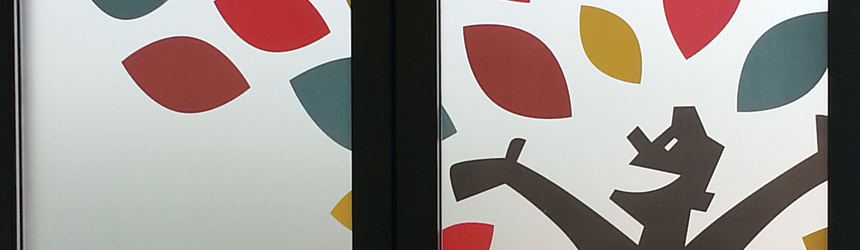
Halloran says many customers can now print their own window graphics that provide privacy. “Many of our customers print a fine white mist embedded with logos or other graphics that let light through but do not allow for vision,” he explains.

Coyne adds that PSPs can now print a white front or mist around a graphic, image, or logo to provide a print solution with the dual purpose of privacy and promotion.

“Adding a little printing to the window for decorative purposes, like incorporating the company logo or a simple design to break up the privacy screen, offers options to the end user,” suggests Stadleman.

Printable privacy media allows the customer to customize or brand the graphic. “I would encourage a print provider to understand the purpose of the privacy media and then convey the benefits to the customer of personalizing the graphic for their space or to achieve their objective,” advises Jones.

“Printable material can be customized to support branding initiatives as well as the overall customer experience. Printed window graphics enable an end user to canvas unlimited spaces in their facility with visuals and messaging that creates a unique customer experience and speaks to their offering our business values,” says Oberle.

Products, Install, and Care
Several media providers offer substrates designed for providing privacy on windows, or can be printed in a way that provides privacy. Here we highlight a selection of these solutions and provide installation and cleaning tips.

3M FASARA Glass Finishes is a portfolio of decorative glass films that provide the look and feel of etched, cut sandblast, and textured glass. It requires a wet install.

Avery Dennison offers a portfolio of digitally printable media, such as opaque, perforated, translucent, and clear films that can be applied to interior windows for environmental aesthetics. Special effect films such as Avery Dennison SC 900 Series Etchmark and Frosted Sparkle can transform a window with a cut pattern or design or be used in combination of other films. In addition, translucent colored films can be used to create graphic window designs.

Retrofit switchable film, a new innovation from Avery Dennison, provides the option for privacy. The films use liquid crystal technology to switch from transparent to opaque with the touch of a hand. The product is not printable. Avery Dennison privacy and switchable films require a wet installation.

Drytac provides four printable products that provide privacy—ViziPrint Impress Clear, ViziPrint Deco, ViziPrint Illuminate, and SpotOn Matte Clear Frosted. ViziPrint Impress Clear is an ultra-clear PET film with a proprietary adhesion technology. ViziPrint Deco is an optically clear gloss PET film with a permanent acrylic adhesive that adheres to most substrates, including glass surfaces.

ViziPrint Illuminate is a translucent matte PET film that uses a mechanical bond to adhere graphics to glass and other smooth, flat surfaces. ViziPrint Illuminate is reverse printable, allowing for indoor and outdoor visibility of window graphics.

SpotOn Matte Clear Frosted is a monomeric PVC film with a dot patterned removable adhesive. The pattern allows for easy, bubble-free application of graphics to a range of substrates without the need for tools or wet application. It acts as a privacy film because of its opacity.

Lintec of America offers 14 different optically clear films, all of which have been printed and converted to privacy films. Another 15 films, which are either frosted or textured, are also printable. Installation of its film should be done with a soapy water solution. For cleaning, soap and water with a soft cloth is ideal and avoid harsh chemicals like Windex, which when it comes in contact with exposed adhesive can lead to edge lifting over a period of time.

The company also has a range of films where the viewing angle changes its degree of privacy, the VisionControlFilm (VCF) lineup. VCFs are designed to change from optically clear to frosted depending on the view or angle. Four different types are available that vary from clear in the center and frosted on the side to clear on the sides and frosted in the center.

Mactac supplies two different types of pressure-sensitive window decorative media, Glass Décor 700 for non-printed applications and IMAGin B-Free. Glass Décor 700 is translucent in nature with a frosted—acid etched type appearance, or dusted—sandblast effect finish. IMAGin B-Free Frosted, Dusted, and Clear air egress adhesive window films are designed for digital printing.

Ritrama offers the Crystal/Etch series, the crystal creates an appearance of sandblasted glass using its Frosted Crystal, while the Etch is a luster finish or glass Etch with a matte finish for a sandblasted look. The Crystal/Etch series can be applied to glass, acrylic, or polycarbonate.

Additionally, Ritrama’s Window Cal III is a white film that is metallized on one side and coated with a white pigmented adhesive to achieve opacity. The material is print to edge approved and allows eye-catching, two-way window graphics when using two components of the Window Cal Series. Window Cal III features a moderate peel removable solvent adhesive and can be applied both wet and dry.

SEAL Easy Dot Clear/Matte is a printable vinyl that does not require any special tools or training to install. Easy Dot Clear is well suited for frosted office partitions. SEAL Ultra Clear PET is not opaque, but with a printed graphic on glass can provide separation in office and restaurant environments. It is wet applied.

Window Options
With the selection of window media options available to PSPs, it is a versatile platform. The ability to add privacy in addition to graphics is attractive to end users in a variety of environments, from offices to hotels and hospitals and even retail.

Feb2018, Digital Output

Captured by Print

By Olivia Cahoon

Digital printing technology gives artists and photographers the advantage of reproduction on demand without the effort of manually reproducing. Businesses, museums, and even interior decorators seek reprints of modern and well-known photography for display and decor. Today’s digital printers can take artwork to supersized proportions.

Above: 90 percent of Coupralux’s business consists of fine art printing. The company, based in Dallas, TX, uses a Nyala 2 from swissQprint to achieve high-quality reproductions and original artwork for customers.

Early Years
Established in 1994, Coupralux Digital, Inc. was founded as the first independent digital services shop serving Dallas and Fort Worth, TX. The company operated from a 2,000 square foot work area. Mike Bowers and his brother recruited additional staff that possessed a technical knowledge of photography and a background in fine arts.

“Back in 1994, we were digital scanning and printing pioneers,” says Mike Bowers, owner/operator, Coupralux. The company’s customers consisted of commercial photographers and small- to mid-sized advertising businesses that had begun to use Adobe Photoshop to produce their work.

According to Bowers, customers needed film scanned and high-quality color proofs. Since the beginning, Coupralux’s business philosophy is to only offer the absolute highest quality digital services regarding resolution and color. This required the early adoption of ICC color management, which allowed the company to use its own color profiles for all ink and media combinations. As a result, it achieves consistent high-gamut output.

For the first ten years Coupralux used Kodak Pro Photo CD and Heidelberg Tango drum scanners and printed on a collection of Iris Graphics 3047 printers. According to Bowers, the company’s focus on quality attracted many clients in the art industry who now make up the majority of Coupralux’s customer base.

Coupralux Digital now operates from a 10,000 square foot facility in Dallas, TX and offers services to LA, OK, and TX with a staff of seven.

Production starts in the digital capture studio with a Better Light, Inc. digital scan back accompanied by an array of different lighting effects and capture software. Prepress is completed on Mac computers with color-profiled monitors using Adobe Creative Suite software.

Coupralux uses Epson aqueous and solvent printers in addition to a swissQprint Nyala 2 UV printer. “These and a variety of finishing processes allow us to offer large format art scanning as well as large format art production,” says Bowers.

Fine Art Printing
Coupralux’s early focus on digital output quality attracted the attention of the fine art industry who traditionally relied on offset printing processes. According to Bowers, once art industry players became comfortable with the company’s digital output quality, the diminished financial risk offered by small quantity digital runs versus high-volume offset became the primary deciding factor for many clients.

With fine art digital printing, Bowers believes client communication is one of the largest challenges the company experiences. He believes it’s integral to understand each artist’s vision or purpose for each project. “Having a team of people passionate about art themselves is key to translating our clients’ wishes into successful art projects,” he adds.

The company produces a full range of printed fine art pieces from watercolors to photography. “Some prints are just the beginning of the artist’s vision and are embellished afterwards while others are exact reproductions,” says Bowers. The company also handles unique pieces digitally created as an original work of fine art.

Roughly 90 percent of Coupralux’s work is digitally printed fine art with the other ten percent occasional architectural interior signage jobs. Self-publishing artists seek the company’s services for high-quality and low-volume art reproductions. Bowers says both corporate interior and hospitality industries also approach the company for high-end, short-run processes for wall décor.

For Coupralux, clients often choose the digital output process that best complements their work. Bowers says watercolor reproduction almost always translates perfectly into aqueous prints on watercolor papers. Original oil and acrylic paintings are often reproduced as a solvent canvas but can also be done on aqueous and UV presses.

Art Reproduction
In December 2016, Coupralux installed the swissQprint Nyala 2 UV printer. “We searched for a long time to find a flatbed printer that would print to the level required for fine art, and we were always wanting something a little better,” admits Bowers.

The Nyala 2 prints up to 2,217 square feet per hour maximum productivity on a 126×79-inch bed. It offers various add-on extensions including nine color channels that can be equipped with CMYK, light colors, white, effect varnish, and spot colors.

“The Nyala 2 was the first printer that hit every note we wanted in a UV printer,” says Bowers. The device is the size the company needs to produce custom oversized art pieces and offers the precision to consistently output high-quality prints.

When Coupralux first implemented the Nyala 2, its employees were familiar with how flatbed printers generally worked. However, Bowers says the training received from swissQprint had the company printing the second day after installation. “The Nyala 2 is a technically complex machine with numerous features, so the learning curve for us has been exploring its limits to see how far we can push its already excellent quality output,” he offers.

After one year of ownership, the Nyala 2 has completed 30 percent of Coupralux’s art production. Bower says he expects its usage to increase. “It greatly expanded the variety of art products we can offer our clients thanks to the variety of materials UV allows for,” he explains.

A variety of media is favored, specifically brands that have name recognition in the art community. This includes 3A Composites USA Dibond, Fredrix Print Canvas materials, Hahnemühle papers, and OPTIX acrylic sheeting from Plaskolite.

Adobe Photoshop is primarily used for the critical color adjustments required in fine art printing. Coupralux drives its printers with Caldera and ErgoSoft RIPs and maintains a portfolio of color management software and hardware.

Regarding digitally printed fine art pieces, Bowers notices artists and clients requesting increasingly large art pieces to fill interior spaces. Additionally, he says many artists use the company’s process as their original medium. “It is extremely rewarding to see an original piece of artwork for the first time coming off our printers,” he shares.

Urban Fabric Photography
In 2016, fine art photographer Justin Terveen approached Coupralux for printed interior art. Terveen is a TX-based photographer specializing in urban aesthetics and non-traditional photography. His company, Urban Fabric Photography, offers art pieces capturing architecture, cityscapes, photojournalism, and urban exploration.

Terveen requested 20 individual fine art images printed for a display at the Dallas Convention Center offices. Using the Nyala 2, Coupralux produced the images on white 3A Dibond panels with a semi-gloss varnish overlay. The images were back printed on Plaskolite OPTIX one-fourth-inch acrylic sheets with a protective polystyrene backing.

According to Bowers, the varnish overlay was printed as a finishing pass on the Nyala 2, saving the company a manual labor step. “The semi-gloss varnish increases both the dynamic range and color gamut of prints, while also providing a physical protection layer,” he explains. Additionally, the Nyala 2’s small ink droplet size along with light inks allowed the company to produce images with no digital artifacts, which is critical to fine art clients.

The job was produced a week after swissQprint installed the Nyala 2. It was also the first job where the company printed using a varnish overlay. The images were back mounted with an aluminum support frame and security hanging hardware. “Typically, we provide or coordinate delivery and installation of oversized art pieces, which many of our smaller clients are unaccustomed or unequipped to handle,” says Bowers.

From job submittal to installation the project took two weeks to complete. Coupralux is now the official print shop for Urban Fabric Photography. “I’ve been coming here for a year or so now and couldn’t be more pleased with the service of work. In the last year, our large format game has been stepped up immensely,” shares Terveen.

Artwork Reimagined
Artists and photographers seek businesses that utilize state-of-the-art print technology to duplicate and expand their artwork while maintaining quality. Using the Nyala 2, Coupralux caters to the needs of the fine art industry and benefits from relationships with artists who feed fine art reproduction demands.

Feb2018, Digital Output

It’s All in the Details

By Olivia Cahoon

Several methods exist for digitally printing fabrics and textiles including dye-sublimation (dye-sub). Print service providers (PSPs) select dye-sub printers partly because of the process. It uses inks that sublimate, turning into gas when exposed to heat, essentially fusing with textiles, and becoming part of the fabric. This enables images to sustain washing and wear and tear.

Dye-sub printers include two categories—transfer and direct. Dye-sub transfer printing entails printing output onto transfer paper, which is then run through a separate heat press and sublimated onto the fabric. Unlike direct dye-sub printing, the transfer method requires additional steps but also comes with its own advantages like higher resolution and greater detail.

Above: SCG Digital’s dye-sub transfer printers are used in the manufacturing of tote bags.

Transfer Printing
Compared to direct dye-sub printing, transfer methods offer a wider substrate versatility by allowing users to transfer images onto fabrics or rigid substrates in a variety of sizes, weights, and features. Direct dye-sub printers are limited in media options due to the need for coated fabrics and complications with direct printing onto velour and materials with less than 50 percent polyester composition.

“You don’t need to use a coated fabric for dye-sub transfer applications, while fabrics must be coated for direct dye-sub,” explains Lily Hunter, product manager, textiles and consumables, Roland DGA Corporation. Direct dye-sub requires a fabric with an ink receptive coating, which is applied by the fabric manufacturer, otherwise, the ink will bleed.

According to Hunter, direct dye-sub is traditionally used for printing flags because the higher saturation allows the flag to be viewed from both sides. Dye-sub transfer typically yields better results for printing graphics with fine lines and greater detail.

Matt Gusse, VP of sales and marketing, Advanced Color Solutions, agrees and says that a transfer printing method controls quality easier and expands the color gamut. Transfer sublimation allows for a variety of applications besides fabrics that includes metal, plastic, wood, and stone.

Gusse says this method also permits paper features like the ability for lower ink consumption, drying additives, ability to stick or be tacky when pressed, a variety of available fabrics, minimum waste, and help for controlling costs. “Clients making mugs/drinkware, license plates, ceramic tiles, photos on metal, key chains, wood tables, phone cases, or pre-sewn wearables are all paper sublimation candidates,” he offers.

Additionally, dye-sub transfer printers generally offer a lower investment than direct dye-sub printing. According to Gusse, direct dye-sub devices can range between $40K and $150K while wide format transfer devices are available for under $20K for 44-inch wide solutions. Desktop and small format dye-sub transfer printers are available as well.

Users that benefit the most from a dye-sub transfer printer handle a variety of apparel, banners, promotional products, and trade show signage. Specialty materials unavailable in large rolls or too expensive for purchase in high quantities are usually suited for dye-sub transfer printing as well.

“Shops that intend to explore a wider range of polyester substrates will likely adopt transfer,” says Kevin Currier, business development manager, digital products, Novus Imaging, an M&R Company. This includes materials that are difficult, wrinkle prone, or stretchy.

Currier believes many shops welcome the workflow of dye-sub transfer because it allows color management based on the transfer paper and applied to multiple substrates. He offers, “in transfer printing, the paper becomes the known factor and all the settings and quirks of running the paper through the system are then easily managed by the operators. The issues introduced by the fabric are then dealt with at the heat press, which is often easier to handle,” he admits.

Learning Curves
There are challenges throughout the dye-sub transfer process. Dye-sub doesn’t have a high light fastness rating, and as a result, outdoor applications are limited. To make dye-sub transfer printing more durable for outdoor use, Hunter says substrate manufacturers are working to create special coatings that prolong the outdoor durability of sublimated prints and goods.

The sublimation process is also sensitive to the environment in which the process takes place. “If the temperature or humidity level is too high or too low, that will negatively affect the output,” explains Hunter. Moisture in the substrate or transfer paper can cause bleeding, color shifting, and uneven transfer.

Shauna Malgieri, product specialist, S-One Holdings Corporation, agrees and believes environment and understanding the sublimation chemistry is one of the most considerable challenges of implementing dye-sub transfer printing. To achieve optimal conditions for quality prints, she recommends keeping accurate records of the testing process.

Additionally, Malgieri suggests PSPs consider the types of products they intend to sublimate to. “If it is fabrics, the sublimation is limited to high polyester content-based fabrics. If they want to sublimate to other products, they need to consider the investment in finishing equipment as well as the production space needed for the equipment,” she explains.

Paper selection is also an important factor for achieving desired image quality. Robin Kavanagh, public relations manager, Sawgrass Inc., believes the paper chosen depends on the end product and that it’s important for PSPs to choose a paper that provides consistent quality. “As is the case with ink, choosing paper simply because it is cheaper can result in greater expenses because of the generation of unacceptable finished materials and other associated wastes,” she explains.

Finishing equipment includes heating presses and sewing machines. Dye-sub transfer printers require a calender device to heat the transferred image onto the application whether that be t-shirts, mugs, or any other fabric or rigid substrate. This requires a more significant amount of space than an inline calender dye-sub system.

According to Greg Lamb, CEO, Global Imaging, a calender is around 25 percent larger than a printer. “If a print shop is considering a three-meter width, there is a significant space requirement for the two pieces of equipment,” he says. This also increases the electrical requirements and costs for operating the printer and heating press.

Before selecting a dye-sub transfer printer, PSPs should consider their target width capacity. For wide format applications, printers are available as wide as 130 inches. Additionally, heat transfer units should be explored to ensure the entire dye-sub transfer printing process is efficient.

“Flat heat presses limit the size and throughput for dye-sub, so those who do mostly fabric will opt for a calender unit,” suggests Randy Anderson, product marketing manager, ValueJet Printers, Mutoh America, Inc. Calender units are available in two basic designs—a heated chamber or a heated oil drum.

According to Anderson, the chamber unit typically uses a quartz heater to heat the air in a chamber that the fabric and paper are exposed to. “Since the heater heats air, these can vary in temperature depending on how long the fabric and paper need to be exposed to sublimate and the capacity of the heat to maintain air temperature,” he explains.

Heated oil drums use hot oil with buffering properties that allow them to maintain steady temperatures under varying conditions. Anderson says a good oil drum feeds more than one printer and is available in a variety of drum diameters.

“If a PSP chooses a dye-sub printer and an appropriate oil drum calender and its demands increase so that additional capacity is needed, then only additional printers are needed as drum calenders run much faster than a single printer, allowing two or more printers per drum calender,” offers Anderson.

Advancements
Some of the newest advancements for dye-sub transfer printers are influenced by the need for longer operation with little to no intervention. According to Currier, the optimum usage of dye-sub transfer printing entails the user loading the printer with a substantial quantity of paper and print files that are printed with little to no supervision.

“This is difficult in situations where only minimal rolls can be loaded, or the transfer paper is difficult to manage, specifically if wrinkles occur or the paper itself walks left or right,” explains Currier. He suggests PSPs seek systems designed to handle large rolls around 400 lbs to allow for several shifts worth of material. Once combined with a printer that has a print queue, large ink tanks, and reliable printheads, PSPs have a solution where printing can occur unattended.

In addition to longer and uninterrupted operation, dye-sub transfer printers are also becoming faster. For high-speed printing, Jacky Shi, partner, SCG Digital America Inc., says the first step is to ensure the ink can dry immediately before it gets reeled into the take up. It’s also important that the roll paper exhibits the ideal amount of tension.

“A take-up reel that sits in the back of the printer ensures that the image has enough time to dry during high-speed printing,” says Shi. Additionally, dual air compression rollers provide efficient media feeding. To help ensure precision feeding during high-speed printing, tension control systems provide sensors that monitor efficiency and speed.

Some companies increase production speed by implementing more printheads into the dye-sub printer. Although it does increase maximum print speed, Tim Check, product manager, professional imaging, Epson, warns that each printhead increases the cost, lowers the reliability, and increases the challenge to keep multiple printheads producing identical output.

As an alternative for faster textile printing, Check says advancements in hyper-accurate paper feed systems and MPO technology can reduce the number of printhead passes used by 50 percent.

Output Quality
Features like paper tension control, fabric head wipers, take-up reels, and high-capacity ink tanks are important to the overall output produced by dye-sub transfer printers. For example, high-capacity tanks allow unattended runs to keep printing without interruption and provide notifications when ink is low.

Larry D’Amico, director of sales, large format, Durst US, says the printer controls for roll-to-roll media are critical for efficiently using dye-sub transfer printers.

Additionally, the ability to handle a variety of popular stretch media and make adjustments automatically during printing allows PSPs to operate unattended. “This provides a significant labor savings, especially in the last shift when you can essentially run with the lights off and no one is present,” shares D’Amico.

Built-in technologies and processes help ensure consistent quality output. This includes printhead gap height, waveform control, and nozzle check and recovery. Tommy Martin, product manager, textiles and apparel business development and marketing, Mimaki USA, Inc., says a high printhead gap enables high-quality printing on thin transfer paper without concerns for cockling. Cockling can produce uneven results or even cause a printhead strike. Waveform control is a manufacturer-specific technology that improves visible quality and dot gain.

Nozzle check and recovery work together to enable continuous and unattended printing by ensuring clogged nozzles don’t reduce image quality. Martin explains that before printing, nozzle check automatically checks for and cleans clogged nozzles. It also enables mapping of unrecoverable nozzles, so printing can continue.

For higher capacity runs that utilize larger machines, Martin shares that media handling systems are available to apply calibrated tension to the paper to maintain stable and precise media feed. “Systems such as these also help reduce telescoping of media during take up and eliminate the potential for buckling or creasing during the calender transfer process thereby accommodating long-run, full-roll transfers.”

Transfer Printing
Using a variety of substrates, dye-sub transfer printers offer high definition and vibrant colors for indoor signage, home décor, and fabrics. Before selecting a dye-sub transfer device, PSPs should consider if the transfer printing method best suits their targeted offering. In addition, the work environment should maintain low humidity and controlled temperatures as well as fit a heat press.

Feb2018, Digital Output

Taking the First Step

By Melissa Donovan

Raw film manufacturers play an important role in the creation of the vinyl materials used daily in the graphic arts. Typically, the manufacturer produces the vinyl and their customer—a converter—applies the adhesive, liner, or coating to create the final product. This is then sent to a print shop and eventually used in a vehicle wrap application, wallcovering, or something else.

Cast vinyl is the traditional popular choice for applications involving wrapping and stretching, but calendered vinyl has undergone manufacturing improvements that allow it to compete with cast vinyl. The additives that make up these materials on a molecular level are also changing, as more raw film consists of phthalate-free plasticizers.

Manufacturing advancements over the last few years have led to vinyl—both cast and calendered—being held to higher specification standards. Machinery and the technology that drives it are able to hone in on microscopic features and control them batch to batch to institute a high level of uniformity.

Above: Calendering line at OMNOVA.

Vinyl Fabrication
At a basic level, there are two types of vinyl—cast and calendered. Both are used in wide format graphic arts applications. The difference between the two is best explained by looking at how they are produced.

Renaat Demeulemeester, president, American RENOLIT Corporation (ARC), takes us through the production of both calendered and cast vinyl. “Calendered vinyl is produced in a continuous process that enables high-volume, low-cost manufacturing. On the calendered line the raw materials are mixed together, extruded, and then flattened out into a thin film by passing through various heated calendered rolls. In cast manufacturing, a liquid is poured onto a carrier sheet, which is then heated in ovens. No stress is involved in the process, so the sheets feature no shrinkage.”

Some of the advantages of calendered film, according to Tammy Polovic, global marketing manager, OMNOVA Solutions, is that it can be manufactured in a wide range of thicknesses, with better thickness control.

Cast materials offer no shrinkage and are more conformable, which is why they’ve always been popular for use in vehicle wrapping. “However, calendered vinyl is typically much less expensive compared to cast. Recent improvements in manufacturing techniques allow calendered vinyl to compete with cast vinyl in certain applications,” explains Chad Turner, VP, Achilles USA, Inc.

A derivative of cast is high-performance thermoplastic polyurethane (TPU). “Cast polyurethane films use a resin that is melted and extruded through a flat die. This manufacturing method ensures the best gloss levels with consistent thickness and offers the ultimate control for all critical properties of the film. Unlike vinyl, polyurethane film extrusion does not require solvents in its manufacture, making it a ‘greener’ alternative,” shares Kevin Beckerdite, product manager – graphic films, SWM International.

TPU is commonly used in outdoor applications where resistance to UV radiation, chemicals, and physical abuse are required. It can be utilized as a primary substrate on which to print and because of superior optical quality, can be used as an overlaminate.

Plasticizer Performance
Vinyl consists of monomer or polymer plasticizers. A plasticizer’s purpose is to make the substrate flexible and improve durability. Monomer vinyls use low weight plasticizers, whereas polymer vinyls consist of higher weight plasticizers.

“Polymeric plasticizers are more robust in the structure and provide greater permeability, and are non-phthalate. They also generally result in higher surface energy. Monomeric plasticizers on the other hand have a lower molecular weight. Depending on type, they can offer a wider range of performance characteristics such as flame retardation, low temperature flexibility, and weatherability—and are not limited to phthalate chemistries,” shares Polovic.

One of the main reasons why calendered vinyl is on par with cast vinyl today more than ever is because of polymer plasticizer usage. “Polymeric films are comprised of more complex, higher molecular weight plasticizers, which leads to a higher viscosity and better stability. This polymeric quality combined with production improvements boost the performance of calendered vinyl. Even though calendered film is not made the same way as cast, it now features nearly the same performance,” says Demeulemeester.

There is also the question of sustainability. Traditional plasticizers are not the greenest additive, so many raw film manufacturers experiment with other options. For example, Achilles expanded its use of non-phthalate plasticizers in its vinyl manufacturing process.

ARC has done the same. In August 2017 it began offering sign and graphics customers phthalate-free films. “The move demonstrates a strong commitment to proactively maintaining a leading position in terms of response to market and customer needs as well as compliance with regulations,” explains Demeulemeester.

Over the last 20 years, Polovic points out that regulatory and environmental stipulations and laws such as PROP 65, REACH, and RoHS, have influenced the manufacturing process and ingredients used in a film recipe. “There is a move to non-heavy metal color pigments and new plasticizer chemistries providing alternatives to traditional phthalate plasticizers.”

Polyurethane graphic films do not need or contain plasticizers to keep them flexible, according to Beckerdite. “TPU maintains excellent elasticity throughout the working life of the film without the need for environmentally risky plasticizers, halogens, or phthalates,” he continues.

Dialing in on Control
Equipment advancements allow for a more reliable manufacturing process. Quality and material properties are more controlled than ever.

Turner cites modern electronics and computer controls as two factors. “They have allowed the process to become much more precise, greatly improving the overall quality of calendered films. Manufacturers can hold a much tighter tolerance than what was possible two decades ago,” he shares.

Demeulemeester agrees, explaining that intelligent control systems monitor and measure parameters related to both the machine setup and the material itself—both crucial to overall quality. “For example, film properties like thickness, color, width, and gloss level are constantly controlled. As a result, the whole manufacturing process has gained much greater uniformity. The films can be specified even tighter and overall quality is more consistent,” he continues.

“The improvements made in the quality control and monitoring equipment in the manufacturing process allows for better gauge consistency, roll profile, and higher gloss levels and greater depth of color achieved if desired,” adds Polovic.

The manufacture of TPU in the graphic arts is relatively new, according to Beckerdite. Available only over the last few years, the production of this cast vinyl product is in its infancy compared to more traditional methods.

Manufacturer Spotlight
Here, raw film manufacturers define their companies’ position in the overall manufacturing process of vinyl/films used in graphic arts applications.

The Achilles Corporation is home to nine manufacturing facilities in China, Japan, Southeast Asia, and the U.S. The main company is 75 years old and the U.S. branch celebrates 45 years in business. Achilles USA—with main headquarters in Everett, WA—is a supplier of vinyl films to a variety of different industries, including graphics, medical products, industrial fabrics, and specialty fabrics. For the graphic arts, it manufactures static cling vinyl, pressure-sensitive films, and overlaminate films.

Achilles also produces polyolefin graphic films such as polypropylene and polyethylene using a cast extrusion process. The company’s cast line is designed for high output and according to Turner outperforms many calendered lines. It extrudes multiple layers at a time, which creates a film that is white on one side and black on the other—all in one process.

OMNOVA, in business as an independent, publicly traded company since 1999, is a calendered vinyl manufacturer of film made in various thicknesses, colors, print patterns, and textures that can be printed through traditional or digital printing methods. Both flexible and rigid, monomer or polymer plasticizer calendered films are created in thicknesses from three- to 40-mil. Features include printability, antimicrobial, fire retardant, UV resistance, low shrinkage, skin contact, and non-skid surfaces. The film is manufactured in three different plants—Auburn, PA; Jeanette, PA; and Thailand.

RENOLIT manages over 30 locations and 4,500 employees on four continents. It is an independent family-owned business celebrating 70 years in the manufacture of high-quality plastic films and related products for technical applications. In the U.S., ARC is based in La Porte, IN. ARC’s calendered film is used as the face stock for numerous pressure-sensitive applications. These products are used for indoor and outdoor advertising and branding, vehicle graphics and architectural graphics, as well as product identification.

SWM’s headquarters is based out of Greenfield, MA and comprised of four separate facilities. Originally known as Argotec, the company was established in 1988 and acquired by SWM in 2015. It mainly offers blown and flat die cast extruded TPU films for use in graphics, automotive, industrial, defense, and medical applications.

According the company, TPU film augments vinyl portfolios to help maintain customers’ brand messages in the most demanding outdoor applications. SWM’s polyurethane film system is manufactured in MA in an 8,000 square foot, hard-walled white room. Each individual extrusion line is housed in its own ISO Class 7 soft-walled clean room.

On the Manufacturing Floor
While the behind the scenes study of raw film manufacturing may not be glamorous, it is a pivotal part in the creation of the material that ultimately goes on to become a wall, floor, or window graphic. The raw film manufacturers mentioned in here—in addition to others—are experts on the most intricate details of a piece of vinyl. It is their knowledge of the science behind the material that creates some of the more durable and high-quality mediums print service providers work with daily.

Feb2018, Digital Output

A Rigid Sampling

By Melissa Tetreault

Print service providers (PSPs) not only require dependable printing technology, but also demand durable and easy to work with materials to best suit their customers’ needs. Media manufacturers work to evolve the performance of digitally printable foamboards and PVC materials to address this.

Rigid substrates include aluminum composite materials, aluminum, paper-based materials, foamboards, and plastics such as PVC sheets, to name just a few options. When digitally printed on, these materials are used for a number of different applications including point of purchase (POP) displays for retail environments and trade show signage. Generally, rigid substrates need to be easy to work with, and be durable enough to last when installed in their final location.

Foamboards and PVC sheets are preferred for select environments, not only for the significant amount of time that they have been on the market, but also because of the range of options that are presented when working with them.

Above: Encore Products’ selection of foamboard products.

Popular Uses
Foamboards and PVC sheets are commonly used because of the variety they offer. With the range of options available in color, thickness, and material, something is available for any particular budget. PSPs can pick their preference without having to sacrifice quality or design aesthetic based off of the price. These qualities make foamboards and PVC sheets a desirable choice for many.

Foamboards for example offer multifaceted uses, from traditional signage applications to furniture. “Unlike other rigid substrates, foamboards are light weight, which makes them ideal for signage and displays. Hanging signs in grocery stores, large menus in restaurants, POP displays, and trade show booths. Foamboards can also be easily cut on digital cutting tables to create unique shapes and designs,” explains Stephen Rosso, assistant manager – trade marketing, Encore Products.

Final environment plays a large role in deciding which material to use. “HDU sheets such as Corafoam are used for interior and exterior signage, such as monument signs, channel letters, and hanging signs. It is used in place of wood, PVC, and other substrates because it cannot absorb water,” shares Brad Burnett, HDU sales representative, Duna-USA Inc.

These materials are diverse in not only usage and cost, but also in regards to safety. According to Tony Lampariello, national rigid media manager, Agfa Graphics, “PVC holds the highest fire certification amongst lower cost rigid substrates. This makes PVC an easy choice for trade show, retail applications, institutions, and any commercial environment where fire rated materials are required.”

PVC materials are commonly used for emergency exit signage. “Photoluminescent rigid PVC sheets with a UL1994-listing are ideal for ADA sign making, such as staircase identification signs that are required nationwide inside high-rise building emergency staircases of hotels/motels, hospitals, and office/administrative skyscrapers,” explains Marina Batzke, GM, American Permalight, Inc.

Durability Considerations
Foamboards and PVC sheets offer durability and ease of use. This is achieved during the manufacturing process.

Brett Thompson, graphics market manager, Piedmont Plastics, shares typical production processes for both types of rigid materials. Foam PVC is typically a homogenous monolithic sheet material, but can be skinned or coated to address display or fabrication concerns. It is light weight by nature, and available in a variety of colors and sheet sizes. Thicknesses range from one to 30 millimeters.

He goes on to explain that foamboards, on the other hand, are composite products. “That is to say, a foamed styrene core is sandwiched between face stock materials. The foam core can be controlled to produce a very stiff material, ideal for flatbed printing, or a light weight product is a great choice for less demanding, low-cost work,” adds Thompson.

Foamboard face stocks range from Kraft paper to styrene film, with each affecting performance and price. In addition, face stocks can be different colors, further enhancing the aesthetic and cost.

Of course, each individual vendor has its own manufacturing process. At American Permalight, its photoluminescent rigid PVC is produced in calender process with high pressure and heat. The photoluminescent effect is not a surface-applied glow film, so there is no surface delamination. The photoluminescence is inside the rigid PVC surface and PSPs can use thinners or solvents to clean the rigid PVC surface—if needed—without impacting the photoluminescent glow.

Duna-USA continues to perfect the manufacture of its products. Corafoam HDU uses a specialized continuous manufacturing technique, which gives it an extremely tight cell structure. This allows it to produce chips instead of dust when cut on a CNC machine. Duna has honed in on the ability to create a material that is easily cut and produces minimal stress in the clean up process.

Eco-Friendly Options
Sustainability is top of mind for many. Certain eco-friendly PSPs and their customers request more sustainable foamboards and PVC sheets, however not many options are available to them.

According to Lampariello, this is not for lack of interest in a sustainable product, but cost. “The issue of recycling and repurposing PVC and foamboards is not an easy task because it’s costly and time consuming. There are few alternatives available. Paperboards are the top choice. However, thicker gauge paperboards do not have the clean finished appearance of foamboards and PVC. Additionally, edge-banding paperboards are cost prohibitive in most cases and edge-banding materials are usually plastic based,” he admits.

Keeping the production process of rigid sheets “green” is important for many manufacturers. “We embrace the conversation, and will do whatever we can to add value for our customers; but sales of traditional foamboard and PVC sheet continue to grow and will not be displaced as the industry standard for a long time to come,” explains Thompson.

Piedmont Plastics is a Sustainable Green Printing Partnership Gold Patron. The company is regularly contacted about sustainable alternatives for PVC-based products. “This usually starts with an end user demanding a greener product from their print provider; the printer then turns to their supplier for help. A volley of sampling and quoting then ensues. Card stock, paperboard, or more recyclable plastics are offered up as potential solutions in the hopes the end user will pay a bit more and expect a bit less,” continues Thompson.

United Industries is also aware of the sustainable preferences of its customers. 30 percent of all the foam it extrudes contains recycled content.

At Encore Products, all foam scrap is reprocessed and put back into its foamboard process. “Polystyrene is an easy polymer to recycle. Due to its amorphous nature, it uses less energy to process than most other polymers used in the printable board markets,” shares Chris Domanski, R&D technical manager, Encore Products.

Static and Warping
Challenges are associated with any and all digitally printed surfaces, and foamboards and PVC sheets are no exception. Static and warping are two with these materials.

According to Wade Sisco, marketing director, UltraBoard, United Industries, “static issues tend to occur with printers intended to print on paper products that are being utilized for other forms of printing. These types of printers generally lack ample static dissipation within the printer.”

The reason a piece of foamboard or PVC warps differs. “There is nothing inherent about the process that impedes the ability of the manufacturer to address warpage before the product leaves their building. Poor packaging or palletizing is usually the reason for a warped PVC sheet. Foamboard tends to be more susceptible to changes in humidity and storage conditions,” explains Thompson.

“During the manufacturing process, we try to minimize moisture levels and tension between the top and bottom papers. The theory is the lower differential between the top and bottom, the less warping in the field,” adds Domanski.

Ink compatibility is also a challenge. “Corona treatments normally applied to materials ensure proper ink adhesion with many standard forms of printing. Recent printers introduced to the market may contain ink sets that don’t adhere to corona-treated materials,” says Sisco. As a result, United Industries has identified the need for non-corona treated materials.

Specialty Options
Specialty foamboard and PVC products with chalkboard, canvas, and cork board surface finishes are popular options. They offer a different design aesthetic than a traditional white-faced board.

Agfa has experienced demand in regards to canvas specialty products, according to Lampariello. This mainly comes from the framing market.

“With the continued development of digital flatbed printers and inks, there are a lot more possibilities to create one-of-a-kind pieces on textured substrates. Designers in all fields are looking for unique substrates to create signage, art for home décor, and even gift items,” says Constance Henshaw, VP/GM, Encore Products.

Some specialty products have more of an effect than simply decorating. American Permalight’s products are an example of just this. “The nationwide building code requirements for photoluminescent egress path markings and staircase identification signs developed out of the 9/11 New York City World Trade Center attacks. The evacuation of many survivors was aided by photoluminescent staircase markings and the International Code Council, the writers of the nationwide building codes, established requirements for UL1994-listed photoluminescent markings and signage inside high-rise building emergency staircases,” explains Batzke.

Stable Creativity
Rigid substrates such as foamboard and PVC sheets provide stability and creativity. The range of durability, price, and quality available allow for these materials to be ideal options in many environmental scenarios thanks to features ranging from fire safety to weather resistance.

Feb2018, Digital Output

Messages of Meaning

By Melissa Donovan

While we commonly associate wide format digital printing as a means for out-of-home marketing, it is also used by artists and designers to communicate about current events and affairs. Blazo Kovacevic, assistant professor of art and design, Binghamton University, and art director, Binghamton University Art Museum is one such person. The professor not only teaches art and design classes, he is also responsible for the design of promotional materials for the art museum as well curating and designing its exhibitions. Additionally, he creates his own artwork.

Above: The Incited exhibition shown in the Dowd Gallery at SUNY Cortland University used a 3-mil clear vinyl with clear lowtac PSA by General Formulations, Ultraflex Systems’ UltraVision Window Perf 60/40, and Photo Tex peel-and-stick adhesive material. It was printed on a Roland VersaUV LEJ-640.

Educating the Next Generation
In 2009, Kovacevic happened upon wide format UV digital printing technology. Impressed with the output, he started printing his art directly onto special polycarbonate film. Taking his personal experience into the workplace, in 2014, he was asked to further the development of the university’s growing graphic design concentration. The result was the Visual Media Center, created in a collaborative effort between Kovacevic and his colleagues. It included a Roland DGA Corporation VersaUV LEJ-640 UV hybrid printer.

“I think this was a game changer for us because shortly after that we were able to produce interesting new exhibitions in the university museum as well as get students interested in large format printing. We are constantly exploring and forever learning new and exciting things that we can do with this technology,” explains Kovacevic.

The Roland VersaUV LEJ-640 is an influence in the classroom. For example, in Spring 2017, as part of the professor’s Advanced Drawing Class, students developed art concepts and designs showcasing their talents for large walls in the new Binghamton University Admissions Center. The graphics were printed with the Roland device on Photo Tex Group, Inc. peel-and-stick adhesive material made from 100 percent polyester fabric.

“We look forward to new opportunities to serve clients and communities outside of our university. These provide real world creative and technical challenges necessary for the growth of our students, our program, and the department overall,” shares Kovacevic.

UV Print Curator
In 2015, Kovacevic became the art director of the Binghamton University Art Museum. He immediately used the Roland UV printer to curate and design an exhibition by Mirko IIić, titled Mirko IIić: Face to Ground. With the idea of applying wallcoverings throughout the exhibit space, Kovacevic looked for a material that would allow for maximum creative freedom, as well as flexibility in installation and affordability. “The latter a particularly important consideration for projects at a state university,” he adds.

Media supplier, D&P Media for Print, Inc., first introduced Kovacevic to Photo Tex. Not only did it offer high print quality, its repositionability made it ideal for the project. Large sections of the museum’s walls were covered with IIić’s illustrations and designs.

A more recent event curated and designed by Kovacevic included both an exhibition and a catalog featuring the recent work of illustrator and graphic designer, Milton Glaser. It used wide format digital printing and an anamorphic illusion to extend Glaser’s work into larger formats. The installation, titled Milton Glaser: Modulated Patterns immersed the viewer in patterned prints of landscapes, objects, and people. Graphics were printed on the Roland UV printer.

Owning the Show
As Kovacevic is an artist in his own right, he constantly exhibits his work. A few years ago he visited the Dowd Gallery at SUNY Cortland University and noticed the potential of the gallery’s layout. Speaking with the director, Kovacevic lined up a solo exhibition for Fall 2017.

He worked for more than a year developing visual modules that depicted the story of human trafficking and ultimately named the exhibition Incited. “I was deeply moved by images and stories of illegal immigrants being transported in inhumane conditions across European borders,” explains Kovacevic. To educate himself, he connected with customs agents of these transit countries, receiving visual materials like x-ray scans of the inside of the transportation trucks to base his work on.

Unfortunately, the original material from the customs agents was not adequate resolution or quality to reproduce via wide format printing. X-ray scanners aren’t designed to create suitable printable images. Kovacevic wanted the installation to be life size, so he had to think of another way to make his vision a reality. He chose to use the x-rays as models, creating three-dimensional (3D) designs of vehicles, objects, and people that could be printed and reproduced on a large scale through a variety of media from wide format printing to 3D printing, animation, and virtual reality.

The project consisted of one window print and two other large format prints displayed on regular walls. For the window print, he looked for a technology that offered varying degrees of transparency—transforming from transparent to opaque as daylight diminished. Enter fellow designer Cary Quinn. He developed the Reflex method, which allows for different images to be seen depending on the direction of the light source. Quinn allowed Kovacevic to use the method for his artwork.

Materials used included a 3-mil clear vinyl with clear low-tac PSA by General Formulations, Ultraflex Systems, Inc.’s UltraVision Window Perf 60/40, and Photo Tex. All were printed on the Roland VersaUV LEJ-640 with Roland Eco-UV ink.

“The clear vinyl substrate was ideal for this project because it allowed for just the right amount of clarity needed for the window installation. The mesh material allowed for easy printing and handling during installation. The Roland UV printer was ideal because it allowed flexibility with the file planning and preparation. It made the whole project cost effective with low ink consumption,” explains Kovacevic.

The window print required 805 square feet of printed media. The 1:1 window installation depicted an image of a semi-trailer carrying two containers concealing three illegal immigrants. As time past from day to night, viewers in the gallery noticed changes in the imagery from x-ray view to opaque. The other two large format prints used 183 and 174 square feet of Photo Tex media.

Kovacevic and three other people installed all three pieces in about a week. He admits there were challenges when it came to applying the clear substrate. The window print was output in 16 separate panels due to their large size. Eight panels measured 70×70 inches and another eight measured 32×70 inches. When it came time to place everything together, there was constant checking and rechecking to ensure accurate placement of each panel. In addition, certain pieces had to be cut post-production to fit into the window panes in the gallery. The final size of the window graphic was 102×560 inches.

Without Wide Format
Without the use of wide format printing, Kovacevic believes this project would not have come to fruition in the iteration it is now known. “I knew that the only way to have a convincing and meaningful art installation was by having a true life-size representation of the people and vehicles that I wanted to depict. That immediately pushed me towards wide format printing technology,” he shares.

The Incited exhibition opened on October 23, 2017 and remained up until December 8, 2017.

Feb2018, Digital Output

You Create and We Print

By Olivia Cahoon

Digital print technology grants artists and designers the ability to broaden brands with limited edition runs of fabric-based items like apparel, home furnishings, and upholstery. The freedom to print any graphic or pattern is alluring for artistic professionals. Print service providers (PSPs) with digital print capabilities make this a viable, cost-effective option.

Above: Amy Caprice worked with North West London-based Contrado to produce fabrics for her Bloom & Gloom home collection. The fabric was printed, cut, and sewn in house, as where the china plates and wallpaper. Contrado uses a mix of dye-sub and direct to fabric printers from Epson, Mimaki, Mutoh, and Roland.

Handmade in London
Two people established Contrado Imaging Ltd. at a kitchen table in North West London in 2002. 15 years later, Contrado now has 11 specific country websites and trades worldwide. It operates from a 50,000 square foot warehouse and employs over 100 workers. Currently, Contrado has two brands—Contrado Imaging, an aspirational custom fabric printing brand that collaborates with artists and designers, and Bags of Love—a personalized gift and clothing company that specializes in printing on demand.

While Chris Childs, managing director and founder, Contrado, says traditional fabric printing is already a huge sector, he believes Contrado’s approach puts the creative opportunity entirely in the end user’s hands, granting less limitations and more control in addition to short print runs, minimum waste, and precise print quality.

“There’s virtually no limit to how small a job we can do. Users can really test their creative ideas before committing to a larger print job and can get something unique in a few days,” he offers.

According to Childs, a variety of industries request digitally printed textiles and as a result, Contrado works with numerous brands and startup companies. On its websites, contrado.co.uk and bagsoflove.com, users can design products within five minutes. “Contrado’s core values are to support and nurture creativity and originality, and change the way people buy fabrics and lifestyle products,” offers Childs.

Over 100 different types of fabrics and more than 450 products are in supply. These include cotton, lace, leather, organza, satin, silk, velvet, and a range of organic and natural textiles. The fabric is obtained from direct sources.

For synthetics and lima cotton, dye-sublimation (dye-sub) print methods are preferred. For natural fabrics it uses direct to fabric printing. The company operates a variety of digital printers from Epson, Mimaki USA, Inc., Mutoh America, Inc., and Roland DGA Corporation.

“While other methods of printing still have their place, as they’re essentially an art form, we couldn’t do what we do, to the standard that we do it, without digital printing. Digital printing is the bread and butter of Contrado,” admits Childs.

Cohesive Collections
In 2016, repeat customer Amy Caprice approached Contrado to print custom designs used in a homeware collection. Caprice is a textile print designer for the loungewear label Bloom & Gloom. Originally, Caprice ordered fabric to create custom products to obtain her fashion degree. She soon expanded into collections by printing homeware and fashion.

The homeware collection consisted of 12 cushions, each with different designs, sizes, and fabrics in addition to one pair of slippers, 7.5 meters of wallpaper, six meters of ribbon, two table runners, five china plates, one decorative plate, and two rugs.

Contrado used a mixture of dye-sub printing for polyester fabrics and pigment printing for natural fabrics. Silk, suede, and polyester cotton were used for the cushions. The fabrics were printed, cut, and sewn in house. The company also printed on china plates and wallpaper.

The home collection was printed and finished four days after job submittal. Childs says this was one of the larger orders the company had worked on in the first few months of developing its store platform.

Artist Freedom
PSPs using digital print technology offer artists and designers the freedom to create unique textile creations from sweaters and footwear to lampshades and cushions.

Jan2018, Digital Output