Liquid Treatment

By Cassandra Balentine

Liquid coatings are popular for flexible applications, like fabric or wallcoverings, but their use extends to non-flexible substrates as well. Point of purchase (POP) applications created on rigid substrates benefit from UV and water-based coatings.

Benefits of Coating
Liquid coatings are advantageous to non-flexible substrates such as corrugated board, coroplast, foamboard, gator board, styrene, and other POP substrates for a variety of reasons.

“UV liquid coatings enhance images while providing a hard, durable, washable coating for low-cost protection of digitally printed materials,” says Bob Leidlein, VP of sales and marketing, Alliance Technology Corporation (ATC).

Chuck McGettrick, sales manager, Marabu North America, adds that liquid coatings provide high resistance to abrasion, chemicals and harmful UV rays, and graffiti while providing an eye-catching professional look.

Kara Work, product manager, S-One Holdings Corporation, agrees, adding that the benefits of a liquid coating can include abrasion resistance, achieving a desired finish, minimizing glare, extending the life of the graphic, and improving cleanability.

Brad Riley, global business development manager, performance coatings, The Lubrizol Corporation, says depending on the application, liquid coatings may be a requirement for an application. “Liquid coatings deliver benefits of improved image quality, higher resolution, and more robust durability. They also enable gloss modifications.”

In Terms of Advancements
While inks have come a long way in regard to the life of a graphic, coatings provide added—and sometimes necessary—protection or enhancement.

Work says finishing a graphic with a coating will always improve the life of the print in some capacity. “In some POP applications where UV light is shining through a window and coming in direct contact with the graphic, it is important to coat in order to achieve some customers’ graphic life expectations,” she comments.

“Today’s inks are very good, but like analog inks, they are not designed to address every need for every application,” shares Riley. “Liquid coatings help bridge the performance gap for aesthetics and durability.”

Leidlein says printed images on non-flexible materials still benefit from adding low-cost UV liquid protection from abrasion, graffiti, and the elements. “Plus, UV liquid coating enhances the images with a variety of finishes and protected images are washable.”

Mike Plier, ink business development director, inkjet, EFI, comments that UV- and LED-cured inks provide a durability advantage, but they do not necessarily provide the extra levels of sun, weather, and hard impact resistance that might be needed in some applications. With display graphics, he says the need for coating is determined by the question of whether or not the graphics have a lot of outdoor exposure and resilience needed in high-traffic areas.

Ink and coating combinations are directly influenced by the chemical makeup of each component. “Ink chemistry can vary significantly from brand to brand and from technology to technology, it is always best to test for compatibility before producing an entire job,” says Work.

Many variables are considered when using liquid coatings. “The coatings perform differently depending on the type of materials and inks. One liquid coating does not necessarily work well with all of the different inks and materials in the market. Different inks and materials have different adhesion characteristics. It is best to sample coat printed images that have been printed on a specific printer, using a specific type of ink, and a specific type of material in production,” recommends Leidlein.

McGettrick agrees that ink compatibility is a concern when selecting a liquid coating for a non-flexible substrate. “Each ink and substrate combination contains different properties that require specific formu-lations to obtain maximum results.”

Riley shares that the highest performing coating is designed with both the ink and end application in mind. “There are coatings with broad ink compatibility, but often at the sacrifice of another performance parameter,” he warns.

Application
Liquid coatings are either machine or hand applied. Depending on the type of coating, an automated or semi-automated method is desired.

Riley suggests that coatings can be applied in many ways, depending on deposition requirements. “Primers can be applied inline, whereas coatings require a higher laydown and are typically applied prepress through analog processes such as gravure and Meyer rod.”

For POP materials, McGettrick suggests automated or semi-automated machinery be used. “This allows for an even, consistent coating to be applied across each piece, leaving little—if any—room for error.”

Work says that UV-curable coatings need to be cured by UV light, and therefore are typically machine applied.

Leidlein also believes the preferred method for UV coating is an automated application where the rigid substrate is fed into a machine that coats and dries, using UV curing in seconds in a high-speed production process.

Water-based coatings can be machine or hand applied and do not require UV light to cure, they simply dry with heat or time.

Certain liquid coatings are also used as primers to improve adhesion to hard-to-print to surfaces. “Some materials are not compatible for printing. There may be adhesion issues,” cautions Leidlein. “In this case, a white or clear primer is applied first to the material. Then printing takes place on the white primer and printed images are subsequently coated with a clear coat for protection,” he explains.

McGettrick says some UV inkjet inks could fail to adhere properly to challenging substrates such as glass. “Certain coatings create an evenly applied primer as a bonding layer for inks. This allows for a far greater range of substrates and applications to be used than ever before.”

Cost Considerations
Coating is an added step, and comes with an additional cost when it comes to print production. However, it is a step that provides value to the printed piece.

While substrate pricing is always variable, here we provide estimates for UV and water-based liquid coatings for non-flexible wide format applications.

“There are many variables to consider, such as media type, application, and the amount of coating being deposited. While there are exceptions, as a rule of thumb the average cost is $0.02 to $0.08 per square foot,” says Plier.

Leidlein estimates UV liquid coating costs to be in the $0.03 to $0.06 per square foot range, adding that these costs are generally added to the overall price of the printed substrate.

“Primers for UV are typically less expensive than coatings required for water-based dye or pigment inkjet printing,” shares Riley.

McGettrick says for POP projects, liquid coating costs depend on several factors including the liquid used, application method, and the quantity of liquid purchased with costs between $0.05 and $0.08 per square foot.

Work estimates UV-curable coating to cost from $0.04 to $0.10 per square foot depending on the product.

She says water-based coating is priced between $0.08 to $0.18 per square foot depending on the product, container size, and application method.

On the Market
Several vendors offer liquid coatings, in either UV-curable or water-based formulations suitable for use on non-flexible substrates for applications like POP displays. Here we outline a few.

ATC offers a variety of UV liquid coatings for many different applications, including gloss, matte, satin, soft touch, non-skid, anti-graffiti, and dry erase finishes. Leidlein says ATC UV liquids have excellent adhesion to most direct printing substrates, such as styrene, coroplast, and di-bond. They provide a hard cured surface, making them ideal for rigid applications, which are in need of additional scuff/scratch resistance. Several of the coatings may be used as a primer coat and top printed, according to Leidlein.

The EFI Armor line of coatings feature excellent chemical, solvent, and abrasion resistance, along with proprietary UV absorbers formulated to protect and prolong the life of any ink it covers. One of EFI’s UV-curable coatings is EFI Armor Erase, a protective anti-graffiti coating that provides a protective barrier against markers, spray paints, and added abrasion resistance.

The company also offers a set of thermoformable inks and coatings that are often used on rigid substrates to produce everything from vending machine enclosures to marine parts, automotive trim, ATVs, and riding lawnmowers bodies and fenders. In many of those types of applications, protective coatings are a must, adheres Plier.

Lubrizol finds it valuable to help educate the industry when it comes to liquid coatings for non-flexible substrates for applications like POP. “We offer performance ink-receptive technologies and prefer to work with customers to identify the right technology for their specific needs,” says Riley.

Marabu’s MaraShield UV-curable liquid coatings are applied by a UV roller coating machine. Applications include primer, finishing, and protection. The coatings are specifically designed for each application, as opposed to a catch all of all-purpose coating, says McGettrick. These include products like UV-PGL primer glass, UV-RG rigid gloss, UV-RM rigid matte, UV-FXG flexible gloss, UV-FXM flexi-ble matte, and UB-CBG corrugated board gloss.

For priming, MaraShield coatings create an evenly coated primer as a bonding layer for inks. This means UV flatbed printers can be used for a greater range of substrates and applications. For finishing, MaraShield offers a professional look. For protection, MaraShield provides resistance to abrasion, chemicals, harmful UV rays, and graffiti.

S-One distributes a comprehensive portfolio of liquid coatings in both wide format and commercial print, offering brands like Marabu and LexJet EnduraCoat.

Liquid Protection
Digitally printed applications benefit from liquid coating solutions. Used to prime, finish, and protect, UV and water-based liquid coating technologies are available for non-flexible substrates like corrugate, styrene, foamboard, and gator board.

Jan2018, Digital Output

Coordinated Cuts

By Olivia Cahoon

For accurate repeatability of complex shape cutting and a computer-controlled device, print service providers (PSPs) select CNC routers. These devices are designed with increasing speeds while automating the entire finishing process. CNC routers take precise control of coordination, location, and speed. While some PSPs opt for a complete CNC router, others select devices with CNC routing functions.

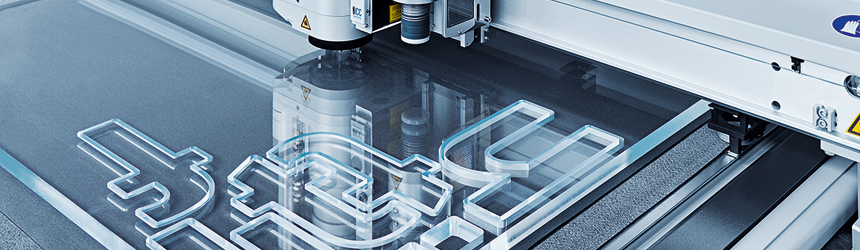
Above: Cutting devices with CNC router functions include the Zünd G3 3XL models paired with the Zünd 3.6kW Router Module – RM-L, which features a depth of up to 50 millimeters.

Accurate Finishing
CNC routers allow PSPs to make accurate cuts on thick materials like metal, plastic, plexiglass, and wood in a short period of time. The devices work constantly and are designed with specific parameters for each finishing job. CNC routers can cut, trim, and shape materials while offering complex precision cuts that are typically difficult or impossible to make by hand.
Joshua Santa Cruz, marketing specialist, MultiCam Inc., says CNC routers potentially reduce secondary finishing processes like hand polishing or sanding. With the correct software and nesting features, he believes end users can reduce material waste and decrease the chance for possible human error.

Using CAD software, CNC routers save and store designs for later use and simpler job repeatability. As designs are transferred to the CNC router, the machine calculates the necessary toolpath. CAD software makes adjustments that scale the designs precisely and accurately.

Werner Waden, president, Colex Finishing, thinks the main benefit of a CNC router is that the cutting information is embedded in the printing file so cut files can be read from the printed image with a digital camera. “This makes the cutting process fast and precise—enabling cutting of shapes, squares, and rectangles,” he adds.
According to Robert Marshall, VP market development, AXYZ International, the speed and efficiency of CNC routers enables fast and easy programming for operators to perform additional tasks while the machine is in use. “CNC routers offer unrivalled versatility for handling a range of materials—our machines offer 368,058 standard machine configurations to process pretty much any material,” he says.

Released in April 2015, AXYZ’s Trident Series features a maximum width of 85 inches. It delivers a triple-head system, which consists of a twin-knife head that includes an oscillating and tangential knife coupled with a quick release routing spindle. The Trident Series processes sheets up to six inches thick and includes performance enhancements like automatic tool change and camera registration.

Learning Curves
Learning to properly use a device requires training. Operator training depends on what tools the CNC router has, intended applications, and materials used.

Roberto Rodriguez, president, Digital Graphic Systems Inc. (DGS), believes the learning curve is fairly short, especially if the operator is mainly doing contour cutting. If so, training takes no longer than one day. “We provide a full set of guidelines to cut different materials and thickness, so the operator does not have to reinvent the wheel,” he explains.

Marshall suggests PSPs receive training directly from the manufacturer and that buyers consider machine and application training. Application training is customized according to business needs. He believes all training issues can be alleviated by working with suppliers that understand individual application needs and offer training tailored to applications. “It is the best way to optimize performance of the workforce and the router,” he recommends.

Compared to manual and traditional routers, CNC routers only require one person to monitor the machine because it is a highly automated process. This is ideal for print providers with limited staff or beginner skilled workers. Training is also offered virtually using specially designed lessons for CNC router operators.

Capabilities beyond traditional routing and cutting may require a more extensive learning process. Rodriguez says three-dimensional (3D) cutting requires more training as well as practice. Based on experience, he says 90 percent of machines are used for contour cutting and engraving versus 3D applications.

Because CNC routers offer high automation with little human control, they also provide safety for operators. They include features for protection against accidents like safety guards that prevent access to the rotating tool during operation. If a problem occurs, the machine damages itself instead of others.

According to Santa Cruz, to fully understand and utilize the complete capabilities of a CNC router, it can take between 30 and 60 days. “With processes and industries continuously evolving, there is something new to learn every day,” he shares.

The Main Tool Heads
CNC routers typically include a router for hard materials like wood, acrylic, and aluminum. However, Rodriguez says some of the more advanced equipment offers an automatic tool changer option that becomes useful for complex jobs. Before implementing a CNC router, PSPs should consider the main tool heads they require to get the most out of their device.

MultiCam recommends every PSP start out with a spindle, drag knife, and oscillating knife. “Each of the three tooling options perform different types of cutting techniques and are generally material specific and would cover a majority of products,” says Santa Cruz. While knives perform better on cardstock, a spindle performs better when cutting one-inch thick acrylic. Santa Cruz suggests PSPs consider what will be cut most often and base main tool heads off these projects.

MultiCam’s Celero was released in October 2017 and includes a spindle and dual knife. It features a 9.8×13.1-foot cutting area and cut speeds up to 3,500 inches per minute. The Celero’s modular design offers easy transportation through double door entryways. It includes a two-inch cut capacity, automatic knife tool changing system, five linear knife and spindle tool changing stations, and an electrical oscillating knife.

Waden also suggests an oscillating knife is one of the main tools a PSP should start with. Oscillating tools are used for corrugated media and foamboard. Additionally, he recommends PSPs consider a router for thicker and denser media like wood, plastics, acrylic, and PVC.

According to Lance George, plastics division sales manager, Biesse America, almost all CNC routers are now configured with a camera registration system to recognize registration marks in addition to software that integrates a tool path based off the marks. “Any printed material that needs to be cut or routed must have this option as part of the router and cutter configuration,” he explains.

The Biesse Rover Plast J FT features a camera recognition system and a tool changer for spindle, oscillating knife, and tangential drag knife. The CNC router handles a maximum width of seven inches and is priced between $60K and $115K.

Additional Tools
PSPs incorporate additional tools to CNC routers as needs arise. To determine when to add more, they should consider current and future projects and customers.

“If a PSP is producing the same product daily, there isn’t a need to add more tooling. But, if they are constantly switching processes and products, it would be ideal to add more tooling to accommodate those markets,” says Santa Cruz.

Dana Goodale, director, product management, Gerber Technology, suggests PSPs add more tools when the costs and logistics of outsourcing outweigh the costs and logistics of doing the work in house. “You have to add the tools, potentially add a new piece of hardware, get trained, and perhaps add people to handle the increased workload,” he explains.

Once a PSP has a CNC router, they take on new applications like cardboard boxes and point of purchase (POP) products by implementing additional tools. Waden says PSPs are able to handle all finishing requests such as decals with kiss-cutting knives, POP displays with a v-cut knife for 90 degree folds, creasing wheels, and perforating wheels.

Released in 2011, the Colex Sharpcut SX-1631 includes a fixed double-edge knife, creasing wheel, kiss-cutting knife, coroplast/corrugated knife, v-cut knife, universal single-edge knife, drawing tool, perforating wheel, one to five horsepower router, oscillating knife, textile knife, and a laser for cutting textiles. “The idea is versatility to take on any project that walks through the door. The more tools you have, the more jobs you can sell,” says Waden.

Automatic tool changers are another option. Rob Cod, sales director, Precix Advanced Cutting Technologies, suggests PSPs add an automatic tool changer when jobs require multiple types of router bits for each single sheet routed. “An automatic tool changer adds approximately $7K to $9K,” he adds.

Precix offers the Industrial Series, released in 2011. The Industrial Series model 13100 features a 6×10-foot cutting area and allows operators to work with materials from foam to thick aluminum. It includes a five horsepower Perske or HSD spindle motor, a heavy-duty industrial linear bearing set, and a vacuum take-off attachment for the spindle. According to Cod, the Industrial Series is available at an average selling price of $18,000.

Considerations for Cutting
Before purchasing a CNC router, PSPs should compare outsourcing costs to implementing a new device. Goodale suggests creating a routing roadmap that analyzes if the PSP has achieved a certain revenue and profit targets within a certain time. If the PSP meets its target, it’s time to purchase or add new routing equipment.

While implementing a CNC router, PSPs should ensure they start out with the correct tools and consider the floor space for the new device. Rodriguez suggests creating a special enclosed environment since the typical cutting process produces dust and debris and generates high levels of noise. “This is especially important when digital printers are operated close to the router—printheads will suffer,” he offers.

Additionally, Santa Cruz says PSPs should educate themselves on the capabilities of each type of CNC router and what works for their business model not only for the present but for the future. “End users should be proactive and invest in a system that can keep up with an ever-changing market and evolving industry,” he offers. It’s important that the router is capable of upgrades as CNC technology advances.

This includes the types of material PSPs cut. Based on this, Rodriguez recommends PSPs select a digital table cutter or a dedicated CNC router. “There are machines that can do both, but the routing functions and spindle power of the digital table cutters are very limited,” he says. He suggests implementing independent machines to work two production lines. “In terms of investment, it’s almost the same to have two machines rather than a hybrid one, but productivity levels are raised to the maximum.”

DGS offers the Tornado II, released in January 2016. The CNC router handles a maximum width of 60×120 inches and is priced between $34,995 and $39,995. It includes a 6.1 horsepower spindle and TYPE 3 design software for two-dimensional and 3D applications. The Tornado II is used for cut out letters, carved and engraved signs, channel letters, POP displays, wood furniture, and molds for vacuum-formed signs.

Additional considerations for PSPs implementing a CNC router include keeping costs down by purchasing inexpensive machines and avoiding necessary accessories. Marshall warns that purchasing an inexpensive machine can actually be costlier in the long term. “The downside to this decision may be lower performance, less reliability, and the limited availability of parts,” he explains.

Device Costs
CNC routers are available in a broad pricing range that depends on the size of the machine—ranging from smaller amateur systems to larger manufacturing-sized devices. Typically, the router’s configuration determines the costs, which includes table size, spindle power, and tools. CNC routers can cost anywhere between $10K and $300K.

CNC machines typically cost more than conventional machining techniques. Starting at roughly $20K, simpler CNC routers are ideal for PSPs that expect to use the device occasionally. Santa Cruz says if the machine is used for over 40 hours during the week, PSPs may want to consider investing in a product that’s capable and built to last.

“A fully equipped 4×8-foot CNC router with at least six horsepower spindle and vacuum pump should be around $35K to $40K,” says Rodriguez. High-speed CNC spindles are best for aluminum, wood, laminates, and composite material.

Steve Aranoff, VP, business development and marketing, MCT Digital, believes CNC routers for 4×8-foot boards can start as low as $20K. However, higher performance and additional productivity capabilities reach over $100K. Routers and cutters with similar CNC functions generally start under $100K with costlier options dependent on cutting bed size and number of tools.

“Given that a $100K system costs under $1,900 a month on a five year lease, and that this represents under 20 hours of use per month for a typical PSP, choosing a low-cost starter system hardly makes sense, especially if you are growing, as the learning curve to change in a year or two may not be at all worth it,” explains Aranoff.

MCT Digital offers the VersaTech2 for just under $125K. The company released first anniversary additions to it in November 2017. It includes functions like a high-speed router, drag knife, kiss-cut knife, and oscillating knife at a maximum work area of 126×126 inches.

Finishing Trends
Recently, Waden sees mainstream PSPs concerned about versatility because they don’t know what job requests to expect and they want to know they can accept any job. As a result, he says more mainstream PSPs now have a versatile cutting device so that large print providers are not the only ones that can perform big jobs. “Mom and pop stores everywhere can offer a variety of jobs on time and exceed their return on investment,” he offers.

This includes value-added products rather than flat, plain prints. Rodriguez believes a digital table cutter or CNC router helps open a variety of innovative opportunities like the production of structural elements such as trade show booths, POP displays, store decorations, and engraved signs. “These applications are not all sold by the square foot, bringing higher levels of profitability to the business,” he adds.

In fact, Goodale thinks routing and finishing tables are becoming more alike to perform a variety of functions. “Finishing tables are adding larger, more capable routing capabilities, and routers are adding more finishing capabilities,” he explains.

Gerber’s Sabre 408 router is designed for dimensional sign making, woodworking, and parts fabrication applications. It features a maximum cut area of 53.5×101 inches and a maximum material thickness of 4.4 inches. A patented material hold and chip removal system maintains material flatness and collects debris to ensure a clean work surface.

Beatrice Drury, director of marketing and communications, Zünd America, agrees and says that multifunctionality is definitely a trend. “Many CNC routers are offering more cutting tools and many multifunctional cutting systems are providing increasingly diverse and robust router options,” she explains. As a result, device crossovers into different markets and applications create more choices and with them, some confusion.

To stay on course, Drury suggests PSPs keep in mind that no matter what type of equipment they consider, it should first meet their current needs for efficiency, reliability, low maintenance, and a highly productive workflow.

One solution that isn’t considered a CNC router but has similar capabilities is the Zünd 3.6kW Router Module – RM-L, released in January 2017, which is compatible with the Zünd G3 3XL models. The router features a depth up to 50 millimeters and integrated minimal quantity lubrication for processing aluminum and aluminum composite material.

Automated Cutting
CNC routers are designed to deliver precise cutting measurements while storing designs for later use. Highly automated, these machines reduce errors and the need for human interaction to create a safer, more productive workspace. Before selecting a CNC router, it’s important that print providers are aware of which tools are necessary for their print shop and if adding additional tools is a possibility

Jan2018, Digital Output

Yes, You Can Print
 on That!

By Cassandra Balentine

Print service providers (PSPs) look to wide format flatbed printers for a variety of applications that require the ability to print directly onto rigid substrates, at production speeds, and in high quality. However, recently, smaller format UV flatbed printers have gained attention among wide format professionals.

These devices tend to offer a minimized footprint, lower investment cost, and support thicker materials, enabling them to print to objects like phone cases and golf balls. They are also enticing for industrial environments enabling mechanical components printing.

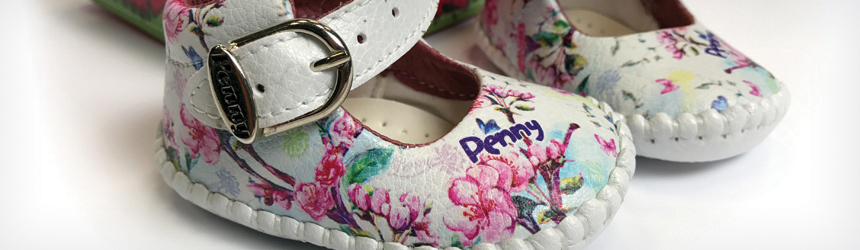
Above: Guatamala-based Artikel Solociones Industriales, S.A. uses Roland digital printing devices to decorate baby shoes.

Flatbed Potential
Smaller UV flatbed devices are attractive to a variety of printing and manufacturing environments. They appeal to those already providing wide format printing as a way to add services and revenue potential.

“Printing on custom products is an endless opportunity and could be anything from book covers to metal bicycle parts. Adding a flatbed UV printer could really open up some new doors and help increase profits,” says Paul Green, research and development, OmniPrint International.

Jay Roberts, UV product manager, Roland DGA Corporation, sees a trend towards custom consumer products and promotional items. “The public’s increasing desire to personalize just about everything is translating into nearly unlimited growth opportunities for on demand printing onto an ever-widening range of items,” explains Roberts. He adds that more businesses use these printers for custom printing accessories, products, and gifts.

“Smaller format like desktop UV LED flatbed printers offer a wider range of materials to print on and bring print providers opportunities to capture new customers in new markets where they may not be playing with their current print technology,” shares David Conrad, director, sales and marketing, Mutoh America, Inc.

“The wide format market can leverage smaller, tabletop UV LED printers for many aspects including prototyping and testing. They can use it to maximize profits on short-run projects or offer products to existing customers that they can’t do on the wide format machines, like ADA/Braille signage and water bottles,” adds Michael Perrelli, marketing manager, Direct Color Systems (DCS).

Josh Hope, senior manager, industrial printing business development and marketing, Mimaki USA, Inc., explains that these units only need a small workspace area and can be placed in an office environment, requiring no special room or electrical requirements. Additionally, the operational learning curve is short, as they tend to fit well into existing workflows. “Depending on the product mix, the supplies inventory—such as rigid media and even inks—may overlap, so there may be no additional investment required in this area,” he adds.

Wide format PSPs more than likely look to adding traditional flatbed printers for the ability to handle large sheets. “Smaller tabletop machines are used in the promotional products market segment where items are smaller and require fixtures for registration purposes. These are also becoming popular with the traditional screen and pad printers as it gives them the ability to print four-color efficiently and run small jobs with variable text economically,” says Chuck McGettrick, sales manager, digital inks, Marabu North America.

Juan Kim, CEO, Valloy Incorporation, suggests while wide format printers focus on productivity, smaller flatbeds are more focused on flexibility and functionality, like better control of UV curing and pinning for spot glossy effects or layered printing.

On the Market
A variety of smaller UV flatbed printing solutions are currently on the market. Here we highlight several offerings.

DCS offers many tabletop flatbed printers, all sharing similar application abilities according to Perrelli. These include the company’s patented ADA/Braille technology, cylindrical printing, TEXTUR3D, and direct to garment. “The models that we offer center on print size—both in printable area and maximum z-height,” he notes.

Engineered Printing Solutions (EPS) and Marabu have a partnership where EPS’ printers can be sold using Marabu’s UltraJet DLE-A ink technology, says McGettrick.

Innovative Digital Systems provides the Turbo 1001 Digital Inkjet Printer. According to the company, the machine prints an entire 20×24-inch print area in 90 seconds. It features a dual table and shuttle mode feature, and high-speed uni- or bi-directional printing. It offers a maximum resolution of up to 1,200 dpi and an adjustable height of 10.8 inches.

Inkcups Now sells the XJET UV LED inkjet printer, which prints a 500×600 millimeter area in 90 seconds and handles items up to 5.75 inches tall. It features a conveyor and patented loading system. The XJET offers one-pass printing on dark substrates with highly opaque white ink.

The company also provides the X2 flatbed UV printer, which contains the components of its larger counterpart, the XJET, but in a flatbed design. Print a 20×24-inch print area in only 90 seconds. The X2 comes with CMYK plus two highly opaque white inks that are UV LED curable in one liter bulk ink containers.

Mimaki’s range of tabletop flatbed devices include the UJF-3042 MkII, UJF-3042 MkII EX, UJF-6042 MkII, and UJF-7151 Plus, which feature a range of print areas from 11.8×16.5 to 20×24 inches. All feature a maximum object height of six inches.

Mutoh offers two tabletop flatbed printers, the ValueJet 426UF, a UV LED printer that features a 19×13-inch bed and prints on substrates and items up to 2.75 inches thick. It lists for $19,995. The ValueJet 626UF has a 23.9×19-inch bed and prints on substrates and items up to 5.9 inches thick and lists for $27,995. Both models include a vacuum table and print either CMYK or CMYK, white, and varnish.

OmniPrint’s Freejet 330UV features dual UV LED lamps, allowing users to print in a faster, bi-directional mode. Additionally, it offers a bulk ink system. “Because the inks are ink bottles and not cartridges, the ink cost is much lower,” says Green. Another feature is a wet capping function, when the printer is not printing the printhead soaks in a cleaning solution to keep the nozzles wet and always ready to print. “Because the printer uses white ink, a circulation system is integrated to help keep the white ink from separating when not in use,” adds Green.

Roland offers four different VersaUV flatbed printers. Three are small format benchtop LEF series models, including the 12-inch LEF-12i, the 20-inch LEF-200, and the 30-inch LEF-300. The systems offer printing up to 1,400 dpi, a mechanical UV LED lamp, and a laser alignment system for quick and easy setup. Each model is capable of printing directly onto virtually any substrate or dimensional object up to 3.94 inches thick. The LEF series printers are also equipped with a non-magnetic height sensor, which allows the table height to be manually or automatically adjusted to optimize printing on an array of objects, as well as gloss and white inks for incorporating embossing and textural effects.

The company also provides Rotaprint attachments for all of its LEF series UV flatbed printers. These devices fit inside the flatbed and use the printer’s existing feed system to easily print white and CMYK onto bottles and other cylindrical objects.

Xanté Corporation recently introduced the UV4000 UV-curable flatbed printer, which features a media width of 36×24 inches and printheads that rise up to 11 inches, enabling it to print to specialty media and rigid substrates. It prints up to 118 square feet per hour at 720×1,200 dpi with six Ricoh printheads and dual LED curing lamps onto coroplast, PVC, aluminum, wood, and almost any other substrate.

Valloy’s TOPAZET UV 6045F and TOPAZET UV 6090F use an LED system for quick drying and can increase productivity by jetting eight droplets for varnish and white. Kim says the machines can reduce the number of layers to reach a certain level of thicknesses. UV pinning and variable curing are supported for different surface textures, including glossy, matte, or satin.

Ink Sets
Due to the range of substrates and items these devices print on, the ink set is critical. The UV inks offered in these machines doesn’t differ all that much—if at all—from traditional wide format UV inks.

“Many UV inks are classified as hard or soft. Soft inks allow more flexibility after curing and are less prone to cracking under stress. Hard inks provide the best adhesion and abrasion resistance once cured, however, they are not designed to be highly flexible. For markets that smaller format printers service, a hybrid ink with the best properties of both hard and soft inks is utilized,” explains Mark Swanzy, COO, Xanté.

Green believes UV inks are good for hard surfaces that need a strong bond.

Conrad notes that the chemistry of the inks are similar to those found in a traditional wide format flatbed printer, but the lamps used by the bigger wide format devices are much larger and more intense.

Cost is another consideration that affects specialty uses like white ink and textured printing. “The rule of thumb for flatbed printing with our machine is a penny per square inch. That obviously rises if you were to print texture of ABA/Braille. At that time, ink cost becomes extremely file dependent,” advises Perrelli.

Ink costs vary depending on coverage, profile, and image type. Conrad adds that white ink is typically slightly more expensive than CMYK.

Green says on average, the cost per liter is around $300. “A liter of ink will last a long time with these machines because the print sizes are generally a lot smaller,” he offers.

McGettrick suggests the average cost per liter is about $150 for CMYK and $175 for white.

Kim estimates the cost to be $80 per liter for color and $100 for white and varnish.

Roberts says the average square foot cost for Roland’s ECO-UV inks is approximately $.24 per square foot, which is higher than traditional solvent inks.

Time equals money. “Having the ability to print onto the finished product far outweighs the difference in cost compared to traditional solvent ink costs. UV ink becomes a production tool. Add the special effects like gloss ink, and your final UV printed products end up being dramatically more profitable then solvent output,” adds Roberts.

New Revenue Opportunity
For a minimal investment in training and floor space, PSPs consider adding smaller UV flatbed printing devices for the ability to effectively print onto a wider range of substrates, including objects like cell phone cases, golf balls, and awards.

Jan2018, Digital Output

Ready & Waiting for Web

By Melissa Donovan

Web to print (W2P) solutions are just one part of the print production workflow. Those able to integrate with additional elements of a digital print workflow—whether an ERP or MIS solution, RIP, CRM—are ideal for many businesses. Wide format print service providers (PSPs) realize that once complete, the efficiency of a fully automated shop is priceless, however the task of achieving full integration can be daunting.

While automation is preferred, certain shops only require standalone W2P. Ideally, this option offers the flexibility to grow into an integrated solution when the PSP is ready. To ensure this occurs, wide format PSPs need to do their homework when it comes to figuring out the best W2P solution for their business. Asking the right questions will ultimately lead to a system that is integral to their brand.

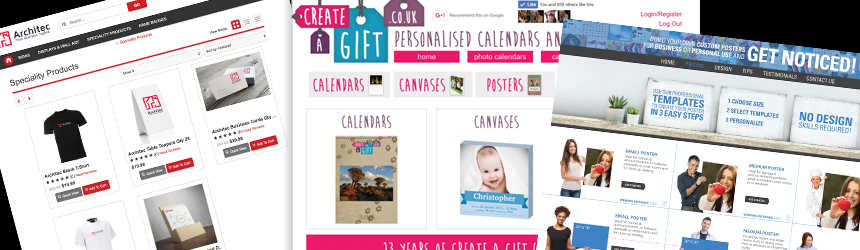
Above: Cyrious Online enables the set up of unique ordering websites for each customer. RedTie Template and RedTie Template Plus let users build products quickly and easily.

The Automated Benefits
There are clear cut advantages to implementing a W2P solution with cross-integration capabilities. Working together, from accounting, ordering, scheduling, and job setup to packaging and shipping, means that all of the information for a print project is in one interface. This saves time, decreases the possibility for error, enhances customer service, and frees up staff for other projects.

“Integration offers many benefits including automated sharing of information between systems. This not only saves time for the PSP internally, but also decreases rework and the errors associated with dual entry of information into multiple systems. Better visibility of order information in multiple systems allows for upsell opportunities and enhanced customer service,” explains Kristen Licursi, director of marketing, Cyrious Software.

Improving customer service with the help of an integrated W2P is what separates a successful print shop from a not-so-successful one. “It not only helps get new clients, but it also helps retain customers. Customer loyalty increases as they get used to ordering from a well-designed website. They can reference their old orders and estimates and reorder whenever they choose,” shares Usman Ali, principal, Ordant.

With an integrated solution, employees can shift their focus to other priorities that may make the business more money. “An order can become virtually hands off, allowing printing staff to concentrate on the custom work that is more time consuming,” says Ellen Faith Hurwitch, VP, director of operations – the Americas, RedTie Group.

According to Bob Raus, category manager, workflow and partner programs, HP, Inc., automation of prepress, job submission, and production can be the difference between profitability and going out of business.

“At this point, providers who do not have a solution like this are at an extreme disadvantage. Service providers do not have to use all the features available. However, they need to have them available for customers and production, and they need to understand how to sell fully integrated solutions, rather than selling print,” agrees Wilson Zehr, CEO, Cendix Solutions.

Wavering Commitment
Hesitation is common when it comes to automating any part of a workflow. The actual implementation, subsequent maintenance down the road, and its reliability make it difficult to commit to an integrated W2P system. Price point, lack of staff, and misunderstandings about the technology are also daunting to a PSP.

All of the above combined can immobilize a business owner, making them scared to pull the trigger. “PSPs may not know where to start or how to choose the best product. The implementation cost is usually high. They are afraid to destabilize their production,” explains Sebastien Hanssens, VP marketing and communication, Caldera.

Haylee Benton, business development, ShopVOX, believes that hesitation comes when software is a little too complex, confusing, and time consuming to set up. “Many business owners or managers worry about the time it will take to train staff and implement changes,” she admits.

“No matter how simple the simplest solution is, there is always plenty of time spent on research, development, and integration—not to mention training and troubleshooting. Most small print providers do not have the manpower to initiate such a solution and contracting it out to a third party organization can be dicey and costly,” advises David Conrad, director of sales and marketing, Mutoh America, Inc.

Specifically for wide format print providers, many are concerned that W2P solutions aren’t robust enough to handle their main offerings. “Hesitation from wide format printers to implement a W2P solution stems from knowing if W2P can support wide format jobs to begin with,” says Therese McGady, marketing associate, Aleyant.

Gil Newsom, operations manager, Rocketprint Software, LLC, shares that online quoting mechanisms are generally met with distrust. As wide format orders are typically complicated and customized, a W2P solution needs to be able to handle these easily—especially in a customer-facing interface with simple pricing options.

Flexibility to Stand Alone
While integrated W2P solutions are gaining in popularity, standalone options are still available. Not every PSP needs to have all of their solutions tied into one system. For many, the flexibility to take an existing W2P solution and down the road be able to integrate because it has the capability to do so is enough.

“From what I have heard from both prospects and customers alike, they like a separate W2P solution that can be easily integrated with other products because it gives them the flexibility of choosing a W2P system that offers the features they need, not the ones they are limited to as part and parcel of a complete, end-to-end solution,” shares Hurwitch.

If existing CRM, ERP, MIS, or RIPs are able to be integrated it makes sense to consider a W2P solution with integration capabilities. However, if none of those solutions exist, it would be easier and cheaper to begin with a standalone platform, according to Niro Barom, sales channel manager, B2CPrint. “Any small business or large corporation that is built with sub divisions could use a standalone platform for each division, or even an add-on feature to the main site, using a sub domain,” he suggests.

“Standalone systems have their place, particularly for those who want to roll their own, or may need multiple W2P solutions to cater to specific requirements of business to business (B2B) clients,” agrees Mark Gallucci, manager, technology marketing – commercial software, CTP, Agfa Graphics.

Standalone options are ideal for smaller shops, especially those looking to increase their online presence and attract new customers. “It depends on the business. Small shops just want print and ship capability and a simple back end that is easy to update and manage. Others want more advanced options and to streamline their workflow and print process including accounting, production, logistics, and billing,” says Conrad.

Starting with a standalone W2P system is a good stepping stone. Slava Apel, CEO, Amazing Print Tech, believes it can help dictate what other components will be needed when the time for further automation arises.

“A standalone solution can enable PSPs to offer customers much more flexibility and create new market and revenue opportunities in its own right,” adds Douglas Gibson, managing director, Infigo Software.

Research and Recommend
Wide format PSPs need to do their homework before committing to a W2P solution. Customer requests must be understood. Existing software and hardware need to be vetted—will they work with the W2P product you are considering? Look at the scalability of the program, will it meet future needs? Features specific to wide format must also be addressed.

“Take the time to step back and figure out exactly what it is you want to achieve with this software—are there certain products or services you want to focus on or that are more profitable to you? Shop around and don’t be fooled by the more is better fallacy of software features—focus on things right for your business and ignore all the bells and whistles that are not relevant to you,” advises Tony Tarpey, COO, SmartSoft Inc.

Licursi suggests keeping the main goal top of mind. “It is too easy to get lost in the details and attracted to shiny features when shopping for a solution.”

The customer will be the one using the W2P storefront, so it should be one that works for them. “A PSP should understand their customer and their customer’s needs, as well as how their products will fit into this new workflow solution,” suggests McGady.

“Test whether the online ordering system will be easy enough for everyone in your client’s organization to use. The whole point of setting up a B2B online ordering system for your customers is to make it easy for many employees in their organization to order the prints they need,” explains Ali.

“Always put yourself in the customer’s shoes. Customers want a user friendly, easy process for ordering that then needs to be matched in the production process in the back end. Ensure that you try the software out from many angles such as a business owner, manager, general staff, and customer,” shares Benton.

A new solution is only as good as the programs and hardware already in place. If the goal is integration, you need to ensure the systems play well together “Speak to your ERP, RIP, and MIS vendors to see what W2P tools they offer or recommend—but don’t limit your choices to them, since there are many others out there,” adds Gallucci.

“Ask your OEM equipment vendor for recommendations as the software from the W2P provider has to work with your wide format equipment,” shares Apel.

Scalability is also important, as it addresses long-term goals. “Print suppliers need to review what other industries they might be able to break into with a robust e-commerce solution,” according to Gibson. He provides the example of the personalized product industry, which is growing at an enormous rate. More businesses want to be able to offer all kinds of unique personalized products. “So wide format printers can broaden their business with a solution that enables them to offer on demand customization and personalization, opening up a whole new industry and revenue stream,” states Gibson.

For wide format, it’s important to research options that offer features tailored to the industry. “Strongly consider the ability to quote wide format products online for your users. If your W2P solution doesn’t quote wide format products online, there is no point in having it for your company,” notes Newsom.

Artwork resolution is another area of concern for wide format print providers. Gibson says PSPs should ensure that per product resolution checking can be done as part of the ordering process.

“The best homework is to pick a few sites that sell wide format products and try to figure out what they are using. If you cannot figure out the platforms that those websites are using look for a few vendors that are mentioned in magazines, awards, trade shows, and user groups. Talk to at least three vendors before making your decision,” recommends Apel.

Once you’ve narrowed down your options, Reuben James Ben Quesus, director of business development, Racad Tech Inc., advises all PSPs ask W2P vendors specific questions. How long have they been in business? What advancements have they undertaken since then? Are there any open source offerings? What about customization? Do they integrate with third party systems? Are sample or demonstration sites available? What are pricing options? How is support responsiveness?

Brand Ambassador
Wide format PSPs need to conduct due diligence before implementing a W2P solution. While integrated solutions are ideal thanks to their automation capabilities, standalone options are also used depending on the shop’s needs.

In either case, a properly implemented W2P solution acts as an extension of your brick-and-mortar business. “Your W2P shop can become a brand ambassador for your business and a growth engine—be sure to investigate the many solutions available in order to select the best fit for your business and your clients,” concludes Gallucci.

Jan2018, Digital Output

Build and They Will Come

By Melissa Donovan

Building wraps are smart and insightful advertisements. Print service providers (PSPs) offering this service hope to create projects that immerse the viewer into the graphic, making it unquestionably memorable—enough so that they will end up buying the product or as is the case so often now, posting it on social media and expanding the reach of the message even further. To achieve graphics of this caliber, PSPs rely on trusted hardware and consumables as well as industry knowledge.

Above: This LSI job was printing using an EFI VUTEk GS5500LXr Pro with UV ink on NuConCept mesh.

Covering Construction
In business since 1974, LSI Graphics, Inc. began offering building wraps seven years ago. The Memphis, TN-based company was originally a booklet/identification badge lamination supplier and went by Lamination Service, Inc. In addition to identification systems, it now offers grand format printing and promotional products. Once a business of one, it now employs 65 and serves customers worldwide out of a work area of over 39,000 square feet.

According to Evan Diener, VP, operations, LSI, building wraps are currently seven to ten percent of the business in terms of revenue, but he expects that to grow. “I believe building wraps are trending upwards. Metropolitan areas and building owners see vacant buildings or large, empty walls as advertising space to add a revenue stream out of thin air for a fairly low cost,” he suggests.

For building wraps LSI regularly works with mesh from NuConCept. The 196-inch product provides durability against outdoor elements like wind and precipitation. It is also ideal for building wrap applications because it is available in 16×300-foot rolls, which limits the amount of necessary seams.

Graphics are printed with the company’s 16-foot wide EFI VUTEk GS5500LXr Pro. Diener cites printing an average size billboard—ten feet and six inches by 36 feet—with the device in 15 minutes. It prints using UV ink, which holds up well in outdoor environments. Thanks to the printer, production isn’t a challenge. The team at LSI produces and finishes banners quickly while maintaining quality.

With the production process of a building wrap under control, Diener says the biggest challenge is logistics, as no building’s or town’s rules are the same. “Navigating through each cities’ signage ordinances and obtaining permits is certainly the most re-occurring challenge as each city is different,” he shares. To combat this, LSI takes the time to research city ordinances prior to meetings and discussions with clients. In doing so, customer expectations are appropriately set in terms of timing, price, and turnaround.

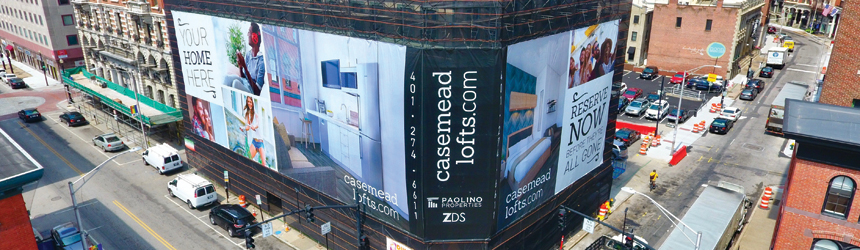
A new client recently reached out to LSI to create a building wrap that not only hid unsightly construction but simultaneously advertised the micro-lofts being built and promoted the construction and architectural firms. “Construction sites and building remodels are an eye sore. If a building banner can advertise the contractor and/or architect for months during construction, it’s an advertising investment, not an expense,” explains Diener.

Located in Providence, RI, the building is surrounded by two sides of a major intersection. Covering the construction scaffolding with a graphic provides an opportunity for thousands of passerby on a daily basis to learn more about the new lofts and the companies involved in the process. The design consists of young people from all demographics exploring urban environments and enjoying city life.

The job was printed on the EFI VUTEk GS5500LXr Pro with UV ink to ensure the wrap would withstand exposure to the elements for the duration of its installation, which according to Diener is 18 to 24 months depending on construction. A total of 5,550 square feet of NuConCept mesh was printed in 11 pieces. To combine all 11 parts into one cohesive banner, two-inch webbing was heat welded with grommets every 24 inches using a 50-foot Miller Weldmaster welder.

Diener says the biggest challenge associated with this project was ensuring the banner was folded in a way that allowed it to be unfolded and ready to be installed immediately—with no confusion on which part needed to be applied where. “Small details like this, having the customer and installers in mind through every aspect of the job, is what sets us apart from most other companies,” he shares.

Busting Out
BPGraphics celebrates over 50 years in the industry. Originally known as the Billboard Printing Company, it specialized in printing paper billboard posters, but as the out of home (OOH) segment evolved, so did its product offerings. The company expanded into all different types of outdoor advertising products. It simultaneously added other large format printing services including fleet graphics, retail point of purchase, and event and venue graphics. To mirror its offerings the PSP changed its name to BPGraphics in the early 2000s.

The shop takes up over 66,000 square feet of space in Phoenix, AZ with 18 digital presses including five-meter grand format UV-curable and solvent devices, UV flatbed, UV roll-to-roll large format, latex ink, dye-sublimation (dye-sub); and inline screenprinting equipment. It is equipped to handle all of its finishing in house as well, from laminating to routing, sewing, welding, and custom fabrication.

With building wraps a natural extension of mesh and vinyl graphics, according to Curt Carpenter, owner/president, BPGraphics, the company has produced a self-adhesive version of the application for its OOH advertising clients since 2004. “As advertisers began to look for more non-traditional spaces to showcase their products, we found that the same skills and knowledge we gained in the outdoor advertising industry easily transferred to building wraps, be they mesh, self-adhesive vinyl, or self-adhesive perforated window vinyl,” shares Carpenter.

In the early 2000s the PSP installed four HP Scitex XL1500 presses from HP, Inc., which are still in use today, especially when producing large mesh building wraps. “The solvent ink works particularly well when welding panels together and welding ink-over-ink so as not to have visible weld lines,” explains Carpenter.

For building wraps requiring self-adhesive vinyl or perforated window material, BPGraphics usually uses one of its HP Latex 3000 series printers—the HP Latex 3000, 3200, or 3600. “The combination of environmental friendliness, speed, and quality—particularly when it comes to sheet matches—makes the HP Latex series of presses the best choice for this type of work,” he continues.

With the ability to print to different substrates, media choice is dependent upon the location and surface of where the graphic will ultimately be installed. For mesh vinyl, BPGraphics prefers product from Ultraflex Systems, Inc. If it is a self-adhesive vinyl or perforated window project, the company uses material from either 3M Commercial Solutions, Arlon Graphics, LLC, or FLEXcon.

Both the hardware and consumables BPGraphics chooses to use play a role in ensuring its customers receive their building wraps in a timely manner. It is time that presents the biggest challenge, according to Carpenter. “Decisions are made around major events about the messaging to display with less time to produce and install the graphics. The advent of digital advertising has skewed the perspective in marketers’ minds about what it takes to create and launch a program,” he explains.

The PSP combats this by educating its customers on all of the steps it takes to successfully complete a building wrap. This includes discussing the permit process—if applicable—and the time it takes for production and installation.

In recent years, Carpenter has noticed growing popularity and public opinion of building wraps, explaining that the application is no longer lumped into the same category as billboards in the minds of consumers. “Increasingly, building graphics tend to help define a space and make it part of the fun of being in that venue. The combined use of celebrity or event graphics along with increased quality of production and materials that can be installed almost anywhere have helped make building wraps fun in the public eye,” he adds.

BPGraphics created one such building wrap in Spring 2017, transforming the Las Vegas Marriott into a “wall busting construction” illusion for ConExpo 2017—a premier trade show for large construction equipment held every three years in Las Vegas, NV.

Client Elite Media wanted to create something amazing for its client, Volvo. To achieve this, BPGraphics worked on a design featuring construction equipment appearing to break out of the hotel. For a life-like effect, the PSP’s prepress team color matched sections of the graphic to the hotel’s exterior paint. The Las Vegas Marriott is in a key location, across the street from one of the many parking lots used for visitors to browse equipment samples at ConExpo.

The design was produced in three graphics, which were printed using an HP Scitex XL1500 on Ultraflex’s UltraMesh due to its easy air flow to prevent capturing the wind. Two of the three graphics measured 84×100 feet and covered over 90 percent of the side of the hotel that faced the parking lot. The third graphic, which faced the street, was 57 feet and eight inches by 99 feet.

Graphics were anchored to a pre-installed cabling system that was mounted to the hotel. The design was up for the length of ConExpo.

Brokering Deals
Grand Image Inc. currently celebrates 20 years in business. The family-run company began in 1997 in a 2,500 square foot facility and still operates today out of a 20,000 square foot building in Hudson, MA with 36 employees.

Starting out, the PSP offered vinyl billboards, banners, building wraps, and fence mesh signage, all done by the parents of Tamir Luria, VP of operations, Grand Image. For the last ten years its offered dye-sub printing, trade show fabrication, and recently began selling 3D digital sculpting services.

Grand Image doesn’t work directly with the end user, but services print brokers. It started out only serving those in the greater Boston area, but now works throughout New England and the greater NY metro area. Customers coast to coast and into Canada work with the company.

Building wraps have always been a part of Grand Image’s offerings. According to Luria, once the company figured out “how to finish banners to withstand the rigors of the building application, it became a significant part of the business.” Today about five percent of the work completed in house is considered building wraps.

To complete these large applications, the shop uses an HP Scitex XL1500. It prints fast and reliably with inexpensive, high-gloss solvent inks. Grand Image sources its own materials, importing from China directly and cutting out the middleman.

Out of the entire building wrap process, Luria finds that the nature of paying attention to dropouts and color shifting along 50 to 100 feet of material is what causes the biggest challenges. “Our operators have to be really aware to notice these shifts. We tack on a color proof by the machine so we are always mindful of the color targets as well the presence of other elements in the layout.”

Staying on top of the latest trends is essential to success and Luria says some of the recent trends involving building wraps include the actual graphic getting larger and the deadlines to finish the projects getting tighter.

Building Masters
Equipped with the correct tools, PSPs can easily handle the production part of a building wrap. Being knowledgeable on signage ordinances, upfront about timing, and considering how to make the installers’ job easier are all strengths that experienced companies leverage to their advantage. This combination of knowledge and technology makes for a well-balanced print provider.

Dec2017, Digital Output

Watch Your Step

By Olivia Cahoon

Digitally printed floor graphics are unique applications that require additional protection to exhibit anti-slip properties. Floor graphic applications are installed indoors and outdoors and generally require a base media combined with a laminated film. This application is used for marketing and branding efforts to communicate with consumers and promote special offers.

Above: Performance POP, based in Dallas, TX, created 1,500 12×18-inch pieces of digitally printed material using Catalina Walk-On Graphics for Deep Eddy Vodka.

Innovative Print and Display
Established in 1981, Performance POP started as a commercial printer in Dallas, TX, offering sheet-fed offset work with ten people in a 10,000 square foot facility. It now has over 190 employees and operates from a 125,000 square foot facility.

Its services include digital, screen, offset, and point of purchase (POP) displays. Performance POP offers metallic three-dimension (3D), lenticular, water-activated ink, temperature sensitive ink, scented ink, liquid coating, and red reveal for retail print services.

It started to offer floor graphics over ten years ago as a solution to limited advertising space in retail locations. “Originally, we used a FLEXcon system for material and printed either offset or with screen processes,” says Greg White, VP, sales, Performance POP. Today, HP Scitex 11000 industrial presses from HP, Inc. handle the printing, as well as HP Latex 3000 presses, run with a Caldera RIP.

Floor graphics customers are predominantly liquor and beer businesses who often promote seasonal specialized offers and products. Five percent of Performance POP’s total work is floor graphics.

Catalina Graphic Films’ Walk-On Graphics is the preferred media for digital print. It is composed of an overlaminating film, which is slip resistant and used to protect graphics, and a vinyl base film for printing. “This system gives us the flexibility to print on white or clear base substrates and use either a 0.006-mil embossed top laminate or a 0.004-mil smooth top laminate depending on the application,” says White.

For most applications, Performance POP uses an Esko Kongsberg XP Auto with i-cut production console for finishing. If print quantities are high, the company finds it more economical to purchase a die and die cut using its large format clamshell die cutters.

Despite experience with floor graphics, challenges still occur. According to White, producing floor graphics with sharp die lines can lead to problems with application and longevity. Performance POP suggests clients avoid sharp edges and consider using rounded edges or clear substrates.

It’s also important to consider durability and safety features. Overlaminates are used for anti-slip properties to avoid harm and promote friction. Some laminates have a raised texture to provide protection and handle heavy traffic loads.

Customized Responsibly
In 2017, repeat customer Deep Eddy Vodka approached Performance POP for floor graphics to enhance the shopper marketing initiative for the 2017 football season. The message promoted a limited-time offer, with the graphics placed in off-premise retail sites to advertise Deep Eddy Lemon, Original, and Ruby Red flavored vodkas.

Catalina Walk-On Graphics with a smooth top laminate were used and printed on the HP Scitex 11000, ideal because of the quantity required—1,500 pieces—and its compatibility with Walk-On Graphics. The graphics were cut with round corners on a Kongsberg XP Auto.

From job submittal to installation, the Deep Eddy Vodka floor graphics project took two weeks to complete. Performance POP printed 1,500, 12×18-inch pieces for the entire project. Field representatives installed them in off-premise retail stores.

According to White, the client was happy with the execution and installation of the floor graphics job. “This was successful for the brand and no doubt will be used again in the future,” he offers.

Promotional Flooring
Floor graphics are designed to communicate marketing messages in high-traffic areas. Substrates are selected for durability to withstand human interaction and environmental elements. When executed properly, this application provides a steady business from retailers that require new graphics for each promotional opportunity.

Dec2017, Digital Output

Under Construction

By Olivia Cahoon

Construction sites regularly use fencing to keep out unwanted visitors and create a defined perimeter for whatever project is in progress. The fencing provides an ideal canvas for advertisements and promotions.

To create superwide banners needed for construction areas, print service providers (PSPs) use grand format printers. Digital Output considers grand format printing anything over 95 inches in width.

Above: Materials used by Color Reflections include Agfa Duratex 13oz Scrim Vinyl Banner and Duratex Mesh.

Construction Signage
At construction sites, superwide printed banners provide exposure for an advertiser and offer a venue to promote upcoming businesses, locations, and events. Additionally, banners are a versatile asset for construction projects by advertising to prospective clients and keeping employees safe by displaying safety requirements and instructions.

David Conrad, director of sales and marketing, Mutoh America, Inc., says printed construction site banners provide a number of benefits including protecting the surrounding area from debris and dust to maintaining a well-kept area that improves the overall look of messy construction spaces.

Randy Paar, marketing manager, display graphics, Canon Solutions America, agrees, citing two benefits of using printed media in construction sites. Banners can turn an otherwise ugly construction site into something more aesthetically pleasing while providing an effective means to communicate information about the building under construction. “This can help in driving occupancy or business once the project is completed,” he adds.

“In addition, job site banners provide a level of security and privacy for the workers behind the fence,” shares Mike Kyritsi, president, swissQprint America.

However, construction site banners are prone to unusually high levels of wear and tear based on the nature of the construction. Conrad suggests PSPs use a durable material for construction banners to ensure the image is able to withstand the environment to maintain an effective and eye-pleasing site.

Like any outdoor installation, there are concerns about durability, installation challenges, potential city ordinances, and cost, according to Paar. PSPs and developers should consider city advertisement codes to ensure their banners can be used before printing.

More or Less
Printing superwide construction banners may be completed on a grand or wide format printer. However, using a grand format printer allows the PSP to print less banners for simpler production processes and maintenance.

While banners can be zip tied to the fence for easy installation, the number of grommets determines the amount of tension displayed across the banner’s surface. Banners produced on a wide format printer will require more grommets and additional installation to ensure it displays properly. “The smaller the format, the more seams that need to be dealt with, which can then result in increasing installation costs,” offers Paar.

According to Conrad, grand format printers like the Mutoh ValueJet 2638X make it easier to panel the length of construction site fences with larger sized prints versus numerous smaller panels that require maintenance.

The Mutoh ValueJet 2638X is a 104-inch eco-solvent printer that uses Mutoh eco-solvent or dye-sublimation inks. It includes a heavy-duty feed and take-up system, RIP, media cradle, and a one year onsite limited warranty. “With dual staggered printheads delivering print speeds of up to 1,186 square feet per hour (sf/h) and optional one-liter ink bags that save users almost 30 percent on overall ink costs, the Mutoh ValueJet 2638X is a productive solution for grand format billboard and construction banner printing,” shares Conrad. It is priced at $49,995.

Speeds and Resolutions
Construction site banners can be printed at high resolutions with low production speed or at low resolutions with higher production speeds. It’s recommended that PSPs balance speed and resolution options with the client’s demands.

“Image print quality really depends on the look and feel the developer is wanting to go for,” explains Conrad. He believes that since these banners are not viewed up close and for extended periods of time, they are commonly printed at lower resolutions for higher production speeds.

Paar agrees and says viewing distance is typically at a significant length away so lower resolutions and higher speeds can still produce very acceptable results. “Lower resolution files are easier to work with for a number of reasons—they transfer faster, take up less disk space, and can be more quickly interpreted by the RIP,” he offers.

However, Conrad points out that if the site is a high-end retail location or brand, the developer or management group may decide to have the images printed at a higher resolution for a more professional appearance in accordance with the site occupants or brand image.

“Lower resolution prints can be produced quicker and may use less ink, thus resulting in lower overall production costs and savings to the developer or management team,” adds Conrad. The opposite is true for higher resolution images.

Kyritsi provides the example of a swissQprint device printing in Speed mode at 2,217 sf/h for a banner that will wrap the skeleton of a building. Conversely, for a banner used on the edge of a sidewalk, the same swissQprint device could print at the same resolution but add one more pass at 1,109 square feet per hour.

swissQprint’s Nyala LED is ideal for construction fence signage. Released in May 2017, it prints in widths of up to 126 inches. The UV printer features nine freely configurable color channels and a real flatbed with a roll to roll and board option.

Inks and Media
Outdoor durability for construction type signage is a concern addressed by ink and media options. These banners can be displayed for months at time and must withstand humidity, rain, and snow while maintaining quality and safety.

Paar says that substrates for construction site banners include a range of products like aluminum composite panels, fluted polypropylene, and plywood. Banners may be mesh, scrim vinyl, or textiles, and inks include solvent, latex, and UV-curable.

Canon Solutions America Océ Arizona 6100 HFV UV flatbed series features a High Flow Vacuum system to improve the draw down capability of warped plywood panels. The Océ Arizona 6100 HFV was released in May 2017 and includes a 98-inch maximum print width and two-inch media thickness. The press prints at 1,668 sf/h and includes seven independent ink channels. The Océ Arizona 6100 HFV series uses Arizona IJC261 and IJC252 UV-curable inks.

Conrad suggests that eco-solvent ink is best for large construction-type banners because it provides high-quality output and long-term durability for outdoor applications—especially in an area that experiences heavy wear and tear from the environment. “Eco-solvent inks also provide excellent fade resistance and will last outdoors much longer without lamination than other inks,” he adds.

Pre-Construction
Before purchasing a grand format printer for construction site graphics, PSPs should consider job volume and if additional applications will be produced on the printer.

According to Conrad, if construction site banners and barriers are the only applications the PSP intends to print, a grand format printer is ideal. “If only a smaller percent of overall jobs will be for this application, a smaller printer like one with a 64-inch maximum width might be the smarter choice,” he suggests.

New construction projects and unfamiliar locations require additional considerations. Each city has individual regulations and ordinances for signage. Paar suggests PSPs become familiar with their local economic conditions, zoning, and demographics to avoid delays and reprints. He offers, “having an alternate source of work for the printer is always beneficial—particularly in the Winter season.”

Using images rather than text is becoming increasingly popular for printed media in construction sites. “Especially since producing them on an inkjet printer is fast and simple and the output is incredible,” says Conrad. Fully printed graphics capture passerby attention and bring increased exposure to the construction site’s purpose.

A Customer’s Take
Located in Philadelphia, PA, Color Reflections is a digital print shop offering grand format printing services. The company provides design, printing, and installation from standard banners to vehicle wraps and custom projects.

Color Reflections creates banners and signage to conceal construction sites behind scrim vinyl while offering a marketing opportunity for commercial builders, developers, and interior designers. The company’s construction graphics include acrylic graphics and chrome stand offs, architectural faux vinyl films, building exteriors, custom printed acoustic panels and quiet walls, custom wallcoverings and murals, dimensional lettering, distraction graphics for glass, eco-friendly products, and installation services.

Construction signage is created using fabric mesh vinyl, vinyl mesh, and ridged goods including Agfa Graphics Duratex 13oz Scrim Vinyl Banner and Duratex Mesh. Duratex 13oz Scrim Vinyl Banner is a lightweight substrate with an outdoor life of up to three years. Duratex Mesh is offered with or without a backer and is a lightweight mesh material for window areas. The mesh weave minimizes wind resistance while allowing air to pass through the material.

The company uses a UV ink on its vinyl construction banners. Eric Berger, president, Color Reflections, says this combination holds up well in exterior applications. Color Reflections generally prints all of its signage in high-quality mode with lower production speeds, including construction site banners.

According to Berger, each construction site presents its own challenges. “Some might be high up on a scaffold or in high wind. Mounting points are always a challenge. If it’s a new construction, the client would not be happy with us driving screws into their new facade,” he offers.

He advises PSPs considering purchasing a grand format printer for construction sites not choose a printer for that sole application. “But if you were to base it on that, you want a unit that allows for ink to collect in a tray so that you can run a mesh,” he suggests.

Superwide Solutions
Construction site banners display messages while concealing messy areas. These applications are best produced with grand format printers but can also be created with wide format devices. Because construction site banners are prone to high levels of weathering, it’s important that PSPs use materials that withstand harsh environments to keep the graphic engaging.

Dec2017, Digital Output

Grand Format Printing

Banners

Print Partnership

By Olivia Cahoon

Print service providers (PSPs) tasked with a job they don’t have the capacity to handle or are not familiar with can outsource to trade-only wholesale printers. By outsourcing, PSPs avoid turning away requests while broadening their services. Located regionally and nationally, these print organizations are equipped to handle almost any print task.

Above: Founded in 2004, Tex Visions provides printing methods and hardware solutions from a 60,000 square foot production facility in Carlisle, PA.

Outsourced Benefits
Working with trade-only wholesale printers allow print providers to utilize outsourced knowledge and experience to deliver cost-effective solutions for customers in addition to gaining ideas for upselling products and growing sales. One of the most beneficial aspects of partnering with a wholesale printer is creating more business and expanding sales opportunities.

“Benefits include the ability to sell an array of products without the investment in equipment, space, personnel, training, and overhead. Even if you do have some or all of the equipment, accepting large jobs that you may not otherwise be able to produce helps scale business,” says Ryan Shacklett, president, Signobi.

Christian Bahnweg, marketing copywriter, Tex Visions, believes PSPs enjoy a number of advantages when outsourcing print. For pricing, wholesale printers can offer more affordable prices than non-wholesale shops because they are able to buy and offer items at bulk prices.

Additionally, partnering with wholesale printers allows PSPs to offer products that they are not required to stock in their own warehouses. “Some of the materials yield higher return on investment (ROI)—enabling the PSP to increase their bottom line,” explains Jennifer Carter, director of business development and strategy, Georgia Printco.

PSPs are also able to focus on their niche and most valuable resources. According to Carter, PSPs can get bogged down with staffing and production issues, inventory, packaging, and shipping. “Outsourcing jobs that would otherwise consume the PSP’s resources helps put those same resources into more economically sound business decisions,” she offers.

Outsourcing jobs also allows PSPs to remain flexible. PSPs avoid employee and space shortages during peak times and vice versa during slow times. Carter believes this is a major benefit for many businesses, especially those that experience seasonal fluctuations.

Analyzing Partnership Costs
Before selecting a wholesale printer, Shacklett says PSPs should be aware of the wholesale printer’s print quality, customer service, and flexibility of online pricing.

PSPs contemplating the use of wholesale printers can analyze costs to determine if it’s practical to use wholesale services. Shacklett suggests PSPs consider if the product is marketable, if there’s money to be made doing it, and if it is complimentary to other products the PSP already sells.

Bahnweg recommends PSPs first estimate the cost of materials, especially since substrates and inks can be expensive. Second, they should look at the cost of the overhead and how much the job will be consumed by operating costs. “Once they have those two numbers, they should add them together and compare them against the quote given to them by the wholesale printer,” he explains.

Wholesale Printers
Wholesale printers are available on a regional and national level with a variety of services to meet the needs of every PSP.

Headquartered in Glendale, CA, 4over, LLC has 20 operating locations and specializes in services including booklets and catalogs, large format, marketing products, offset and digital printing, packaging and labels, promotional products, and stationary and envelopes. The company’s newest products include sidewalk signs, painted edge cards, brown kraft cards, raised spot UV, and raised foil.

Digital Print Solutions is located in Kensington, MN. It offers its services to sign companies, advertising agencies, print shops, photographers, and other resellers. The company provides solutions from banners and flat signs to fabric table covers. Digital Print Solutions ships anywhere in the U.S. and internationally.

El Monte, CA is home to Fly Digital Print, a trade-only printer that does not sell directly to end users. The company specializes in indoor and outdoor wide format printed signs and displays. Fly Digital Print offers adhesives, banners, paper products, textiles, displays, and hardware.

Established in 2001 and based in Lakeland, GA, Georgia Printco offers specialized printing on most substrates using large and grand format printers including dye-sublimation (dye-sub). The company handles its digital printing and finishing services from a 40,000 square foot production facility.

GH Imaging, is headquartered in Muskegon, MI. The company offers adhesive prints, apparel, banners, custom signs, flags, frames, hardware, and table covers. Its equipment includes a direct to garment printer, UV flatbed, UV roll to roll, and a dye-sub fabric printer.

Located in Massillon, OH, ImagineThis offers backlit signs, billboards, building wraps, fleet graphics, outdoor advertising, trade show graphics, transit graphics, vehicle graphics, and vinyl and mesh banners. The company specializes in large quantity orders and large outdoor graphics.

Headquartered in Las Vegas, NV, JW Media provides print order fulfillment for small and large resellers. Its services include banners, custom made fabric, flags, magnets, posters, rigid signs, stands, stickers, and window perforations. JW Media offers same and next day shipping.

Established in 1996, Signobi offers UV flatbed and eco-solvent printing as well as flatbed knife cutting and milling from an 8,000 square foot production facility in Denver, CO. It specializes in contour cutting, white ink, and clear materials.

Based in Shelby, MI, Signs365 offers 24 hour standard production time, guaranteed rush delivery, and overnight delivery anywhere in the U.S. Its equipment includes the Durst Rho 1312 industrial press and HP Latex 3500 printers.

Founded in 2004, Tex Visions provides printing methods and hardware solutions from a 60,000 square foot production facility in Carlisle, PA. The company specializes in digital printing, die cutting, and hardware solutions.

Xarisma is located in Huntsville, AL, and offers printing on a variety of fabrics, vinyl, and rigid substrates. The company is a digital textile printer and manufacturer for banners, custom flags, expendable displays, indoor displays, inflatables, patio umbrellas, silicone edge graphics, street displays, tents, and wallpaper.

Zoo Printing offers a variety of large format products including posters, point of purchase displays, retractable banners, trade show graphics, magnets, labels, window cling, and yard signs.

Wholesale Printing
PSPs have the option of partnering with a wholesale printer to avoid turning away jobs. Before outsourcing, PSPs should analyze ROI by comparing in-house costs to wholesale printer quotes.

Dec2017, Digital Output

At the Show

By Digital Output Staff

The Specialty Graphic Imaging Association’s (SGIA’s) annual expo took place in October at the Ernest N. Morial Convention Center in New Orleans, LA. Despite the threat of Hurricane Nate, the show was a success with 19,360 registered attendees. 597 exhibitors showcased some of their newest products and solutions.

Here, we include information on products shown on the expo floor, categorized under finishing, inks, media, printers, and workflow.

Above: Top Value Fabrics displayed its digitally printed textiles for upholstery applications.

Finishing
From industrial routers to fabric cutters, laminators, and media handling devices, vendors premiered advanced technology that eliminates the bottleneck typically found on the backend in finishing.

Advanced Greig Laminators showcased several of its newest products. The Compadre is an entry-level laminator targeting small to medium sign shops. The 64i laminator offers a 62-inch width using thermal or pressure-sensitive laminating film.

Alliance Technology Corp. displayed the ATC-80RTR, a roll-to-roll coating system for precision mayer rod UV liquid coating. The ATC-UV36HA coating system was also shown. It provides a sheet-fed UV liquid coating solution that produces coating finishes on inks and substrates up to one-inch thick.

AXYZ International promoted its Trident 4010ATZ. The Trident 4000 Series handles materials up to 60 inches in width and lengths from 48 inches to 50 feet, depending on the configuration. A CNC router, it is ideal for cut to print using multiple tools for all materials.

Biesse America demonstrated the Rover Plast J FT. It’s developed to cut through many different materials. It is equipped with both a tangential and oscillating blade.

Colex displayed the Colex Sharpcut 3232 10.5×10.5-foot flatbed cutter with automatic roll and optional board loader. Also in the booth, the new Fotoba XLD320 X/Y cutter for media up to 130 inches wide and 40-mil thick. The device cuts a range of textiles.

Digital Graphic Systems had the DGS V-Pro X5 industrial table cutter in its booth. It can be configured in 4×8- to 5×10-foot beds. The multi-tool digital table cutter processes folding boards, foamboard, corrugated board, PVC, styrene, honeycomb boards, vinyl, magnets, textiles, and paper.

E.L. Hatton Sales Co. highlighted its BravoBanner, which automatically applies adhesive-based BravoTabs and BravoTape along the edge of banners. BravoBanner finishes 100 banners per hour with a single operator. BravoTabs help to make strong banners with grommets.

Esko demonstrated Kongsberg Automate, designed to support a print operator with material handling, production, waste management, and stacking. Depending on the Kongsberg finishing system model and the user’s requirements, solutions such as roll feed and unwind, sheet feed and stack, multi-zone production, and robotic cell can all be added to the process.

Foster announced the new Power Jumbo, a powered version of its On-a-Roll Lifter. The lifter eliminates the manual effort required to lift and maneuver media rolls as heavy as 990 lbs and diameters as large as 19.6 inches.

GBC, part of ACCO Brands, showcased its SEAL 62 Pro laminator. The device is 61 inches in width and comes in two different models—Pro D and Pro S. The Pro D model offers dual roller heating—top and bottom; whereas the Pro S is a single roller heater located on the top. Both offer fast processing speeds of up to 20 feet per minute.

Graphic Finishing Partners brought two new laminators to the show. The Gfp 44TH is a top heat laminator and board mounter with a 44-inch width. The top roller allows for mounting and overlaminating in a single pass. The Gfp 563TH-3 MaxPro is a top heat laminator as well but offers maximum productivity. Swing out supply shafts allow for fast roll changes and easy loading.

Kern exhibited the OptiFlex laser cutter and engraving systems. They feature an improved motion system with a rack and pinion design and powerful servo motors. This improves acceleration rates up to three times faster than older models.

Laguna Tools showcased the Laguna IQ Benchtop CNC router. The 24×36-inch device runs anywhere from 6,000 to 24,000 RPMs. The company also exhibited the Laguna Smartshop Xcel high-speed digital cutting system. It features a newly designed frame and lighter weight beam while offering a range of tools to handle all cutting and routing needs.

MCT promoted its newest enhancements on the VersaTech2 cutter. One of which is a horizontally mounted laser that achieves a 30 percent increase in speed for fabric cutting and sealing. New tool inserts include a high-speed driven rotary tool, high-speed oscillating tool, a Braille tool, and plotting pen.

Miller Weldmaster highlighted the 112 Extreme and Digitran finishing solutions. The 112 Extreme is a high-performance welder capable of welding speeds of up to 20 meters per minute. Digitran is an all-in-one sewing and welding solution ideal for finishing PVC banners and signs or sewing digital textiles.

MultiCam unveiled the Celero digital finisher. It offers cutting speeds of up to 3,500 inches per minute as well as 12,000 inches per minute maximum traverse speed. Its cutting area measures 3×4 feet.

Rollem showed the Insignia6 sheet-fed flexo-magnetic die cutter. The machine offers production-level die cutting on pressure sensitive, plastics, PVC, Tyvek, and card stocks.

Royal Sovereign International showcased the RCS6500H laminator. It is a 65-inch heat assist top roller laminator offering laminating speeds of up to 28 feet per minute. A FilmSaver system senses when media is not feeding into the rollers and slows down the rollers to save film.

Summa America made its debut as a company at the show. It exhibited the Twin Workflow for its F Series and S Class 2 OPOS CAM series cutters. It allows users to decide after finishing a print job whether it will be cut on either series of cutters thanks to machines using the same cut data and the ability to read the same cut marks with a built-in camera.

Trotec Laser demonstrated the SP2000, designed to laser cut large format materials including acrylics, wood, textiles, and cardboard. Its working area is 1.68×2.510 millimeters. Easy to access from all four sides, SP2000 features a 1.8 millimeter wide load opening at the front and rear of the machine.

Universal Laser Systems showcased the ILS Platform Series. It is ideal for large objects, offering work area options of 36×24 and 48×24 inches. Powered by a CO2 laser, the system can operate with Dual Laser Configuration, which combines two laser sources into a single beam. Joined with SuperSpeed, beams from the two lasers produce two lines of a raster image simultaneously to speed up productivity.

Vision Engraving & Routing Systems promoted its 2525/2550 CNC router/engraver. This heavy-duty router features a high-speed Vision Series 4 Controller, Vision Pro software, and Red Laser Pointer for easy job setup. It is ideal for milling, drilling, contouring, engraving, and routing.

Zünd displayed its D3 L-3200 cutter with double routing capabilities, as well as another cutter with Laser Module – LM 100W cut and seal for finishing textiles. The Zünd laser module is equipped with an air-cooled CO2 100W laser with a processing speed of 144 feet per minute. As a Class 1 laser, it requires no special safety gear such as protective glasses. The laser module is fully enclosed, which provides reliable protection for the operator.

Inks
Popular themes in this segment included UV ink debuts as well as new dye-sublimation (dye-sub) chemistries to fuel the growing popularity of direct to print and fabric printing, respectively.

Budget Inks focused on its Roland Eco-Maxx Ultra replacement cartridges. They are OEM matched in color gamut and cartridge compatibility. The cartridges support SolJet Pro, VersaCAMM, and VersaArt models and offer the latest technology including better adhesion, high scratch resistance, and higher gloss.

INX International discussed Triangle brand inks, Prodigy industrial and packaging inks, and the CP100 UV digital cylindrical printer with show attendees who learned more about the JetINX Printhead Drive and Ink Recirculation system.

Kao Collins promoted its variety of ink sets. It recently announced the formation of its Advanced Printing Solutions business, with the goal to create eco-friendly, technically superior options for industrial inkjet and traditional printing markets.

J-Teck USA invited attendees learn more about its J-Next line of sublimation ink, including J-Next Extra, J-Next Print, and J-Next Subly.

Marabu North America demonstrated its UltraJet digital inks on the fJET UV LED flatbed printer that prints on a range of substrates and premanufactured materials. UltraJet DLE-A is specifically designed for UV LED printers and offers superior adhesion to a variety of substrates.

OCP-USA, Inc. displayed a black box in its booth that showcased the OCP Stella DX dye-sub ink series. This included fluorescent inks with spectacular results when exposed to UV light.

Sensient Imaging Technologies shared information on its water-based SensiJet SX inks developed for printing on non- and semi-porous substrates. The inks include components that offer adhesion without the use of any volatile component or substance causing concern in regulated applications like food packaging or skin contact items.

Media
Media used in window, wall, and floor graphics to fabric for décor applications were all shown. Pressure-sensitive vinyls and films as well as rigid sheets also dominated the floor, proving vehicle wraps and traditional signage are still requested by print buyers.

3A Composites showed its Gatorfoam Pro. Similar to the company’s Gatorfoam heavy-duty graphics display board, enhanced Pro facers offer superior ink adhesion and printability. In addition, the facers feature increased dent and scratch resistance during fabrication and display of graphic designs.

Adams Magnetic Products displayed a new high-energy magnet strip material. It is available in 20-mil thickness. The company plans to introduce wider width material featuring the high-energy magnet.

Arlon Graphics, LLC showcased its SLX Cast Wrap, which it launched in the Spring. It is a premium gloss white repositionable cast film with FLITE Technology. This provides lite initial contact with air egress for repositionability.

Arnold Magnetic Technologies’ Flexmag Industries exhibited FlexCoat EZ. The product is available magnetized or unmagnetized. Standard size rolls and custom sheets and rolls are available. It is 100 percent recyclable and offered in .015-, .020-, and .030-inch thicknesses.

Aurora Specialty Textiles Group premiered its Expressions Semi-Gloss Décor Canvas. It is a lightweight, 100 percent polyester canvas. A proprietary, enhanced acrylic coating provides ideal ink coverage.

Catalina Graphic Films provided attendees with samples and information on its entire product portfolio. Of note Clear-Ad Plus and Opti-Cling—part of the company’s window media lineup. Opti-Cling features Enviro-Cling technology with clear viewing. Clear-Ad Plus is an optically clear vinyl with a low-tack removable acrylic adhesive and a clear film release liner.

ContraVision introduced ContraVision HD Performance. The micro-perforated window film features smaller holes and a more compact arrangement of them, making the see-through view much smoother.

Cooley Group showcased Enviroflex PE products, all are part of the company’s goal to provide more sustainable alternatives to vinyl with PVC-free materials. PE Poster is UV printable and available in widths up to 135 inches. PE Latex SD is latex printable and offered in widths of 126 inches. PE Latex Hi-Res is also latex printable and available in widths of up to 126 inches as well.

D&K Group brought its Brilliance PSA Laminating Films to the show. The overlaminates contain UV inhibitors and are designed for short- to medium-term indoor and outdoor applications. They are available in gloss, luster, matte, and canvas finishes.

DAF Products consulted with many attendees on its portfolio of media products. Noteworthy was EZ-Tac Print Vinyl Matte 6-mil. It is a 6-mil PVC film used for stickers, labels, decals, and point of purchase (POP). It is printable with latex, eco/mild-solvent, and UV-curable printers.

Dazian Fabrics promoted its Acrobat with Mira-S and Acrobat HV with Mira-S. Mira-S is an elastomeric polyester fiber variant that provides ideal stretch properties while offering elasticity and softness. Both Acrobat and Acrobat HV are available in optic white and fast black styles.

Dietzgen’s Magic portfolio exhibited its lineup of products for graphic arts professionals. This includes RENEW, a 30-mil/4.5 oz. non-woven PET banner. It is 100 percent post-consumer waste, made from recycled plastic bottles.

DreamScape displayed its line of wallcovering media. Terralon Regatta is a PVC-free, 31 percent post-consumer recycled wallcovering product. It is part of its Terralon eco-friendly wallcovering media with no PVC, plasticizers, or phthalates. The company also showed its WallWraps repositionable peel-and-stick wallcoverings available in four textures—Brilliant, Ravello, Caviar, and Classic.

Drytac showcased SpotOn, 4-mil monomeric PVC films with a unique dot patterned removable adhesive. The adhesive allows for easy, bubble-free application of graphics to walls and windows.

Encore Products promoted its Mixed Metals Foam Board and Fine Art Board portfolios. Mixed Metals are fully printable metallic paper surfaces—brushed aluminum and gold foamboard. Fine Art Board includes canvas, cork, chalkboard, and extreme white textures.

Felix Schoeller celebrated its first appearance at the SGIA Expo. Its noted product was S-RACE sublimation transfer paper. The paper is fast drying, features excellent line sharpness, quick transfer properties, and quality lay flat performance. Options are available for both hard substrates and textiles.

Fisher Textiles shared its range of digitally printable fabrics. GF 6732 Apollo, GF 9049 EZ Stretch, and GF 6088 Motto were just some of the many items featured in the booth. Specifically, GF 6732 Apollo is ideal for backlit, retail displays, and silicone edge graphics. It features an extreme white point and utilizes a diffuser fabric behind it to enhance print and prevent hotspots.

FloorSignage showcased its AlumiGraphics line of floor graphics products, including AlumiGraphics Silver Smooth and Glow Grip. Silver Smooth is for outdoor walls and features a smooth silver finish that requires no overlaminate. Glow Grip is designed for pedestrian walkways/stairwells and offers a slip-resistant photoluminescent surface. The company also promotes its EZ Grip Graphics line, which is for smooth indoor floors requiring a peel-and-stick installation.

GPA discussed new products like Ultra Design 16 pt. Cherry Veneer and 40-mil Brushed Copper. Both products are ideal for POP and retail applications and are printable with UV inkjet.

Grimco is a distributor of major manufacturers. At the show it highlighted some of its own branded material including Briteline, FowardBanner, and KeyBanner media.

Heytex showcased its digitex luxor B1/Mi product. The textile is designed for backlit applications like light boxes, aluminum frame systems with silicone keder, and large format backlit advertising. It is available in a five-meter fabric width and is 100 percent PVC free.

Jessup Manufacturing Co. promoted its line of self-adhesive graphics products primarily used on floors. TexWalk, SportWalk, CatWalk, ClearWalk, SoftWalk, Glo Brite, and Asphalt Art are all part of its non-slip family.

Kapco Graphic Products discussed its broad portfolio of digital products. This includes Kapco Solvent Cast Air Release Vinyl, 1.2-mil Cast Gloss Laminate, Kapco Solvent 19-mil Satin Canvas, Kapco Solvent 3-mil White Vinyl, and 5-mil Embossed Laminate.

Katz Americas displayed Katz Display Board, made up of all-natural wood pulp board core. The product is eco-friendly and 100 percent recyclable. It comes in a number of different thicknesses, but at the show the company highlighted the 120 pt. thickness.

LexJet’s booth provided graphic applications in every corner. Of note was its newest member of the brand family, Vescom Sand 20oz. A Type II compliant wallcovering it provides a seamless surface. Also in the booth was EnduraFab Frontlit Premier fabric compatible with latex printers.

Lintec of America, Inc. exhibited its Vision Control Film. As viewing angles change, so does the transparency of the glass until it appears fully frosted. There are four versions of this film and each offers two choices of viewing angles.

Low & Bonar brought its AirTex 7535 FR Duo wallcovering to the show. It’s a coated polyester fabric with a grey coating on the back of material so that the user doesn’t have to clean the wall surface prior to application.

Mac Papers invited attendees to pull out their passports and travel around the world in their booth learning about its different offerings. Its focus at the show was dye-sub and Coldenhove sublimation transfer paper, which the company distributes.

Mactac exhibited IMAGin DecoMural wall media, which recently underwent several enhancements. The material’s new PVC face stock is an 8-mil textured film that is scratch resistant and simulates canvas. Also updated is a more robust removable adhesive and a new lay flat liner.

Magnum Magnetics highlighted its DigiMaxx Latex material, optimized for printing with latex devices and certified by HP.

Master Magnetics, Inc. featured new ThinFORCE high-energy magnetic sheeting. It provides exceptional magnetics strength in a thinner and lighter material.

Mohawk highlighted new products in its growing wide format digital media line. These include Metalik pressure-sensitive adhesive-backed material, non-skid floor graphics, a white satin roll-up film, and pure cotton for fine art applications.

The Mosaica Group introduced its Poly Pro line of products. Poly ProBlend and Poly GloBlend are blended polyolefin. Environmentally friendly, they are made with 30 percent post-consumer content and do not contain carcinogens. They will not crack, yellow, or become brittle in outdoor environments.

Neenah Paper focused on promoting the company to the wide format audience. Two of its newest products are wallcoverings, a pressure-sensitive product and Type II material.

Nekoosa showed a range of products including its Ztac and ClingZ product lines. It also showcased LumaPrint, a backlit polyester. Ztac is an ultra-low tack, repositionable polyester film. ClingZ is an adhesive-free, electrically charged graphic film that adheres to any dry surface. LumaPrint is a printable backlit polyester designed for eco-solvent, latex, and UV printing. With a translucent polyester base stock, it is matte, water resistant, with double-layered coatings.

New Force Magnetics brought its new 48-inch wide media product to the show. Available with or without adhesive or in white, this flexible magnetic sheeting can be manufactured as a plain surface or with several different laminates—available in multiple colors.

Newlife Magnetics showcased Miracle Mag and its Wall Lizard product. Miracle Mag combines micro-suction cling technology and magnet sheeting technology to create super holding force—more than 220 lbs. per square foot. Wall Lizard is ideal for short- and long-term applications and adheres to windows, metal, PVC, wood, and low volatile organic compound painted walls. Not only is it removable, it is repositionable, bubble free, and dry apply.

Orafol Americas invited attendees to learn more about of some of its newest product announcements. ORACAL 641 Economy Cal just released 21 new matte colors in the portfolio. Also highlighted, ORACAL 970RA, which is available in three product lines—Premium Wrapping Cast, Premium Shift Effect Cast, and Unique Colors by Will Castro Designs.

Palram introduced Palboard, a multi-layer PVC sheet. It provides an ultra-smooth surface for excellent ink adhesion, is easy to fabricate, can be cold bent with a v-groove cut, and offers good mechanical strength and excellent chemical resistance.

Perception Wide Format exhibited High Gloss Canvas. The 70 polyester/30 cotton product is 19-mil thick and ideal for printing with either eco-solvent, solvent, latex, or UV-curable ink. It is archival, features a non-yellowing imaging layer, and a weight of 340gsm.

PhotoTex Group displayed Photo Tex High-Tack EX and EXS versions. Both products feature a 50 percent stronger adhesive. They are ideal for textured walls with eggshell or orange peel paints and permanent installs.

Piedmont Plastics focused on Palram’s newest product. A distributor of the rigid media brand, it provided insight to attendees on the new multi-layer PVC sheet available in a range of thicknesses.

Plaskolite highlighted its OPTIX media portfolio, which includes OPTIX DA. It is an acrylic sheet designed for directly printing on the media with UV curing ink.

PreMex Solutions premiered its DuraVibe fabric line. Of note, is the company’s DuraVibe Latex home décor fabrics, which provide some of the best available crock fastness in the industry, according to the company. A popular product in the portfolio is Leenane, a medium weight textured weave. It is composed of 96 percent cotton and four percent linen and available in a width of 56 inches.

Presto Tape showcased CanvasTac #343, a 17-mil adhesive-backed canvas designed for wallcovering applications. It is printable with UV, latex, solvent, and eco-solvent inks. CanvasTac is available in gold iridescent and silver finishes.

Quality Media & Laminating Solutions promoted banner stand, backlit, and wall graphics applications in its booth. It also displayed the Foster On-a-Roll Lifter Standard and Standard Plus models, which allow users to maneuver heavy media rolls.

S. Walter Packaging discussed its dye-sub backing tissue with attendees. It offers a full line of dye-sub backing tissue for blanket protection of rotary heat presses. The tissues withstand heavy ink loads to extend the life of calender belts. Material is offered in widths up to 130 inches.

SENFA debuted its Alterra product line. 65 percent of the textile is composed of recycled yarn and the base is coated polyester. It is available in widths of 126 inches and both UV and latex printable. Alterra’s main use is for indoor backlit displays.

Sihl USA highlighted Sublicolor transfer paper and Design2Wall wallpaper. The Sublicolor portfolio includes papers for universal use, sports—elastic-based fabrics, and impact—hard substrates. Design2Wall is compatible with both latex and eco-solvent printers. The product line is made up of six different solutions with matte, satin, and linen finishes.

Tekra, a division of EIS, Inc., expanded its JetView product line. JetView UV Chalkboard Film is a non-PVC printable, erasable material with a removable adhesive. JetView Latex Low Tack Window Film is ideal for storefront signage printed using latex ink. JetView Solvent Blockout Film is a 99 percent opaque, PP/PET blend film designed for trade show graphics.

Top Value Fabrics—found in both its own booth and newly acquired company Pacific Coast Fabrics—displayed its newest digitally printed textiles for upholstery applications. For example, Glacier S/567 is a 100 percent polyester heavyweight textile. It is designed with a DuPont Teflon Durable Water Repel coating—making it ideal for indoor and outdoor environments.

Ultraflex Systems, Inc. debuted the VorTex Bolero S225, a 6.5 oz. woven polyester fabric. It is fire retardant and available in widths from 54 to 126 inches. The material can be printed using solvent, eco-solvent, UV, and latex printers.

United Industries shared information on its Ultra Board, a heavy duty, all-plastic panel with a high-impact polystyrene surface. It is available in black, white, white/black/black, and white/black/white stock colors. Standard sheet sizes are 48×96, 60×96, and 60×120 inches.

Verseidag US highlighted its seemee 3P Value Premium Backlit FR B4400. It is designed for use in LED light boxes and backlit applications printed using direct or transfer dye-sub processes. The material features a tight weave and wrinkle, crease resistant yarn.

Yupo exhibited its Yupo Octopus and Yupo Jelly no-adhesive synthetic papers. Yupo Octopus uses micro-suction cups to grip onto any flat, smooth surface. Yupo Jelly is the same, except it is a clear substrate with a clear micro-suction back.

Printers
Whether looking to print on fabric or a premanufactured piece, vendors brought printers large and small, wide and narrow to the SGIA Expo.

Agfa Graphics highlighted the Jeti Tauro LED. It offers six-color plus white or primer printing for both rigid and flexible media. The printer is 2.54 meters wide and can print up to 275 square meters per hour.

Afinia Label promoted the L801 Industrial Color Label Printer. Based on Memjet technology, the printer outputs at speeds of up to 60 feet per minute. It is ideal for short- to medium-range print runs for inventory and product identification applications.

AnaJet exhibited its RICOH Ri 3000/Ri 6000 direct to garment (DTG) printers. The Ricoh Ri 6000 prints full-color 12×10-inch graphics on light garments in less than 27 seconds. Both printers utilize water-based inks that provide soft and vibrant output.

Brother International highlights its GTX line of DTG printers, the company’s newest generation of devices. The print area is 16×21 inches and new ink, Innobella Textile, water-based pigment inks provide a larger color gamut then past iterations.

Canon Solutions America showed a video at its booth depicting its High Flow Vacuum in action on an Océ Arizona 6100. It is designed to handle hold down of porous, warped substrates without using tape. The table features 250,000 air holes for maximum hold down.

DGI premiered its Fabrijet FT-1908SE with fluorescent ink. The printer is upgraded to include six or eight colors and is ideal for dye-sub printing of textiles. At 74 inches it reaches maximum print speeds of 615 square feet per hour (sf/h).

DigiFab Systems exhibited the StampaJet K2/K4-330TX printer series. Direct to fabric devices, the printers are equipped with tension-based feed and take up. Both offer 130-inch wide printing with Kyocera industrial printheads and the company’s exclusive line of DigiDye inks.

For the first time in the U.S., Durst Image Technology US LLC showed its Delta WT 250 using Durst Water Technology. The printer is designed for corrugated packaging and display applications and the Durst WT inks comply with the strictest health and safety regulations.

EFI premiered the EFI Pro 24f 4×8-foot dedicated flatbed printer. It prints in four colors plus white on materials up to two inches thick. A multi-zone vacuum system eliminates masking. It also showcased the Reggiani Renoir Flexy printer with Dynaplast fabric adhesion designed for industrial apparel and décor textile applications.

Engineered Printing Solutions demonstrated the Roto-Jet UV LED printer designed specifically for printing onto cylindrical objects. The device prints and cures, so the object comes off the printer fully ready to use. White, primer, and varnish are all options for the printhead channels, in addition to traditional CMYK.

Epson showcases its newest dye-sub printer, the SureColor F9370, which is designed for millions of garments and not short runs. The 64-inch device can handle industrial-level production with speeds up to 1,169 sf/h.

Fujifilm North America Corporation, Graphic Systems Division brought the new SpyderX flatbed to the show, as well as the Onset M. The SpyderX is a combination flatbed and roll-to-roll UV inkjet press. A mid-range inkjet printer, it is available in a width of 126 inches. The Onset M is a B1 format printer designed to offer high-quality, short runs to the industrial print market.

GSG exhibited HP Print and Cut solutions. In the booth it demonstrated the HP Latex 315 solution. The HP Latex 315 is a 54-inch printer available through GSG with a SAi FlexPrint HP edition RIP. It can be installed by GSG trained technicians.

Graphics One—recently acquired by Prism Inks—debuted the GO 901X dye-sub printer. At 24 inches, the printer is a complete system that includes DTX Industrial Dye Sub Ink from Prism, Wasatch SoftRIP, GO Xtreme Dye Sub Paper, and stand/catch basket.

HP, Inc. highlighted the newest addition to its latex printer line. A new 54-inch HP Latex 115 printer delivers high image quality for applications both in and out. The HP Latex 115 Print and Cut was also shown, which offers an end-to-end solution for printing and cutting.

Inkcups exhibited the Helix, a rotary inkjet printer for straight walled and tapered cylinders. The machine is servo-driven and offers resolutions of 1,200×1,200 dpi. Cylinder length ranges from three to 12 inches.

IT Supplies demonstrated Canon Solution America’s Océ Colorado 1640 roll-to-roll printer. It uses UVgel technology, a UV-curable ink that instantly gels on contact with the media.

Kip America displayed the KIP 900 series. The KIP 970 is a color print system and the KIP 980 and KIP 990 are multifunction systems. All three devices feature 7,800 square foot media capacity and 5,760 sf/h color productivity.

Kornit provided live demonstrations of its Allegro printer, running for the first time using pink and yellow neon ink. The Allegro is a 70.8-inch wide direct to fabric textile printer that can print onto natural, manmade, and synthetic fabrics. The new inks are field upgradeable for existing customers.

The M&R Companies’ Novus Imaging showcased the Textura 1800 dye-sub printer. It is designed for unattended roll to roll, high-speed transfer printing. At 70 inches wide it is rated to print at speeds of up to 1,500 sf/h.

Mimaki USA, Inc. announced its new UCJV Series UV LED cut and print devices. The four-color UCJV150-160 and seven-color UCJV300-160 were both on the show floor. The UCJV300-160 model is capable of multilayer printing, enabling backlit graphics that are transformed by different light sources.

Mutoh America, Inc. performed a technology preview of the Performance 2508UF 4×8-foot flatbed printer with four vacuum zones. The ValueJet 626UF tabletop UV LED flatbed printer was also on the floor. It allows for printing onto three-dimensional objects up to 5.9 inches thick.

New Solution Engineering showcased the NS Pro Evo printer. The NS Pro Evo is based on Memjet technology and is a single pass inkjet printer ideal for label print solution providers. It offers a web width of 3.18 to 9.44 inches and print speeds of 30 or 60 feet per minute.

Oki Data Americas brought its range of printers to the show, in addition to demonstrating vehicle wraps with Troy Downey. Of note was the ColorPainter M-64s. It is equipped for low-odor, eco-solvent ink and is Greenguard Gold Certified for the safety of indoor graphics. The 64 inch printer outputs at 900×900 dpi visual resolution.

Ricoh highlighted its new flatbed printer, specifically designed for industrial décor, the RICOH Pro T7210. It supports substrates up to 4.3 inches thick with a print size of 6.9×10.5 feet. Maximum speed is up to 538.2 sf/h.

Roland DGA Corporation’s VersaUV LEJ-640FT was on the floor. It allows users to print directly to rigid materials up to six inches thick and weighing up to 220 pounds. Some materials include foamcore, plastic, wood, glass, metal, USB drives, or smartphone cases.

SCG Digital America demonstrated the Grando GD-3200AE-X4 sublimation printer. At 128 inches wide it prints at a maximum 430 sf/h in four pass at 720×720 dpi. The machine offers a stable feeding system and an integrated post heater, infrared dryer, and fan system.

swissQprint exhibited the new Nyala LED printer complemented by Rob, the loading/unloading robot that can handle almost any rigid material with a non-porous surface. The Nyala LED delivers a maximum output of 2,217 sf/h from a 126×79.9-inch bed.

Vanguard Digital Printing introduced the VSP1400, a single-pass UV digital press that prints to boards up to 48×104 inches. It also showcased the VT2000 and VT3200 dye-sub printers. Both utilize Kyocera printhead technology with water-based inks.

Xanté demonstrated the new UV4000 UV flatbed. It allows for printing onto coroplast, clear acrylic, foamboard, wood, steel, and more at 720×1,200 dpi. It also can output onto irregular shaped three-dimensional objects with the ability to accept media up to 11 inches tall with a 36×24-inch print area.

Workflow
With customers requesting finished product faster than ever, software solutions that drive efficiencies throughout the workflow process are a must.

4over demonstrated PrinterBridge, a white label print site the wholesale printer designed for its customers. Users can fully customize their web to print storefront to offer their customers mobile optimization, designer templates, preflighting, and live status updates.

Caldera showcased all of its workflow products with a focus on applications in its booth. Of note was StreamLive, a SaaS application for production submission and tracking. Cloud based, the program creates customer job sheets, submits files to software workflow, connects with Caldera RIP, and automates email reporting.

GMG exhibited PrintFactory, a complete production suite for banner, sign, and superwide format printing. The solution includes the latest ink optimization technology that can reduce ink usage by up to 20 percent. In addition, cloud-based tools now allow users to view printers and jobs all in one web interface at any time.

Onyx Graphics, Inc. demonstrated its ONYX Hub software solution. Part of the ONYX SiteSolutions family, it is designed to bring real time, historic and trend data to business owners and production managers. It is licensed through any ONYX Thrive workflow software key and includes a browser-based dashboard with reporting features.

Pixta brought PixtaFlow, a cloud-based, job management tool to the show. The product is accessed through a web browser and brings scheduling, estimating, templates, and more into a sign shop’s workflow to streamline and improve efficiencies.

SA International provided attendees with information on its DisplayGenie software, in addition to other products like sign.com and Flexi Subscriptions. DisplayGenie assists those looking to design custom corrugated boxes and packages. The solution is equipped with three-dimensional design templates to simplify construction.

Next Year
We continue to cover the graphic arts and all of its newest product announcements. Next year, the SGIA Expo takes place in Las Vegas, NV October 18 to 20, 2018. It is the last event under the SGIA name, as the 2019 trade show premieres in Dallas, TX as Print United.

Dec2017, Digital Output