Changing How We Think

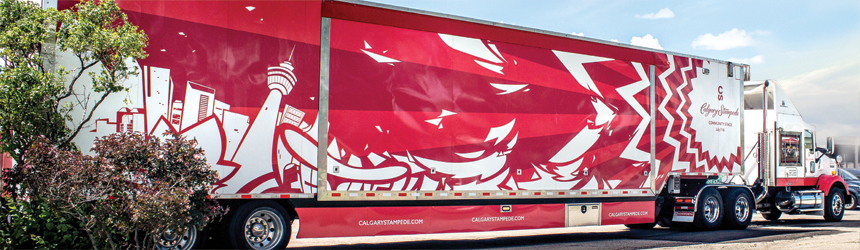
Westwind Design Group of Calgary, AB, Canada won first place in the Digital Output 2017 Application of the Year awards for its work for The Calgary Stampede.

By Melissa Donovan

As in years past, the August issue contains our annual state of the industry report. We reached out to market-leading vendors to gather information on the technology, people, and applications influencing the graphic arts. The overarching theme after sifting through all of the data is that digital is changing how we, the consumer, think. The power to personalize and customize is more than company branding or promotional material found on signage, but moving into fashion, the industrial sector, and who knows where else. Recent advancements in equipment, consumables, and software solutions support this.

Above: Westwind Design Group of Calgary, AB, Canada won first place in the Digital Output 2017 Application of the Year awards for its work for The Calgary Stampede.

Continuing to Progress
A stagnant industry is not only boring, it eventually becomes non-existent. The graphic arts continues to advance through new technology introductions. In addition, it influences other markets to embrace digital.

Technology includes equipment, consumables, and software solutions. On the equipment side of things, Jim Lambert, VP, GM – digital division, INX International Ink Co., says great strides took place in the last few years, specifically in regards to higher resolution and faster printheads. “The driving factor is the method for delivering the drop or dot. Printheads are faster with higher native resolutions, allowing for printing in single pass, which is competitive compared to offset printing,” he shares.

“Digital ink has advanced side by side with device and printhead technology resulting in wide color gamut and durability such as light and water fastness, washability, and handling and rub resistance,” explains Dan Halkyard, senior market manager, S-One Holdings Corp.

Jim Halloran, VP sales and marketing, Lintec of America, Inc., believes we are witnessing a steady but slow evolution in printing equipment and matching materials like ink. An example of this is the progression of UV-curable inks becoming more flexible and curing with less energy.

Other advancements on the consumables side include media, specifically textiles. According to the 2015 Statista Industry Report on Textile and Apparel Manufacturing, $73B of textile products were shipped within the U.S. in 2014. These numbers reflect the significant growth and opportunity for digitally printed textile media, shares Michael Compton, product marketing manager, Top Value Fabrics.

“In the fabric world, yarns are reverse engineered specific to different printing platforms. Integrating new fabrics and technology is now the industry norm. Once the crocking issue is resolved in pigment printing and can run with the same reliability as dye-sublimation, we will see significant changes,” suggests Kathryn Sanders, marketing and sales, Pacific Coast Fabrics.

Another focus in regards to media is ease of installation. “This is evident by the increase in products that do not require professional installation teams, but allow store level employees to install graphics themselves,” cites Kylie Schleicher, marketing manager, Ultraflex Systems, Inc.

“Cost reduction and simplicity are becoming more of a priority. In fact, the application process can be so easy that no professional installation is required. Labor is always the most expensive part of the overall cost, but by helping control this an overall campaign becomes more cost effective,” recommends Darren J. Speizer, VP of sales and marketing, Drytac.

Besides ease in install, labor costs continue to be minimized with advancements in software solutions like workflow products and RIPs. “The best solutions drive print shops to greater profits with print production tools that customers can rely on. RIP providers need to understand the products that shops are selling and provide tools that make them easy to produce. Because of this, the industry constantly looks for innovative ways to reduce downtime and improve production times,” shares Bryan Manwaring, director of product marketing, Onyx Graphics, Inc.

“There is more emphasis put on workflow and interconnectivity between what used to be dissimilar processes. We see more blending of traditional and digital workflows, which brings more diversity to the shop floor. The ability to bring previously outsourced work back in house for more control and profit continues to grow,” explains Josh Hope, senior manager, industrial printing business development and marketing, Mimaki USA, Inc.

These updates to technology—equipment, consumables, and software solutions—enable other segments, like industrial, fashion, and home décor to adopt digital printing processes.

According to Terry Mitchell, director, marketing communications, Graphic Systems Division, Fujifilm North America Corporation, the biggest advancement in the last few years is the development of inkjet technology for many print applications across several market segments. “Inkjet technology solutions have existed for many years in wide format applications, but more recently we have seen advancements in inkjet applications for general commercial printing and industrial applications.”

“The industry has embraced the broader range of what is possible with inkjet. Customers in the signage and graphics space recognize the parts of the market that are becoming commoditized and come to us for solutions to move into higher margin markets like soft signage, corrugated display, or thermoformed products,” says Ken Hanulec, VP of marketing, EFI Inkjet.

Larry Salomon, VP, wide format, Agfa Graphics, experiences the same type of requests from Agfa customers. In particular, the company’s industrial printing division works with manufacturers to support inline printing as part of the production process.

Other industries implement digital printing because the equipment continues to offer reliability and ease of use. “This has led to a lot of new businesses that aren’t traditional printers adding printing to their manufacturing or customization workflow. Runs are as low as one piece, as LED UV, sublimation, and other technologies allow vendors to personalize a variety of consumer goods easily and cost effectively,” shares Andrew Oransky, president, Roland DGA Corporation.

The PSP Profile
It’s challenging to nail down a specific definition of today’s PSP. “One interesting aspect of our market is that it contains incredible diversity and there is no ‘typical’ customer. This was true ten years ago and is true today. There are many different ways to be successful and no standard size company defines that success,” suggests Larry D’Amico, director of sales, large format, Durst Image Technology US.

Organization size, revenue, and services offered vary greatly and continue to change. Based on a 2016 industry survey conducted by the Specialty Graphic Imaging Association, 29.1 percent of PSPs polled had an annual sales revenue of $250,000 to $1.5M. This is the largest percentage, whereas the smallest percentage, at 2.5 percent, had an annual sales revenue of $20M to $35M. 33.7 percent of participants reported a company size of one to four employees. And of those in the one to four employee category, 62.7 percent make $0 to $250K a year.

Citing Printing Industries of America, John Fulena, VP, commercial and industrial printing group, Ricoh, says that the average PSP employs under 100 staff members and generates up to $10M in sales.

“At the other end of the spectrum are the large facilities. Among these companies we are seeing growth—but also consolidation. These are sign and display companies that expanded and invested in $1 million or more wide format inkjet presses to manufacture product for larger companies,” explains Greg Stewart, strategy and product marketing manager, Kongsberg business unit, Esko.

SA International (SAi) conducts on-going customer visits and semi-annual customer surveys. “We have over 50,000 active end users in North America, with the majority of them sign/print businesses. The typical PSP using our software has $250,000 to $1,000,000 in annual revenue and one to three wide format printers. Approximately 15 percent of them outsource work at least weekly. On average, PSPs’ per-employee annual revenue is around $110,000 and hasn’t changed significantly in at least the last five years,” admits Dean Derhak, product marketing director, SAi.

“While annual sales have only grown modestly in the printing industry over the past few years, many PSPs have remained successful due to reducing operational costs and increasing production efficiencies. This is the result of dedicated decisions and steps PSPs have taken to mold their businesses to today’s economy and the needs of today’s customers,” explains Eric Hawkinson, senior director, marketing, production print solutions, Canon Solutions America.

Customer needs are “faster, cheaper, and better,” says Jason Yard, marketing director, Mactac Distributor Products. “That has been the theme for decades, but is more evident in recent years. End customers are making decisions faster, so they want their graphics faster. They also want it cheaper than they wanted it a year ago because there is more competition. And they expect it to be even better quality than the last time, so it creates quite the paradox for print providers.”

To combat the paradox, today’s PSPs look to differentiate themselves by expanding service offerings and merging multiple technologies under one roof. “More printers are diversifying the range of products offered or markets served. In the past commercial printers, sign and display printers, tag and label printers, and everyone pretty much served a segment of the market. We see commercial printers expanding into sign and display and packaging segments, and some sign and display printers offering traditional commercial print,” admits Mitchell.

“Today’s print shop offers a variety of platforms to augment traditional materials. What used to represent separate and distinct industries is now under one roof, making the race to stay relevant all the more vexing. The most obvious difference in modern print shops versus those of a decade ago is the prevalence of flatbed printers. What used to be a luxury is now a necessity. This technology is singularly responsible for the changes described above. Once PSPs realized they could print on virtually anything, hybridization started taking place. Photo labs printing billboards, screenprinters sublimating, and electric sign companies wrapping cars,” describes Brett Thompson, graphic marketing manager, Piedmont Plastics.

One thing that almost every print provider has in common is the need to produce products efficiently and cost effectively while standing out from the competition by offering unique services thanks to technological advancements. “PSPs have evolved into a far more spectacular business than what they were five to ten years ago. The creativity of today’s PSP coupled with their clients need for high-quality prints on materials we never dreamed of printing on is what drives the creation of innovative equipment,” shares Jim Peterson, founding partner, Vanguard Digital Printing Systems.

“Looking at it from a financing standpoint, PSPs that survived a difficult economic environment and made investments in technology to stay competitive are stronger and more profitable than in years past. Balance sheets are de-leveraged on average, and income statements look better with decent profit taking,” adds John Cote, NA sales manager, Zünd America, Inc.

Variations in Applications
A common theme in the last few years is new applications driving technology advancement. The variety of applications produced via digital is astounding. “Digital creates new applications and enables mass customization. It is changing the way we think about visual communication, fashion, and decoration,” advises Sebastien Hanssens, VP marketing and communication, Caldera.

Perhaps one of the most out-of-the-box applications is three-dimensional (3D) printing. “3D printing is a relatively new application that has come a very long way in a short time. The direct influence on our industry is still in the early stages, but it is clearly something that is on the horizon. 3D scanning and full-color output are now a possibility and the demand for high-quality output in the marketplace will continue to drive new advancements in the field,” says Hope.

Similar to 3D printing in that it is relatively new and unique are industrial and direct object applications. “Whenever a shop finds a new unusual substrate it can print to and do a good job of it, it’ll find business, and that encourages the industry to develop technology to make that success repeatable. Products for industrial and residential décor, and architectural applications are great examples of solutions PSPs can offer uniquely without pressure of market commoditization,” shares Fulena.

“Inkjet technology’s very nature is jetting liquids of various types onto practically any substrate. We are just at the infancy of what will be possible in the future by jetting liquids. It’s no longer unheard of to think that today’s print providers will move towards industrial inkjet applications as new substrates and inks are developed,” argues Randy Paar, manager, marketing – display graphics, large format solutions, Canon Solutions America.

Lambert believes that direct object printing is a focus for many printer companies. “Take a look at a water bottle, a can, a caulk tuber, or a tapered drinking glass—many of these are now digitally printed and opening up new opportunities for brand owners. They can now create marketing campaigns that are more regionalized. And since no films or printing plates are required, they are really loving the flexibility and the ability to print on 3D objects that were impossible to print on several years ago,” he continues.

Applications that cannot be replaced with LCD screens or web graphics influence development. These include décor, packaging, and apparel. Halloran believes new applications will be driven toward the “decoration of things. Meaning if you are decorating walls, windows, rugs, and chairs you can’t lose business to a PDF or a tablet.”

“Décor and event—creating a mood or theme—applications are influencing the industry. These are targeted at entertainment venues, offices, and residences. Instead of printing a sign, poster, or banner—three of the most common applications—UV inkjet technology is used to customize or personalize an image to make it more upscale,” agrees Salomon.

Packaging is another application with staying power. “In wide format, corrugated display and packaging is one area with the most room for growth. There can be tremendous efficiencies with digital in that space, especially with a system that can replace litholam,” says Hanulec.

“Attracting new customers is the key to growth, being able to offer specialty display and box packaging software services at a reduced price to larger retail brand manufacturers could quadruple a small shop’s business overnight,” suggests Michael B. Frawley, VP of sales, MCT Digital.

“In flexible packaging and folding cartons—markets were digital adoption is low, the growth will surprise everyone. Brands want to stand out on the shelves and want to attract consumers for all kind of occasions. Corrugated printing is a new frontier—millions of boxes will become more than a box especially in retail and for online shopping,” adds Francois Martin, global marketing head, Graphic Solutions Business, HP Inc.

Printed fabric used for apparel is irreplaceable. “Fast fashion benefits from fabric printing technologies that produce unique, durable, vividly colored garments on a range of fabrics that go well beyond polyester,” shares Halkyard.

“Leggings have led the way for digital printing in apparel, but we’re seeing a shift from performance fabrics to high-end fashion,” concurs Sanders.

The traditional signage market, especially point of purchase (POP) and out-of-home advertising applications, remain significant. Specialty materials used to wrap walls, vehicles, windows, and even floor graphics are ever present.

“Taking into consideration how increasingly competitive the retail landscape has become in the past few years, retailers are looking for any place—like floors, windows, and walls—to promote products. With advancements in adhesive technology, there are now more opportunities to utilize these spaces to efficiently turn them into advertising mediums,” says Speizer.

According to Yard, the development of specialty materials effects the industry. “Wall, floor, and window products have expanded exponentially and influenced print providers to become experts on all things architectural. In many cases, these specialty materials provide higher profit margin as well.”

“Installers continue to push the limits of films by wrapping objects with extreme contours. Vinyl manufacturers need to keep this in mind as new products are developed. Questions to answer—will the film conform, will it stay down in challenging areas when stretched, and do adhesives even stick to the object the installers are trying to wrap?,” asks Molly Waters, senior technical specialist, Avery Dennison Graphics Solutions.

Continued advancements in graphic films provide special visual effects. “Installers leverage the appearance of special effects with films that provide different looks such as texture, sparkle, metallic reflective, and color change films. Colors, effects, and textures continually evolve and require refreshed pallets to stay relevant with personalization and customization trends,” says Tammi Johnson, business development manager, 3M Commercial Solutions.

Magnetic applications are also used frequently and continue to push the industry in new directions thanks to ease of use and versatility. “There’s a big push for magnet and magnet-receptive media being used in retail signage such as menu boards and in-store wall graphics and POP displays. These systems allow retailers to easily change out their graphics for different dayparts or seasonal offerings,” shares Jim Cirigliano, marketing manager, Magnum Magnetics.

“This combination of printable magnetic and magnetic-receptive sheeting is popular because it works for small applications such as restaurant menus and retail POP displays, as well as large architectural and commercial full-wall mural designs, with the same high resolution, vibrant, attention-getting color achievable with other printable substrates,” shares Mike Gertz, marketing manager, Master Magnetics, Inc.

A Fascinating Future
We keep moving into new markets and introducing new technology, all thanks to the immense promise of digital inkjet technology. It’ll be interesting and fascinating to learn what the next 12 months have in store for us. Digital Output will continue to report on all of these developments.

Aug2017, Digital Output

Fairway Fashion

By Cassandra Balentine

The ability to print digitally is beneficial for startups looking to establish a brand. Those with a vision and determination get to market quickly. One such company is Bad Birdie, a golf clothing brand launched in May 2017 out of Los Angeles, CA.

The clothing line came to life in just a few months. Jason Richardson, founder, Bad Birdie, explains that he was driving from AZ to LA last Thanksgiving when his business idea struck. It was then he formed the concept of a golf polo company committed to bringing a new, daring look to the course. The line consists of polo shirts that offer style, boldness, and freshness. Bad Birdie’s polo shirts feature bright colors and fun prints. “We make golf polo shirts for players whose style is as fresh as their game,” comments Richardson.

With many established brands to contend with, its prints set it apart from the competition. “Our main differentiator is our designs,” says Richardson. The company launched with 12 designs from various creative professionals, and the plan is to add more over time.

“Our polos are hand sewn in Los Angeles and designed to fit perfectly while crushing your driver, sinking a birdie putt, or drinking an adult beverage,” adds Richardson.

Above: Golf clothing brand Bad Birdie of Los Angeles, CA offers unique golf shirts created with digitally printed media from Pacific Coast Fabrics by Stanton Calprints of Montebello, CA.

Print and Manufacturing Partners
Bad Birdie relies on integral relationships with vendors to print and produce its shirts in a timely manner.

In addition to its unique style, the polo shirts are manufactured with quality in mind. This starts with a premium digitally printable fabric from Pacific Coast Fabrics. Originally, the company was looking into a custom fabric, but found Pacific Coast Fabrics’ products to meet its needs with a speedy turnaround time. The premium fabric is made in Los Angeles and features moisture wicking and anti-odor functionality.

The Bad Birdie brand is about the look, but also the quality of its clothing. To turn the designs into a desirable product, Richardson sought out print and manufacturing professionals for production. As a startup, it’s important to keep manufacturing costs down and runs low. Richardson says he chose to partner with Stanton Calprints, Inc., based on the service and fast turnaround it is able to provide Bad Birdie.

The print provider is based out of Montebello, CA. Operating out of a 25,000 square foot facility, it is a fabric printer well versed at providing fabrics to the garment trade of Southern, CA. Since the 1980s, the company has relied on sublimation printing to create activewear garments made with blended fabrics.

On its website, the shop notes that it expanded from just three transfer machines in 1995 to six rotary presses, two large flatbed presses, and four high-quality inkjet printers equipped with special sublimation inks, along with proprietary equipment for producing both engineered and custom prints for a variety of applications.

With this setup, the print provider quickly produces samples and accommodates shorter runs for clients like Bad Birdie.

After the shirts are sublimated by Stanton Calprints, they are manufactured into the final product from a finishing partner in Los Angeles. “Runs normally take about two weeks, but I have a great vendor who understands the quick turnaround needs of a startup and can make the polo shirts quicker if necessary,” shares Richardson.

The products are primarily sold online through Bad Birdie’s website. Stocking them in golf pro shops is a future goal.

Because the company’s polo shirts are digitally printed, maintaining a stock of inventory isn’t necessary. “We try to keep a stock inventory, but with the success of our launch we are selling out and have shirts on backorder,” admits Richardson.

Teeing Off
In three years, Richardson hopes to see his brand on the PGA golf tour. The company is active in marketing online, showing off its designs through its social media handle, @badbirdiegolf. The company offers a modern look for a classic game, and is ready to take over the course.

Aug2017, Digital Output

Textiles Favor Bold

By Olivia Cahoon

Direct and transfer dye-sublimation (dye-sub) is used to print on textile applications from sportswear to trade show signage. As this technology expands into segments beyond the graphics arts, manufacturers enhance ink sets with new color options like high-density black. High-density black ink produces a better and richer tone ideal for apparel and signage production. The increased contrast makes colors appear vibrant and durable.

Above: Nova Print, based in Riverside, CA, used J-Teck J-Next Subly Extra Black ink to create 12 54×240-inch panels for a trade show backdrop for customer Get Suppli.

A Richer, Denser Black
High-density black ink is used for apparel, backlit applications, commercial applications, décor, point of purchase signage, soft signage, and trade show graphics. The demand for specialty colors varies in each segment.

In the commercial space, special colors like high-density black are developed to produce a bold hue that combats washed out and faded colors. “Backlit and certain commercial applications tend to wash out with constant bright light applications, which then shows through the fabric graphics,” explains Tommy Martin, product manager, textile and apparel business development and marketing, Mimaki USA, Inc. This drives the demand for richer colors.

“Vibrant, strong color and dense black reproduction is crucial for high-visual impact soft signage,” adds Tony Cox, business manager, Sun Chemical Corporation.

Tim Check, product manager, Epson, believes printers seek high-efficiency ink that delivers rich black tones and doesn’t oversaturate transfer paper. “Oversaturated paper requires that the printer slow down for the ink to dry and uses high amounts of ink, which increases production costs,” he continues.

Apparel applications like Spandex and team uniforms also benefit from specialty ink. Lily Hunter, product manager, textiles and consumables, Roland DGA Corporation, says print providers want a true black that’s rich and dense. “You don’t want this type of apparel to be transparent or even blue black or green black.” These applications require rich, opaque black dye-sub ink.

According to Check, all textile applications benefit from high-density ink because of improved image quality and ink efficiency. He says the ink produces a very dark neutral black on fabrics and boosts the surrounding colors’ vibrancy with added contrast.

Rob Almstrom, CEO/president, American Print Consultants LLC and representative for INX International Ink Co., agrees and says while any application benefits from high-density black ink, it’s especially important for applications such as backlit fabric displays and other direct-to-textile printing applications where deep, rich color is desired.

“The market is becoming more competitive, with an increasing amount of print shops throwing their hats into the dye-sub ring every day,” admits Almstrom. This creates the need for increased quality and color ranges to compete for end user work. “Offering a superior product with richer, denser color is one way production houses achieve this.”

Other sources driving the demand for high-density black ink are educated printers and competitive manufacturers looking for a distinct advantage. Matt Gusse, VP, sales and marketing, Advanced Color Solutions, says one of the first questions potential buyers ask at trade shows is to see printed black ink samples.

“Generally speaking, these clients have seen or had issues trying to achieve the deepest, darkest black without brown or blue tints,” shares Gusse. “Apparel items with two- or four-way stretch fabric like leggings, compression shorts, and rash guards look better and feature denser color with high-density black ink.”

These inks generally show less fade with extended UV exposure as well. Gusse cites items like metal signage, wakeboards, snowboards, custom pool tiles, and backsplashes as holding their true color for longer periods with less coating or protection.

As printers turn to high-density dye-sub ink for brighter and stronger colors, there is a demand for shorter sublimation times to increase productivity and reduce transfer paper weight for cost savings. Juan Kim, CEO, Valloy Incorporation, stresses the importance of reducing ink drying time and preventing issues with stamping and artifacts caused during material take up.

Recipes for Success
Dye-sub applications are either transfer or direct-to-textile printed. The differences between the inks used in these methods are caused by specific chemical formulations generally guarded by ink vendors. High-density black ink is no exception.

“Specific chemical formulations are proprietary, but I can say that the colorant and pigment is higher for both processes in order to produce a deeper, bolder black,” admits Martin. Average black dye-sub ink is generally used for graphics with gradients that require a wider range of black shades. Alternatively, in high-density black ink the dot gain is usually deeper and larger for applications that don’t require gradients.

Jack Papaiacovou, VP/GM, Hilord Chemical Corporation, agrees and says while chemical formulations are proprietary, the challenge of creating darker blacks is in balancing high dye loads in a stable formulation.

“Dye-sub ink is unique in that a true black ink does not exist,” explains Check. Manufacturers mix different colorants to create black. For example, black can be made with cyan, yellow, and magenta colorants.

“The mix of colorants used by each manufacturer is a closely guarded trade secret,” adds Check. The first generation of high-density ink originally created printhead issues. He says customers once had to choose between regular black ink with low maintenance and high-density black ink with increased maintenance.

Today, ink vendors work to deliver low maintenance. Because high-density black ink consists of a different chemical formulation than regular ink, it uses less water. Milling technology is important to prevent nozzle clogging problems. “Particle size is now more uniform due in part to the sonic milling machines employed in the process. This permits new formulations to meet today’s dense black ink demands,” suggests Kim.

Out With the Old
High-density black ink is used as a replacement for black ink but can also be switched out with a different channel. Replacing traditional black ink is the popular option. However, Almstrom says it is possible to add the ink as a separate channel to increase overall gamut, special colors, and traditional dilutes like light cyan and light black.

“This allows for smoother light colors and flesh tones, as well as a better penetration for direct disperse applications where double-sided printing is desirable,” explains Almstrom. Higher density ink is less wet and may hinder the inks ability to migrate through the print’s second side in low saturation areas.

Steven Greaves, director of operations, Alpha Inkjet, believes high-density black can be switched out with any channel as long as the print provider implements the proper RIP software.

Mimaki printers use high-density black ink as a replacement for regular black. Martin says in some solutions, the printers can install light black, regular, or deep black. “In those cases, the printer is capable of using a profile to print deep black with better gradients.”

According to Check, Epson developed UltraChrome DS high-density black ink to be the only black ink used in its SureColor F-Series dye-sub printers. In these situations, high-density black ink is used as a replacement ink.

Highlighting Ink
Besides high-density black ink, other notable trends in dye-sub inks are apparent. Ink manufacturers offer fluorescent colors to create vibrant graphics. Gusse says fluorescent ink is extending into all sports and fashion applications including corporate logos. It is also used with metal and canvas art to create abstract effects.

Aside from black, CMYK ink sets with higher density are popular but also subjected to the same benefits and limitations as black, according to Almstrom.

While most dye-sub ink trends are progressive, some present challenges. Gusse warns of unlicensed and illegal ink marketed by email for pennies on the dollar. “It can be difficult for a printer not to want to try a low-cost alternative,” he admits.

Unlicensed dye-sub ink manufacturers can supply low-grade, non-nano, less consistent products. Gusse believes the most common ink sets have less pigment, the possibility of particles to damage printheads, and variances from batch to batch. “Any of which can be catastrophic to the color, or even worse, your equipment.”

Transforming Black
Special colors like high-density black ink are rich and dense and ideal for applications from apparel and décor to soft signage and trade show graphics. Other trends occurring in dye-sub ink sets include fluorescent colors. Print providers, end users, and ink vendors drive demand for high-density ink, requesting features like dense color on stretchy fabrics and resistance to fading.

Aug2017, Digital Output

Another Great Year

By Mark Hanley

The 2016 calendar year was another great one for wide format. Wide format inkjet markets again showed strong above average, year-to-year growth in low-end, highly localized roll-to-roll eco-solvent and latex markets, and in high-end UV markets. While aqueous markets continue to decline slowly.

The eco-solvent and latex market with its capability to generate small quantities of indoor/outdoor graphics—mostly outdoor-oriented these days—dominates revenues and physical output across the whole market. UV systems continue to provide unmatchable production solutions to larger scale print providers.

On top of this, the soft or textile signage market—which I.T. Strategies counts separately to the wide format market, but part of whose output is used as a form of wide format display output—is now more than 20 percent of all other wide format inkjet markets combined. This makes it a general adoption preference for all sizes of print providers in all wide format graphics channels.

Topline Numbers Analysis and Projections
The statistics in Chart A show the overall size of the wide format inkjet market—excluding soft signage—worldwide with some projections to 2021. The revenue data is measured at the level of pricing from vendors to dealers or users according to the different channels used.

For a market of nearly 25 years vintage, it still grows remarkably at a demand level. That reflects the unsaturated and ever-more-creative use to which the consumer economy places on localized store, retail, and commercial graphics—the largest, if not the only dynamic driver of the markets overall.

That said, the vendor picture is not quite as enticing, even though there is still growth. Behind that growth is efficient competition resulting in ever-more productive systems at lower acquisition prices.

Projections from 2016 to 2021
Chart B shows projections from 2016 through 2021. It also provides a snapshot of the year-over-year growth 2015 to 2016. The difference between the projected five year growth rate and the year-over-year number shows what is meant by above average, year-over-year growth rates. The wide format graphics market cannot be measured accurately just from year to year. Acquisition cycles and technology adoption rates are longer than a year, resulting in a growth rate that averages out over time—more like three to five years.

The statistics in Chart B refer to units of systems sold and ink and hardware revenues. Underlying these statistics are output statistics around square meters printed in total, in turn driving ink sales for vendors. Output statistics are a truer measure of final market demand and the numbers show this in Chart C.

Chart D provides an updated graphic representation of the relative sizes of each wide format sector in terms of vendor revenues for hardware and ink and square meters printed.

Sectoral Commentary
Aqueous Markets
As in the last few years, aqueous professional and in-house markets continue to exhibit mild decline, though they continue to yield large revenues and profits for participants in those markets.

Aqueous technology is still seen by most as yielding by far the highest print quality of any wide format technology. A sub-sector of the aqueous market is graphic arts and packaging proofing, where most printers swear by aqueous color-perfect systems. Similarly, aqueous is still the go-to answer for applications where quality is the prime value such as portraiture, rendering of product, or building projections.

The true decline in aqueous markets is due to the migration of the commercial wide format graphics market towards eco-solvent and latex solutions. Over 20 years ago aqueous systems were the only option, but they were not capable of generating outdoor output that could withstand light, water, and other environmental influences.

Then along came eco-solvent, and after that the functionally equivalent latex, which is really aqueous technology with the addition of water-soluble solvents that allow it to print on film providing a permanent bond—ink to substrate. This opened the external graphics market to low-cost roll-to-roll systems. It was previously only open to aggressive solvent systems. That in turn sparked a revolution in non-regulated, on premise signage, which is what drove the growth in wide format graphics in the last ten years.

Eco-Solvent and Latex Markets
The maturity of this sector has been predicted for quite a while now, but every year the growth in system sales is confounding. 2016 is the same story. This is mostly demand driven as the uses being discovered commercially for this universal graphics print technology keep growing. A good example is fleet graphics. Fleet graphics have been digitally printable for years, but the real acceptance of it and its value has come more slowly, so that by now the true market for it is really just beginning to flourish.

The growth is also partly supplier driven in the sense that since its advent, latex was perceived as a major threat by the Japanese suppliers of eco-solvent systems. The proliferation of eco-solvent systems as a defensive reaction has been spectacular. This means more competition, resulting in better systems for less money.

Aggressive Solvent Markets
Large-scale and outdoor digital graphics began many years ago as a direct consequence of the availability of aggressive solvent systems. They are still out there in the install base—and are still sold by Asian vendors—but are as good as gone as new systems in Europe and North America. Partly no one liked the effects of volatile organic compounds from the ink, but it was also a market of little interest to vendors whose control of a very low-priced ink market vanished early on.

UV Markets
UV markets in wide format graphics represent the largest use anywhere of UV inkjet technology. From being a convenient flatbed technology this sector has become the basis for generating wide format graphics in production quantities. This does not mean high volumes day in, day out, but very high seasonal or occasional burst speed capability on a highly accelerated level perhaps exceeding average volumes by up to 20 times.

While this burst volume capability is strategic and growing well, in the overall context of the wide format graphics market UV is still a relative second in line to eco-solvent and latex markets in aggregate volume terms. It is also a lower priced ink market. While consumable revenues are climbing relative to hardware revenues, hardware revenues still exceed consumables revenues, which is not the case for eco-solvent and latex markets.

The 2016 sales compared to 2015 by UV sub-sector are shown in Chart E. Output of print by UV sub-sector is illustrated in Chart F.

This data shows a general spurt in growth across all UV formats. Within these numbers there has been some significant changes in vendor positions. As with eco-solvent and latex this trend is traced back to demand development driven by an improved consumer economy and by a richer competitive offering in competitive graphic products. In particular the growth in roll-to-roll UV systems is striking. This could be influenced by company acquisitions, but it may mean a higher scaled modern graphics market at major events and retail-related users.

At the very top of the high-end flatbed UV market is a sub-sub-sector referred to as super high end for systems that are close to $1M or over and generally can print around 5K square feet per hour or more. Chart G is the history of sales of those systems.

Soft Signage Graphics Market
Soft signage is not new, but it has seen a spurt in growth in the last three to four years to the point where its output now represents more than 20 percent of all the rest of inkjet wide format graphics output. It has a high end—over $100K acquisition price, and a low end—under $100K acquisition price. Its analysis is complicated by the fact that while the high-end systems are soft signage dedicated, and can be counted cleanly, the larger low end is made up of systems that are sometimes sold for soft signage but are more often sold as apparel printers. It is hard to sort out usage at the print provider level on the simple basis of placements.

The technology used for soft signage is dye-sublimation printing, which allows for a high-quality, brilliant color gamut on synthetic fibers. This is uniquely attractive to signage users. Soft signage is also very light, easy to transport, store, and recycle. As a result of these factors there is not a print outlet in wide format anywhere that does not now want to have this technology as part of their offering.

The summary statistics offered in analysis of the soft signage market in 2016 are illustrated in Chart H.

Mark Hanley, president, I.T. Strategies, has over 20 years of experience in the electronic printing industry. He specializes in identifying new markets for digital color printing technologies. In addition to conducting research and consulting, he travels extensively around the world, facilitating partnerships and strategic alliances between manufacturers in Europe, Japan, and the U.S.

Prior to co-founding I.T. Strategies, Hanley organized the European operations of CAP International, subsequently known as BIS Strategic Decisions. From 1990 to 1992, he was services director at BIS, responsible for the management and growth of electronic hard copy information services in Asia-Pacific, Europe, and North America.

Aug2017, Digital Output