Colorful Carpets

TEST

By Olivia Cahoon

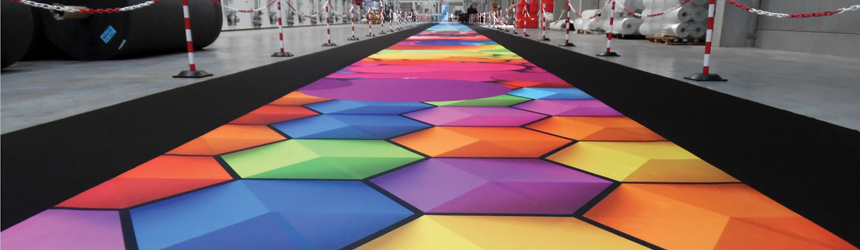
Digitally printed carpet graphics provide a vibrant and colorful option to display a message, promote a band, or direct traffic. Depending on the intended environment, carpet graphics may be designed with images, solid colors, or text. As a type of textile, these graphics require a print provider with knowledge about the nuances of outputting to fabric and experience with this niche material.

Event Carpeting
Incorporated into the U.S. in 2016, Sommer Flooring Inc. is a branch of a European carpet manufacturer and part of a Belgian family-owned company with origins dating back to 1898. Its U.S. headquarters is located in Kennesaw, GA. 250 staff members are employed across several plants and branches throughout the entire international operation.

“We have a strong European base with plants in Belgium and France,” shares Yves Colpaert, president, Sommer Flooring. The company’s branches are in the Netherlands, U.K., and U.S. Distributors and sales representatives are also found in Australia, Europe, and the Middle East.

Sommer Flooring aims to provide a one-stop shop for all event flooring needs, offering clients the benefits of in-depth production and industry knowledge. The company supplies fiber production and technical textiles developed for building and automotive, in addition to a range of vinyl and safety flooring.

Needlepunched Carpet
100 percent recyclable and fire certified, the production and distribution of needlepunched carpets are targeted toward event and trade show customers. The product is digitally printable. “As we are in the trade show and event industry, we noticed the need for personalization of flooring products and exclusive products,” explains Colpaert.

Needlepunched carpet is a thin and affordable option made from 100 percent polypropylene fibers. It can be combined with padding for added comfort at trade shows and events. Sommer Flooring’s needlepunched carpet portfolio includes various products. The company’s Expoprint carpet is positioned for digital printing. A custom design can be output on a carpet up to 6.5 feet wide. The print is suited for use both indoors and outdoors.

This carpet can be used with two printing techniques—transfer dye sublimation (dye-sub) and direct printing with LED curing. Colpaert says the best results occur with LED curing using an EFI VUTEk GS3250LX Pro. The printer handles rigid and sheeted media up to 126.5 inches wide and two inches thick. Its LED technology is intended for a greater range of supported substrates and “greener” printing.

Sommer Flooring has printed carpet for five years in Europe, mostly with the dye-sub technique, and for the past year in the U.S.

Carpets for Occasions
Recently, the carpet manufacturer was approached by Nolan’s Rental, Inc. of Webster, NY. The client is a full-service tent and party rental facility used for weddings, meetings, and small parties. It requested a floor graphic that resembled a boardwalk. The goal was to create an attractive floor display without installing real wood.

Sommer Flooring used 6.5-foot wide Expoprint carpet, printed on the EFI VUTEk GS3250LX Pro. 6.5×65 feet of media was output for the project.

According to Colpaert, the carpet was easy to install despite working with a hard surface. Double-sided tape was used to adhere the needlepunched carpet to the base floor.

The reall challenge was delivering the completed project in time for the event. “A late delivery means a catastrophe in the event industry,” he says. The carpet was completed and installed on schedule. Overall, the client was pleased with the completed carpet graphic.

Comfort and Style
Sommer Flooring produces a special needlepunched carpet that can be digitally printed. The UV LED printing process allows the company to offer customers vibrant graphics whether used on trade show floors or events like weddings, private parties, and corporate events.

Carpet printing is not an everyday occurance in a print shop, but digital technologies—especially UV LED curing—have enabled manufacturers in many fields to adopt the practice and offer customers unique, one-of-a-kind products. One offs and short runs are financially possible thanks to these advancements.

July2017, Digital Output

Double Time

By Cassandra Balentine

Print providers look to get the most out of equipment investments by searching for a solution that best suits their specific needs. For some, it may mean several devices dedicated to one specific application. For others, versatility is critical. For print service providers (PSPs) producing a range of textile applications, dual-mode printers that support both printing to transfer paper and direct-to-fabric media are appealing—specifically to PSPs looking for more versatility.

Dual-Mode Textile Printers
Several vendors provide textile printers that support both printing to transfer and direct-to-fabric media.

DGI offers the 124-inch Fabrijet FT-3204X hybrid textile printer. The device prints on both fabrics and papers; an optional dual roll printing system maximizes productivity as two 64-inch rolls can run simultaneously. The device is powered by eight Panasonic printheads. According to DGI, the machine is primarily used in the U.S. market for printing display materials at exhibitions and for home textiles. The MSRP is under $100,000.

For productivity and quality, the Fabrijet FT-3204X offers 720×360 dpi one-pass printing at 150 square meters per hour (sm/h) in its fastest mode; 80 sm/h in its normal, four-pass mode at 720×720 dpi; and 55 sm/h in six pass Interleave mode with 720×1,080 dpi. It uses DGI original dye-sublimation ink and sublimation paper or textile for inkjet.

The Durst Rhotex 325 from Durst Image Technology US is a dual-purpose printing system that combines direct-to-textile printing and transfer paper printing technology. It is ideal for the creation of soft signage—flags, banners, and backlit displays; home textiles, like tablecloths, bed linens, and upholstery; and clothing—sportswear, t-shirts, and accessories.

The Durst Rhotex 325 features Durst’s WTS printhead technology, which achieves high-quality print output using water-based, environmentally friendly, 100 percent free of volatile organic compounds inks with print speeds up to 7,765 square feet per hour (sf/h).

According to Mike Wozny, senior product manager, EFI Inkjet, EFI has one of the most comprehensive digital textile printer lines. This includes the Reggiani portfolio. “EFI Reggiani printers are commonly used for industrial textile and apparel imaging in both direct or fabric and transfer paper applications,” he shares.

In the soft signage market, the company adapted that technology in its EFI VUTEk FabriVU product line, which includes 1.8-, 3.4-, and 5.2-meter printers that print direct or onto transfer paper using the same aqueous ink set. These devices offer ultra-high resolution of up to 2,400 dpi and four-level grayscale printing with four to 18 picoliter drop sizes.

Inkjet Technology, Inc. offers two dual-mode textile printers, including the 126-inch ITI3200-TXR and ITI3200-TXK. The ITI3200-TXR features an industrial construction and Ricoh Gen-5 printheads, a 600×1,200 resolution, and speeds from 1,300 sf/h. It handles elastic media and offers inline heaters and a front take-up media configuration. The printer incorporates a course roller in front as well as heavy feed rollers and two dancer balls, a vacuum system, and can handle a 220 lb. roll of material. The printer itself weighs 2,400 lb. It is listed for $99,995 to $118,995.

A newer machine by the company, the ITI3200-TXK features an industrial construction and Kyocera printheads offering a resolution of 600×600 dpi and speeds from 2,200 sf/h. The device handles elastic media and a 220 lb. roll of material. It features inline heaters, a rear take-up media configuration, and a vacuum system. This printer weighs 3,900 lb. According to Noel Mareno, GM/director of sales, Inkjet Technology, a two-meter configuration will be available soon with this capability.

PrinterEvolution offers several textile printers with dual-mode capability for direct to textile and printing to transfer paper. These include the Evo33 DS, T1800, T2600, and T3200. The Evo33 DS is a 126-inch device that offers speeds of 860 sf/h; the T1800 features a 74-inch width and 1,600 sf/h; the T2600 features a 102-inch print width and 1,600 sf/h; and the T3200 features a 126-inch print width and 1,600 sf/h. The company’s sister brand, Global Imaging, distributes the 126-inch Durst Rhotex 325.

Changeover
For dual-mode printers, changeover is an essential consideration. The primary requirement for changeover is a media switch, but the complexity of this act varies by machine.

Tara Lamb, president, Global Imaging, says the company’s portfolio of dual-mode printers are developed with ink that prints transfer or direct so that no ink changeovers are necessary. “The only mechanical change is accessing a spittoon tray to catch any pass-through ink that can occur during direct printing,” she offers.

She explains that the Evo33 DS platform requires the printer operator to bypass the tray cover to access the spittoon tray to catch pass-through ink that transfers through the fabric.

Lamb says to print to the PrinterEvolution T-Series or Durst Rhotex 325, the operator “simply mounts a spittoon tray on top of the vacuum platen to catch pass-through ink.”

“Both mechanical changes are very simple and fast,” assures Lamb.

Along with physical media changes, paper profiles are also updated in the changeover. Wozny suggests that along with changing the actual media roll, switching from transfer paper to textile—or vice versa—requires updating the media profile in the printer’s digital front end. “Once the correct media profile is loaded, the printer achieves consistent, accurate color based on the exact type of fabric or transfer paper being printed.”

Investment Considerations
Versatility is the obvious attraction of a dual-mode printer. However, there are other considerations such as applications regularly created and output quality.

PSP requiring a varied and demanding customer base look to dual-mode printers to help shorten setup and production time and to broaden their market base, says Mareno. He adds that the market served and type of job dictates the mode used.

Lamb agrees, sharing that applications are the biggest driver for print providers that need both methods of textile printing. “Transfer printing is excellent for most needs of textile printing, including stretch fabrics. Direct printing is preferred for backlit, flag, mesh, and other open weave fabrics. In addition, a PSP who handles a high volume of one-off prints on a variety of fabrics will certainly gain efficiencies by printing to transfer paper because they will not need to change material in the printer for each job,” she offers. “For those who do long runs or only a small number of materials, direct printing may be the preferred method.”

Wozny says there was a time when printing to transfer paper was considered the only way to get vibrant colors and higher end detail. “EFI’s soft signage printers, including the Fiery digital front end used in preparing jobs, help to eliminate that disparity.”

He adds that some customers want the option for both based on economics. “You can see which method provides the best results at the best cost,” he says. “If a customer can get the same results printing direct that he or she would get printing on transfer paper, they usually prefer that but it might depend on the design and durability needs. And it can also be an economic decision weighing the cost of transfer paper media plus fabric compared to the cost of treated fabric needed to print direct,” continues Wozny.

Specific Features
When considering an investment in any machine, it is important to outline the must-have and nice-to-have features. For textile printing, and specifically dual-mode printers, several considerations come into play including media handling and labor.

Lamb suggests print providers potentially looking for a dual-mode textile printer consider several factors, such as ensuring the media handling for either direct or transfer media is superior, “this affects image quality a great deal.” A high-quality vacuum system is important for holding down thin transfer paper.

Feeding is important. “Soft signage involves wrinkling in media that you don’t have in traditional signage and our wrinkle detect feature saves a lot of heartache for customers. The same goes for having accurate and reliable feeding,” explains Wozny.

A good bypass tray used during direct printing ensures pass-through ink is not picked up by the backside of the fabric, and a heater should work across the entire platen for direct-to-fabric media and transfer paper. “The higher speed printers require heat assist for the media to dry,” offers Lamb.

Pros and Cons
As with any decision, there are advantages and disadvantages. As dedicated devices, direct and transfer printing have their strengths and intended applications. If a PSP is looking to offer a specific service, a single-mode printer may be preferred over a dual mode.

Direct printing is often used for soft signage applications like flags and backlit. Lamb says this is because the dye penetrates deep into the fibers to create rich and dense color saturation. “Transfer printing does not allow for enough of the off-gassed ink to penetrate, which can lead to flat colors. Flags and mesh require direct to achieve the best backside penetration, ideally in the 90 percent range,” she offers.

On the other hand, transfer printing is ideal for other types of fabric printing and “was long thought to provide the most precise image,” says Lamb. “Transfer is superior when it comes to stretch fabrics,” she attests.

Juan Kim, CEO, Valloy Incorporation, suggests that the product concept for direct to textile and printing to transfer paper is different. “For printing on transfer paper, fast drying is the most important, together with printhead height control,” he advises.

However, Wozny says the ability to perform direct and transfer printing with a single device gives customers maximum versatility as long as it can be done efficiently and quickly. “Swapping out ink sets not only adds time and labor to the process, it creates incremental cost in wasted ink from flushing out lines. So there is a definite productivity and cost improvement from using a single ink set,” he continues.

“In my opinion, it is the ability to have that versatility in the manufacturing environment that can be a game changer by not being restricted to one type of job to a specific printer,” says Mareno, regarding dual-mode devices.

“If it is a well-made printer with properly engineered components, there are only benefits,” adds Lamb.

Versatility Wins
For those with limited space and the need for a variety of textile applications, dual-mode printers are an option. With advanced media handling and inks designed to pop, these solutions step up when a dedicated machine isn’t the right fit.

July2017, Digital Output

Fabulous and Framed

By Olivia Cahoon

Printed textiles are commonly used as brand promotion and color backdrops in retail spaces. One popular hardware method for displaying digitally printed fabric is silicone edge graphic (SEG) frames. Woven and knit fabrics are often selected for SEG systems and offer clients dual usage. Print service providers (PSPs) should consider lighting, print process, multiple uses, and measurements prior to choosing a substrate.

It’s All in the Fabric
Fabrics for SEG systems are chosen based on print application and end use. PSPs commonly use knit and woven fabrics for frontlit and backlit applications and blockout usage.

Lily Hunter, product manager, textiles and consumables, Roland DGA Corporation, says knit fabrics stretch easily to fit contemporary curved frames with opaque consistency and minimal tearing.

Michael Compton, product marketing manager, Top Value Fabrics, agrees and says knit fabric typically performs the best in SEG frames. It stretches more in width than in length for easier management.

“A fabric’s stretch width on a printer is easier to work with. If an SEG fabric stretches too much in length it can cause the fabric to experience an hourglass effect while distorting the finished print,” he adds.

Mike Sanders, VP, Pacific Coast Fabrics, believes warped knits are the best fabrics for SEG systems. “Warped knits ensure dimensional stability and have a locking stitch that will not tear. In contrast, a twill weave features a blasted construction, which skews the design and can easily tear across the fabric,” he continues.

According to Heather McCusker, wide format product line manager, Agfa Graphics, the benefit of knit fabric is it is cold cut, while woven fabrics are heat sealed to keep fabric from fraying.

Sharon Roland, advertising and PR manager, Fisher Textiles, says PSPs can use either knits or wovens in SEG systems. It all depends on the required stretch for proper fit in regards to the final application. “We have found our wovens work better for backlit, whereas our knits are better for frontlit.”

Luminescent Fabric
Lighting affects fabric’s appearance in frontlit, backlit, and blackout fabric applications. “As expected, an even distribution of light without pinholes is essential for light boxes. Pinholes for unlit SEG systems need to be factored in too, if there is a light source behind or in front of the SEG system,” explains Sanders. Some unlit SEG systems are double sided and use blockout fabric to shelter light.

Paul Grider, director of product development and technical services, Dazian, says fabric for frontlit applications needs sufficient opacity so outdoor direct sunlight or indoor artificial lighting does not burn the graphic and compromise the color and image quality. “In many SEG structures, a blackout lining or a coated blackback print media needs to be used,” he suggests.

Output, position, and LED color temperature affect backlit applications. Using the wrong fabrics may lead to hot spotting, uneven illumination, and unwanted translucent effects. Grider believes coated fabrics tend to create more uniformed diffusion properties and fewer pinholes for light points to penetrate. “Many non-coated fabrics utilize unique constructions and micro denier fiber to achieve similar properties,” he adds.

Lighting affects fabric appearance in SEG systems, so products are typically designed for certain lighting conditions to maximize the print’s effect. “For example, there are certain products designed for utilization in an application where light hits the SEG frame from the front, allowing the product to illuminate with vibrancy,” shares Jaimie Mask, product specialist, S-One Holdings Corporation.

McCusker believes backlit products with light from behind the image make the image pop, while frontlit products shine light on the image, adding a more enhanced view of the print.

“A high-quality, coated SEG backlit fabric prints with brilliant color and image consistency without allowing hot spots from LED lights to show through the fabric after installation,” explains Compton. Paying attention to fabric weight and stretch in backlit SEG fabrics also ensures the material fits tightly in the frame system without wrinkles.

Grider notes color temperatures from artificial light sources also impact a print’s appearance. “A print of a snowy mountain that is frontlit will require a light source with a cooler tone. If it’s a print of a tropical island, a warmer color temperature may be desired,” he says.

While end users usually choose traditional white LED lights, Hunter notices some are starting to use different colored lights, like blue or pink, to make the graphics pop.

Print Processes
SEG fabrics are printed with dye-sublimation (dye-sub), direct disperse, UV, and latex printers. Sanders says the print process is dependent on the fabric, not on the application. He suggests direct disperse for light boxes due to its deep saturation.

Kylie Schleicher, marketing manager, Ultraflex Systems, Inc., believes latex and dye-sub are ideal ink types that maintain a soft hand and flexibility of the fabric.

“We have seen many customers prefer utilizing direct dye-sub to print backlit SEG, this output offers better color saturation, which is a plus for producing quality backlit,” agrees Eric Tischer, president, Verseidag US.

Roland thinks backlighting requires adjustments in the print process. “PSPs typically must lay down more ink and use a higher curing temperature to get a vivid image that pops with the added light source,” she says.

Hunter says most people believe transfer sublimation printers don’t lay down enough ink for backlit signs and end up with direct sublimation. “There’s a fear that the images will end up looking washed out.”

While sublimation transfer and direct printing are chosen for easy folding and shipping, McCusker finds value in UV printing. “UV is making a push at backlit SEG for its color vibrancy—UV prints just need to be handled with slight care in shipping,” she recommends.

Compton believes both heat transfer printing and dye-sub direct produce beautiful graphics on any fabric. “The market for direct printing is trending upward with the launch of more direct print systems as well as inks providing excellent color and finished graphic print quality.”

Beyond Frames
Besides SEG frames, these fabrics are used for banners, exhibits, free standing frames, home furnishings, photographic back drops, point of purchase, retail, roll-ups, table throws, and wall mounts. “The best fabrics are multifunctional, you do not want to have a lot of styles sitting in your shop,” suggests Sanders.

Schleicher notes that some fabrics have both frontlit and backlit capabilities.

Snagged Fabric
McCusker finds correct sizing to be the greatest challenge associated with fabric and SEG systems. “Correct sizing on SEG is very important. You do not want a graphic to sag,” she says. Loose fabric creates wrinkles while tight fabric may snag or tear.

“Always make sure you have the right measurements for keder placement, so your fabric is nice and taut in the framing system,” recommends Hunter. She also warns that backlit SEGs reveal flaws from the sublimation process like wrinkles and uneven colors. “Knowing this, take your time during the production process to ensure optimum results.”

Tischer agrees and says the greatest challenge associated with SEG and fabric is ensuring the SEG keder and silicone edge beading finished dimensions are correct. “There is a very small window to ensure the product fits properly into the SEG frame, too tight or too lose will ruin the display.”

PSPs must be aware of the fabric finishing process. “Understand the cutability of a fabric, some could have issues with fraying and need hot knives for cutting,” advises Mask.

Compton believes PSPs should work with their fabric suppliers to overcome these challenges and consult with them on the proper fabric for their print system, client requirements, frame system, and end use of the finished graphic.

Framed Considerations
Other major fabric concerns for PSPs creating SEG systems include fabric wrinkle resistance, white point, and if it is a backlit or frontlit SEG. “Fabrics with a light diffusing coating work best for backlit while blockout fabrics for frontlit will hide any shadows from lights near or behind the SEG,” says Mask.

Roland adds that backlit SEG sometimes uses an opaque liner on the inside of the frame to intensify the light source. “In this instance, it is very important for the liner to be opaque,” she shares.

Fabric weight is relative to the SEG system’s size. Large displays use heavy fabrics to keep the graphic smooth and tight while light fabrics are used for smaller SEG systems. Compton says fabric weight varies from four to nine ounces per square yard.

Bright and consistent fabric white points allow PSPs to create and print high-quality graphics without the need to reprofile. Mask says white point always offers benefits for improved image quality and depth to give the final application a visual pop.

Stretchability is a major concern. Excessive stretch risks wrinkles and sagging in the print’s corners and edges. “It is important to note that fabrics with too much stretch can cause issues with sewing the silicone edge on the graphic where the possibility of the fabric bunching up at the sewing needle can occur,” explains Compton.

Sanders warns PSPs considering stretch in both directions to ensure the stretch is equal. “If the stretch is unequal, the image can become skewed or the fabric can wrinkle. Even after the initial installation, wrinkles can show up later.”

While Hunter believes white point and stretchability are key factors for fabrics, she says testing various fabrics to see which types illuminate best and diffuse light to avoid hot spots are even more important.

Transportation also affects the printed media. According to Grider, coated fabrics that are folded tend to have permanent creasing that shows up in the graphic for backlit applications. “Uncoated knits perform better and their stretch properties eliminate wrinkling even when the printed media is folded,” he adds.

Framed Fabrics
While knit or woven fabrics are used for SEG frames, it’s important to consider if the frame will be frontlit, backlit, or require a blockout fabric. Knit fabrics are cold cut and stretch easily, while woven are heat sealed and best used for backlit applications. Besides SEG frames, these fabrics are found in applications from banners to home furnishing and retail. PSPs choosing textiles for use in SEG framing systems need to consider sizing, wrinkle resistance, print process, lighting, and stretchability to determine the best material for the job.

July2017, Digital Output

Fusing Fabric

By Melissa Donovan

Welding is an alternative for finishing digitally printed fabrics. For those print service providers (PSPs) not familiar with how to operate an industrial sewing machine, the option of welding is available. It is often used to finish vinyl banners, so many PSPs might already have experience using such a device.

The decision to weld is based on the application, end use, and user. There are different types of welding processes as well—certain ones are ideal for fabric over others. As more PSPs print to fabric, welding devices adapt to the newest trends.

Why Weld
Print providers may decide to use a welding device to finish fabric for many reasons. While sewing machines or seamers are ideal finishing solutions, a welder offers both durability and less material waste, all while providing a clean and polished end product.

According to Christina Lefebvre, area sales manager, NA, Matic S.A., welded fabric is aesthetically pleasing, especially compared to sewing. “There is no stitching running through the print. No matter what the printed image is, there is no way that the weld will interfere with the message, it is invisible. Welding creates a flat, uniform bond between two layers of fabric. In addition, when the fabric is hung, there are no ruffles, therefore the printed image is not disrupted by creases.”

“When welding, operators no longer have to try to thread match to the fabric or worry about thread rotting when hung outdoors. It provides a high-quality seam that can be used in outdoor environments. Some of the largest billboards in the world are welded,” shares Jeannette Hendrickson, marketing manager, Miller Weldmaster.

Traci Evling, managing director, JTE Machine Systems, Inc., lists benefits including lower cost of labor, no weakening—puncturing—of material at the seam, and reduced cost of materials—no thread needed. “In many cases, the amount of fabric used can be reduced, as a sewn seam usually requires a folded hem and a welded seam does not necessarily,” she continues.

Compared to other technologies related to finishing fabric, a welder is not as dependent on a user’s experience level, suggest Rod Butler, business unit manager, Sani USA and Pascal Smeets, sales engineer, Asco BV.

It’s important to note that certain fabric types are more weldable than others. “Most polyester fabric, nonwovens, and some Tyvek-type material can be ultrasonically welded. All PVC/PU unsupported and coated materials can be radio frequency (RF) welded. Non-coated acrylics and nylon material are not easily weldable. True silicone or non-PVC silicone edge graphics (SEG) are not weldable. Cottons are not weldable without a tape,” recommends Evling.

Tech Differences
There are different welding technologies—ultrasonic, impulse, and hot air or wedge.

Hendrickson says each technology has its benefits depending on the application. “From our experience, ultrasonic is typically used for lighter textiles and delicate fabrics. Impulse is a static bar that goes up and down, however, as the bar touches the outside surface; it can leave a sheen on the image and does not always produce the most desired look. Hot air or hot wedge welding both use a technology that puts the heat in-between the seams leaving the outside print untouched and providing the best looking seams for banners,” she suggests.

Ultrasonic technology is best for polyester fabrics typically used in digital printing, advises Evling. “With the right settings and tooling, ultrasonic welding is very fast and easy, without the need for seaming tape or special materials. In an ultrasonic weld, the melt is created within the material itself, as a result of the high frequency vibrating the metal surfaces above and below the material, causing the thermoplastic to melt, and fuse together within a few seconds,” she continues.

Lefebvre argues that there is no possible injury or harm that can come from using an impulse welder. “The electrodes do not stay hot to touch once the weld is completed and the machine does not emit anything harmful.”

“Impulse welding offers accurate temperature and positioning of where the heat is applied. It is also less noisy and inexpensive,” agree Butler and Smeets.

Ideal for Fabric
While a number of welding technologies are available, some are more suitable for banner material than fabric. Here are some of the best devices designed for welding digitally printable fabric.

DAP America, Inc. distributes Pfaff Industrial welders in North America. The Pfaff 8320 is programmed as a hot wedge or hot air welding machine. An interchangeable swivel allows it to transform from hot air to hot wedge and back. All parameters are controlled electronically, with one integrated control board monitoring heat sealing temperature, air flow, roller pressure, and two motors for the top and bottom roller.

The Fiab 900 is Fiab’s standard high-frequency device, designed to work with a variety of materials. Features include lasers to make handling fabrics easy, a vacuum table system, weld joint tape application, remote control, and side platforms. There are five versions of the Fiab 900, all with different output powers and welding surfaces.

Forsstrom High Frequency AB offers the TX 200-500 high-frequency welding machine. It can be used as a standalone device or complementing a larger system of welding machines. The machine offers three-sided access for optimized material handling.

The JTE Sonic Bar Welder welds digital graphic fabrics in short, straight seams in seconds. It uses ultrasonic frequency to weld fabrics without any puckering including recyclable fabrics to non-coated polyesters and acrylics.

Kabar Manufacturing Corporation’s 20 KW standard track and trolley RF welder is ideal for finishing digitally printed fabric. It features impulse sealing capability. Common applications completed include awnings, billboards, and banners.

Leister Technologies LLC offers the Seamtek 900 AT. A multi-arm system guarantees flexibility between multiple applications. It produces lap welds, hems, open hems, piping welds, and tape welds. A test mode allows for quick parameter determination. Guides allow for even the inexperienced user to utilize the Seamtek 900 AT easily.

Media One distributes the Matic Ares and Ares Plus welders. Both are equipped with cooling parameters that allow the electrodes to stay in contact with the fabric after the welding period. According to Lefebvre, this acts as ironing and prevents the fabric from buckling and creasing. All of the welders are fully programmable, meaning the operator can set specific controls just for fabric.

Miller Weldmaster’s Digitran is ideal for finishing digitally printed fabrics. It is an all-in-one sewing and welding solution. A transport system synced with the sewing machine provides precise material handling. The device utilizes a robust high lead sewing machine for maximum uptime with easy-to-use touch controls. It is configured for multiple seam finishes and a driven roller for accommodating any size job.

Sani USA distributes Asco welders in the U.S. The company has manufactured impulse welders as large as 24 feet. Its models include automatic pocket folding and welding, automatic seaming of panels, invisible welding, and data logging and ERP software integration.

Supply55, Inc. offers the BannerPRO banner welding system, which hems for grommets, pole pockets, and pocked sign fabrication. The heavy-duty, all-steel construction is hands free with foot pedal operation. A solid state electronic timer ensures consistent welds every time.

On Point
Trends in this segment of the market affect the newest iterations of welding machines. With digitally printed fabric becoming increasingly popular, finishing hardware is poised to handle an influx of job requests at a rapid response rate.

For example, models like the Matic Ares Plus include a Turbo Device to give an extra boost, cutting the welding time in half versus regular electrodes. “Printers are now so fast that finishing is the bottleneck,” adds Lefebvre.

Hendrickson agrees, citing large customers who have thousands of banners to finish and want solutions that eliminate all of their finishing bottlenecks. “As such, they seek automation, which is able to finish the sides of the banners including grommets and cutting banners to size,” she says.

Application introductions effect welder usage. Evling gives the introduction of SEG systems as one such factor. “Now these edges are typically made from PVC material and are excellent candidates for welding,” she shares.

“We are experiencing a wider range of digital textiles and fabrics that can be printed on because of UV technologies. As an example, most of the billboards are now all polyethylene. Polyethylene is well suited for hot air welding,” explains Hendrickson.

Finishing Fabric
Welding is an ideal alternative to finish digitally printed fabric. If not familiar or not ready to invest in a sewing machine, this device is a good option. Not only does it offer durability, but can save on labor and material costs. A number of welders are available to work with digitally printed fabric, be sure to conduct due diligence prior to purchasing as some are designed for banner materials and more rugged vinyl.

July2017, Digital Output

Textiles Take the Runway

By Olivia Cahoon

Textile printing is used for a range of applications across industries from fashion and film to home furnishing and trade shows. Quick turnarounds, reasonable prices, and small minimums entice customers to seek textiles for one offs, prototypes, and apparel samples.

Fashion by MY Prints
Established in 2011, MY Prints specializes in dye-sublimation (dye-sub) textile printing for apparel, costuming, fine arts, film, home furnishing, trade shows, television, and the accessory industry in Los Angeles, CA. With two employees, the shop began in a 1,500 square foot office with its primary focus on textile printing. Today, MY Prints employs a staff of six and serves customers domestically and internationally.

Core applications include apparel samples, one offs, and prototyping for fashion, film, and TV. The shop prints costumes and set designs for theatrical productions, home furnishings and accessories for interior décor, large signage for trade show graphics, and illuminated graphics for light box frames.

The company’s main business is in apparel and fashion. “We support our apparel customers by producing digitally printed sample yardage to showcase upcoming print collections,” says Carol Yeager, owner/creative director, MY Prints.
Printed textiles are cut and sewn into showroom samples and viewed by retail buyers. “We have also produced short final production runs for clients looking to do quick turnaround domestic printing,” adds Yeager.

MY Prints supports film and television by offering services like art development, prototyping, and printed yardage. “We have had the pleasure of printing wardrobes for feature films, television series, and major amusement park costumes,” explains Yeager.

“Every application printed by us whether an apparel sample, wardrobe for a movie or television show, or a large trade show sign must be executed with the highest level of attention and quality. The media we prefer to use varies based on the project and our customer’s needs but at the end of the day, we go for quality and high output over cutting corners using cheaper substrates,” says Yeager.

One media vendor it does work with regularly is Pacific Coast Fabrics. For printers, MY Prints uses an Epson SureColor F9200 and Mutoh America, Inc. ValueJet 1638WX and ValueJet 1938TX. According to Yeager, these brands are reasonable in price point, reliable in output, and user friendly.

Fascinating Textiles
Yeager and her partner Steven Moreno celebrate over ten years of textile printing experience prior to owning and operating the shop. Yeager believes there are many advantages to digital dye-sub printing compared to traditional printing methods including smaller minimums and short-run capabilities, quick turnaround, increased design capabilities and print quality, designer customization, catching speed to market trends, and a print-what-you-need philosophy for inventory management.

“Smaller minimums and shorter runs allow our customers to commit to less yardage, aiding in their bottom dollar,” she explains.

Digital print also enables faster turnarounds to save time. Before digital, design samples could take months to import. New designs are now created, printed, and tested in the market in a fraction of the time compared to traditional analog methods that took three to six months from concept to production.

“Digitally printed samples aid in our customers’ ability to test out more concepts and designs with less financial commitments. This is compared to analog methods that entail cutting and storing expensive screens that may or may not make it to production,” says Yeager.

The demand for rapid customization and specialization also drives digital textile printing. Yeager believes every customer can be a designer and have the freedom to create unique and specialized products that define brands and help to stand out from competition.

She also believes printing a photo-real image onto textiles is as easy as printing a basic monotone dot. “There is also a wider color gamut than the traditional methods that had color restrictions due to screen and design repeat size limitations.”

Manufacturers and retailers benefit from inventory cost control by producing only what they need. “Short runs will be the method of inventory control and with the added benefit of being able to react better to current trends with speed to market orders,” suggests Yeager.

Walking the Runway
Third generation fashion designer, Fernando Alberto, recently approached MY Prints after being referred to the print shop by Epson. Alberto sought to incorporate prints into his Fernando Alberto Atelier New York Fashion Week show for 2017.

To complete this job, the shop used the Epson SureColor F9200 printer, Epson inks, and Epson transfer paper for samples.

After Alberto provided the artwork and fabric, the collection was designed, printed, and sewn in less than two weeks. “Samples can be printed within days of conception and a collection can come to life in the fraction of the time it used to take with old methods like pigment or wet printing,” advises Yeager.

The only challenge the shop faced during the job was finding the best synthetic poly fabric substrate that mimicked high-end silk. “Our client’s collection falls under the couture/atelier category, so it was important to find fabrics that were luxurious and showcased his atelier designs,” she explains.

12 pieces were printed, cut, and sewn for the runway collection. The finished application included synthetic poly chiffon and poly charmeuse, which according to Yeager, resembles silk. “Synthetic poly fabrics have come a long way over the years but there is still a high demand for further developments in poly fabrics that mimic silk and other natural fibers more closely,” she adds.

The completed printed collection was showcased domestically and internationally in NY and Los Angeles, CA fashion week runway shows and in Mexico City. According to Yeager, “Alberto was very happy with our services and approached us to help him print additional prints for his upcoming resort 2017 collection.”

Transforming Print
Continued advancements in digital technology push digital platforms into all areas of the commercial market, including textile printing. Companies like MY Prints offer textile printing to provide multiple industries with increased design capabilities, designer customization, quick turnarounds, and smaller minimums.

According to Yeager, digital print will continue to take shares from traditional analog printing as it continues to resolve problems that traditional printing methods cannot. “With the emergence of large, high-speed single-pass printers dominating the market, customers can take advantage of digital printing at a production level with the assurance that there will be high output and efficiency,” she concludes.

July2017, Digital Output

Magnetic Signage

By Elizabeth Quirk

Magnets are prevalent in today’s print shops. Their allure is in the ease of use for the user, specifically during the initial install and the ability to easily change out graphics afterwards. There are two options when it comes to magnets—magnetic and magnetic-receptive media.

Magnetic media is printed directly while magnetized, or printed on then magnetized, whereas magnetic-receptive media works as a part of an overall magnetic display system, in which a magnetic base is installed and magnetic-receptive graphics are printed and attached to the magnet. Although magnetic-receptive sheeting is not a magnet, it adheres to the base material like a magnet to metal.

Attractive Trends
Magnetic media trends include a renewed focus on print quality and compatibility with multiple types of printers. The technology is quickly changing and improving as market demand for wider, thinner, and stronger magnet sheeting increases. As a result, printer manufacturers continue to innovate and magnet manufacturers are tasked with keeping up.

Magnetic-receptive media is gaining traction as a printable substrate used to create large format signage and interchangeable printed pieces. Market demands for wide format magnetic-receptive sheeting continues to increase as more graphics and signage producers/users learn about the advantages of magnetic-receptive sheeting.

In recent years, the use of magnetic graphics systems were trending among printers and retail merchandising designers. According to Mike Gertz, marketing manager, Master Magnetics, Inc., the main reason for using magnetic and magnetic-receptive sheeting for retail point of purchase displays, architectural/commercial wall designs, restaurant menus, and bank interest rate signs is the ability to easily change out variable information or graphic elements without having to remove the entire graphic.

Andrew Carpentier, president, Rochester Magnet Co., provides more insight to the currents trends for both types of magnets. “The market opportunities for sign and display makers are endless with printable magnetic and magnetic-receptive materials—vehicle signs, menu and attendance boards, directories, calendars, save the date cards, marketing reminders and warehouse labeling, to name a few.”

Influencers
Simplicity is the mother of invention. Magnets provide simple solutions for installation and change of message when the time comes to swap out a seasonal campaign or drive a promotion. Designers of point of sale displays understand that keeping it simple for the retailer is key. Carpentier argues that wide format material is now influencing the use of printable flexible magnetic and magnetic-receptive materials.

“The largest influence on the use of magnetic and magnetic-receptive materials is the ability to print the material using most print methods in the print industry today,” explains Stephen S. McLevey, customer service and product manager, Flexmag Industries, Inc., a division of Arnold Magnetic Technologies.

Jim Cirigliano, marketing manager, Magnum Magnetics Corporation, says that customer demand for outstanding imaging on printed magnet drives the market to provide excellent and consistent quality. As magnetic media’s usage for large format, high-end applications grows, product quality is increasingly under the microscope. Retailers using magnetic signage expect graphics to be crisp and flawless, so printers demand media that prints cleanly and consistent.

“Customer knowledge and interest in magnetic graphics systems as well as the increased prevalence of wide format printers drive demand for wider and thinner printable magnetic-receptive media used to create these interchangeable displays,” states Cirigliano.

Retail merchandising designers, retailers, interior designers, and most importantly, commercial printers that are knowledgeable about the advantages are big influencers. According to Gertz, the need for frequently changing information and easily interchangeable graphics for new attention-grabbing messaging has influenced this trend as well. “Comparisons of other signage and display options show that magnetic graphic systems provide an effective and economical solution,” he adds.

There are many benefits in using magnetic-receptive media in applications such as in-store graphics and large format signage that are replaced often. As more print providers and signage customers learn of these benefits, they use magnetic and magnetic-receptive media over other conventional print substrates.

For the most part, the specific application dictates the best graphic choice. According to Clay Reierson, project manager, Xcel Products, Inc., the size of the graphic, existing fixtures and displays, indoor/outdoor environment, and the amount of required change outs plus the total budget are all considerations in order to determine the course of action.

“Magnetic and magnetic-receptive media are a great investment. They are both cost effective to change, retailers are opting to keep their brands fresh. Changing these out more often helps the sale of their products and keeps them coming back to the printer for more graphics,” adds Reierson.

Alice Martin, director of marketing, Adams Magnetic Products, lists benefits including ease of installation, media portability, layered add-on messaging, and graphic cost/flexibility. Layered add-on messaging is especially attractive. “Now for both seasonal customers, or applications where a subliminal message is needed, the user can layer a 30 percent discount sign on top of existing graphics or layer key messages about a product on a daily basis,” she shares.

Environments and Applications
Both magnetic and magnetic-receptive media are ideal for temporary signage and can be removed or replaced quickly and easily, requiring no professional installers. According to Darrell Adams, VP – North America, Newlife Magnetics LLC, this makes both ideal for in-store personnel to install and for chain stores to change in-store advertising and graphics more often—at a lower cost than other conventional printable substrates.

Adams discusses both types of magnets, what environment and application they are best suited for and why. He begins with magnetic media, stating it is best suited for car signs, printed refrigerator magnets, and changeable outdoor signage. Magnetic media requires a metallic or metal surface for the magnet to attract to. Paints with metallic additives are available to be used on conventional drywall and other non-metallic surface applications.

“Once the paint with metallic additives is applied to the surface, a magnet sheet attracts to it just like it does to a metal surface. These may also be painted over with standard paint to make the wall or surface appear to look like any other painted surface,” says Adams.

When it comes to magnetic-receptive media, Adams believes this type of sheeting is best suited for indoor use but may also be used outdoors. Magnetic-receptive media requires a standard magnet sheet for the permanent base of the application system. Once this base magnet sheet is applied to the application surface, it can be reused as many times as needed.

For permanent signage applications, a base magnet sheet with pressure-sensitive adhesive applied to the back can be used to hold the base magnet sheet to the application surface.

For applications that require complete removal without damage, a paint with metallic additives can be used to paint the wall surface so that it will attract and hold a base magnet sheet that’s been magnetized on both sides. The metallic paint can also be covered with something a little more standard to make it appear as a normal wall, according to Adams.

“The magnetic-receptive media sheeting is printed and stacked on top of the base magnet sheet that holds the receptive media in place. When changes in the printed graphics are desired, a new magnetic-receptive sheet can be printed and placed to replace the older graphic. Multiple layers of magnetic-receptive sheeting can also be stacked on top of the base magnet, which makes it an interchangeable sign that can also be rearranged to the order in which the magnetic-receptive media are stacked on the base magnet,” explains Adams.

More Magnets
Adams Magnetic Products offers MegaMAG for magnetic media. It is available in 40- and 48-inch widths and comes in 20- or 30-mil thickness. MAGbond is the company’s magnetic-receptive product. It comes in widths of 50, 54, or 60 inches in 10-mil PET or 13-mil art paper laminate. It works in combination with all flexible magnet sheet and most existing magnetic wall systems.

The Flexmag division of Arnold Magnetic Technologies offers FlexCoat-EZ magnetic material. It is compatible with eco-solvent, UV, latex, and offset ink systems. The product is available in widths up to 40 inches and thicknesses ranging from 0.015 to 0.045 inches.

Magnum Magnetics’ DigiMaxx is a superwide magnetic material. It allows users to print directly to magnet either 40 to 48 inches in width. Typical thickness is 20- or 30-mil, but custom material can be fabricated to meet specific customer requires. The material is made in the U.S.

Master Magnetics magnetic graphic system consists of PrintMagnetVinyl and FlexIRON magnetic-receptive sheeting. It ranges in cost from $1.75 to $2 per square foot. PrintMagnetVinyl is available up to 48 inches in width and printable with solvent, eco-solvent, UV, and latex printers. FlexIRON attracts many types of low-profile magnets, including flexible magnetic sheeting and strip in addition to ceramic and neodymium magnets.

Newlife Magnetics provides several components to create a complete magnet wall system. Mag-Paint is used to make a magnet stick to the wall or sign surface. Wall-Mag is magnet sheeting with adhesive on the non-magnetized side used to permanently adhere to a wall or signage surface. Ino-Steel is a printable magnetic-receptive skin that is placed on top of magnetic sheeting—up to five layers can be stacked on top of each other. DigiVinyl-Mag is a white, printable, wide format magnetic sheeting used for wall graphics placed directly on the wall painted with Mag-Paint or a metal wall/surface.

Rochester Magnet’s DigiMag Vinyl is a white, printable magnetic media for wide format solvent, eco-solvent, UV, and latex inkjet printers. The product is available in both matte and gloss finishes. When in use, DigiMag Vinyl lays flat and adheres to metal surfaces or a magnetic-receptive sheet, like the company’s RubberSteel.

Ultraflex Systems, Inc. offers Signetics Duo, printable on both sides, allowing two graphics to be printed simultaneously and changed in a matter of seconds. The double-sided capability reduces material cost, and freight and installation fees as the material is easily rolled up, turned over, and rolled back to the surface. Signetics LTX offers universal print compatibility with enhanced engineering for use with latex inks. Signetics Select is designed with a smooth backside that eliminates scratches on prints when stacked or rolled.

XMR DS, a double-sided magnetic-receptive material, is available from Xcel Products in rolls of 60 inches by 100 feet. The media is compatible with eco-solvent, latex, solvent, and UV-curable ink. Another popular product is XMR Dimensions, which combines embossing technology with a magnetic-receptive substrate. Texture options include canvas, mosaic, woodgrain, leather, and plaster.

Magnetic Popularity
Magnets are prevalent in today’s print shops. Both magnetic and magnetic-receptive media are easy to use and offer the ability to effortlessly change out graphics when needed. Although each type is best suited for specific applications and environments, both help to make the lives of retailers, designers, and many others much easier and more efficient.

July2017, Digital Output

Home Sweet Home

By Olivia Cahoon

Clients seeking personalized graphic design consider digitally printed wallcoverings for unique images produced to a specific room’s dimensions. This application is found anywhere from retail stores, hotels, hospitals, and corporate offices to the home.

With customization in high demand, home décor is a growing niche for digitally printed wallcoverings. Home owners look to convey their unique style with printed graphics that can only be found on their property. When creating wallcoverings for home décor, print service providers (PSPs) should consider material, adhesive, and installation.

Vinyl, Paper, and Fabric, Oh My!
Wallcovering materials include vinyl or film, paper, and fabric. Lily Hunter, product manager, textiles and consumables, Roland DGA Corporation, advises PSPs to first consider design aspects when choosing which material to use in the home. “For a softer look, go with fabric or matte paper, or even a wallcovering that has texture. On the other hand, if you’d rather a glossy, ‘high pop’ appearance, go with a glossy film or vinyl.”

Vinyl wallcoverings allow clients to choose customized designs, patterns, and images for direct printing. While traditional wallpaper cannot be applied to stucco walls, vinyl has the potential. “Whether the surface of your wall is smooth or bumpy, there are a variety of options to make sure the material not only sticks to the wall, but also looks good,” says Matt Topeff, product development engineer, 3M Commercial Solutions.

For wallcovering printability with most types of print technology, Alan Dworman, president, Catalina Graphic Films, suggests vinyl and textured vinyl. “Textured gives the appearance of a very expensive fabric with a much lower cost point,” he recommends.

Greg Maze, sales and marketing manager, digital and wide format, Neenah Paper, Inc., believes paper-based wallcoverings are the ideal solution for home décor. Paper-based wallcoverings are available non-pasted, pre-pasted, or with pressure-sensitive adhesives in smooth or textured finishes for easy installation.

“Home décor doesn’t usually need to be as durable as commercial décor,” explains Maze. Paper-based wallcoverings are breathable to prevent moisture buildup and potential mold. “This helps promote a healthier environment,” he adds.

For a warm appearance, Jean Luc Lutz, product manager, Senfa, suggests fabric material.

“You might use vinyl as a budget-friendly choice or fabric to enhance the texture and feel of the graphic,” agrees Clay Reierson, director of operations, Xcel Products, Inc. He believes vinyl and fabric are good choices in terms of durability.

Dennis Brunnett, technical service specialist, FLEXcon, believes high-end fabrics coated with adhesives diffuse light better than smooth material and provide easy installation. “Fabrics and heavier gauge vinyl are ideal for rougher walls—they help disguise imperfections,” he says.

According Michael Kirk, sales director, Heytex, fabric material doesn’t use glue and offers limited dirt and dust. “The feel and look of textiles is much more valuable and gives a convenient atmosphere,” he continues.

In addition, fabric offer acoustic benefits. “We have received feedback that fabric wallcoverings help absorb sound. Instead of sound bouncing off a smooth surface, it tends ot hit the texture of the fabric and disperse,” explains Ken Rauch, product manager, Presto Tape.

Sticky Solutions
Installation methods, wall surfaces, and life expectancy determine the ideal adhesive for home décor wallcoverings. Mark Shaneyfelt, director of sales and marketing, printable textiles, Aurora Specialty Textiles Group, Inc., says the wallcovering market requires products that meet pressure-sensitive consumer demands. There are two installation methods for wallcoverings—wet and dry.

Traditional wallpaper is applied with a wet paste that repositions before drying. “Applying paste to the wall is much more forgiving than applying it onto the back of the material, and this is possible only with fabrics,” says Gautier Peers, North American sales manager, Dickson Coatings.

Water-based paste takes several hours to dry while panels are repositioned if needed. After removal, the paste is cleaned from the wall with a wet sponge. Heather McCusker, wide format product line manager, Agfa Graphics, recommends using paste adhesives with strong mildew inhibitors.

Unlike traditional wallpaper, adhesive-backed vinyl is a dry application that adheres to the surface with pressure. Some adhesives allow the wallcovering to be repositioned until firm pressure is applied.

Wall surfaces can affect the adhesive’s efficiency. Hunter says premium paints with low volatile organic compounds (VOCs) may interact negatively with pressure-sensitive adhesives. “Most of the time, this interaction will deaden the adhesive, causing even the strongest and highest tack adhesive to fall off almost immediately,” she continues. The interaction may also cause adhesives to have a higher tack, making a repositionable product permanent.

To avoid installation challenges, Topeff advises PSPs to consider if wall surfaces are smooth or textured and how long the wallcovering should last. “Wallpaper is pretty permanent, and no one likes to remove wallpaper,” he adds.

Homeowners that have trouble deciding which media or adhesive to use can look to the final install location for guidance. Wallcoverings used in dining and living rooms may benefit from fabric and wallpaper paste. David Williams, North American market manager, Innova Art Ltd., suggests decorations for children’s rooms be applied with repositionable adhesives. “Since children’s tastes change as they grow older, this would avoid a major project every few years,” he advises.

Marty Davis, director of wide format and graphics, Mac Papers, believes vinyl is the preferred material for bathrooms and kitchens because it’s easier to clean. For formal settings like dining rooms or a feature wall, Davis suggests fabric for an artistic look.

Installation and Selling
Application challenges occur more often during homeowner installations than for trained professionals. Hunter believes most homeowners aren’t properly trained to test and prepare walls, and the type of media selected may be incompatible with wall surfaces or location.

“With this in mind, it’s important that the seller provide his or her customer with clear instructions for preparation and application,” says Hunter. For example, Ed McCarron, national sales manager, Dietzgen, suggests using a washable wallcovering solution to keep the walls clean. “Using a liquid laminate to finish the mural panels prior to installation is a good practice. It allows for cleaning and makes it easier to remove any paste that surfaces during installation,” he adds.

Josh Barnard, product manager, digital print media, Avery Dennison Graphics Solutions, agrees and recommends homeowners work with PSPs to ensure the correct film and adhesives are chosen and the wall décor is installed correctly.

Home décor wallcovering installations generally occur in smaller areas than in corporate or retail. These locations may have high fluctuations in temperature. “Material needs to handle changes from heating to air conditioning along with humidity from open windows or the bathroom,” explains Walter Gierlach Jr., president, Photo Tex Group, Inc.

The selling of a home décor wallcovering is unique. According to Eric Tischer, president, Verseidag US, “printed home décor fabrics are typically represented and linked together through interior designers. These designers have the relationship with the PSP versus the PSP dealing directly with the homeowner.”

“But as a PSP, you need to get creative—residential doesn’t just mean one home at a time. It can mean multiple units at a time, fill an entire condo or work with a national home builder; often featuring well decorated spaces in model homes or interior décor services in the home building process,” explains Rachel Gamberg, décor market development manager, S-One Holdings Corporation.

Brunnett says selling home décor wallcoverings is different from corporate, sports, and hospital settings. Home décor graphics volumes are smaller by square foot.

“Commercial settings usually require much more approvals and certifications like fire resistance and clean-ability,” agrees Jason Yard, marketing director, Mactac Distributor Products.

Agio Imaging
Established in 2001, Agio Imaging is a print shop in Kalamazoo, MI that offers grand format printing, design, fabrication, and installation. With 18 employees and a network of subcontractors, the shop operates from a 22,500 square foot facility.

Agio Imaging carries over 200 different substrates to accommodate an array of print solutions with short delivery times. “With an extensive lineup of state-of-the-art printing equipment and range of stock materials, we offer graphic solutions for projects of all sizes and budgets,” says Davina Logan, director of sales, marketing and administration, Agio Imaging.

In 2004 the shop started creating wallcoverings and wall graphics. Agio Imaging partners with Dickson Coatings for home décor wallcoverings. The company’s EverGreen fabrics product line offers an array of styles including Jet Tex and Jet Tex Design textured wallcoverings. According to Logan, the EverGreen fabrics line is an eco-friendly PVC-free material, flame retardant, and features a soft, natural look.

Logan believes home décor wallcoverings are a great way to completely customize walls and create visual impact. Clients request wallcoverings for photographs, textures, and borders. “Being able to personalize walls and rooms with interior décor items is vastly growing. After all, why select something out of a catalog when you can design a room the way you envision,” she shares.

However, designing home décor wallcoverings does have its challenges. Clients may supply images with low resolutions unsuitable for large scale reproduction. Agio Imaging’s prepress department reviews each image to ensure it prints clearly.

Recently, Agio Imaging was approached by a client that requested a 100 square foot boat wallcovering for a living room. “The final intent was to create something bigger than just a framed piece of artwork, something that would have great visual impact in the room and create a warm, yet iconic atmosphere,” says Logan.

Dickson Coating EverGreen fabrics were used for the soft and subtle texture. The living room included a vaulted ceiling, so Agio Imaging used scaffolding during installation. The shop also protected the hardwood floors from stray wallcovering paste. “The boat photograph became a stunning piece of art and a focal point in the living area of the residency,” says Logan.

Dali Decals
Founded in 2007, Dali Decals started as a decal shop in Jacksonville, FL. It originally offered decals from a living room but soon grew to a 7,000 square foot warehouse and studio space. Today the shop offers acrylic, banners, custom printed canvas and wood, pop ups, PVC prints, and wall decals. The shop first created wall decals for a close friend and soon after launched an official website.

Dali Decals has produced wallcoverings for ten years. The shop uses Oracal 631 Exhibition Cal and Oracal 651 Intermediate Cal from Orafol Americas for cut vinyl wallcoverings. “We love being able to create a variety of wallcoverings that are affordable and easily changeable. The creative process is so much fun, and it is constantly changing,” explains Alicia Soret, executive director, Dali Decals.

Soret warns that low to no VOC paint with stain blockers and textured surfaces are the biggest challenge for wallcovering installation. “Beyond that, educating customers on graphics, proportions, and file formats is always exciting,” she adds.

Many of Dali Decals’ home décor clients use decals to liven up their homes and decorate children’s areas. For these clients, the shop offers quotes, monograms, and murals. It typically takes one day for the shop to process a custom order. All orders include detailed instructions for installation, complete with pictures. “Our customers are almost always pleased with the end result, and they usually come back for more,” says Soret.

AAA Sign Crafters
In 1971, AAA Sign Crafters started as a hand painted and woodcraft sign shop in Marietta, GA. It began with three employees and focused on real estate signage. Today, AAA Sign Crafters has five employees and produces vehicle wraps, fleet graphics, and wall wraps.

Hank Cobb, VP/co-owner, AAA Sign Crafters, believes the benefits of home décor wallcoverings are endless. “From kitchen scenes to mancaves, we can produce whatever your heart desires,” he says.

Callie Harbin Baptist Church recently approached AAA Sign Crafters for a 20×4.3-foot wall wrap for the church’s meet-and-greet room. The wrap was printed on Avery Dennison MPI 2611 Matte Removable Wall Film. It is a six-mil white calendered wall film with clear removable acrylic adhesive. It lasts four years outdoors and seven years indoors. AAA Sign Crafters uses Avery Dennison materials for all wrap jobs.

The church wallcovering was completed on time with no challenges and the client was pleased. According to Cobb, “wall wraps enhance any room and eliminate the days of work you would put in painting or wallpapering. We think wall wraps are the best bet for customizing any place and always impress.”

Wall Decorations
Alison F. Zepp, VP, marketing and strategy, Jessup Manufacturing Company, believes the demand for home décor wallcoverings is driven by the need to make a home a full expression of individuality and taste. Digitally printed wallcoverings achieve this in a number of ways, starting with the material chosen. PSPs offering wallcoverings for home décor should research material selection, adhesives, installation, and selling tips to offer the best product for the job.

June2017, Digital Output

Unconventional Printing

By Melissa Donovan

In addition to printing on media used to create displays and other applications, flatbeds also print to three-dimensional (3D) objects. One method is running multiple items at once by constructing a jig and placing it on the flatbed. These include flash drives, golf balls, and lunch boxes—to name a few. Larger untraditional pieces can also be placed through a printer, like doors and guitar cases.

A flatbed printer allows for large batches of these products to be printed in a short amount of time. It positions a print service provider (PSP) to meet quick turnarounds and high customization requests. New offerings present another way to profit. Specific features make a flatbed ideal for printing onto multiple items at once or larger untraditional pieces. Advanced ink technology allows for adhesion onto a number of materials, raised heights of printheads accommodate 3D objects, and table beds are designed to accurately hold down complex items.

There are devices that print over 24 inches in width and others considered tabletop flatbeds are smaller in dimension. For the purpose of this article, we focus on flatbeds over 24 inches in width.

Heightened Interest
PSPs considering purchasing a printer or using a current flatbed device for printing unique applications recognize the opportunity of a new revenue stream. Customized products are in high demand and buyers spend good money for them.

“Personalizing and customizing all kinds of objects is a huge trend right now. People pay more for these types of products. This is having an effect upon markets in various industries as well as buying behavior. Each person has a natural desire to create his or her look, and UV flatbeds make it simple to transform all kinds of things to suit individual preferences and styles,” explains Jay Roberts, product manager, UV printers, Roland DGA Corporation.

According to Tom Wittenberg, Americas large format market segment manager, sign and decor, HP, Inc., niche markets where large volumes aren’t the standard—school basketballs with logos, personalized lunch boxes, or one-of-a-kind art on a guitar case—are unique in nature, achieving both higher pricing and higher margins. “The key is getting enough of the small volumes to support the return on investment on the printer,” he adds.

Since the cost to personalize a product—or multiple pieces—through digital printing is minimal, says Josh Hope, senior manager, industrial printing, Mimaki USA, Inc., it all comes down to reduced costs and increased profit due to the ease of customization.

Diversifying offerings increases net profitability, agrees Randy Paar, LFS marketing manager – display graphics, Canon Solutions America.

“A lot of print shops incorporate flatbed printers into their shop for additional add-on purchases. For example, if someone is purchasing a banner for the high school soccer team, they may want an award or water bottle for the players too,” shares Michelle Johnson, advertising and events manager, Mutoh America, Inc.

Offering these services means what was once a rare occurrence becomes standard. “By saying yes to the difficult, unique, one-of-a-kind work, a print provider can get their foot in the door for more attractive and regular program work,” admits Mark Schlimme, director of marketing/product manager – wide format, Screen Americas.

Elevated Requests
With the capability to print onto a range of materials, a number of unique applications are produced digitally. The variety means a range of buyers request them, from customers PSPs are familiar working with to newer clients.

Wittenberg lists printed doors, wooden panels for artwork, and decorative tiles for kitchens, to stereo speakers thin enough to appear as artwork on a wall, blank wrapped canvases, and jewelry boxes as examples of unique applications customized by digital flatbed printers.

“At this point, it is anything and everything. Customization of an already premium item can make all the difference in standing out in what can be a very crowded and competitive market,” shares Hope.

Stone blocks, smashed metal pipes, broken recycled glass, refurbished oak planks, lunch boxes, shipping pallets, electrical fixtures, and toilet seats are some of the “craziest” items seen by Roberts.

Javier Mahmoud, VP of sales and marketing, CET Color, suggests anything in the industrial gamut, from skateboards to phone cases.

“Everything from window shades to doors to furniture to lamp shades to advertising premiums such as jump drives, golf balls, and phone cases. Demands for fast-turn prototyping are also driving innovative uses of flatbed printers,” shares Schlimme.

The demand is primarily driven by people in the know about the capabilities of a flatbed, according to Paar. These include graphic designers, interior designers, manufacturers, and entrepreneurs.

Consumers, corporations, schools, and hospitality also look to create unique environments or unique experiences for individuals, says Wittenberg.

“I have heard providers say they’ve received requests from architects, exterior and interior designers, movie and play set designers, advertising agencies looking for odd items, customers who want to create a unique point of purchase display, and even artists looking for a new canvas medium,” adds Roberts.

Big-Time Aspects
Specific features found on a flatbed make it ideal for printing onto 3D objects. These include the ink, coatings, or varnish; printheads; and material handling.

Ink sets designed for digital flatbeds offer versatility in a number of ways. For example, white ink and varnish can be used decoratively to draw attention to specific areas, suggests Paar. Layers of ink provide texture, which offers a unique look and feel, according to Wittenberg.

“The ability to match digital inks to the appropriate application is a huge benefit. Digital UV inks are available in a range of flexibility and durability for many applications. Add to that the ability to use clear for special effects and jettable primer for challenging substrates and there is a range of printing possibilities,” says Hope.

Printheads are designed to handle robust, industrial-type objects, while still generating high-quality images. “Drop control is a critical factor in image quality to a variety of substrates. Droplet size, shape uniformity, repeatability, and time of flight control are all factors of an engineer’s ability to address the printheads using the tools provided by the printhead manufacturer,” shares Schlimme.

Built-in printhead height ensures the correct distance between the printhead and material occurs. If too far away, the ink won’t properly adhere, if too close, the printhead becomes damaged. Some flatbeds have sensors, like a laser, while others may use media detection bars. “Making sure the printhead height is ideal for each object is crucial,” cautions Roberts.

Flatbed tables handle 3D objects with minimal room for error. “Some flatbeds offer vacuum beds that offer a reverse air option giving media lift or blow back, which is useful when working with heavier media that weights 60 or 70 pounds. The vacuum bed makes it easy to slide media on and off the bed,” explains Michael La Bianca, digital imaging applications specialist, Agfa Graphics.

“One of the most useful features of a flatbed printer is the stationary table. Because the item or substrate being printed onto doesn’t need to move, this allows the PSP to productively print with high precision, repeatability, and quality across all types and shapes of substrates,” advises Paar.

Some flatbed printers are equipped with registration pins, which helps align jigs properly, adds Heather Roden, Acuity product marketing manager, Fujifilm North America Corporation, Graphic Systems Division.

Raised Concerns
While printing to untraditional items like guitar cases, flash drives, and golf balls opens up a new revenue stream, it does come with challenges. PSPs should be aware of these prior to taking on a job. Tips and tricks to ensure success include testing and being conscious of pricing.

“Printing onto non-traditional items can require testing, more testing, and testing again. Because the PSP is venturing into unknown territory, there is the possibility that things won’t work on the first attempt. Figuring out the secret formula however can help in retaining customers and the new revenue gained from the application,” suggests Paar.

Wittenberg recommends PSPs think through costing and ensure they receive enough money for the job to profit. “Some of the jobs may have higher levels of scrap or require running the printer very slowly. These can quickly take a job into the red if not taken into consideration upfront. Are you going to need a jig if the items are small and/or multiple up? This is another cost that needs to be captured, especially if this is a one-time job.”

Don’t skimp to save. Using a cheaper base material—flash drive, water bottle, etc.—may end up costing more in the long run. “PSPs should be very careful in selecting the target materials. A small savings in the raw product can cost you more if the cheaper product does not hold ink as well as a name brand item might,” advises Hope.

One of the biggest challenges when it comes to printing to unique objects is ink adhesion. “Products from different manufacturers can produce different results. If you must use a certain product and the adhesion is an issue there are many primer products on the market that can help. Primer must also be tested as the results will vary greatly on different materials,” explains Ken Parsley, flatbed/hybrid product manager, Mutoh.

Keeping an item flat during the printing process can also be difficult. “This controls the quality of the print and helps ensure the end result meets the customer’s expectations. The many different and unusual substrates used require some special handling. Often fixtures or jigs hold items in place and wedges level odd-shaped objects to create a flat printing surface,” shares Roberts.

Opening Doors
Borne Türelemente, based in Trierweiler an der Mosel, Germany, is a family-owned company specializing in the production of doors and frames for DIY stores in Germany and other European countries. Founded in 1956, the business employs a staff of 1,100 worldwide. It owns two furniture factories in Barlinek and Gorzów, Poland. These house 500 employees that exclusively produce cabinet doors, tables, and pictures for Swedish furniture company IKEA to distribute worldwide.

One of the many products IKEA offers is the PAX cabinet system, which includes doors. Originally they were only available in a limited number of smooth coated colors, but thanks to advancements in inkjet technology, the cabinet doors can now be purchased with designs. All artwork is created by IKEA in Sweden and then sent to Borne Türelemente as a PDF file with exact color samples. Any color combination is offered, in addition to decorative patterns or graphics resembling wood grain. The image is printed via a flatbed device directly to the cabinet door.

As Borne Türelemente’s largest customer, IKEA influences any new technology introduced in the Polish locations. For over a year, Frank Borne, CEO, Borne Türelemente and IKEA representatives researched hardware with plans to upgrade the company’s current wide format flatbed printers. The EFI VUTEk GS3250LX Pro was of particular interest because of its photographic image quality, printing width of 126.5 inches, and performance.

Using samples, Borne Türelemente and its customer vigorously tested the EFI VUTEk GS3250LX Pro. IKEA paid close attention to the high resolution and detail, ink adhesion, accuracy of printing special colors, and the environmental impact of the UV inks. After all of the qualifications were met, the printer was installed in the Gorzów location in January 2016.

“With the evaluation of the machine, IKEA became convinced of the quality of our printers. And because more digitally printed doors are being purchased, we let the EFI VUTEk GS3250LX Pro print around the clock,” shares Borne. The success of the printer led to adding a second device at the end of October 2016. In addition, IKEA and Borne Türelemente are exploring direct printing onto other 3D objects used in décor.

Unique Opportunities
Buyers from different backgrounds request customization in low volumes. Digital printing is poised to capitalize on these demands and help generate profits. Ink, printhead, and material handling technologies found on flatbeds manage unconventional items as small as a flash drive to as large as a garage door. These advancements present new opportunities for PSPs willing to become acquainted with the nuances of printing to untraditional objects

June2017, Digital Output

Display Work

By Cassandra Balentine

Print service providers (PSPs) look for versatile solutions that enable many types of graphics without sacrificing quality or productivity. One popular application is point of purchase (POP) and display graphics, which require a range of varied collateral that is typically changed out frequently.

Jenny Anderson-Giese, a graphic designer by trade, opened RPM Graphics, Inc. in 1999. At that time, the company primarily focused on graphic design and operated out of one room of her house in Dayton, MN.

Today, the shop offers wide format printing, including posters, banners, canvas gallery wraps, foam core signs, and yard signs. It also produces and installs vehicle graphics, commercial real estate signs, and building signage. Its clients are primarily in the Twin Cities metro area. However, it also serves corporate customers with out-of-state locations. It has two employees and 3,600 square feet of space, in Rogers, MN, but it is looking to expand on both fronts in the near future.

Chuck Giese, VP/sales/installation, RPM Graphics, joined the company full time in March of 2006. He offers a breakdown of the business, pointing out that approximately 81 percent of its sales come from its digital wide format printing services.

Upgrading Equipment and Offerings
The shop regularly produces POP graphics. Giese estimates that about 62 percent of its wide format business is this type of work. Due to the range of applications that fall under this category, equipment versatility is critical. The company decided it was time to invest in a digital solution in 2005. Giese admits that it was daunting, but something that needed to be done to progress and expand its capabilities. A Roland DGA Corporation VersaCAMM SP-540 eco-solvent printer/cutter was selected. “In our eyes, it added to the professional capabilities of our company,” shares Giese.

Today, the shop’s equipment portfolio looks much different. It operates two Mutoh America, Inc. eco-solvent printers—the 63-inch ValueJet 1624 and 54-inch ValueJet 1324. For finishing, it relies on two laminators—a 54- and 63-inch, a 54-inch cutter plotter.

The Mutoh printers were added in 2008. They offer the speed and print quality the shop relies on for display and POP work. Additionally, they provide the ability to switch from vinyl to banners and canvas.

Giese says the Mutoh printers were selected for two primary reasons. The first was because they are not printer/cutter combination printers. The plan was to keep those services as separate operations, on separate machines. “This decision was based on becoming more productive and adding speed,” he explains.

The second reason revolved around service. Giese felt that a locally represented company would enable a close working relationship that would pay off when needing service or training.

Application Focused
The POP and display work RPM Graphics creates is popular and varied. One vertical the shop serves often is non-profits, including churches and schools. “Our favorite customer is Feed My Starving Children (FMSC),” admits Giese. Based out of Coon Rapids, MN the organization has a total of seven locations nationwide.

RPM Graphics produces a lot of work for the non-profit. For example, it creates marketplace displays for FMSC’s corporate locations and mobile packing events all over the country. These are foam core signs, printed on adhesive-backed vinyl with Mutoh printers. They are laminated, mounted to foam core, and then trimmed. Easels are added to the back of most of them as well.

Gallery wraps are produced to show the success of the non-profit organization. They are canvas displays that show children that have flourished with the help of FMSC. The wraps are printed with a Mutoh printer onto canvas, trimmed, and manually wrapped.

The company also creates work for special events. FMSC holds two galas annually, one that takes place in Minneapolis, MN and the other in Rosemont, IL. A recent FMSC gala required over 80 foam core signs, dye-sub signs, large wall graphics, and banner displays—up to 20×20 feet.

With projects for FMSC, the shop typically has about a week to turn it around from the point of receiving the digital artwork, and most are set up for production.

The various products are displayed for different time frames. For instance, the gala displays are only showcased for the length of the gala. Marketplace displays are typically in place for each season, and graphics at the office and packing locations are in place much longer.

Future Considerations
RPM Graphics is now in the position to make its next move, and is eyeing flatbed printers. “We are exploding at the seams and are looking at further expanding our company,” concludes Giese.

June2017, Digital Output