Legal Signs

By Olivia Cahoon

Customers approach sign shops for a variety of print jobs with specific sizes, heights, colors, and graphics. Although each request is unique, they all have the same purpose—to display a sign.

But specific ordinances at local and national levels affect how signs are made and where they are placed. In some municipalities, it is the print service provider’s (PSP’s) responsibility to adhere to sign regulations.

Included in these parameters, wide format printed signage used in outdoor public areas must adhere to specific rules for sizing, material, ink, and installation. To explain signage regulations and identify the best resources, we spoke with leaders of the graphic arts community.

Trustworthy Businesses
Sign regulations are established at city, county, and state levels. But responsibility for complying with sign ordinances depends on the local municipality. Rick Hartwig, EHS specialist, government and business information, Specialty Graphic Imaging Association, explains that some municipalities place responsibility with the sign owner, while others require sign producers to complete the sign permit application.

“The city of Chicago requires sign permits to be applied for by a licensed sign contractor,” says Hartwig. However, multiple codes can overlap depending on sign placement. For example, a pole sign posted within the city limits of Chicago, IL and viewable from a state highway is subject to city codes and Illinois Department of Transportation codes.

To maintain a trustworthy business, it’s important that PSPs ensure signage and graphics are compliant with local sign codes.

“If the PSP’s objective is to develop a strong long-term business relationship with its customer, it should look out for the client’s best interest and guide them toward solutions that avoid unnecessary complications,” suggests David Hickey, VP of advocacy, International Sign Association (ISA).

Hickey believes it is the PSP’s responsibility to get involved in the local sign code process to provide expertise and represent the sign graphics and visual communications industry. By adhering to local sign policies, PSPs help local officials understand that visible and effective signs are important to the success of businesses and communities.

Outdoor Public Signage
Outdoor signage is amongst the heaviest regulated signage due to public viewing. This includes building wraps, billboards, monument, temporary, political, and pole signs.

“Because the U.S. has 39,000 local governments, each with their own unique sign codes, there are few universal rules,” explains Hickey. However, general considerations help PSPs adhere to signage restrictions.

Few communities specify what materials and inks may be used for outdoor signage. Local codes tend to describe temporary sign requirements in terms of using durable and sturdy materials that are securely attached.

Hickey believes the key to installing outdoor signage is location. He warns PSPs to be careful about installing signage on, in, or above the right of way—this includes sidewalks, utility poles, and feather signs. “Many communities allow A-frame signs and banners but may specify times and locations for display or may require registration or permitting,” he adds.

Hartwig says that PSPs and sign owners should review the applicable sign codes for installation. “Different areas can have vastly different restrictions, and a municipality may have districts with distinct guidelines, such as historic, mixed, and sign districts.”

Sign codes are categorized by type and may address structural components and installation through building codes and permits like electrical and excavation. Hartwig advises sign owners and PSPs to be aware that codes review design, maintenance, permits, placement on property, removal service, and time limitations. “Depending on the locality, there can also be permit requirements for any subcontractors used in the project,” he continues.

Outdoor signage sizing is a considerable regulation PSPs should be aware of. Most local codes include size limitations for outdoor signage and window signs. Windows signs don’t usually require a permit but even ones posted inside adhere to size limitations.

In 2015, the U.S. Supreme Court case, Reed v. Gilbert, clarified when municipalities may impose content-based restrictions on signage. Hickey says the case affirmed that communities cannot restrict sign messages. However, jurisdictions may restrict certain colors or require certain fonts.

Illegal Signs
PSPs and sign owners that do not comply with sign codes may face a loss of licenses, expensive daily fines, service disputes, and costs to remove or remake signs. Hartwig warns that sign producers may also face legal issues with the city, develop a bad reputation, or lose business.

“If you don’t know the rules or don’t follow them, then you might not be able to get your customer the sign they want, and you’ll have a difficult time with the government,” cautions Hickey.

Sign owners and users held responsible for code violations face removal costs, remaking signs, legal issues, and lost business. “It’s not uncommon for a sign customer to point blame at the sign producer for illegal or non-compliant signs. Most customers will assume the sign producer knows the area’s rules and regulations,” says Hartwig.

Piedmont Press and Graphics
Founded in 1987, Piedmont Press and Graphics is a full-service printer located in Warrenton, VA. The shop offers booklet binding, finishing services, graphic design, mailing, marketing services, and signage for banners, labels, point of purchase, vehicles, and windows.

Piedmont Press started as a print and copy center in a 600 square foot facility. It now has a production area of 2,500 square feet with four employees and a handful of part-time employees. The PSP prints outdoor signage using HP, Inc. printers with media from 3M Commercial Solutions and Avery Dennison Graphics Solutions—mostly sourced from Grimco, Inc.

For signage rules and regulations, Tony Tedeschi, CEO, Piedmont Press, believes the shop is moderately knowledgeable. “We know when to call the local government zoning offices,” he says. In fact, the shop suggests customers look at zoning law websites, the local government, and published articles and items from ISA to learn more about signage restrictions.

To efficiently abide by signage rules, Piedmont Press reads all signage regulations the local government posts and meets with government officials. “We do our best to accommodate the customer requests and then, if we believe they conflict with local regulations, we refer them to the zoning office or call on their behalf,” explains Tedeschi.

According to Tedeschi, signage rules and regulations don’t change as often as the interpretation does. But, unclear and outdated regulations can be time consuming endeavors. In some scenarios, PSPs aren’t compensated for the time invested working with authorities to figure out correct dimensions or placement.

However, good signage regulations can lead to an increase in requests for quality designs provided by sign professionals. “Ultimately, we want to create beautiful looking signs and do such a good job of planning that when the town or county sees an application that our company has worked on, they will be confident that we followed the rules and expedite our client’s permit,” shares Tedeschi.

Being Resourceful
To avoid fines and legal issues, PSPs may become familiar with sign regulations and codes by viewing the municipality’s website. However, Hartwig warns that the codes change often and the websites are not always up to date. He suggests contacting the staff at the local planning or zoning department that has authority over signage. “Contacting an actual person also helps to establish a working relationship in case you have questions or need variances down the road,” he adds.

Hickey says the best place to change a sign code, make it less restrictive, or get assistance with a permit issue is through local sign associations and ISA. “The resources developed by the Sign Research Foundation and the expertise provided by the ISA staff on these kinds of issues are very effective in educating local officials about why signs are so important to business and communities.”

The Sign Research Foundation supplies academic research on vibrant and effective sign strategies, systems, and codes. The foundation works with architects, urban planners, developers, code officials, business owners, and designers to create more navigable cities and strong urban identities.

ISA offers assistance and resources to help PSPs promote visible and effective signs. Best Practices in Regulating Temporary Signs provides a guideline on legal resources, statistics, and the best practices for individual types of temporary signs like advertising murals, balloon signs, light pole banners, sidewalk signs, and window signs. The complimentary guide is published by the Sign Research Foundation.

ISA’s official website also offers resources for local officials, position statements, sign code case studies, and the sign industry and congress. “If more communities develop better sign codes, it gives the sign, graphics, and visual communications industry a better opportunity to grow business,” suggests Hickey.

Signage Rules
When local sign regulations fall under the PSP’s responsibility, loss of license, fines, and shop reputation is at stake. Outdoor signage poses an exceptional challenge due to public viewing, sign placement and limitations, and the possibility of multiple codes overlapping. To avoid signage code violations and to efficiently meet client expectations, PSPs may refer to local government offices, online code listings, and association guidelines to ensure all signage rules are followed.

June2017, Digital Output
Applications Fuel Print

By Digital Output Staff

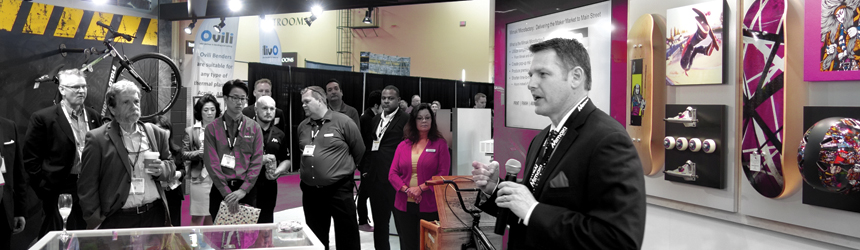
The International Sign Association’s (ISA’s) annual International Sign Expo event concluded April 22. Held in Las Vegas, NV at the Mandalay Bay Convention Center, the trade show broke attendance records, as reported by ISA with over 20,500 attending. Close to 600 vendors exhibited throughout a 210,000 square foot floor space.

Applications Abound
If there was ever a theme for the show, it was clear that applications are largely influencing the industry. For example, Mimaki USA, Inc. launched its Microfactory, showcasing the various ways digital is used throughout the manufacturing process. A skateboard’s wheels and board were both digitally decorated, using a UJF-7151 plus and JFX200-2531, respectively. Hats were printed and sewn in the booth, as were computer cases. “We want to educate visitors about the ability to open up new revenue streams,” shared Ken VanHorn, VP, marketing and operations, Mimaki.

During a press conference, Scott Schinlever, SVP/GM, EFI Inkjet, pointed out the recent trend of how “people were transitioning from printers to short-run manufacturers.” EFI is assisting in this with the introduction of its EFI Pro 16h printer, an affordable entry point for hybrid roll/flatbed production printing.

New Technology
Other innovations of note included the first public viewing of the new Océ Colorado 1640 printer from Canon Solutions America. The roll-to-roll device is a 64-inch printer designed with UVgel. Proprietary technology, the ink set is touted as a new UV-curable ink that instantly gels on contact with media.

HP, Inc. entered the print and cut segment with the new HP Latex 300 Print and Cut Series. The printer targets sign shops, quick printers, and print service providers looking to incorporate printing and cutting into a single workflow, which helps with time savings.

Mimaki also used the ISA International Sign Expo as a springboard for its venture into three-dimensional (3D) printing. The Mimaki 3DUJ-P printer was in action at the booth. It creates incredibly realistic products and is able to utilize clear inks independently or with color ink to create translucent objects.

Mutoh America, Inc. premiered the ValueJet 1948WX dye-sublimation printer and ValueJet 626UF UV flatbed. The 1948WX is a 75-inch four printhead printer that further expands the company’s soft signage printer line. The 626UF is a 19×23-inch UV LED flatbed printer with an expanded print width and depth and optional rotary attachment.

Next Year
ISA International Sign Expo 2018 is held March 21 to 24 at the Orange County Convention Center in Orlando, FL. We hope to see you there. To learn about more products displayed at the 2017 show, visit digitaloutput.net and search keyword “ISA2017.”

June2017, Digital Output

Man and the Machine

By Melissa Donovan

As vehicle wraps become commonplace, printers and wrap installers look for new ways to use their craft. One way to do this is to go large by wrapping big boats, planes, and even trains. Print service providers (PSPs) equipped to handle these projects make quite a name for themselves.

One of the First
GeckoWraps, based in Las Vegas, NV, began in 2006. It was one of the first companies in the area, according to Shane Lloyd, CEO, GeckoWraps, to start offering vehicle wraps. In one year, the print provider tripled revenue.

The PSP offers printing, installing, design services, and photography to its customers. It’s extended beyond wrapping vehicles to a range of objects from ATMs and vending machines, trashcans and dumpsters, slot machines, concrete walls, and ice machines to shipping containers, tables and counters, and helmets.

Three wide format printers from Mutoh America, Inc. are found in the print shop. Lloyd says the Mutoh printers are ideal because of the range of materials his team constantly wraps with. “Printing on white vinyl is something everyone does. We print on a lot of chrome and metallic—and we were actually printing on it before it was made printable,” he admits.

Besides wraps, GeckoWraps offers wide format digital printing and installation of banners; wall graphics; floor graphics; window graphics; directional signage; flags; posters; backdrops; tablecloths; trade show graphics; small format items like flyers, brochures, and catalogs; and even promotional products—pens, drinkware, and bags.

With a home base in Las Vegas, the company is positioned to cater to many unique project requests. A lot of the work it completes is done for casinos and hotels in the area. However, customers are found nationwide. A 5,000 square foot building is more of a showroom than a production facility, as Lloyd explains that a large portion of the wrapping takes place offsite at customers’ locations.

Industrial Machinery
Over a decade after its inception, GeckoWraps has parlayed its wrap expertise from cars to other vehicles like boats, planes, helicopters, and industrial machinery. Industrial machinery, which includes cranes and excavators, is an ideal candidate for digitally printed wraps. The material not only dresses up an ordinarily dull-looking vehicle to attract attention but also protects the base surface from debris.

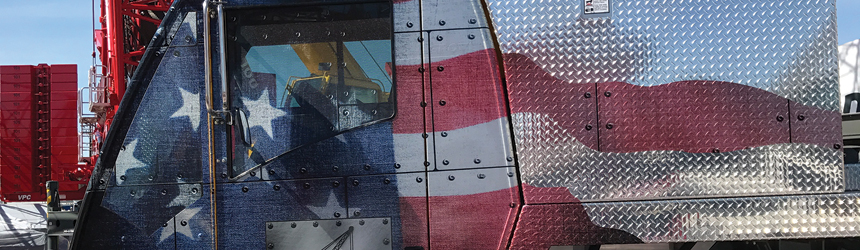
GeckoWraps recently completed a job for Manitowoc, a manufacturer of cranes. One of the biggest construction trade shows was coming up, CONEXPO-CON/AGG, which is held every three years in Las Vegas at the Las Vegas Convention Center. Manitowoc wanted to maintain a big presence and looked to GeckoWraps to achieve it by wrapping one of its Grove TMS9000-2 cranes. The boom on this machine measures 169.3 feet and the chassis has a width of 8.5 feet and length of 43.8 feet. At full span, the outrigger system measures 23 feet.

Working with Manitowoc’s marketing team, using three-dimensional (3D) renderings, four different designs were conceptualized. The final one included American flags and metalwork graphics.

Most of the dimensions were based on the 3D rendering. This was perhaps one of the biggest challenges of the entire job. “When equipment isn’t accessible to measure, unforeseen challenges come up like a piece may appear on the vehicle after we did the rendering, or something might be removed. When this happens, we just adapt and overcome,” explains Lloyd.

While initial conversations regarding the project occurred in Fall of 2016, GeckoWraps didn’t start wrapping the crane until March 2017. In between that time frame graphics were printed, prepped, and cut so no time would be wasted once the wrap process began.

Graphics were printed on a Mutoh ValueJet 1624X. It was chosen because of its ability to print on unique substrates like chrome and metallic. Lloyd estimates that 1,200 to 1,500 square feet of media from 3M Commercial Solutions was used for the Manitowoc job. Specifically, 3M Wrap Film Series 1080 in white aluminum featuring a satin finish.

The crane was brought onsite a few days prior to CONEXPO-CON/AGG, which took place from March 7 to 11, 2017, and partially wrapped during a four day period. It was then moved to the expo site and installation was completed in three additional days. From design to install, the entire job took 190 man hours.

Never Stop Innovating
While the crane is one of the biggest jobs GeckoWraps has completed to date, Lloyd says that doesn’t mean it stops innovating. “It’s a constant challenge to think outside the box. While it’s hard to do every time, each job presents us with the question of how can we outdo ourselves?” Using its fleet of Mutoh printers and stepping up to the plate when large projects come along, GeckoWraps is positioned to answer that question.

June2017, Digital Output

Digital in Industrial

By Digital Output Staff

The inaugural InPrint USA was held in April 2017 at the Orange County Convention Center in Orlando, FL. Co-located with ICE USA, the two shows drew in 3,400 verified registrants according to the event organizers, Mack Brooks Exhibitions, Inc.

With a focus on industrial print, the InPrint USA show centered on manufacturers that use print as an essential component of their manufacturing process. This includes fields such as industrial specialty, screen, digital, inkjet, and three-dimensional technology.

Industrial Innovations
Digital Output was on the scene and examined some of the digital technology impacting the industrial space.

Cruse Digital Imaging Equipment exhibited a version of its Portal 2D + 3D scanner. The device was developed to capture flat originals such as décor, paper, maps, and wallpaper. It captures fine details thanks to high optical resolution. Many manufacturers in the flooring industry use the device.

Engineered Printing Solutions debuted its Roto-jet industrial cylindrical printer. Print on flat walled or tapered objects using white, CMYK, primer, or varnish. The device accommodates objects from 1.5 to six inches in diameter and up to ten inches in length.

Inkcups Now showcased several inkjet printers including the Helix, X2, and Xjet800. The Helix is a rotary inkjet printer for straight walled and tapered cylinders. The X2 features a 20×24-inch flatbed print area. The Xjet800 is an industrial inkjet printer designed for high-volume production demand.

INX International exhibited its CP 100 UV digital cylindrical printer, designed for prototyping, short runs, and promotional items. It provides four-color capability with resolutions up to 1,400×1,400 dpi.

Mimaki USA, Inc. demonstrated its UJF-7151 plus UV LED flatbed printer. It prints on a variety of substrates including plastic, metal, wood, leather, and glass. Print dimensions are 28 inches wide by 20 inches long and six inches thick.

Roland DGA Corporation displayed its VersaUV LEF-300 UV flatbed printer. Attendees of the show who happened by the Showcase Theater to hear a speaker or two were treated to a notebook printed on the device. The printer outputs on items up to 3.94 inches thick.

Major ink manufacturers were also at the show, discussing how their products play a role in the manufacturing process. These vendors included Afford Industrial, Amica Systems, Fujifilm North America Corporation, Kao Collins, Mankiewicz, Marabu North America, Nazdar, Sensient Imaging Technologies, Staedlter Industrial Products, Sun Chemical Corporation, and Wikoff Digital.

Agfa Graphics showcased the various applications that can come from digital print in the industrial realm. The booth displayed flooring, chairs, wallcoverings, and even sneakers.

InPrint USA and ICE USA will be held in Louisville, KY April 9 to 11, 2019.

June2017, Digital Output

Crystal Clear

By Olivia Cahoon

Digital print technology allows glass to be directly printed for fast and resilient graphics. Several industries including commercial, residential, and transit stations seek images printed on glass for a clean, durable, and professional look.

Recently, Nike took advantage of this technology when it approached a print provider to create opaque decorative glass for the expansion of its world headquarters.

Moon Shadow Glass
Founded in 1978, Moon Shadow Glass, based in Sandy, OR, is known for its high-quality decorative glass solutions, customer service, and timely delivery. The print shop’s motto is “if it can be done with glass, we can do it.”

Moon Shadow Glass began with one employee in a 400 square foot garage serving the Northwest U.S. The company originally offered screenprinting but evolved to etched, photo etched, direct print, grooved, and laminated decorative glass offerings. Today, with ten employees, the company distributes glass worldwide from an 8,500 square foot facility.

The company serves the commercial, signage, and residential industries. Some of its clients include the Oregon Zoo, TriMet—the local transit line, and the University of Oregon. It accepts orders as small as 6×6 inches and as large as 60×130 inches. The finished glass work is crated in house for shipment or onsite delivery to ensure safety.

Graphics to Glass
12 years ago, Moon Shadow Glass first saw laminated printed glass, mostly frit style, at the biannual Glasstec in Germany. Frit ink is composed of superfine ground glass applied to substrates at high temperatures. It produces a clear image on one side.

In 2012, the shop started to create printed, laminated glass. Moon Shadow Glass originally used an EFI VUTEk H650 printer. After receiving a large job for the Elephant Land exhibit at the Oregon Zoo, the shop decided to upgrade. It now uses a 65-inch EFI H1625 LED printer with white ink.

“Digital offers another option to do our decorative glass lines where we can do color fills on etched glass, direct printed panel, and two-sided printing. It is now about 50 percent of our business,” explains Tim Frasier, president, Moon Shadow Glass. “The nice thing about digital is that we get full four-color prints, double sided, at high resolution,” he adds.

Laminated glass is used for restaurant tabletops, office partitions, and space dividers. Architects, designers, contractors, and manufacturers seek decorative glass in the commercial space. Designs include surface etching, shading, surface beveling, and adding color. Surface beveling is completed by cutting and polishing grooves into the surface of thicker glass panels.

While decorative glass creates an elegant display, print providers may run into trouble if a workspace is not in pristine condition. “The main challenge is ensuring the glass is dust-, oil-, and scratch-free. We clean the glass multiple times to make sure we get a clear and perfected printed image,” shares Frasier.

In the last several years he says designers and architects have requested two-sided, high-resolution, full-color images with the ability to be completely opaque or semi-transparent.

Nike Seeks Glass
In April 2016, Moon Shadow Glass was approached by repeat client Nike, which sought decorative glass for its interior garage at the Nike World Headquarters campus in Beaverton, OR. The corporation requested glass graphics that were opaque but allowed light into its 1,200 parking space and four-story interior garage.

OldCastle Glass in Battle Ground, WA supplied the glass for the Nike project. Tools included the EFI H1625, Adobe Systems Incorporated Photoshop, and SA International’s FlexiSIGN RIP. “The EFI printer allowed us to print a two-sided image with semi-transparency in high resolution all in one pass,” explains Frasier.

After four months of fabrication and eight months of planning, Moon Shadow Glass printed 480 pieces of full-color laminated glass to create 8,000 square feet of wall murals. The graphics depict athletes and the Nike slogan and brand. Encore Glass in Salem, OR handled installation.

Despite the enormity of the project, the shop didn’t run into problems with the size of the graphics, but rather the shape. Frasier says the staff experienced challenges with the need for irregularly shaped cut glass, which was required to ensure the print was correctly aligned. The project was completed on time despite being on a much larger scale than Moon Shadow Glass’ average jobs.

Glass and Graphics
Glass signage is a practical and professional option for high-impact graphics. With the right technology, print providers print directly onto glass to offer double-sided, photo-realistic images.

May2017, Digital Output

Where & When

By Melissa Donovan

Eco-friendly media, sometimes referred to as “green” or sustainable, is in many forms. These materials range from vinyl and films to paper-based substrates and fabric. They are used in a number of different applications and environments. Wide format digital print service providers (PSPs) may use this media to appeal to eco-conscious customers while supporting their own environmentally friendly efforts. Challenges are apparent from cost to construction, but there continues to be demand for eco-friendly products.

Location, Location, Location
Eco-friendly media is used in various applications and environments. With a vast range of material options—fabric, film, paper, and vinyl—there is no limit to where this specialty product can appear.

Fabric
Gautier Peers, territory sales manager, Dickson Coatings, says most of its company’s eco-friendly fabrics are used for indoor decoration applications such as wallcoverings, window blinds, and canvas wraps in hotels, corporate offices, retail outlets, museums, restaurants, and private residences.

“The interior, décor, retail, and exhibition market segments are frequently using these type of fabrics. This is because companies and their brands want to be sustainable and environmentally friendly, due to them not wanting the fabric possessing PVC, heavy metals, or volatile organic compounds,” advises Eric Tischer, president, Verseidag US.

Besides traditional signage, eco-friendly fabric is also used for apparel. “Eco-friendly media is becoming extremely popular for apparel applications, with the rise of athleisure wear and custom apparel products,” explains Sharon Roland, advertising and PR manager, Fisher Textiles.

Film
Dennis Brunnett, technical service specialist and Jodi Sawyer, market development manager, FLEXcon, find that most non-vinyl film solutions classified as environmentally friendly are used in indoor, short-term promotional advertising. This includes retail windows, walls, and counters; as well as restaurant settings and corporate office locations.

Another popular use—vehicle graphics. Stephen D. Smith, industry manager for graphics, SWM International (formerly Argotec), says that there are those PSPs that are eco-conscious enough to insist on designing, printing, and wrapping vehicles with more eco-friendly products.

Paper-Based Substrates
Paper-based substrates can be flexible or rigid. Either construction is found in different environments as a variety of applications.

For example, rigid board includes indoor, temporary point of purchase (POP) retail graphics that are generally short-term applications—in place for two to three weeks maximum, according to Tony Lampariello, national rigid media manager, Agfa Graphics.

Flexible materials are used in a number of ways. “Our eco-friendly dimensional wall panels are used in retail stores, POP displays, trade show booths, commercial building, television and motion picture, theater productions, and residential,” says Danielle Hoon, marketing, Simple Walls.

“With the accelerated pace of today’s limited-time offers, pop-up promotions, and seasonal turnovers, paper-based materials provide advantages in the retailer’s recycling stream. Paper is disposable and more widely recycled. When a paper sign is no longer needed, it can go right into the blue box with no special sorting, also eliminating the need to commission specialty waste removal,” shares Greg Maze, sales and marketing manager – digital and wide format, Neenah Paper, Inc.

Vinyl
Eco-friendly vinyl is used in display and graphics applications. According to Bryan Rose, VP and GM, global new business development, Cooley Group, these range from outdoor advertising billboards and displays to retail and POP applications such as banners, backdrops, and backlit displays.

In addition to POP, there is a demand for eco-friendly materials in architectural and design spaces. “From a PSA vinyl perspective, the applications are far reaching, but the majority of applications tend to revolve around interior applications such as wall murals and POP displays or graphics,” suggests Craig Campbell, market manager – graphic products, Orafol Americas.

The Ideal User
Eco-friendly media—fabric, film, paper based, and vinyl—is requested by a specific client base.

Fabric
A good portion of requests for green fabric are driven by larger companies who make sustainability and overall environmentally green operations part of their global platform and marketing, admits Mike Compton, product marketing manager, Top Value Fabrics. “But, more companies are beginning to request eco-friendly fabric media as concerns grow over landfill space and relative decomposition and recyclability of various fabrics,” he adds.

“Companies with a history of environmental consciousness are requesting eco-friendly media, as well as new companies that are interested in giving back or aligning with the eco-label,” agree Kathryn Sanders, marketing and sales and Mike Sanders, VP, Pacific Coast Fabrics.

These organizations look for minimal hazardous materials as part of their décor include schools, hospitals, and even government institutions, according to Walter Gierlach Jr., owner, Photo Tex Group, Inc.

“Places that work with children,” adds Kylie Schleicher, marketing manager, Ultraflex Systems, Inc.

Film
Eco-friendly film use is influenced by brand owners. According to Brunnett and Sawyer, brand owners interested in green films are looking to either make an environmentally conscious buying decision, or looking to promote—for marketing purposes—the use of eco-friendly media as a benefit.

“They use this type of media when consumers are in close proximity to the graphics and can appreciate the more professional look or in situations where the location and placement requires unique properties,” explains Marcel Medved, business development director, Continental Grafix.

PSPs who choose to use sustainable films want to differentiate themselves from the competition, or are employed by those brand owners with sustainability initiatives in place, say Holly Coleman, market development manager, Tim Boxeth, marketing manager, and Beau Hommes, technical service engineer, 3M Commercial Solutions.

“Printer providers that offer eco-friendly media are looking for higher performing films in terms of conformability and lifting resistance, ease of install, and durability,” they continue.

Paper-Based Substrates
Similar to film products, paper-based eco-friendly media is commonly requested by brand owners representing vendors that want to convey a green message—one reflecting their company as a whole or individual product values.

“There is a growing demand from large fast moving consumer goods companies and their respective agencies as they look to move away from non-eco materials like plastics and MDF to sustainable products,” shares Rowan Maher, CMO, Xanita.

Lampariello cites the tech industry as always requesting sustainable media. Specifically, he mentions high-profile brands like Apple, Google, Microsoft, Nike, Target, and Walmart, as those who are very green in material selection for in-store displays, particularly rigid substrates.

PSPs positioned to serve these big box companies are the ones stocking and providing green materials. “The $25+ million PSPs with multiple, high-speed flatbeds. This mostly due to a larger exposure to the higher volume and fulfillment needs for big box and high-profile brands,” adds Lampariello.

About 60 percent of Mac Papers’ eco-friendly media sales is specified by the company’s conventional print customers that are entering into wide format and signage. “They are already familiar with the many ecological and environmental programs on the paper side of the business and seem to readily understand eco-friendly products,” says Marty Davis, director of wide format and graphics, Mac Papers.

Vinyl
Sustainable vinyl material interest generates from interior/environmental designers, according to Campbell. “The materials they choose set the tone for not only a particular space but in many cases an entire project,” he continues.

Similar to fabric, sustainable vinyl materials are preferred by the hospitality and healthcare industries, as well as schools, because it is PVC-free and breathable, shares Lisa Schultz, operations manager, DreamScape.

PSPs looking to become more environmentally friendly as a whole—from consumables to shop operation—are looking to work with eco-friendly vinyl. “PSPs that are ISO14001. PSPs that are certified members of SGP. Also, printers that utilize more sustainable solutions throughout their entire operation—from how their shop is set up to be energy efficient and ergonomically designed, to how they conduct business, to the media they chose to print on,” suggests Rose.

Challenges to Overcome
Despite the positive connotations of green media, it does have its challenges. Cost, appearance, and quality are all factors that continue to improve.

Fabric
According to Sanders and Sanders, the price difference between green fabrics versus less sustainable counterparts is typically $1 to $1.50.

“The cost is about 25 percent more than textiles made out of regular polyester,” cites Christopher McGovern, EVP of business development, Berger Textiles.

Pricing varies depending on fabric weight and construction. “Also, depending on the output, ink receptivity treatments can cause fabrics to range drastically in price. Typically, uncoated fabrics for transfer dye-sublimation will cost less than coated fabrics for other outputs due to the additional components and production,” explains Tischer.

Compared to some of the first eco-friendly fabrics to hit the market, today’s products have advanced significantly. “The white point of eco-friendly fabrics has improved. This is due largely in part to improvements in the recycling purification process. Because of this, the fiber is now whiter, which in turn makes the fabrics whiter,” shares Roland.

Despite advances, there is room for development. “For instance, many recycled fabrics do not have a strong color yield like their non-recycled counterparts. Though, these problems depend on the supplier. This discrepancy can be a significant quality issue for recycled media and price tends to be the best indicator of quality,” advise Sanders and Sanders.

Film
Smith says urethane films have prices that are ten to 15 cents more per square foot than similar less eco-friendly products.

According to Medved, green products are in the range of $0.50 to $2 per square foot, depending on the construction.

“This is an area that is improving. Manufacturers are aware that an eco-friendly product isn’t going to be widely accepted if it is significantly more expensive than standard products in use,” admits Ed McCarron, national sales manager – digital imaging, Dietzgen Corporation.

Paper-Based Substrates
Cost savings reaches beyond the substrate, says Maze. “This may be as much as 25 percent less in paper-based solutions—but paper-based products also provide enhanced print production, improved consistency of substrate quality, as well economical disposal alternatives,” says Maze.

Some eco-friendly products in this segment actually cost less. Lampariello says one green rigid substrate substrate—same thickness, three millimeters—is $0.50 per square foot, whereas the PVC version is $0.72 per square foot.

While the lightness of paper-based product is a positive for the environment, the durability is challenge. “As more of the traditional paper companies enter this market, they are bringing their coating and manufacturing process in line with the wide format and signage world. We have seen an increase in dimensional stability and rigidity on many of the board and corrugate type products,” shares Davis.

“There have been tremendous improvements in the durability of renewable fiber-based substrates that satisfy the performance requirements of many commercial applications. Adoption is gaining momentum,” agrees Will Fuller, VP, business development, Monadnock Paper Mills, Inc.

Vinyl
According to Rose, eco-friendly vinyl can be anywhere from ten to 15 percent more expensive, but the key is really in product design and how the solution is delivered.

“For example, if a media costs 15 percent more, but it is 50 percent lighter and 100 percent recyclable, does it truly cost more? A product with those features will allow printers to run more efficiently and with reduced scrap. The true costs are likely similar if not lower due to the reduction in scrap and the increased efficiencies,” he continues.

Schultz shares that DreamScape’s typical PVC-based product retails for approximately $0.48 per square foot, while its eco-friendly option retails at approximately $0.66 per square foot.

The cost gap is being reduced. “Quality is improving as customers generally will not compromise on quality or performance. The days of higher cost green products being sold are gone,” admits Timothy Schoenbeck, wide format business development manager, Kernow North America Inc.

“Generally speaking, eco-friendly materials have traditionally been higher in cost than non-green alternatives, especially for commodity items like banners and adhesive-backed calendar vinyl film. These days, there are more eco-friendly media options out there, and the difference in price is not as significant as it used to be,” says Lily Hunter, product manager, textiles and consumables, Roland DGA Corporation.

Conscious of the Options
There are a lot of options when it comes to green media. Fabric, film, paper based, and vinyl are all available to those PSPs looking to increase their sustainable footprint. Today’s materials aren’t barred by application restraints and are seen in a number of different environments. While costs are still a bit higher than more traditional substrates, eco-friendly’s price and quality make it worth the while for brand owners looking to maintain eco-conscious standards.

May2017, Digital Output

Not Just a Window

By Olivia Cahoon

Corporations seek customized décor for privacy and brand promotion. To meet these needs, print service providers (PSPs) offer window graphics for aesthetic and practical functions in retail and office spaces. Window graphics may be applied with adhesive or cling and are designed to withstand harsh weather conditions—making them a viable option across industries.

Evolving from Photography
Established in 1986, PhotoWorksGroup Inc., is a grand format and environmental graphics production house in Charlottesville, VA that masters in fabrication and installation. The shop started with two employees in a 1,600 square foot work space as a large format studio offering photography, film processing, and custom printing with a one hour miniature lab.

PhotoWorksGroup now employs 18 and serves the U.S. from a 15,000 square foot work space. The print provider produces backlit applications, banners, poster prints, roll ups, and wallpaper. It also uses dye-sublimation (dye-sub) fabric printing for airport, museum, and trade show graphics. Its clients include advertising agencies, museums, universities, hospitality industries, and manufacturers and corporations.

An HP, Inc. Latex 360, purchased two years ago, is used for roll-up production, backlit applications, and general prints. For dye-sub printing to transfer paper, the shop has a Roland DGA Corporation device. Its Epson Stylus Pro 9800 with UltraChrome ink is employed for giclée fine art reproduction. PhotoWorksGroup also owns a Screen Americas Truepress Jet1600 125.7-inch UV flatbed printer.

Installed in 2016, the shop’s latest printer is a Mimaki USA, Inc. UJV55-320 roll printer with white ink. The UJV55-320 has a 128-inch width and features seven ink colors. It handles media up to 127.9 inches wide or two simultaneous rolls up to 60 inches wide. “We use this for all of our large production window graphics, vinyl wallpaper jobs, and grand format fabric,” says Geoff Kilmer, founder/president, PhotoWorksGroup.

Clear polyester media from Lintec of America, Inc. is commonly used for permanent window graphic installs. It is available with high clarity and permanent or removable adhesives. “It’s consistent and durable. We’ve used it for about three years,” shares Kilmer.

The Window Revolution
PhotoWorksGroup has produced window graphics for five years. About ten percent of the shop’s requests are window graphics jobs and the number is growing. Window graphics are used in corporations and retail environments for advertisements, brand awareness, decoration, optical illusions, privacy, and UV protection.

Material options include perforated and non-perforated. Perforated media enables UV protection and privacy, often used in corporate settings for work spaces. Non-perforated, adhesive-backed options provide textured and blockout effects that highlight the graphic for display.

High-clarity polyester films are often used for window decoration while non-PVC films may be used as an eco-friendly alternative. Graphics are typically applied with adhesives or cling options like static and suction. Cling material is white and clear for easy application and removability in retail settings. It’s commonly used for short-term advertisements.

Recently, window graphics have become a standard for decorating and branding glass enclosed offices and conference rooms in high-end corporate spaces. “They are gaining popularity in the high-end corporate office market as permanent graphics for branding the space,” says Kilmer.

Window graphics are used to boost employee morale by decorating clear, unused surfaces. In office settings divided by glass panels, they also provide privacy within glass cubicles while still offering visibility. Window graphics are printed as transparent or with blockout functions.

While window graphics provide conventional and aesthetic benefits, the installation process is complicated. “In my opinion, you need formal training and practice to successfully install. We typically print multi-panel seamed murals. The printing and installation is more demanding than a multi-panel vinyl mural,” explains Kilmer.

Dust or dirt surrounding the window graphics installation area, particularly following construction, poses potential risks. Debris may become trapped in the graphic during application, especially when dirt particles are in the air. “It takes technique to get the film down,” adds Kilmer.

Applying graphics to glass windows is a delicate process. Depending on material thickness and the install method, heat applied directly to the graphic may crack or break the glass.

Printing History on Windows
In July 2016, PhotoWorksGroup was approached by Gensler to complete a window graphics project for the Washington Post’s new headquarters. Gensler is an integrated architect, interior and environmental graphic designer, planning, and consulting firm with offices worldwide. Gensler furnished the artwork produced and installed by PhotoWorksGroup.

The firm assisted the Washington Post, which sought two graphic types for glass panels throughout its six-story headquarters in Washington, D.C. “One graphic type was unique combinations of historical headlines, arranged to provide privacy and branding. The other was for workstation endcaps with historical quotes,” says Kilmer.

For this job, the PSP used Lintec media printed with latex ink. The shop designed the graphics on a Caldera RIP and printed on the HP Latex 360 printer. The mural panels were trimmed with one to two inches of bleed on all sides using a Zünd G3 digital cutter.

The graphics were installed in over 24 locations within the Washington Post headquarters, totaling over 6,000 square feet of material.

According to Kilmer, the shop experienced challenges due to inconsistent and unequal glass panels. To overcome this, the panels were custom sized to correspond with the glass panel seams. “This required keeping track of each location’s unique glass panel dimensions and tiling the murals to match,” he says.

The entire job took three months to complete, however, it was a tight deadline. The shop followed right behind the construction efforts. “As a result, keeping the installations pristine was a challenge in a construction environment,” adds Kilmer.

The Washington Post was pleased with the quality and timeliness of the PSP’s services. As such, PhotoWorksGroup continues to do work for them as needs arise.

Progress for Windows
Whether in retail or corporate settings, window graphics provide permanent and reusable décor. Print providers offer window graphics because they provide multiple functions like filtering UV light, decorating spaces, promoting brands, and adverting. As digital technology advances, large corporations like the Washington Post take notice and realize the benefits of digitally printed window graphics.

May2017, Digital Output

Color Critics

By Cassandra Balentine

Print service provider’s (PSP’s) reputation is often credited to its ability to provide high-quality graphics. Those in the wide format space invest in color management to ensure color vibrancy and consistency—even when multiple output devices are utilized.

A variety of software solutions—including those from Caldera, EFI, Onyx Graphics, Inc., SA International (SAi), and Wasatch Computer Technology—are available to drive proper color management, specifically targeting the wide format space. PSPs rely on either one solution or a custom mix to ensure quality and consistency.

Since every PSP is different, production workflows and color management are unique to each shop. We spoke to three different PSPs regarding their color concerns and solutions. These shops believe that color is critical and strive to perfect the process to ensure its output lives up to expectations.

ER2 Image Group
Founded 26 years ago in 1990 as Bloomingdale Signs by Tomorrow, ER2 Image Group transformed from a small sign shop with few employees to a one-stop shop for wide and grand format output with a staff of 60. Now the PSP can run prints from “the smallest of small to the largest of large,” comments Gary C. Schellerer, COO/VP of operations, ER2 Image Group.

With an array of equipment and ink capabilities—solvent, latex, UV, and even thermal resin—color gets complicated. It is essential that each job is thought out from the get-go, since a scenario involving multiple printers requires that color be restricted by the device with the lowest gamut.

Color consistency is critical, and a service that clients expect. “Customers want their colors to match, period,” states Schellerer, adding that the larger the customer, the more educated and seasoned they are. “If you know what you’re doing and understand color, you should be able to create a workflow that guarantees these matches.”

To help manage color and the shop’s overall productivity, ER2 Image Group is a veteran user of Onyx Graphics, Inc.’s ONYX ProductionHouse RIP and ONYX Thrive print workflow software. Schellerer estimates that the company has been using this software for about 20 years. “We’ve seen the introductory stages of Onyx and it was one of the first companies that developed the ability to lay down the ink in four colors. They were pioneers in the earliest stages,” he recalls.

Today, the shop operates ten RIP stations, all licensed with an ONYX RIP and supported with ONYX Thrive. “Because it is versatile, we are able to easily take operators from one machine to the other,” says Schellerer.

Another thing the shop appreciates about the Onyx solutions are its focus on production and the sign industry in general. “The ability to lay down cut marks or grommet holes gives us a lot of flexibility and time-saving features for our production staff,” he comments. “When you’re talking about millions of square feet, the ability to process jobs efficiently has a huge effect.”

With Onyx, ER2 Image Group truly has a software partner. The company served as a beta site for new features, and provided feedback that was implemented in future versions. “One of the things we appreciate is that the company actually listens to us,” exclaims Schellerer. For example, it asked Onyx for a way to choose colors of varying degrees when you’ve come close to replicating a color. “The feature they’ve added enables us to explode out a color that we’ve tried to replicate and substitute it into the artwork.”

By far, the biggest challenge is consistency and having the skills—and the tools that support them—are essential to reputable sign business like ER2 Image Group. Schellerer notes that it often produces national airport campaigns using fabric panels that advertise company brandings for different airlines. “When these are reproduced, they need to match between each airport,” he explains. The color expectations are high, and if a print is rejected it is expensive for the print provider. “If those images aren’t perfect out the door, it is the expense of reinstalling those panels around the country,” he stresses.

ER2 Image Group provides a variety of wide and grand format graphics on an array of different devices. To help manage productivity and color correctness, ONYX workflow tools play a large role in its success.

Letragraf
Founded in 1990 with more than 25 years of experience in the graphic arts and printing business, Letragraf, S.L. was born with the objective of providing personalized and quality service to its clients. Focused on the development of the company in parallel with the needs of the market, its goal is to always provide an efficient, fast, and consistent response to new materials, designs, and ways of understanding business to business or business to consumer communication.

Today, the company operates out of 12,917 square foot facility in Humanes de Madrid in Spain. It serves national and international clients in the European Union. It has 17 employees.

Letragraf offers a variety of wide and narrow format print services, including advertising decoration and indoor and outdoor signage. It believes in making the most out of every medium for both aesthetics and branding purposes.

The company relies on a long list of machinery to perform a variety of output, including both digital and offset. For wide format, it offers digital printing to both rigid and flexible materials in glossy or matte finish and with varnish or laminate. For finishing, it utilizes folding and die cutting. Among its equipment portfolio, it runs three Mutoh America, Inc. ValueJet eco-solvent printers and one 3×2 meter Jetrix UV flatbed printer, manufactured by InkTec Co., Ltd.

Its primary business is printing large format on rigid substrates as well as punching/milling and packaging.

Color is an essential part of the print business’ overall operation. To support this, the company understands the importance of color management software, and invested in PixelBlaster software from SAi. The selection of this software over competitive offerings was mainly due to its familiarity with the software provider, having utilized SAi’s FlexiPRINT software in the past.

PixelBlaster is production software designed for superwide, high-volume, and specialty print shops. It supports each stage of the production process from preflight to production. The modular, PDF-based software is designed to ensure consistent and predictable print color on a variety of printers. Additionally, the solution features built-in proofing capabilities.

The shop was very satisfied with these tools and knew the solution SAi proposed would meet its needs and provide them with improved color management and certifications that would guarantee good monitoring of the production process.

“We saw several solutions from other manufacturers, but given the good relationship with SAi and its previous products, we thought that we could adopt it immediately so that our production process would not be affected. This would let us give our customers better service from the first moment without interruptions or delays,” shares Miguel Martin, marketing and design manager, Letragraf.

It is 100 percent satisfied with its decision to implement SAi PixelBlaster. “There is always room for improvement, but we know that the people at SAi are always looking for better solutions and enhancements to upgrade their products,” says Martin.

Letragraf benefits from the advanced color control provided by PixelBlaster. The biggest challenge is integrating it into all of the production equipment, inks, and finishing. “Consistency throughout the entire job workflow is an issue,” admits Martin.

In addition to PixelBlaster from SAi, the company utilizes Enfocus PitStop to control color and PDF elements.

Martin finds three primary challenges when it comes to the practice of managing color. The first is what the customer wants and sees in the system, the second is what the agency does and the guarantees it works with, and the third is a solid follow up to realize the color and certifications meet expectations.

The choice to invest in a specific color management strategy is driven by both ease of use and customer demands. “The decision is an average between the two factors,” explains Martin.

A recent color-critical job completed by Letragraf involved a two-sided, in-store graphic using transparent media. The client presented Letragraf with the idea. Both sides were different and included text. Using transparent media, it was important that one side of the design could not be seen by the other. To complete this job, the company searched for a material that could support temperature changes without generating deformities. Additionally, the media needed to provide good adhesion without leaving a residue at the end of the campaign.

The shop developed a series of samples for the client to review. The samples showcased appropriate color on both sides of the design. The print consisted of a mirror image on transparent PVC with a white anchorage of selective ink above and the other side printed on a selective target.

“PixelBlaster was integral to this job. “We made different profiles for both faces and in this way, handled the color independently for each one knowing at all times that the color was suitable for a complete certification of the work,” says Martin.

The print job was completed in three steps. To start, Letragraf printed on reverse backlit media or transparent film on the Mutoh eco-solvent printer. Next, it was taken to the Jetrix flatbed printer for white ink. The second side was also printed with the Jetrix.

Finally, the job was die cut, finished, packaged, and shipped to the customer.

The use of production software gave Letragraf the confidence it needed to produce a two-sided indoor graphic that included transparencies.

FedEx Office
FedEx Office, headquartered in Plano, TX, operates more than 1,800 retail centers throughout Canada and the U.S. The company acquired Kinkos in 2004 and rebranded the business segment FedEx Office to better reflect its services and product offerings. Today, it staffs 15,000 employees and counting. Wide format printing is offered through both retail centers and centralized production centers.

FedEx Office provides printing and shipping services. Its portfolio covers the entire gamut of printed products from simple posters to banners to large format building wraps. “Anything you can imagine, we can print,” states Jerod Littlefield, VP, operations, planning and support, FedEx Office.

The company offers nationwide service. “The retail fronts are additionally supported by strategically placed manufacturing hubs equipped with high-volume production capabilities. These centralized production centers enable faster turnaround with expanded product offerings,” says Littlefield.

With so many locations, the company utilizes customized software to drive and color manage its wide format printing fleet. “The software includes an extensive list of features, with a focus on color management and quality. Ease of use and an intuitive user interface are also critical features to simplify our team members’ ability to adopt the technology needed to meet the day-to-day requirements and ever-changing needs of our most color critical customers,” explains Littlefield.

He says while most of its requirements are met with various software applications, there are a few gaps that alternative solutions or custom built software address.

When researching color management solutions, FedEx Office invests many resources into the evaluation process. “The wide format space has recently exploded with a range of printers and RIPs driving them. Color management has always been the key feature in the section of the RIPs,” offers Littlefield. “Additionally, necessary features include an extensive tool set for spot color editing to make brand color matching easier than ever.”

Calibration and profiling features are also a priority in driving color and quality consistency across all retail and production centers for the company. Other important elements include application security, ease of use, support for printers and spectrophotometers, and remote fleet management tools.

Because the company caters to a variety of customer needs, it relies on an exhaustive list of qualification criteria for the tools it uses. “More than the selection, our requirements are driven by customer—internal and external—demand,” says Littlefield.

Littlefield suggests that the field of color management has matured in the last several years with a wide area of software for calibration, profile creation and editing, and spot color matching. “From a production perspective, the tool sets are adequate to produce an acceptable color match. The real challenge is that for color management to work each and every time, the entire workflow—such as selection of different file formats for incoming files, PDF conversion settings, variation in consumables, environmental factors, printer hardware drift, inadequate calibration, and color verifications or operator execution—could break a color managed workflow.”

He believes color management to be more than just color—it’s getting the file right, performing preflight, selecting stable consumables, ensuring your printer is in its baseline stable state, confirming the operator knows the right setting/workflow to use, and having a well vetted out quality control process.

Littlefield stresses the importance of ensuring color and quality requirements are well defined and documented for all of FedEx Office’s commercial customers. Recently, it on-boarded a color-critical customer with more than 20 brand colors. The customer produced physical samples that they wanted FedEx Office to match.

“We worked with them to quantify their brand colors in colorimetric terms—or L*a*b* values. We also ran several tests internally to identify the best print process and hardware to use to meet the tight color requirements. The optimized color workflow ensured that the color expectations were met each and every time the job was printed. Our existing infrastructure in place for cross-center print production ensured the jobs—when printed across multiple locations—matched as well. We used an array of color management software and spectrophotometers to develop color standards and to assist with daily production,” says Littlefield.

Overall, FedEx Office feels its strong color management program encompasses every printing segment that it provides—from narrow format to inkjet to traditional offset. “It composes of initiatives that focus on color management training to certifications, color verification, hardware, consumable testing and qualifications, production SOP development, and definition of support/escalation models. All of our production centers hold the G7 Master Printer certification. Our team of G7 experts ensures each stage of the workflow process is well defined and optimized to produce the results to meet the requirements of our commercial and retail customers,” concludes Littlefield.

Color Control
Brand owners, as well as PSPs, are concerned with color. They rely on specific procedures and the right selection of software and hardware to ensure consistency and vibrancy on all output. While some look for end-to-end solutions that manage the process from start to finish, others customize the process with a variety of tools. No matter what the means, print customers expect PSPs to be color experts and masters of their trade.

May2017, Digital Output

Gaining a Broader Perspective

By Melissa Donovan

Instead of working directly with a wide format printer manufacturer, print service providers (PSPs) may find it beneficial to work with a distributor. While there are advantages to both options, a distributor offers unique benefits. These value-added dealers are positioned to serve a PSP with a vast amount of knowledge on range of products.

Working with the Distributor
There are a number of reasons why a PSP would consider doing business with a distributor versus directly with a manufacturer. For one, they often sell products from other manufacturers, and they can provide a range of options that are the best for a business. In addition, a distributor may be able to offer pricing deals, packages, and warranties not available elsewhere. Most also have multiple locations, so shipping will not take as long nor will service calls.

With multiple product lines from different vendors, distributors are able to offer a variety of options at excellent prices. “The advantage of buying through a distributor is that they are able to bundle multiple pieces of equipment, media, service, and software into a package, or roll existing leases into a single payment. Distributors many times leverage with multiple manufacturers and use their buying power to advocate for PSPs to reduce investments on a larger scale,” says Tara Lamb, president, Global Imaging, Inc.

“Distributors can provide creative product offerings that combine synergistic products from different manufacturers that are attractively priced with options for extended service and support contracts,” agrees Randy Geesman, president, Paradigm Imaging Group, Inc.

Jason Bartusick, president, Media One, says that while the general perception is that pricing is less when buying from a manufacturer directly, distributors offer other factors that present value to a PSP. This includes the ability to consolidate multiple product lines from various manufacturers for shipping and quick turnaround of inventory, translating to fast shipping, so the product is set up and running on the shop floor immediately.

The availability of more locations across the country also benefits a PSP when it comes time for a service call. “Having access to local service when your machine experiences downtime is a must. We have many customers who make the decision to buy from us—sometimes consciously spending more with us than the competition—because they know they will be able to leverage excellent and timely service that will keep their printer up and running and keep their business profitable,” admits Tracey Schaub, sales manager, TyrrellTech, Inc.

“Distributors often do the servicing for the equipment they sell. If they don’t do the servicing, they will still advocate on behalf of their customers. The distributor often eliminates any finger pointing when something goes wrong, as they own that whole experience for the PSP and will work to resolve the issue,” adds Lamb.

The PSP Profile
PSPs of numerous shapes and sizes work with wide format printer distributors.

For Agfa Graphics, the ideal PSP is one looking to grow their business. “They already have a good handle on their operating costs whether a small, mid-level, or a large national PSP. They may be looking to expand their inkjet offerings, or they may be interested in new ways to reduce costs and improve profitability,” suggests Michael Ciaramella, VP of sales, Agfa.

A PSP considering a long-term partnership is ideal. “Our philosophy on partnering with a quality distributor rather than a manufacturer is that the distributor can become an extension of the PSP’s staff and a partner who is involved consistently rather than only occasionally,” shares Lamb.

According to Geesman, PSPs who recognize the advantages of working with a distributor are those looking for integrated solutions and assistance with optimizing production workflows that address their particular needs. “Many PSPs are involved in selling equipment and solutions in addition to their internal production needs, so partnering with a distributor can fulfill both purposes,” he adds.

Operations for Consideration
Here we provide a background on some wide format printer distributors in the U.S.

Advanced Color Solutions has two locations, one in Corona, CA and the other in the Midwest. The company sells printers from Mutoh America, Inc. and Roland DGA Corporation. It offers sublimation packages that bundle printers with heat presses to provide an end-to-end solution.

Advantage Sign & Graphic Solutions’ corporate headquarters is located in Hudsonville, MI. It has several branches throughout the U.S. to serve customers nationwide, including AZ, CA, FL, GA, IL, IN, MN, PA, TX, VA, and WA. Over 90 employees serve the sign and graphics industry. Printer manufacturers represented include Epson, Gerber Technology, and HP, Inc.

Agfa is unique in that it is both a manufacturer and distributor. With 18 locations coast to coast, it delivers solutions within 24 to 48 hours. A staff size of 530 provides product expertise in inkjet equipment, ink, media, applications, and color management. Printer brands offered include Agfa, Epson, and HP.

Big Systems, LLC, based in Menomonee Falls, WI, is a value-added printer dealer and system integrator. It works with PSPs throughout the Midwest and the U.S. The company offers printers from Epson, Graphics One, HP, and Mimaki USA, Inc.

Denco Sales is headquartered in Denver, CO. It has eight locations throughout the Western U.S., with branches in CO, ID, NM, OR, and WA, plus three in CA. It offers top products for visual communication providers in addition to installation and training. Denco distributes printers from Gerber, HP, and Roland.

Global Imaging hosts a corporate office in Louisville, CO, with remote locations that include sales staff and warehousing from coast to coast. 35 employees offer product expertise in both Canada and the U.S. from knowledge on grand format, fabric, and UV to large format 3D. Printer brands offered include Durst Image Technology US LLC, Massivit 3D, Novus Imaging, Inc., and PrinterEvolution.

Grimco, Inc. is a national company with locations coast to coast serving the sign industry. With its main location in Fenton, MO, it offers printers from Epson and HP.

GSG Inc. has locations in LA, OH, OK, and TX; with its main office in Dallas, TX. It not only sells digital printers, but through its equipment services division provides maintenance and repair of equipment. Digital printers offered include Epson, HP, and Roland.

LexJet Corporation’s corporate headquarters is based in Sarasota, FL. Additional locations are placed strategically throughout the U.S. to serve PSPs nationwide, guaranteeing customers get what they need quickly. These locations include GA, IL, NV, PA, TX, and ON, Canada. The company distributes printers from Canon USA, Inc., Epson, HP, and Oki Data Americas.

Media One is split between four locations, with its headquarters in Garden Grove, CA. A staff of 35 help service PSPs with printers from d.gen, HP, Mimaki, MJet, and Oki Data. Its product expertise is textile manufacturing. The company serves clients nationwide.

NuSign Supply offers warehouse and service centers in both Los Angeles, CA and Houston, TX. It distributes equipment from DGI, Epson, HP, Massivit 3D, Mimaki, Mutoh, and Roland.

Paradigm Imaging Group is located in Costa Mesa, CA. It provides printer hardware from manufacturers like Mutoh and SID Signs. With an expertise in large format scanning and printing, it offers products to the sign, AEC, fine art, GIS, and manufacturing markets through a reseller network of over 150 partners throughout North America.

TyrrellTech has three locations in FL, MD, and NJ, serving areas up and down the East Coast. Its staff of 23 include service-trained sales representatives to ensure PSPs speak to a technical salesperson when they have questions about products. The distributor offers printers from Epson, Mimaki, and Roland.

The Value of a Distributor
Conducting business with distributors presents advantages including quick service and a number of hardware options. If nothing else, they are a good resource. “One of the greatest benefits of partnering with a distributor is the broad scope of knowledge and product portfolio they offer. By building a strong relationship with a distributor, PSPs can count on them as a source of information,” recommends Lamb. Consider working with a distributor to purchase your next wide format printer.

May2017, Digital Output

Unwrapping Designs

By Olivia Cahoon

Used for mobile marketing and personalizing, vehicle wraps are in steady demand. However, the design process is challenging due to vehicle measurements, curvature, and overlapping panels.

Software with application-specific tools overcome these challenges to provide a better workflow. Print service providers (PSPs) implement wrap software to save time and create better results.

Wrap software includes templates, design programs, and clip art. These tools offer print providers premade layouts, helpful shortcuts, and artwork for cars, trucks, and boats.

Design Accuracy
Wrap software saves time by eliminating the need to measure vehicles and create templates from scratch. The programs include features like pre-measured dimensions for various vehicle models. This detailed accuracy helps to prevent lost revenue from designs that need to be corrected multiple times or installation errors if something was designed improperly.

Dave Dorsey, president, Aurora Graphics Inc., explains that most shops can’t justify the time or equipment for talented artists to create original wrap artwork. To avoid a hefty investment, he says it’s much easier, faster, and inexpensive to purchase a pattern.

“Buying existing artwork enables the customer to look over the available designs, pick one, and move forward rather than paying and waiting for artwork to be designed and ultimately approved or rejected,” adds Dorsey.

Wrap software tackles the vehicle curvature, spaces, handles, and angles considered during artwork creation. “Designing for a vehicle wrap is a dramatically different workflow than working on a standard flat space,” says Sobia Hameed, product manager, CorelDRAW Graphics Suite, Corel Corporation.

Furthermore, vehicle wrap software standardizes the initial quote and customer proposal process. “Presenting the vehicle graphics design to potential customers on a professionally created template improves the ability to close the sale,” explains Luke Green, sales manager, Pro Vehicle Outlines.

Templates for Efficiency
Wrap templates include libraries of pre-designed canvases for nearly any vehicle. PSPs may purchase desired templates based upon client demands.

The use of templates allows print providers to focus on the wrap’s creative design rather than the mathematics of the vehicle outline preparation. Annette Plummer, marketing director, SA International (SAi), believes using templates makes it easier for PSPs to communicate design concepts to the customer.

The SAi store offers over 4,000 vehicle templates available as photorealistic or full-size vector outlines. The templates are instantly downloadable after purchase.

The Bad Wrap also offers photographic templates. “The collection of photographic templates range from model year 2000 to current, focusing on cars, trucks, and vans available in the U.S.,” shares Jeff Garrison, technical director, The Bad Wrap. The templates are tenth scale, layered, masked, and design ready. They are available as individual designs for $29.99 and through a one or two year subscription package.

According to Green, the primary issue facing template use is ensuring the template library provides accurate measurements for all vehicle components and includes detailed vehicle trim placement. “Pro Vehicle Outlines always recommends that template users double check all details by quickly reviewing trim locations and conducting quick measurements on the actual vehicle,” he says. This includes the trim detail’s proper positioning.

Pro Vehicle Outlines is an 8GB file format accompanied by a reference book and an online subscription for immediate access to new vehicle templates. The templates are designed to import into existing design software. Green says this makes the learning curve for Pro Vehicle Outlines virtually non-existent. The software includes over 10,000 vehicles from 1994 to 2017.

Larry Lopez, owner, Art Station Vehicle Templates, says that because templates are two dimensional and the final product is three dimensional, it’s the designer’s responsibility to envision the template’s appearance on the vehicle. He suggests bleeds to allow enough vinyl for manipulation in any direction.

Artwork Collections
Clip art is artwork sold in collection sets that provide pre-designed graphics for vehicle wraps. The images include universal symbols and simple elements to inspire designers. Clip art eliminates the need to create custom graphics or textures. Instead, clip art directly imports into the design program.

According to Hameed, “the trick is to integrate clip art into your designs in such a way that your work remains unique and fresh for your client.”

Dorsey says large digital art sought by the vinyl industry is a relatively new arena. Raster artwork that is output ready in raw form may be 18.5 to 30 feet in length and 90 to 100 inches tall. “This is the scale of wrap art and we produce it at full scale to meet this need.”

Dorsey considers Aurora Graphics’ clip art as digital art. “We have thousands of complete wraps, partials, and of course design elements too. All of them are geared for vinyl output and are produced at full scale in the correct color space for today’s RIP software to ensure the best results possible.”

Design Programs
Design software enables adding, moving, and resizing graphic elements. Dorsey says that from artwork creation to final editing, design programs are vital and a mainstay within the vinyl industry. The software allows designers to save on costs and time. “If you don’t know the proper way to use it, it can eat your profits before you cash the check from the job you are engaged in,” he cautions.

Design software is sold alone or included in packages with templates and clip art collections. Adobe Systems Incorporated’s Creative Cloud provides the entire collection of Adobe desktop and mobile applications, like Photoshop and InDesign. It provides built-in templates and step-by-step tutorials.

CorelDRAW Graphics Suite is a complete design package capable of formatting vehicle jobs as large as buses. The software includes special tools for node editing, font management and selection, and integrates vendor-specific color palettes for accuracy.

Its design elements feature a knife tool that creates cut overlaps to tuck vinyl wraps inside vehicle doors and around angles. “A task that could easily take many steps and a lot of time for each overlap can now be completed with just one click,” says Hameed.

Design software understands cuts may need to wrap or separate from its adjoining piece, common for vehicle wrap designs.

A good design program includes features for other designs and graphics aside from vehicle wraps. “Vector illustration, photo editing, font management, and support for large paper sizes up to 150×150 feet are all essential features for anyone working in graphic production environments,” continues Hameed.

Software that scales to full size creates accurate layouts. SAi Flexi software accommodates full-scale vehicle templates for easier installation. Using the program’s Artwork Approval Tool, PSPs may send wrap proofs and receive comments from clients within the software. Plummer says the feature streamlines workflow and gets the job into production quicker.

Still, designing a complex vehicle wrap may be challenging for PSPs. To aid in this process, tutorial videos are readily available. Garrison says that The Bad Wrap offers tutorials and customer service to aid the design process.

Concerns for Wraps
Print providers considering vehicle wrap software should first ensure the shop’s operating system sufficiently handles large files. Workspaces must also accommodate full-size vehicle templates—12 to 15 feet long.

Wrap software is compatible with a variety of formats ideal for a PSP. However, additional plugins and add-ons increase the software’s cost. This may lead PSPs to be tempted by free or inexpensive templates available online. Green recommends avoiding this type of software. “Saving a few dollars on a template could very well end up costing hundreds of dollars in lost revenue because of accuracy errors,” he explains.

Print providers should also be aware of how many templates are included in the purchase. Green advises PSPs to see if the templates are North American vehicles or a collection of foreign vehicles rarely used in the U.S. Newly released vehicles should be added regularly to the collection and accessible.

Lopez suggests PSPs download template samples. Art Station Vehicle Templates offers several vehicle template samples for trucks and cars in vector format. The templates include an undistorted rear window shape for vehicles with drastic rear end slants. “We are constantly adding and updating our products. We provide quarterly updates to all our customers for a year for both of our products,” he says.

Art Station Vehicle Templates also markets a square footage guide, Wrap Dimensions, to aid PSPs with price quotes. “It helps you give the customer an immediate and accurate quote from the square footage of the vehicle,” explains Lopez.

Wrap designs are usually wider than the printer and media so designs are split apart into two panels. Installing the panels onto the car, also known as tiling, may be a challenge unless the software has an automatic tiling feature. “Doing this manually is time consuming and often results in errors that waste material,” shares Plummer. Software with tiling features avoid difficult tiling crossovers.

Vehicle wrap software should also be easy enough for the shop’s designer to use. PSPs should consider if new employees will adapt quickly to the software. Designers with insufficient knowledge of software programs leads to inadvertent editing, which may affect color and finishing.

“Knowing the workflow and the limitations of the editing software are vital. Lacking these skills can result in a roadblock in production,” suggests Dorsey.

Focused on Fonts
Founded in 1979, Diaz Sign Art provides graphic services for logos, print design, websites, business cards, brochures, letterhead, wrap design, illustrations, and t-shirts in Pontiac, IL. The shop originally offered interior design, painting, and hand-painted lettering and artwork, which it continues to offer today.

Diaz Sign Art uses Roland DGA Corporation VersaCAMM large format printers for signage. The shop commonly produces lettering and large graphics for semi-trucks and truck fleets using CorelDRAW Graphics Suite X8 and a Roland VersaWorks RIP.

The shop implemented CorelDRAW software after viewing a demonstration in 1990. “I was really impressed with the capabilities of CorelDRAW version one and have been using it ever since. CorelDRAW Graphics Suite is my go-to software for all vehicle wraps and designs, I use it every day,” adds Joseph Diaz, owner/creative director, Diaz Sign Art.

CorelDRAW Graphics Suite X8 features Corel Font Manager for custom font organization. Diaz credits the wrap software’s user-friendly features and regular updates for its efficiency. “Once I’m in CorelDRAW, I can then filter my fonts to only see the style I want, so rather than spend time searching through thousands of fonts, I narrow it down to a specific category. That alone saves time, especially with big font collections.”

A Core Vertical
In 1979 Image Craft started as a photographic reproduction service that has since evolved into a large format digital printer in Phoenix, AZ. Doug Olson started Image Craft in a 6×4-inch closet in his one-bedroom apartment using the oven to dry prints. The company now serves clients worldwide in a 60,000 square foot plant.

Eric Rutin, sales and marketing VP, Image Craft, says the company lives by the motto, “any image, any size, anywhere.” The shop offers 392 products and its five core verticals include wallcoverings, window graphics, banners, corporate branding, and fleet wraps.

The print service provider subscribes to Art Station Vehicle Templates for singular wrap jobs and fleet wraps. After Image Craft expanded into national fleets, Rutin says the company quickly learned the importance of accurate templates for all projects.

The shop serves large businesses including Cox Communications for fleet wraps. “With a fleet like Cox that spreads across the country and has dozens of various vehicle makes and models, it would be impossible to survey each vehicle before designing and printing their wrap,” explains Rutin.

Using Art Station Vehicle Templates, Rutin says the shop is confident that executed wraps look exactly as intended. He adds that templates are accurate and updated, which saves time and money throughout the entire workflow. “When a client wraps their vehicle, they are making an investment in their brand and pocketbook, so a misplaced logo over a door handle or artwork that doesn’t fit the curves of the vehicle is completely unacceptable.”

Templates Kept Up to Date
Established in 2015, Skepple Inc. Wraphic Design Studio is a virtual design department in Jacksonville, FL. The company’s purpose is to fill a niche for vinyl wrap and sign shops without full-time designers.

Skepple started as a multipurpose business that offered websites, design, drop ship printing, and outsourced wrap installations. The company now works with more than 150 wrap shops in 22 countries with two designers in a 200 square foot office.

The company creates designs for custom and commercial street wraps for vehicles, trucks, trailers, race cars, and boats. The files are ready for print with the appropriate size, preferred color profiles, and overlapping panels.

Skepple creates its designs using Adobe Creative Suite. It also uses the application Astropad, which integrates the Apple iPad Pro into Adobe’s applications to directly hand draw into the program.

Scott Kepple, owner, Skepple, says the company regularly uses The Bad Wrap templates for accuracy. “We find ourselves basing many designs on The Bad Wrap templates because they are more appealing to look at than normal templates since they give a more realistic look of the vehicle in its final form.”

The Bad Wrap eliminates the need for the company to size, crop, and create templates. Skepple may immediately begin designing and by doing so, save time and money. The software has a layered TIFF format that allows designers to utilize templates in Adobe Photoshop and Illustrator.

Kepple credits The Bad Wrap’s catalog features for keeping his company up to date. “You can purchase templates as needed or download with a subscription. They are always adding new templates.”

Yearly Subscription
Based in Woburn, MA, Wrap Solutions is a graphic design, large format printing, and automobile advertising agency. The shop handles vehicle wrap design, printing, and vehicle wrap installation.

It originally offered hand carved signs and painting but made the transition to digital printing. Today, Wrap Solutions works in a 7,000 square foot area and serves Canada and the U.S. to deliver vehicle and boat wraps and window and wall graphics.

The shop produces 1,000 vehicle wraps a year with a minimum of three a day. It’s worked with corporations like Amaze International, Bapton College, Foco Fit Club, Massachusetts General Hospital, and MIT.

The company designs, prints, and installs full, partial, and quarter wraps directly to any vehicle. To do this, Wrap Solutions has a yearly subscription to Pro Vehicle Outlines and uses Adobe InDesign.

Emily Harguss, art director, Wrap Solutions, says the shop uses Pro Vehicle Outlines every day for its vehicle wraps. “It ensures accuracy for production and is very simple,” says Harguss. The program allows the shop to implement outside artwork into the software. “We find it to be more accurate and the one we trust.”

Wraps Come to Life
Print providers consider wrap software to avoid errors and save time and money. PSPs may utilize templates, clip art, design programs, or a bundled package of all three. Wrap software is composed of useful tools for the design process, which streamlines workflow and delivers quality assurance.

May2017, Digital Output