Grand Expectations

By Cassandra Balentine

Grand format printing equipment offers many features that attract exhibit and display graphic providers. Speed and quality are top concerns for this market, and these devices include key options such as bulk ink tanks, large roll capacity, and increased ease of use.

While roll to roll (RTR) configurations dominate this segment, depending on a shop’s typical workload and environment, hybrid and flatbed devices are sometimes employed.

Digital Output segments the large format print industry into wide and grand format segments. Grand format devices offer print widths of 95 inches or higher, enabling print service providers (PSPs) to produce multiple-up prints and grand graphics without seams.

Exhibit and display graphic providers look to grand format for speed, quality, and durability requirements.

Speed and Quality Demands
For grand format work, the balance between speed and quality is achieved based on a PSP’s preference and job requirements. The latest advancements address these points and incorporate functions to encourage versatility.

When singling out the exhibit and display market serviced with grand format devices, speed is a top priority, although exact speed demands vary greatly and can be determined by the production scale of the PSP.

Ricardo Augusto Lie, business director, Ampla Digital, stresses the variety of speed demands. “Some national players may request a very high-speed machine with more than 1,000 square feet per hour (sf/h) production, and some smaller to medium local players may be good with up to 500 sf/h. It is much more related to the size and the sales volumes of each company,” he notes.

“Due to the extremely tight turnaround times between exhibitions, these types of PSPs are typically looking for speeds that can produce same-day results in case their client has a last-minute request or need for a reprint,” points out Michael Maxwell, senior manager, marketing and business development, Sign and Graphics, Mimaki USA.

Maxwell believes that many PSPs gravitate towards faster production speeds because of the nature of the customer’s demands. He explains that printer architecture improvements and the incorporation of features—such as Mimaki’s Core Technologies—give exhibit and display graphic producers the ability to utilize these lower resolution production speeds while in some cases, improving apparent quality.

Quality is a top priority for those utilizing grand format printers for the exhibit and display market.
Tom Wittenberg, marketing segment manager, sign and display, graphic solutions business, the Americas, HP Inc., adds that as the exhibit and display market continues to grow, owners request even faster speeds to get more out of the printers and lower total costs. “However, quality must not be lost as a result of speed,” he stresses.

Thomas Krumm, product marketing manager, EFI Inkjet, agrees, pointing out that print providers don’t really want to compromise quality for speed and vice versa. “As printers get faster, our customers expect the quality to follow.”

“These customers cannot afford inconsistent prints or loss of production,” comments Maxwell, stating that many PSPs that provide exhibit and display graphics need fast turnaround with sharp image quality and an expanded color gamut to properly represent corporate logo guidelines and brand consistency requirements.

Javier Mahmoud, VP of sales and marketing, CET Color, says the level of quality requested for exhibits and displays may not be museum artwork, but they do request pleasing quality at a normal viewing distance. “We are reminded that these prints are for exhibit display, so the number of passes per print may be lower than normal.”

Larry Salomon, VP, wide format, Agfa Graphics, points out that these producers require an inkjet device that offers both high resolution and high speeds since the application dictates the process. “They need high-quality output for any work that will be viewed at a close distance. Images must be crisp and vibrant, which means a grand format printer needs to offer high resolution and a wide color gamut.”

He finds that there is a visible difference between an image produced with four and six colors, particularly with images that feature skin tones. “There is a current trend in exhibit displays to show more human images. The ability to produce skin tones requires an inkjet with six colors, CMYK with light cyan and light magenta,” offers Salomon. “On the flip side, there are graphics that hang 20 feet above an exhibit hall and they can be produced at a lower quality and higher speed. Being able to sell clients high resolution and high speed means more business.”

In addition to image quality, the reduction and elimination of seams are another quality and production benefit served with grand format printing equipment. “When you’re printing large jobs on smaller machines, you have to print the job off in sections. If you can print one panel, a lot of the manual work after printing is eliminated,” states Michelle Johnson, advertising and events manager, Mutoh.

Cost Considerations
Most PSPs don’t want to sacrifice quality for speed, but cost does play a role and ultimately, the decision is based on client demands. In many cases, higher quality often equates to higher operating costs.

Augusto Lie states that higher printing costs are associated with higher resolution. These jobs will consume more ink and produce less sf/h to dilute the energy, labor, depreciation, and other operational costs.

Wittenberg agrees, noting that very simply, the price more than likely increases at lower speeds and decreases at higher speeds. “Ultimately, the end customer is the driver. That said, end users are getting very selective with their quality and expect speed and quality together with excellent pricing.”

Salomon says price is always going to be a function of the quality since high quality equals high resolution and slower speeds. “If you have a printer that can output 100 of something, 50 of something, 25 of something, running the machine is time in the shop with labor costs, overhead expenses, and hard consumable costs related to ink and media,” he offers, adding that PSPs should analyze their ink costs because low ink consumption translates to higher profits.

Maxwell suggests that the pricing between speed- and quality-driven grand format models is fairly small. “However, in a high production, high turnaround environment, exhibit and display graphic PSPs can enjoy lower operating costs. Higher resolution images utilize more drops per square foot or inch, which increases these costs,” he adds.

Mahmoud argues that because the market is so competitive, “an up-charge on higher resolution print is not the norm.” To put it into perspective, he points out that the demonstrations done at its corporate office, and where final assembly happens, most of its customer orders fall under the faster speed/lower resolution category. “Per their feedback, this is happening because of the way the final print will be used.”

One Versus Many
PSPs must determine whether it is best to invest in a fleet of smaller devices or one grand format device for their particular production needs.

“Choosing a single, higher-speed grand format printer over multiple, smaller printers really pays off in terms of capacity—especially burst capacity, as well as capital equipment and labor costs,” states Krumm.

Maxwell suggests that a grand format, roll-based printer can produce superwide output without the need for seaming, “which is not only unattractive for the exhibitor, it also reduces labor for the PSP in the finishing step.”

He explains that some roll-based UV printers can also print directly to fabric materials that can be rolled for easy transport and used as soft signage, displays, and backlits that otherwise cannot be seamed.

Some machines are configured with a dual-roll capacity, where two sets of graphics on narrower rolls can be printed at the same time, adds Maxwell.

He says roll-based printers dominate the space due to their ability to achieve the width needed without restrictions on length, or the need to reload the printer as often. “The ability of PSPs to set a machine up for a production, and queue up multiple jobs for production without physical interaction greatly improves production capabilities while reducing costs.

The Role of Flatbed
Once it is determined grand format is the way to go, typically PSPs involved in exhibit and display work veer towards RTR versus flatbed, but for those with rigid needs, flatbed grand format devices are available.

The decision to select a R2R device over a flatbed is largely based on media versatility. Specific to display and exhibit graphics, Wittenberg says the vast majority of these providers utilize flexible materials.

Hybrid offerings are a way to improve versatility for those with a need to print onto both flexible and rigid media.

Augusto Lie believes RTR grand format solutions are popular because it is where the biggest volumes are. He says this will be true for a long time. However, he sees a growing demand for displays that use flatbed or hybrid printers.

Salomon says high-volume shops employ purposeful machines. They have RTR for RTR work and either a flatbed or hybrid for rigid jobs. He warns there are compromises in speed and quality in how they operate. “In the shops that have three to five machines, some can do both, but generally they have dedicated machines.”

On the other hand, smaller shops may only have one printing device and a hybrid offers the versatility to do both rigid and flexible jobs.

Grand Format Solutions
A variety of grand format printers are available for PSPs targeting the exhibit and display market. Here, we highlight offerings from those quoted in this article. For a comprehensive overview of grand format devices, please visit the chart following this article.

Agfa offers a number of grand format printers suited for the exhibit and display market, including the Anapurna M3200i RTR, Jeti Titan, Jeti Mira, Jeti Tauro, and the newly introduced hybrid Anapurna H3200i LED. According to Salomon, the RTR and hybrid offerings can print flexible media to any length. All of the machines are UV curable.

Additionally, Agfa’s grand format systems “use less ink yet produce high quality images,” says Salomon. Agfa Graphics’ inks are developed using a unique dispersion technology that enables a wide color gamut and a high pigment load, which translates to low ink consumption and lower costs. This is a key differentiator, especially with high production output.

Salomon explains that UV-LED curing technology from Agfa Graphics offers display producers improved lamp life and stability, UV-LED inks also provide fast dry times on a variety of materials and a wide color gamut.

Ampla provides solvent-based grand format printers in RTR configurations and RTR and flatbed configurations of UV curable grand format printers. The company says the main attractiveness of its equipment is to bring in an affordable price level and industrial manufacturing concept machine that adopts high reliability industrial systems, allowing them to produce on long cycles. Some examples of these industrial systems are the adoption of PLC controls, industrial computers, magnetic encoders, planetary gearboxes, digital touchscreen IHM interface, and single-block chassis construction.

CET Color currently offers printers with two types of printheads, the Ricoh Gen5 or Kyocera printhead. “When one buys our printer, they like the fact that it can be field upgradable to add a second row of heads. By doing this, the speed can increase about 85 percent without buying an entirely new machine,” says Mahmoud.

Because speed, quality, and curing technologies are top priorities for many PSPs in the grand format space, CET Color offers ink formulations and LED curing systems that work hand in hand to ensure that speed is not sacrificed.

The company’s 125-inch grand format printer features a five picoliter drop size, which Mahmoud says is a differentiator for them.

The EFI VUTEk LX3 Pro is a 3.2 meter, eight color hybrid roll/flatbed printer, and is one of the company’s most popular offerings for the exhibit and display market, according to Krumm. “It is a high-volume printer with fast speeds—up to 96 boards per hour—and it has a superior LED ink set that allows many of our customers to produce point of purchase-quality work in four-color modes,” he offers.

EFI also offers a popular three and five meter VUTEk GS dedicated roll-to-roll grand format LED printers, as well as solutions more targeted toward entry-level in roll-to-roll, the three- and five-meter EFI Quantum LX LED printer series.

“Customers that are looking to migrate sizable portions of analog screen or offset work to a digital printer also like to use our 3.2-meter VUTEk HS Series. Like the hybrid VUTEk HS125 Pro inkjet press, which runs 125 boards per hour,” adds Krumm.

Wittenberg says HP Latex technology is a hot seller in this category, offering a variety of features including speed and versatility. Specifically, the company says the inks dry instantly. “Customers can move directly into secondary processing for the product or ship immediately. The time reduction means quicker turns for end users.” These inks also provide environmental benefits.

Mimaki has several Core Technologies that are part of its grand format portfolio of products. These technologies alleviate common issues that PSPs often experience with grand format printers. They are designed to create confidence in the image quality, repeatability, and reliability of its products. Based on the focus and application relevance of the product in question, these Core Technologies are matched to improve user experience.

Mimaki Core Technologies include various solutions such as Waveform Control, Mimaki Intelligent Heaters, Mimaki Fine Diffusion, Mimaki Advanced Pass System, Nozzle Check Unit, Nozzle Recovery Function, Mimaki Circulation Technology, Mimaki Bulk Ink System, and Uninterrupted Ink Supply System.

Mutoh’s ValueJet 2638X Eco-Ultra printer is a dual head machine, enabling users to print at very fast speeds. Ideal for high production shops creating indoor and outdoor applications, it gives users the option for two sets of CMYK or CMYK plus light cyan, light magenta, and light black. The company’s Smart Printing Technologies are also included and are one of a kind, including DropMaster, which is a dot placement technology that eliminates manual printhead adjustments.

Achieving a Balance
PSPs look to grand format printers to solve width and production demands. Exhibit and display providers seek a balance between speed and quality that equipment vendors consistently address in terms of faster speeds and better quality capabilities. DO

Dec2016, Digital Output

Get by With a Little Help

By Melissa Donovan

When print service providers (PSPs) are tasked with a job they don’t have the capacity to handle or simply are not familiar with the work, they are faced with two options—turn the job away and risk losing the customer or outsource to a trade-only wholesale printer. Choosing to work with a wholesale printer comes with many benefits. Not only do you keep the job, but you can earn repeat business.

Most wholesale printers operate in guaranteed time frames to ensure the job request is processed and back to you or the customer on time. If a level of anonymity needs to maintained, these companies are designed to offer it. Lastly, wholesale operations are commonly outfitted with the latest and greatest technologies, which helps when customers are looking for the next big thing to make them stand out from the competition.

The Wholesale Landscape
Wholesale printers are found throughout the U.S. and each has characteristics that allow them to differentiate themselves. These range from quick turnaround on same-day orders, sophisticated ordering portals, and standout customer service, to vast media selection.

At Signobi, based in Denver, CO, a staff of 18 offers large format printing on specialty and commodity materials with white ink. It also specializes in custom contour cutting. According to Ryan Shacklett, president, Signobi, the trade-only company “provides online estimating tools that easily allow for configuration exactly how the customer needs, and instant multiple quantity pricing ability to make estimating and ordering signs as quick and accurate as possible.”

Fly Digital Print is another example of a wholesale printer, operating one location with 15 employees. According to David R. Kim, CEO, Fly Digital Print, the company offers a diverse base of large format printing services, which includes standard applications like banners, posters, and boards, as well as unique items such as custom printed luggage and window shades.

Other leading trade-only wholesale printers include 4over, Inc., AI Innovations, Circle Graphics, Digital Print Solutions, Georgia Printco, GH Imaging, Imaginethis, John’s Studio Wholesale, MPI Print, PC Signs & Graphics, Premier Media Group, Signs365, Tex Visions, Xarisma, and Zoo Printing, Inc.

Kim says wholesale printing services enable print providers to have the time to build relationships and focus on sales. In addition, they act as a backup in the case of an emergency. “Actual printing sometimes brings on a lot of unexpected surprises and challenges, such as machine malfunctions and reprinting the same job numerous times. This takes away from focusing on the customer,” he offers.

Waste is another consideration. “When ordering from a wholesale printer, the customer knows exactly what the cost of the item will be. In large format printing, there can be a lot of waste due to the sizes of the media available. If for example, an order demands to print one 18×24-inch poster and the smallest media width available to is 36 inches, you are wasting 12 inches on the side,” explains Kim.

Considering the Alternative
Peter Stranathan, president, Visibility Signage Experts, says his company can do a lot of things, but trusting a trade-only wholesale printer like Signobi is worth it when it comes to certain print jobs. The company, based out of Windsor, CO, began in 2005. It currently employs seven people in one 4,000 square foot location offering street side, storefront, and interior large format products to multi-location companies across the U.S.

The PSP celebrates working two years with Signobi. While shopping for a flatbed printer, Peter Stranathan, president, Visibility Signage Experts, realized the cost and commitment involved in integrating such a device into the business. He also understood that he would need to purchase a flatbed cutter soon after.

After considering the alternatives, he approached Signobi and decided to move its flatbed printing business to the trade-only wholesale printer. Signobi prints all of the art to specification and cuts jobs to shape as well, saving tens of thousands of dollars in overhead expense, according to Stranathan.

“Partnering with a wholesale printer allows us to take care of our customers better, create more innovative products, keep costs lower, and fulfill orders faster,” shares Stranathan. Products that need to be direct printed, shape cut, and or have multiple artworks all nested in a single job are sent to Signobi from Visibility Signage Experts.

Stranathan was attracted to how Signobi’s staff handles multiple art and shape cut items. Software enables the PSP to input all of its artwork and specifications online, which automatically is populated into the wholesaler printer’s production schedule.

All Together
Trade-only wholesale printers are ideal PSPs uncomfortable offering a service, but unwilling to let go of a job completely. “You get the benefits of vast expertise and equipment, which provides you with a great expansion on what your company can offer to your customers, meaning you sell more and make more money,” advises Shacklett. Think of this as a partnership, or an extension of one’s business. DO

Dec2016, Digital Output

Walking on Sunshine

By Olivia Cahoon

While wall graphics, banners, and stands effectively attract attention to businesses, floor graphics provide a creative take on a new surface and the opportunity for print service providers (PSPs) to add new space to their marketing toolkit.

Floor graphics are used to promote events, decorate, provide information, and direct traffic. They are used both indoors and out for varying lengths of time. Floor graphic media often features an adhesive that makes for an easy installation and removal. Additionally, media and overlaminates often provide a surface that offers anti slip and in some cases, scratch and scuff resistance.

Maryland Signs and Graphics
Headquartered in Towson, MD, Maryland Signs and Graphics is a growing print shop that specializes in large format graphics. Established in 2010 with three employees, the shop started out offering a range of basic services like banners, point of purchase, lawn signs, and vehicle graphics. At the onset, its goal was to provide affordable commercial solutions without the usual overhead of a large manufacturing staff or installation fleet.

Today the PSP still operates with the same goal, but has grown to offer more applications, including wall and floor graphics that will adhere to nearly any surface. The company also creates architectural signs like monuments, wayfinding, lobby logos, ADA signs, installation, and channel letters with an expanded staff of five employees.

Today, the shop operates out of the same 2,000 square foot facility that it opened with. Although their work area hasn’t grown, they now dedicate the entire space to production without a showroom or store front. The shop also utilizes offsite locations for vehicle wraps and manufacturing. It frequently serves surrounding areas including DE, Southern PA, and Northern VA.

The PSP serves a number of clients like Alliance, Carbiz, the Children’s Guild, Little Caesar’s, and MoneyGram for channel letters, window graphics, illuminated signage, monument signage, and vehicle and floor wraps.

Looking Down
Floor graphics are a popular application for Maryland Signs and Graphics. They create the applications for a number of clients and have utilized a range of media for this work, depending on the application at hand “We have used the gamut of 3M, Avery, AlumiGraphics, Asphalt Art, Arlon, and ORAFOL,” says David Kurniawan, co-founder, Maryland Signs and Graphics.

They like the AlumiGraphics Grip for floor graphics product because it doesn’t require a lamination for anti-slip reduction. “A temporary application, easy application, and even easier removal makes this media—although a little bit on the pricey side at around five dollars per square foot—an easy media of choice,” says Kurniawan.

The AlumiGraphics Grip has an aluminum foil base that holds and conforms to surface textures. Its high durability makes it ideal for floor graphics and can withstand pedestrian traffic and rolling vehicles. The media has a high friction surface that makes it safe for wet and dry conditions that meet the anti-slip stability of Occupational Health and Safety Standards. It also has a reflective surface that helps it stand out at night.

The company also relies on Arlon DPF 8000. The Arlon DPF 8000 is a 3.5 mil calendered white opaque vinyl with high tack adhesive. It can be used for hard to sticky surfaces like cement and brick with vivid images, bringing graphics to nearly any floor surface. The media can also be cut easily using scissors, die-cutters, or plotter cutters.

To print its floor graphics, Maryland Signs and Graphics typically looks to its HP Latex DesignJet 360 Printer. Featuring six ink cartridges and a resolution of up to 1,200×1,200 dpi, the printer handles media up to 64 inches. Prints are completely cured and dried inside the printer, allowing for immediate finishing.

The DesignJet 360 is the shop’s third latex printer. “We have been a firm believer in latex print technology from HP with its versatility of indoor and outdoor applications, so maybe we are a little bit bias but it has worked for us so why switch?” says Kurniawan.

Baltimore Public Library
In July of 2016, the Baltimore County Public Library contacted Maryland Signs for temporary floor graphics. The application was to be placed on sidewalks and needed to be easy to remove, attractive, and slip resistant. The graphic included several large colored footsteps and texts to create a path.

To meet these requirements, the company selected AlumiGraphics Grip media, due to its ability to install and remove easily, and the fact that no lamination was required for anti-slip properties, according to Kurniawan.

The shop’s HP Latex DesignJet 360 printer was used to produce the graphics.

The total combined square footage of the job was nearly 650 square feet and took three days to finish. Kurniawan shares that overall it was an easy installation. “The client was impressed and came back for similar jobs using this media,” shares Kurniawan.

University of Maryland
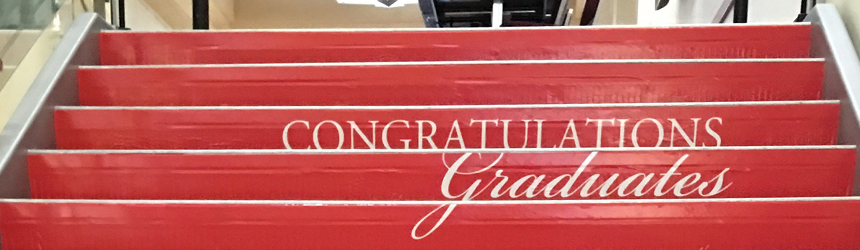
Maryland Signs and Graphics completed a similar job for the University of Maryland in Baltimore. The University requested temporary signage created to announce the 2016 graduating class. The floor graphics would be applied as stair risers and featured two images of graduates accompanied by text.

For this job, the PSPs used the 3M Scotchcal Graphic Film With Comply Adhesive Series IJ35C gloss. The 3M IJ35C is vinyl for solvent, UV, and latex inks. It features pressure-sensitive adhesive with Comply Adhesive for fast, easy bubble-free installations. Kurniawan says the media lasts one and a half months and peels off clean. It has a film width of five inches and a thickness of 3.2 mil.

The graphics were printed on the HP Latex DesignJet 360. It took five days to complete and totaled 960 square feet. Kurniawan describes the finishing process and install as easy, effortless, and with a good grip. “Our client was impressed. We have done this for them for three academic years in a row,” says Kurniawan.

Floor Graphics
Floor graphics are hard to miss, they demand attention and are ideal for a variety of promotional and event graphics. PSPs that offer the application are able to provide an easy choice for a variety of businesses and organizations looking to promote a graphic. DO

Dec2016, Digital Output

Behind the Fabric

By Olivia Cahoon

Trade shows offer an ideal opportunity to showcase products and attract new customers. Blockout fabric helps exhibitors to direct attention to their products with high-impact graphics.

Blockout fabric is popular in retail and trade show settings because it provides an opaque substrate, allowing stunning image quality. Print service providers (PSPs) suggest masking stands with this fabric type for a more appealing display.

Both double- and single-sided options are available. Double-sided products are considered a premium and cost about 20 percent more than single-sided offerings.

Layering for Light Blocking
Blockout fabrics are often composed of polyester and woven fabrics. This is because knit fabrics aren’t opaque enough to block out light. However, blockout fabrics vary in, material composition, coating, and quality. The printing composition and differentiating characteristics provide PSPs with options.

There are two basic types of blockout fabrics. Those with one layer of fabric and a backing of gray or black blockout liner and those with a blockout liner between two printable fabrics. The first offers the ability to print double sided, while the two-layer version is limited to single-sided prints.

For double-sided printing, a black woven yarn base added between the outer print layers of material or coatings offers greater opacity than that of perhaps a gray yarn, ultimately resulting in an enhanced image quality, offers Joseph Rooney, sales manager, Heytex.

Eric Tischer, president, Verseidag US, points out that laminating a black or white foil on both sides of the fabric—or even a black foil on the back, creates the blockout visual. Other methods include using a black or gray-based coat with a white topcoat on the fabric for PVC or coated textiles. Even 3D woven textiles have the ability to blockout light because of the black yarns in the middle layer. “This only works in medium and low widths and where the white surface is not really a bright white, as you can’t cover or hide the black yarns completely,” says Tischer.

Rooney says that a single-sided fabric has a backside coating or polyurethane (PUR) treatment that allows for complete blockout coverage. It also makes the fabric more durable.

Michael Sanders, VP, Pacific Coast Fabrics, points out that the back coating of blockout fabrics impact the structure of the fabric by increasing thickness and opaqueness.

Trade Shows, Retail, and More
Because blockout fabric conceals framing systems commonly used to structure booth displays, it is a good option for this type of signage. It creates a fully opaque look that isn’t possible with transparent fabric, and blocks light from behind the image so the frame isn’t visible. This optimizes the printability of the image and draws attention to printed graphics. However, it has many uses outside the booth as well.

Mike Compton, product marketing manager, Top Value Fabrics, says that blockout fabrics are typically multipurpose and heavyweight blockouts make terrific options for banners, banner stands, display graphics, and table cloths.

Sanders agrees, noting that while blockout fabrics are great for creating a fully opaque look in frame systems, it’s also useful in multi-image lightboxes and roll-ups. “By using blockout fabric in between lightbox images you can ensure individual image clarity,” he says.

In addition to blocking light, the fabric also saves time and money because of its ability to handle the job of two fabrics. Sharon Roland, advertising manager, Fisher Textiles, shares that blockout fabric is a popular choice in retail because it can be used for double-sided prints in point of purchase (POP) displays and banners.

“Iit makes sense to use a one-ply printable blockout fabric for certain jobs because it can do the job of two fabrics and save the cut and sew step, which can be costly and time consuming,” adds Roland.

Rooney says that blockout fabric is popular in retail and trade show applications because the fabric properties allow for a lighter weight that reduces shipping costs. He points out that the textile feel is more appealing in both settings compared with traditional vinyl or PET offerings. It also tends to photograph well because of the enhanced image quality.

Blockout fabric is well suited for densely lit areas where advertisement’s focus is integral. “The gorgeous, wide color range is only enhanced by the fabric’s blockout properties. A good quality blockout offers a smooth, elegant drape and a slight stretch to ensure a good fit in retail and expo frame systems,” says Compton.

It can also be used to optimize small spaces. “Blockout fabrics offer the print provider and retailer the option for double-sided printing to best utilize retail space if needed, without any imaging or verbiage showing through to the imaging on the opposite side,” says Tischer.

Fabric Features
While many great fabric options exist in the market, PSPs should consider several specific qualities. For starters, blockout fabrics should always be 100 percent light proof.

Finding the perfect blockout fabric also depends on what it is being used for. Some fabrics are more durable than others. If it isn’t durable enough, the fabric can peel off or disintegrate completely. But a fabric that is too durable can affect the fabric’s ease of use. “Some blockout fabrics have a coating that makes the fabric rigid and stiff, thus making the installation into frame systems challenging,” says Sanders.

Slightly stretchy blockout fabrics work well for trade show graphics because the elasticity prevents needle holes in the fabric and improper placement on the framing system. “If looking to pillowcase two fabrics together, it’s important for the blockout to have some stretch so it can properly align,” says Roland.

To save material costs PSPs can also look at printability. Testing the fabric can ensure it will yield a wide color gamut with the desired ink compatibly. Compton shares that some blockout fabrics will yield brilliant results using dye-sublimation (dye-sub) transfer, dye-sub direct, UV, or latex.

Ultimately, the qualities to look for depend on the application and how the blockout fabric can enhance its features. “Printability and the product’s hand are also key to many retailers as they want to showcase a product with image, pop, and clarity,” says Tischer.

On the Market
Here we review the composition of a selection of blockout fabrics on the market today.

Fisher Textiles GF 8873 white/black/white, GF 8880 Opaque White, and DD 8881 Opaque White are three layered material blockout fabrics with a layer of black in the middle for a sandwich effect and a soft hand. The GF 4100 Sheeting and GF 7100 X-Out is a woven fabric coated with a multi-layering for opaqueness. The GF 7100 X-Out is a polyester fabric with a viscose and rayon flocking intended for blockout liner and opaque single-sided banner applications. Most of the company’s coated blockout fabrics are printed with UV curable machines while uncoated fabrics are used for dye-sub transfer.

“Our GF 8880 Opaque White and DD 8881 Opaque White have an extreme white point. GF 7110 has excellent stretch,” says Roland.

Heytex’s new Deco-Flex Opaque offers a knitted polyester base with a backside PUR treatment affording todays printers up to five meters or 197 inches for grand format textile blockout applications. Rooney says it can be printed with direct disperse dye-sub, UV, and latex printing. The fabric has a black backside and features bending resistance and foldability if using bubble wraps.

Pacific Coast Fabrics offers the optic white Deko-Tex Blockout 7255KMFLBS by Georg+Otto Friedrich, which is made entirely of polyester. It is flame repellent and has a slight elasticity so that it doesn’t cause needle holes. The fabric has an aqueous finishing and is capable of printing transfer dye-sub, disperse direct to fabric, UV, and HP Latex printing.

Top Value Fabrics offers its Midnight Blockout option which is a knitted polyester fabric engineered with a durable black back to ensure opacity for applications that require blockout. It features a slight stretch to make it an ideal option for a variety of exhibit frames, retail POP, theatrical displays, and banner stands. The fabric features an acrylic black back that offers optimal blockout and increased durability.

Verseidag US features the seemee Blockout Premium B1104 and B1108. The base fabric is polyester with PVC coating on both sides. The B1104 has a width of 10.6 inches, while the B1108 measures 16.4 inches. Designed for indoor and outdoor use, the coating provides smoothness and its finishing prevents sticking during printing. The print topcoat achieves consistent image quality and color reproduction alongside UV stability.

Display Options
Blockout fabrics are used for banners, display graphics, light boxes, and frame systems. The woven fabrics and multi-layers create an opaque look that conceals hardware and draws attention to advertised products. Because of this, the fabric is desirable in retail and trade show settings.

PSPs considering blockout fabric should determine what qualities are most important. While some fabrics are more durable, others can be slightly elastic, flame repellant certified, and have offer a higher printability. They can also be two or multi-layered.

With many options to choose from, it shouldn’t be difficult to find the perfect blockout fabric. DO

Dec2016, Digital Output

The Winning Vendors

By Melissa Donovan

Every November, Digital Output announces the top 50 companies and ten honorable mentions for our Readers’ Choice Top 50 awards. Using our lead generation system, DOdirect.net, we compile requests from readers based on their inquiries into vendors and specific products from both editorial and advertisements, as found in the magazine and online at digitaloutput.net.

The results are a snapshot of some of the most interesting and popular products, services, and current trends occurring in the graphic arts. For example, there are a high number of vendors offering fabric, fabric-based printing devices, or tools involved in the textile process. Likewise, rigid board suppliers, flatbed manufacturers, and finishing devices with table beds are prevalent in this year’s list.

If you don’t see your favorite vendor included below, be sure to inquire throughout 2017 on their newest products and services. Your interaction with the magazine—online and in print—drives the Readers’ Choice Top 50!

Top 50
Congratulations to all of this year’s winners. We’ve included information about each vendor here, listed alphabetically. Be sure to flip to the chart on page XX, which includes some of their top products from 2016.

3M Commercial Solutions helps customers worldwide build brands by providing total graphics and light management solutions. The company manufactures or certifies lighting solutions, graphic films and graphic protection, flexible substrates, as well as inks and toners used to create finished graphics that are consistent, reliable, and durable.

Agfa Graphics helps produce powerful messages by making graphic communication solutions more attractive, affordable, and profitable. Working with world-class manufacturers, Agfa provides an innovative and broad portfolio of products and services to help users choose the right hardware, software, consumables, and services that meet their budget and goals. The company offers integrated solutions that can maximize purchase power and put you in a position to profit.

Arlon Graphics, LLC manufactures and markets a full line of high-quality pressure-sensitive cut vinyl, flexible substrates, and print media films for digital imaging, signage, vehicle graphics, and screenprinting. The company is headquartered in Placentia, CA with strategically positioned distribution out of Australia, Europe, Latin America, and the U.K. to service customers worldwide.

Aurora Specialty Textiles Group, Inc. provides a range of high-quality textile and canvas products and is dedicated to helping customers succeed in today’s highly dynamic, ever-changing wide format print media markets through investments in ultra-wide width, state-of-the-art coating, and finishing technologies and comprehensive research and development expertise. A North American leader in innovative textile solutions, Aurora’s print media fabrics are compatible with all of today’s printing technologies, including latex, solvent, UV-curable, dye-sublimation (dye-sub) transfer, and dye-sub direct ink.

Avery Dennison Graphics Solutions features innovative products for digital and screen and cut print platforms. New vinyl films and adhesive technologies bring promotional graphics such as signage, exhibits, displays, car wraps, and bus graphics to longer term, durable applications such as fleet markings, backlit signs, vehicle color change, and architectural graphics to life.

Caldera is a software company with almost 25 years of experience in developing, marketing, and supporting high-quality technological software for wide format imaging with a commitment to increasing productivity, cost efficiency, and color output. The company’s suite of award-winning, production-orientated print and print-to-cut workflow programs offers color management, imaging, and driving solutions for large and grand format peripherals.

Canon Solutions America (CSA), Inc., a Canon U.S.A. Company, provides industry leading enterprise, production, and large format printing solutions, supported by professional service offerings. Helping customers stay ahead of print industry trends, CSA provides companies of all sizes with cutting-edge technology supported by the Canon and Océ brands. With a robust large format print portfolio, CSA helps customers turn speed and high-volume large format production into profit with a dynamic suite of applications, media, and equipment fit to meet demanding business needs. Discover the next level in large format productivity starting today.

CET Color is an award-winning pioneer in wide format UV printing. Founded by a print shop owner, the company draws on its firsthand experience to innovate flatbed and hybrid printers that offer both quality and efficiency at an unbeatable value. CET’s Q5-1000h 126-inch hybrid printer won the 2014 SGIA product of the year award, and its newest K2-Series features state-of-the-art 4.25-inch Kyocera printheads equipped with 2,656 nozzles each. With field upgradeability and custom configuration options, CET takes businesses to new heights.

Coveris Advanced Coatings’ Digital Imaging Division offers innovative products for wide format printing. It is best known for its award-winning Magic portfolio of digital imaging media and inks. Featuring distinctive coatings, Magic provides media compatible with most water-based, latex, UV-curable, solvent, and eco-solvent inks.

DreamScape, a division of Roysons Corporation, is a leading manufacturer of textured digitally printable or special effect wallcoverings and protective topcoats. With over 35 years of experience in the wallpaper industry, the company offers the largest selection of high-quality certified, Class A commercial grade vinyl and PVC-free wallcoverings for residential and commercial applications available in rolls for solvent, eco-solvent, UV-curable, and latex printers.

Drytac is an international manufacturer of adhesive-coated products, including graphic films, window films, double-sided tapes, self-adhesive print media, label stock, industrial adhesives, and heat-activated and pressure-sensitive laminates and mounting adhesives.

Durst Image Technology US LLC is a world-class manufacturer of professional wide and grand format digital UV inkjet printers for today’s imaging industry. The company’s products are designed for performance, reliability, and longevity—offering the highest print quality, productivity, flexibility, and efficiency. Learn more about Durst product offerings and discover new business opportunities. Depend on Durst—a global leader in industry printing innovation.

EFI is a global technology company leading the worldwide transformation from analog to digital imaging. It is passionate about fueling customer success with products that increase competitiveness and boost productivity. To do that, the company develops breakthrough technologies for the manufacturing of signage, packaging, textiles, ceramic tiles, and personalized documents, with a range of printers, inks, digital front ends, and a comprehensive business and production workflow suite.

EnCore Products manufactures foamboard for digital printing, screenprinting, point of purchase displays, exhibits, cut graphics, indoor signage, and dry mounting. The EnCore Foam Board line includes White, Colors, Black on Black, White-Black-Black, Permanent Pressure Sensitive, Repositionable Pressure Sensitive, SingleStep Activated, MightyCore Rigid, PilloCore, DuraPrime, and Design Boards. All products are made in the U.S. and available in a variety of size and thickness combinations.

Epson America, Inc. offers an extensive array of award-winning image capture and image output products for business, commercial print, graphic arts, photographic, signage, direct to garment, and fabric production.

Esko is a global supplier of integrated solutions for signs and displays and packaging. The range of Kongsberg cutting tables tackle the production of signage, displays, and the finishing of normal printed materials. Dedicated prepress software allows companies to work faster without sacrificing quality.

Fisher Textiles is a leading supplier of fabrics for dye-sublimation, latex, solvent, and UV printing. Its reputation and pride in providing quality textiles with unsurpassed service is reflected in over 25 years of experience. The company’s capital investment of inventory and three warehouse locations allow it to fill just-in-time requirements. It stands behind its products and takes pride in providing some of the best fabrics in digital printing.

FLEXcon believes that relationships matter and that’s why it sells direct. With over 60 years of industry knowledge and experience in pressure-sensitive films and adhesives, customers benefit by collaborating with the company to gain a sharper competitive edge.

Fly Digital Print is a trade-only large format printer. It offers a full line of large format products using only branded media and original inks. Great prices, incredible service, quick turns, and a no banding lines guarantee.

Fujifilm North America Corporation, the Graphic Systems Division, delivers solutions for workflow, consultative services, remote monitoring, color standardization and G7 implementation, pressroom products, CTP, proofing, digital printing, wide format packaging, labels, and specialty printing. Fujifilm also manufactures and distributes Sericol inks and is a leader in the development of UV inks for screenprinting, narrow web, and large format digital printing.

Gans Ink and Supply Co. is a trusted choice for a full-service ink manufacturer and supplier in the printing industry for over 65 years. Recently Gans brought that legacy experience to wide format and became an authorized dealer for HP latex printers, Graphtec cutters, and Gfp laminators. The company is proud to take its place as a full-service integrator for all sign, banner, wrap, and specialty wide format products.

HP, Inc. creates technology that makes life better for everyone, everywhere. HP’s Graphics Solutions Business reinvents high-value and high-volume printing so that its customers can reinvent their possibilities and the possibilities of their own customers.

InkTec develops and supplies various high-quality inks for digital printers. These are based on the inkjet technology used in everything from regular office printers to actual photos in the outdoors. Additionally, InkTec develops a UV-curable inkjet printer, Jetrix, and high-quality UV ink with cutting-edge technology in inkjet.

INX Digital delivers technologies that drive digital growth all over the world. Integrate digital technology into an existing operation or expand and improve current digital capabilities with INX Digital. Combining the ink formulating expertise of INX with leading Evolve, Prodigy, and Triangle brands makes INX Digital an unequaled source for products, technologies, systems, consultation, and services to help reach new levels of digital production excellence. The company offers services and manufacturing with operations based in China, Europe, and the U.S.

Kapco Graphic Products is a manufacturer and converter offering digital media for water-based inkjet and solvent, latex, and UV printers; mounting adhesives; laminates and backers; sign; vinyl; and supplies. Adhesive-backed, water-proof, and specialty vinyl, banner, canvas/fabric, film, and paper inkjet media; and vinyl, banner, film, canvas, and paper solvent media plus PSA UV and thermal laminates in four finishes are available.

Katz Americas is a producer and converter of wood pulpboard. Its products are eco-friendly, contain pre-consumer recycled content, and are fully recyclable. According to the company, it provides a superior alternative to foam and plastic display options.

LexJet is a one-stop, direct source for equipment, materials, and software used to print fine art, photography, point of purchase, trade show displays, and commercial graphics. Dedicated to total convenience and personal customer service, LexJet provides one day ground delivery to most of the continental U.S., online ordering, highly trained account specialists, free and unlimited product and technical support, and extensive educational resources.

Lintec Corporation is a manufacturer of pressure-sensitive films for visual marking, signage, and architectural window applications. It specializes in optically clear, frosted, and textured films for display, point of purchase, and window graphics. The company offers a range of laminates, mounting, and printable films.

Mactac Distributor Products’ applications include indoor-outdoor signage, vehicle wraps, trade show displays, and wall environmental graphics. In fact, for more than 50 years, Mactac has been at the forefront of product development for digital printing, mounting, laminating, screenprinting, and cut vinyl needs. Rely on the company for industry-leading quality and unmatched service, and trust it has the next up-and-coming innovation to transform business. That is its unwavering commitment to its customers.

Magnum Magnetics is a U.S. manufacturer of flexible magnetic sheeting, strip, and custom profiles. It offers printable magnetic sheeting for multiple printing presses including offset, flexographic, inkjet, and digital. The company takes the time to understand an application before recommending a magnetic solution.

Marabu North America draws on more than 150 years of experience in developing inks and coatings. Its product line includes MaraJet digital printing inks, ClearShield water-based coatings, the StarLam liquid laminator, and Marashield UV-curable coatings. The company’s success is built on not just high-quality products but its ability to work with customers to offer tailor-made solutions to their printing and coating needs.

Master Magnetics, Inc.—the Magnet Source—features a robust line of magnetic assemblies, flexible magnetic sheeting, magnetic receptive, and magnetic strip. Ideal for signmaking, vehicle graphics, and point of purchase displays, PrintMagnetVinyl and FlexIRON—printable magnetic sheeting and receptive—works with most large format standard inkjet printers and plotters. Celebrating 40 years of excellence, Master Magnetics is one of the best sources in the magnetic field.

Media One is a full-service provider for large format inkjet. Its specialty is print manufacturers with production environments in the textile printing segment. The company covers the whole workflow from equipment, RIP software, color management, finishing equipment, consulting, and consumables—textiles, inks, and films. It offers full nationwide technical support. Media One is an industry leader for textile printing solutions and its clientele are some of the most recognized companies in the industry.

Mimaki USA, Inc. is an innovator and a pioneer in the development of digital printing and cutting products worldwide. The company engineers and manufactures a complete line of digital printers and cutters, and offers a total workflow solution for the many applications found in sign and graphics, textile and apparel, and industrial. In 2014, Mimaki USA celebrated 15 years of serving customers in the Americas.

Mutoh America, Inc. is a leading manufacturer of wide format printers and plotting cutters. It is home to the ValueJets, Mutoh’s line of inkjet printers known for quality, speed, and Smart Printing technologies.

Newlife Magnetics LLC is one of the world’s largest flexible magnet and print media manufacturers specializing in wide format magnetic media. It makes printable magnet sheeting up to 48 inches wide. The company manufactures the Maco Magnetics Display System consisting of Ino-Steel + Wall-Mag or Mag-Paint. Cling-King print media adheres to smooth and non-porous surfaces without any adhesives. It is ideal for window graphics and car signs. Cling-King is available in white, transparent, and frosted in 100-foot rolls by 50-inch widths.

OKI Data Americas serves sign and graphics, production, and specialty printing with OKI ColorPainter wide format printers as well as its innovative line of professional digital production devices for short-run, on demand commercial applications. ColorPainter printers use inks that last longer outdoors, cost less per square foot, and provide industry-best color density and image quality at fast real-time speeds.

Onyx Graphics, Inc. celebrates over 25 years of innovation and is dedicated to helping customers increase productivity, reduce costs, and gain a competitive edge with superior print and color quality. Innovative, productive, and satisfied customers around the globe motivate Onyx to continually develop and enhance its technologies. Longstanding relationships with printer manufacturers position the company as a market leader in powerful, reliable, large format printing workflow software.

Orafol Americas Inc., a subsidiary of Orafol Europe GmbH, is a leading global manufacturer of premium vinyl graphic products, reflective solutions, and adhesive tape systems used in signage, graphics, industrial, and traffic and safety applications. The company’s distribution network spans Canada, the Caribbean, Latin America, and the U.S.

Pacific Coast Fabrics (PCF) is a pioneering provider of digital print textiles, in wide and grand format, for direct disperse, dye-sublimation, latex, UV, and a full line of fabrics for pigment printing. All of its fabrics are developed to the company’s high-quality and performance standards. Many of its premium fabrics are offered with flame repellant coatings. PCF is proud to be a global partner with Georg+Otto Friedrich, one of Europe’s largest manufacturers of digital warp knit fabrics. PCF also stocks fabrics for performance and fashion apparel as well as home furnishings and frame systems.

Palram is a leading manufacturer of Palight foam PVC, Palclear transparent PVC, and Palsun polycarbonate sheets and coils for sign and graphics. All products are optimized for digital printing, display, and fabrication work. With over 50 years of expertise in the industry, Palram has established manufacturing, distribution, and sales operations across seven continents and 120 countries around the world. Products sold in the U.S. are marketed through a network of authorized distributors.

Perception Wide Format Media, a brand of Worthen Industries, is based in Nashua, NH, and is a family-owned, ISO 9001 certified manufacturer of specialty coated canvases and fabrics designed for the graphic arts. Its mission is simple—consistently manufacture and deliver the highest quality, innovative America-made craft wide format media. The company is committed to responsible manufacturing and environmental sustainability throughout its operations and is a patron of SGP.

Qué Media, Inc., for almost 20 years, has grown to become a distinguished global coating manufacturer of aqueous, solvent/eco-solvent, and latex digital print media for display graphics, point of sale advertising, and photo reproduction. Its expertise has been most influential in wide format and color laser. With regards to wide format, it currently coats substrates such as polypropylene, PVC, backlit film, fabrics, banner material, and multi-layered PET film in addition to a full line of pressure-sensitive laminates.

Ritrama is an international group of companies dedicated to the worldwide manufacturing of specialty and commodity self-adhesive materials. The company is a worldwide manufacturer of pressure-sensitive graphic films with a reputation for performance and value. The commitment of Ritrama is to provide excellent quality, innovation, and worldwide service.

Roland DGA Corporation offers an award-winning lineup of wide format inkjet printers and integrated printer/cutters equipped with eco-solvent, sublimation, and UV inks, including SOLJET, TrueVIS, VersaCAMM, VersaUV, VersaEXPRESS, VersaStudio, and Texart models. All Roland inkjets come bundled with powerful, yet easy to use RIP software, and several models offer specialty ink options, including white, metallic silver, light black, and clear coat.

SA International is recognized as a global leader in providing complete, professional solutions for signmaking, digital printing, and CNC machining for users.

Signs365 is a trade-only grand format wholesale printer. It offers 24 hour standard production with overnight, anywhere shipping to trade professionals and graphic artists.

Top Value Fabrics is a leading supplier of quality print media. With over 40 years of success in the textile industry, it offers a complete line of printable banner media including digital and screen banner, specialty textiles, and dye-sublimation for indoor and outdoor use. The company supplies a wide selection of frontlit, backlit, blockout, PET, water based, mesh, PP, and specialty textiles in standard and custom widths from 38 to 197 inches, manufactured to its specifications.

Ultraflex Systems, Inc. celebrates being recognized as an international innovator and leader in PVC and specialty substrates for 25 years. With a commitment to progress, quality, and product development, Ultraflex continually adds and modifies formulas to offer a variety of materials to meet the ever-changing needs of the global market. The growth and success of Ultraflex is due to the knowledgeable sales team and customer service specialists who guide customers to the appropriate product choice for their application. Ultraflex services Canada, Latin America, and the U.S. through six North American warehouses and a network of highly trained distributors. With over 70 items, customers are guaranteed to find the ideal fit for any application.

Zünd, a leading manufacturer of digital flatbed cutting systems, offers multifunctional, high-productivity cutters/routers with numerous tools and automated material-handling options for processing printed/unprinted materials up to ten feet wide. Designed for maximum versatility and modularity, GS3/S3 and now D3 cutters are powered by Zünd Cut Center, an end-to-end workflow suite including automatic quick response code capture that makes Zünd cutting systems efficient and easy to use.

Honorable Mention
Ten vendors also made the cut under honorable mention—congratulations to them! Again, we’ve included information on each company below, listed alphabetically.

Advanced Greig Laminators, Inc. is a manufacturer of high-quality laminating equipment and a provider of laminates and media solutions.

Alpina Manufacturing offers LED light box, Flip-up, Slide-in, or Banner Grip Frames made in any size or quantity to hold graphics or banners. Change graphics without removing frames from wall with a beautiful presentation at a low cost. Frames are for indoor or outdoor use.

Condé Systems, with an emphasis on dye-sublimation (dye-sub) technology and the sublimation printing process, offers everything needed to produce and market personalized products including dye-sub transfer systems and supplies, heat transfer systems, heat presses, blank imprintable products, production software, and a huge collection of educational and instructional videos. Find out how creating personalized photo gifts and awards can help your business be more profitable.

DigiFab Systems is an innovative developer and manufacturer of equipment for digital printing, supplies, and software. The product lines currently include inkjet printers, heat presses, steamers, inkjet inks, paper, fabrics, and CAD-RIP software for textile and graphics applications. DigiFab is headquartered in Los Angeles, CA and conducts business globally.

GCC, founded in 1989, is a worldwide leader and manufacturer of cutting plotters; laser engravers, markers, and cutters; and UV inkjet printers for various applications such as signage and advertising, personalization and identification, gifts and promotions, apparel, and electronics. Headquartered in Taiwan, GCC has branch offices in China, Europe, and the U.S.

Graphics One is a leading developer and international distributor of professional digital imaging products. It has established distribution in over 60 countries, with offices in Colombia, Mexico, and the U.S. Graphics One provides a worldwide network offering in-country installation, service, and technical advice in support of its products.

PhotoTex Group, Inc. is an exclusive distributor for the original patented Photo Tex self-adhesive removable material. Photo Tex is distributed through a worldwide dealer network. This material can be printed on any inkjet, DI, or lithographic equipment. It does not shrink, rip, or wrinkle in any climate and can be easily removed, reused, and repositioned over and over again. Install for a day or a decade. Now offering Block Out and High Tack versions.

Screen USA is long known as a dominant player in CTP and workflow, and is now a leading manufacturer of production class inkjet print engines helping customers grow revenue, decrease cost, and find new business opportunities in diverse markets with inkjet printing technology for high-speed continuous, wide format, and label and packaging platforms.

Verseidag US is a manufacturer and distributor of more than 50 PVC coated, laminated vinyl, and textile substrates for solvent, latex, UV, aqueous, screenprint, transfer/direct dye-sublimation, and flexible sign applications. A versatile offering ranging from 36 to 196 inches wide, seamless goods are available at a number of warehouse locations throughout North America.

VKF Renzel USA Corp. offers Aluminum Poster Snap Frames, which bring an upscale look to any business, office, or home. The sleek, aluminum finish of the poster frame highlights advertisements and graphics while displaying a unique and contemporary look.

Signing Off for 2016
Congratulations again to all of this year’s Readers’ Choice Top 50 winners! Thanks to product introductions from these vendors the graphic arts continues to grow into new markets and expand its presence in existing ones. DO

Nov2016, Digital Output

Printing on Apparel

By Dana Hatic

In a consumer-driven market, the demand for customizable apparel is on the rise. Digital technology for producing such apparel has evolved to allow for optimal wearability while still accommodating personalization needs in small or large quantities. Today’s textiles optimized for digital print offer ease of production, heightened specialization, and greater comfort.

Specific for Digital
Digital print meets the increasing request for custom printed apparel. Consumers, corporations; in home or out of home, the demand is there for personalized product.

“Consumers want at least some level of personalization and customizing. Also, brands are looking to offer more designs and apparel that lend itself to shorter runs. Digital printing lets manufacturers and brands offer more designs and do more test marketing,” explains Mark Sawchak, managing partner/owner, Expand Systems, LLC.

Ken Siecinski, activewear program manager, Top Value Fabrics (TVF), agrees, citing printers’ ability to print outstanding digital imagery for custom apparel as one of the main reasons the demand for digital apparel is so high. “The detailed graphics printers can create on athletic wear, yoga clothing, and for corporate event apparel is incredible. When corporations sponsor large public events, many of which are at professional sporting venues, we are accustomed to seeing customized digital apparel and the unique looks are attention getting,” he continues.

Companies involving screenprinting in their daily processes may spend anywhere from $350 per screen, but if digital printing is used to achieve the same effect, it eliminates the need for screens, and therefore the extra cost, allowing businesses to save thousands of dollars and gain flexibility and variety in the types of prints they produce.

“When you have no screens and no minimum, you break all the rules and break away from conventional rotary and flatbed printing. After you know how to design fabrics for digital, you know how to work with customers to meet specific needs—then you meet their demands,” suggests Mike Sanders, VP, Pacific Coast Fabrics (PCF).

Michael Katz, president, Jacquard Inkjet Fabric Systems, points out that although the variety of digitally printed fabrics is tremendous and the process brings such possibilities, there is a little being done in large production runs. “It is mostly for prototype work and small couture runs in small studios,” he admits.

If the infrastructure allows, the textile industry could move towards an increase in production-level digital printing because of the diminished cost that comes from removing the need for screen setups.

“Wherever there exists an industry of cutting and sewing for garments, all the supporting industries such as printing, dyeing, weaving, finishing mills, and logistics will follow. Gradually, digital printing in the U.S. is changing the paradigm, or if not changing it, it is certainly encouraging supporting industries to grow,” shares Katz.

The Importance of Dye-Sub and Material Type
There are a number of methods for digitally printing fabrics, including dye-sublimation (dye-sub), in which printers use inks that turn into gas when exposed to heat and essentially fuse with the textile and become part of the fabric, allowing the images to sustain through multiple rounds of washing.

Once absorbed into the fibers of the textile, the dye does not usually change the feel of the fabric, but sometimes an initial washing will expel any base coating that makes the textile more absorbent.

James Gay, director of marketing, Fisher Textiles, says the benefits of the dye-sub method become tangible in the feel of the finished fabric. “The quality of overall sublimation colors without the feel of something screenprinted on it has become one of the most appealing aspects.”

“Today’s technology provides a process where the inks offer no added weight nor do they diminish the softness or performance a fabric offers,” agrees Siecinski.

Another versatile method of digital printing involves pigments, which can bind to both natural and synthetic textiles. The challenge with pigment ink is getting it to integrate with fabrics, but with the proper binder, pigments become highly functional.

“The great part about pigments are you can put them on any fabric or any blend of fabrics,” says Sanders. “Pigment printing will be a huge revolution as far as digital printing goes.”

The type of fabric customers request for their customized apparel influences the materials used in the digital printing process, and it all begins with the textiles.

“Polyester is most commonly printed with sublimation or direct printed with disperse dye,” according to Sawchak. “Cotton is typically printed with reactive ink or pigment. Nylon, wool, and silk are typically printed with acid dye inks. Blends are often printed with pigment ink. These different solutions give the best results.”

Features to Look For
The wearability of a fabric factors heavily into the digital printing of those designed for apparel.

“Hand is a key attribute as this property directly impacts the ‘feel’ of the garment,” says Sawchak. Hand refers to the way a fabric feels—soft, firm, pliable, and elastic. “Other attributes including breathability, moisture wicking, and image durability—such as washability—are also important.”

Wicking technology comes in handy for items like running apparel, cycling gear, and triathlon attire, according to Sanders. Cotton stays wet with sweat, but other fabrics tend to work better with wicking formulas and can last longer despite heavy use.

Fisher Textiles specializes in products used for sports, as well as athlesiure garments that are skyrocketing in popularity due to comfort and versatility. For such fabrics, moisture wicking capabilities are essential.

“Polyester with moisture management is very desirable,” shares Gay. “Fabrics contain various amounts of stretch, which allows garments to move and the moisture management system on our fabrics gives a cool feel,” he continues.

Weight is another consideration. “For example, garments for high-impact sports like lacrosse typically need heavier weights due to abrasion resistance, whereas a sport like track and field can sacrifice wear and tear for the priority of cooler comfort,” explains Siecinski.

Products in Brief
Expand Systems recently launched its DuraVibe line of digitally printable fabrics.

Fisher Textiles offers ET 3000 Yoga, which is dye-sub printable. Available in 60-inch widths and a weight of 14.5 oz. per square yard it is a circular knit construction and suggested for use in athletic, fitness, active wear, and yoga pants. ET 3000 Yoga is comprised of 86 percent Repreve recycled polyester and 14 percent Spandex. It is inherently treated with Sorbtek, Unifi’s moisture management system.

The company also offers ET 2600 Jersey Spandex Knit. Dye-sub printable, in 61-inch widths and a weight of 10.5 oz. per square yard, it is a jersey, circular knit construction that is ideal for athletic, fitness, or active wear. ET 2600 Jersey Spandex Knit is comprised of 92 percent Repreve recycled polyester, eight percent Spandex, and is inherently treated with Sorbtek.

Jacquard’s ProCoat fabrics are designed to be used with reactive or acid textile dyes. The treatment maintains resolution of the print and aids in fixation and color yield. ProCoat fabrics are completely washable and dry cleanable, making them ideal for many applications including wearable and commercial textiles. ProCoat fabrics must be matched to the correct ink for the fabric type. Color is generally post-fixed by steaming or heating. Cotton, silk, linen, and nylon are available.

PCF’s fashion apparel line of transfer dye-sub sheer fabrics include Jennifer S/914 – 4 Way Stretch, Jersey Knit S/3507 – 4 Way, Scuba Deluxe S/661, Sheer Knit Polyester, and Stealth (Heavy) S/913. These are all polyesters. It also offers a sports apparel line of polyester fabrics, which include advanced moisture management and wicking technology, tensile memory, and unsurpassed print definition.

Of note is Jennifer S/914 – 4 Way Stretch—part of both the fashion and sports apparel portfolios. The product is available in both optic white and black. Content is 88 percent polyester and 12 percent Invista Lyrca. Jennifer S/914 is a versatile textile, designed for athletic workouts, but can also be worn for casual occasions. It is ideal for yoga pants, leggings, performance shorts, and compression tops. Jennifer S/914 is 100 percent made in the U.S. including yarn, knitting, bleaching, and finishing. Black is a specialty solution dyed for color blocking on digitally printed garments. It is to be used as trim with digital prints, or as solid black garments, but not for sublimation printing.

TVF offers a variety of Knit, Stretch, Tricot, and Woven fabrics for activewear apparel. This line of fabrics is engineered exclusively for dye-sub transfer printing. The company’s newest offerings include full dull polyester/spandex, a heavy polyester spandex with great stretch characteristics, a heavy eyelet mesh, and a pin dot fleece.

Apparel for Textiles
The uses for customizable printed textiles span broad categories of apparel from leggings, swimsuits, and bicycling jerseys to t–shirts, board shorts, and beyond. Textiles developed for digital printing are designed to print well with dye-sub and pigment processes and offer characteristics inherent to the hand of the wearer—breathability, softness, and moisture wicking when applicable. With comfort in mind, textiles optimized for digital printing processes that are eventually used for the purpose of apparel are gaining traction in a blossoming niche.

Nov2016, Digital Output

Graphics on Wheels

By Olivia Cahoon

Businesses rely on vehicle wraps to promote a brand to a wider audience. Many times, companies request multiple vehicles be wrapped to cover more ground. Wrapping a fleet of vehicles presents challenges such as ensuring each graphic is identical in size and color. The job can take a week or months depending on the number and size of the vehicles. Here, we take a look at different fleet wrap projects from three print service providers (PSPs).

Moving Groceries
Located in Farmington, NY, Ewing Graphics began in 1982, specializing in production and fleet graphics installation with an emphasis on fleet and logistics. The IT department develops systems capable of tracking and planning fleet programs of any size. “Our knowledge and ability to forecast the needs and hurdles of a program is a great asset to our customers. We love a challenge,” says Tom Ewing, president, Ewing Graphics.

In 2013, it moved to a 9,000 square foot building. The location allows a staff of 21 plus Ewing and his wife to handle large trailers and small vehicles in shop. 65 percent of the large trailer graphics are full wraps and 35 percent are small vehicle wraps. It considers over 20 vehicles or trailers a year to be a fleet wrap, which makes up 55 percent of its customers’ fleet wrap projects.

For over 25 years the company has used Arlon Graphics, LLC and 3M Commercial Solutions media. “Arlon’s DPF 6000XRP film is our go-to film for vehicle wraps. It is a pressure-sensitive film with air egress that we have great success with,” shares Ewing.

Ewing Graphics runs two Roland DGA Corporation SOLJET PRO III XC-540 inkjet printers and one SOLJET Pro 4 XR-640. In the past, it outsourced large trailer printing projects but with the cost of latex printers decreasing, it purchased HP, Inc. latex printers and brought the work in house.

Recently, the PSP put its printers to good use when Wegmans Food Markets—a repeat customer—requested graphics for a fleet of 130 trailers. The trailers are a significant part of the grocery chain’s image and presence in the food services market.

Beginning with design, the print provider worked directly with the grocer’s in-house design team to produce scaled and full-sized prints. Once in agreement, Ewing Graphics took the next step and created a prototype trailer. The entire design process took approximately four to five weeks.

Similar to other large fleet projects, the trailers were wrapped in 3M Controltac Graphic Film with Comply v3 Adhesive and Arlon 3200 gloss laminate. The combination of the two allows for quick application and conforms well around the rivets, according to Ewing. A completed Wegmans trailer uses 920 square feet of media.

Depending on volume, either an HP Latex 3500 or HP Latex 570 printer was used to print the graphics. “The latex process produces great color and doesn’t affect the film adhesive, making the application easier, especially in hot weather,” suggests Ewing.

Printed graphics were laminated with a SEAL—now part of ACCO Brands—Image 600-S laminator and applied with eight-inch squeegees with glass fiber tape. A RollePro from GForce Products, LLC was run over each trailer’s rivets. The device uses heat to crease the media around the rivet, leaving the graphic smooth and clean.

Installing a wrap of this magnitude and multitude takes time and immense organization to complete. All of the trailers were numbered as they came in from the manufacturer to track the progress of the project. Ewing Graphics completed two Wegmans trailers a day while using four installers. A tractor moved trailers around its three-acre lot and customized scissor lifts maintained the pace. Ewing shares that one of the biggest challenges of fleet wrapping is identifying the schedule and length of time the project entails, including holidays, which can affect production.

The Wegmans trailer fleet is one of many large installs the PSP has handled. It strives for efficiency and value when printing and installing graphics. “The grocery chain keeps utilizing our services, but we never take it for granted and keep trying new things to get better,” says Ewing.

Driving Landscape
In 2012, Printed Pixel, Inc. began business in South Amboy, NJ in a 6,000 square foot work area. The print shop offers branding, graphic design, graphic production, installation, and removal. With 65 percent of the company’s work vehicle wraps and 45 percent of that fleet work, six employees handle some of the largest buses and RVs in the U.S.

The PSP uses Avery Dennison Graphics Solutions products, specifically MPI 1005 Supercast Series, MPI 1105 Supercast Series, and DOL 1360 and DOL 6460 overlaminate films. MPI 1005 and MPI 1105 both feature ten years of outdoor durability and are compatible with solvent, eco-solvent, UV-curable, and latex inks.

Various HP latex machines are found in house, like the HP Designjet L26500—its first. “One of the main benefits of latex is the cure times versus outgassing with solvent printers,” suggests George Kern, art director, Printed Pixel.

With recent advancements in media and print technology, Kern admits that more customers request reflective films in their designs. Reflective car wraps make vehicles noticeable at night, increasing the wrap’s effectiveness and exposure time. “Many of our customers are contractors whose vehicles are on the road in the early mornings and late at night. They like the increased visibility for added exposure and safety,” he shares.

Jeff Lampart, owner, JL Landscaping, approached Printed Pixel to help rebrand his business. The goal was to create a new, unified look illustrating how the company had grown. Starting with his logo, the PSP created all of the marketing collateral from business cards to vehicle wraps.

A finalized version of the new logo and branding concepts were completed in eight days. “Jeff really trusted us and gave us creative freedom throughout the process,” shares Kern. At press time, the project was ongoing—wrapping trailers, trucks, heavy machinery, and other vehicles. “We are constantly coming up with designs using JL Landscaping’s current branding to fit a wide array of equipment,” he continues.

Printed Pixel began the project with Avery Dennison MPI 1005 and now uses Avery Dennison MPI 1105 in addition to Avery Dennison DOL 1360 and DOL 6460 overlaminates, and Avery Dennison MPI 6200 Reflective Imaging Film Series. The HP Designjet L26500 with HP 792 Latex Ink prints the graphics. “The fast drying and curing times allow us to produce the jobs quickly, minimizing downtime,” explains Kern. As of August 2016, 10,000 square feet of material was used for this one project.

While many templates for wrapping specific vehicle models are found through software programs, some of the equipment Printed Pixel wrapped or will wrap is completely custom. As such, it created its own templates for a number of different vehicles.

Compared with other jobs, Kern shares that the amount of contour-cut reflective media and the scope of the project really stand out. It’s rebranding all of the heavy machinery and equipment in JL Landscaping’s fleet. “There is no mistaking who is working on a job site when his company is called in, and that is exactly what he wanted,” he quips.

Lampart loves everything that is completed so far. “Jeff is a great customer, a better friend, and one of our best salesmen so to speak. A personal endorsement of our work or a referral to our business is one of the best compliments we could ask for,” says Kern.

Rolling Tankers
Established in 2015, Wrap Legends focuses on bringing innovation and resourcefulness to vinyl graphics. With five employees in a 2,500 square foot work area in Anaheim Hills, CA, the PSP specializes in premium vehicle vinyl wraps, graphics, paint protection films, and offers other services like window tinting, signage, and decals. It mainly serves the Southern CA area. 50 percent of the firm’s work is vehicle wraps and of that, 50 percent is fleet wraps.

Wrap Legends uses media from Avery Dennison, specifically MPI 1005 and Supreme Wrapping Film SW900, a wrapping film in an assortment of colors. The shop also uses 3M Controltac Graphic Film IJ180, 3M Envision Print Wrap Film LX480Cv3, and 3M Wrap Film Series 1080.

For printing, an HP Latex 360 is used. “After conducting major research, the latex printer was found to be the most efficient and productive,” shares William Brice, owner/founder, Wrap Legends. It creates indoor and outdoor prints on varying substrates, including textiles.

While the PSP is new to the industry, it’s noticed a rise in demand for vehicle wraps.

For three months, Wrap Legends worked with United Pacific, formerly United Oil, to create iconic gasoline tankers to promote employee morale. It wrapped 24 United Pacific trucks, 400 square feet each, with each truck taking ten hours to wrap.

The entire project used die cut graphics, with the help of SA International’s FlexiSIGN vinyl cutting software, a Roland CAMM-1 GX-640 vinyl cutter, and a Graphtec America, Inc. FC8600-160 cutting plotter. Avery Dennison Supreme Wrapping Film SW900 was used because it matched United Pacific’s brand colors the closest.

Brice shares that the installation process was not an easy task. “Not only was this our first big fleet job but we also had zero experience with tankers. We wasted a lot of material in the beginning but then figured it out,” he comments.

Wrap Legends also faced challenges with the trucks’ oil tanks being large and round. “We laid the red vinyl all in one place. Text was cut out of Avery Dennison chrome and was 15 feet long. A metallic grey roll was cut in ten-inch increments for the stripes at the bottom,” shares Brice.

Despite the challenges, he says there are no regrets. “This was a big job for us. It took us to the next level and taught us a lot.” United Pacific was 100 percent satisfied with the fleet job.

Wrap Up
Fleet wraps are the ultimate mobile advertisement. Some may use die cut vinyl or film with reflective media, while others rely on printed graphics to convey a branding message. Jobs can include multiples of the same vehicle model or different types of cars, trucks, and trailers. Depending on the customer, the entire fleet may be wrapped all at once or over a span of time. PSPs offering fleet wraps need to be prepared for any and all scenarios. DO

Nov2016, Digital Output

How to Apply – Wet or Dry?

by Cassandra Balentine

A variety of media options are available for window graphics. The type of adhesion helps determine if a wet or dry installation technique is best. A wet application is recommended for solvent-based adhesives. For water-based adhesives, dry method is preferred.

“There is no one-size-fits-all choice when it comes to window media,” comments Kitt Jones, application specialist, Roland DGA Corporation. “Whether you do wet or dry installation for these graphics is based on your ability—or your installer’s—to achieve a clean and bubble-free install.”

From opaque and clear to perforated and air egress features, window media options—both vinyl and film—encompass a variety of differentiating factors. There are advantages and disadvantages to both wet and dry application techniques.

Media Types
In general, wet apply is acceptable for clear and opaque media. “When printed and installed properly it gives the appearance of direct printing on glass,” explains Jim Halloran, VP, sales and marketing, Lintec of America, Inc.

It is also ideal for standard media—both cling and pressure sensitive—that do not feature air aggress technology. This includes static cling or any low-tack adhesive product without air egress.

“A properly performed wet install will give the best, clearest look. However, it can be costly to hire professional installers to get the desired appearance,” says Gary York, wide format specialist, Agfa Graphics North America.

When a wet application isn’t appropriate, installers look to the dry method. This is preferred for perforated window media options. Stephanie Kline, product manager, Arlon Graphics, LLC, shares that this is due to the potential for liquid getting trapped in the holes and causing the graphic to look blurry.

Mark A. Elvester, senior technologies, technical service, 3M Commercial Solutions, suggests that the holes in perforated window film have the effect of adding air release to the film, eliminating the need to use soap and water to get an application without air bubbles. He says that if the perforated material features an overlaminate, water could get trapped and actually make it function poorly.

For window media options that feature an air-release adhesive, a dry method of application is recommended. “The characteristics of these types of materials make them easier to apply so a wet application isn’t necessary,” comments Brian Cheshire, business unit manager, Kapco Graphic Products.

Halloran agrees, noting that pressure-sensitive media coated with an air egress liner provides channels for the air to pass through when applying the graphic.

Karin Biel, marketing and design, Aslan, Schwarz GmbH & Co. KG, adds that the structure of air release channels is very fine and almost invisible. After application they may be visible at short range, but after some time—depending on temperature and humidity—the structure is reduced to a minimum due to the adhesive.

York says that a dry air egress product can be installed by novice users with decent to good results. “Print service providers (PSPs) who provide a dry install product can raise their profit margin by charging more for the graphic since it will save the end user a great deal of money by not having to hire an installer,” he suggests.

Considerations for Wet Apply
Both wet and dry installation methods for window graphics come with advantages and disadvantages. For wet applications, benefits include movability and a clean application. However, the process can get messy and is affected by the environment.

Before selecting material for a window graphic, the installation method should be considered up front, keeping in mind the installer’s skill level as well as the environment the graphic will be placed in.

Cheshire says the primary advantage of a wet application is a smooth, bubble-free finish. “This is especially critical when working with a clear film because you can see the adhesive,” he offers.

Matt Buckley, wide format specialist, GPA, Specialty Substrate Solutions, agrees, noting that he always recommends wet applying window film because it results in a better bond to the glass while avoiding bubbles.

Kline explains that wet apply installations are easy to reposition on the window after application. “Application fluid acts as a lubricant that allows the installer to move the vinyl on the window to find the right position of the graphic.”

According to Halloran, wet apply is superior if graphics need to be tiled together. “Aligning graphics seams are easier when the film can be moved around on the glass while wet,” he says.

“Wet application allows the installer to chase air bubbles out with film that doesn’t have air release built into the adhesive,” explains Elvester. “The disadvantage of a wet application is that the small amount of water left under the film turns a milky color for a few days while it dries through. The customer has to wait during this dry time for the graphic to look as it is intended.”

Darrell Adams, VP, Newlife Magnetics, LLC, believes that especially for window cling media, wet application helps remove trapped air bubbles from behind printed media. “Materials that use the micro-suction technology can achieve a strong holding force and clear transparency once all bubbles are removed. This type of application can last for as long as two years.” He points out that some cling materials are made in a way that the air trapped behind the media can escape on its own and be dry applied.

David Timmerman, regional technical specialist, Avery Dennison Graphics Solutions, agrees, and suggests reaching out to the manufacturer or doing a quick test to ensure adhesive is compatible with a wet application. “Adhesives that work well with wet application are solvent acrylic based. If emulsion-based adhesives are applied using the wet application method, the adhesive may appear milky due to the fluid causing adhesive whitening,” he cautions.

Nate Goodman, product manager, Drytac, cautions that wet installation can be messy and requires more knowledge and skill compared to certain dry applications. Additionally, the inks and films need to be resistant to the application fluid and the amount of pressure used during the installation.

Water management is critical, offers Andreas DeGroot, senior marketing manager, Sihl Inc. “Where the water goes, drips, and pools is important to know—especially on an outside install. Nothing is worse than a beautiful graphic on a nice clean widow and having the sill and wall below the graphic streaked with dirty water drip marks. Include in your budget some time to clean up afterwards, maybe even hose down the wall and sill. A better step is to have in the contract that the owner will prewash the window, sills, and wall to prevent unnecessary loss of productive time.”

Tamara Pitman, product manager, and Kristina Devine, senior marketing and pricing specialist, Coveris Advanced Coatings, note that if the installer is using a premask for a wet application to ensure it is completely dry before removing it.

“It is critical to remove all application fluid and any air trapped underneath the film to get maximum adhesion when using a wet installation method,” adds Timmerman. “It is best to squeegee from the center at the top of the film, moving out toward the edges of the graphic and removing the liner as you go.”

On the other hand, Dennis Brunnett, technical service specialist, FLEXcon, points out that if too much water is squeegeed out of a wet applied window graphic, it can diminish adhesion to the window.

Weather is another important consideration. “Because cold makes adhesive less aggressive, adding the wet method can make the adhesive slow to adhere and limit the installer’s ability to remove the premask,” says Buckley.

Halloran adds that it is important to understand the environment where the installation is going. “Most adhesives need to be applied above 40 degrees Fahrenheit, which can be challenging on an exterior window in the Winter up North.”

Too much heat is also an issue. “If it is too hot outside, the material becomes flimsy and is hard to handle. And the heat of the window can dry the water too quickly, making it hard to get the application completed without wrinkles. Even the best installer will leave a thin layer of water behind the adhesive.”

Jones points out that wind is another environmental factor. “Since wet mounting doesn’t allow for immediate adhesion, wind can cause the media to sag or blow off during install, and can even peel the vinyl off completely.” She says painters tape helps prevent this, but it’s best to avoid performing installation on windy days.

Wet applied graphics often require a follow up after the application fluid has dried out. “During the visit the tape needs to be removed to ensure all the edges are down tight and to trim the graphic away from the window seals,” says Jeffrey Stadelman, marketing manager, Mactac Distributor Products.

Dry Installation 
Considerations
Dry applications are often an easier install because they don’t require time to dry. Aqueous adhesives are typically best dry applied, since they will often soften and become cloudy if water is used during installation, says Goodman. He adds that window films, as well as adhesives patented as bubble free, are best dry installed.

Adams suggests that in most cases, store personnel are capable of applying bubble-free materials that are installed dry. “However, most bubble-free materials feature very small holes that allow the air bubbles trapped behind the material to escape. Usually these holes create some distortion in the material that can be seen up close and prevent the maximum optical clarity of transparent films.”

Brunnett points out that that while dry apply is ideal to avoid distortion of the adhesive, it can be difficult to apply compared with wet application. He says that application methods differ between professional installers and non-installers.

Dry application allows less room for error due to the strength of the initial adhesion, according to Timmerman. “Low-tack tape can place the film correctly while the liner is still attached. It is best to squeegee from the center at the top of the film, using overlapping strokes and removing the liner as you go.”

“The dry application is immediately finished if the graphic adhesive has air channels or is perforated for bubble-free window graphics,” says Elvester.

Buckley suggests that PSPs ensure installers are aware that permanent adhesives can bond quickly to glass, giving them no time to reposition graphics. “Installers should preposition graphics before actual application using tape, then squeegee graphics from the inside out using overlapping strokes, taking care that the graphic does not come in contact with the glass before the squeegee pushes down.”

Stadelman suggests that the best advantage of a dry application is that the install time is cut by up to 50 percent, which saves a significant amount of money.

The dry apply method should work with all adhesive types, including emulsion and solvent. “During installation, this method is more likely to show squeegee marks, but these tend to disappear over time,” adds Kline.

Similar to wet apply, environmental concerns are factored into dry application. Buckley says to avoid hot weather. “If graphics are dry applied during hot conditions or too hot surfaces, the adhesive can become very aggressive. Also, if the installer is not experienced, it can be easier to trap air under the graphic resulting in unsightly bubbles.”

Marcel Medved, business development manager, Continental Grafix USA, recommends that for dry applied window media, windows need to be clean, dry, and above 50 degrees Fahrenheit. “It is also critical to trim the graphic back one eighth of an inch to one fourth of an inch from the frame or seal. This prevents graphic failure during expansion of the glass caused by temperature changes.”

Certain media factors can have an impact on the ease of installation. “Media thickness, the size of the graphic, the number of seams, the height off of the ground, and air egress liners are all ways that product composition can help or hinder installation,” suggests Brunnett.

Pitman and Devine note that when dry mounting, keep in mind that if the product is 6 mil or thicker, it applies without creasing. If the product features air egress adhesive, it usually applies bubble free. They suggest using a felt squeegee or applying a premask for application. “Use a product with a removable adhesive. If mounted incorrectly, you could take it off and start again.”

Kline says that dry applications run the risk of air bubbles getting trapped between film and glass. “This method requires professional installers experienced in installing dry while using a film that does not have air egress technology.”

Elvester agrees, stating that if there is no air release, there is a greater chance that there will be trapped air somewhere in the graphic.

Installer Points and Tools
In addition to knowledge on what media works best with what type of application type, installers—both novice and professional—benefit from application tips on preparation, tools, and testing.

“The first question I would ask is if the graphics will be professionally or self installed by the end user. If they are professionally installed, I would provide the installer with a data sheet from the manufacturer. If they are going to be self installed, I would prepare application instructions for the end user,” suggests Cheshire.

Goodman says that no matter the installation method used, it is important to clean the window beforehand with soapy water, a window squeegee, and a lint-free cloth.

Elvester recommends a five-inch stainless steel scraper for both wet and dry applications. Even after the window is washed, leftover small particles will raise the film and cause visible defects. The stainless steel blade is less likely to scratch the glass than a carbon steel blade.

If installs are to be handled by the end user, York recommends PSPs include a squeegee and some sample directions. “For instance, a restaurant employee who normally operates restaurant equipment might need basic instructions on how to remove the liner to apply the graphic,” he offers.

Elvester also suggests performing a sprinkle test of water on the window. “If the water beads, use Bon Ami or Soft Scrub cleaner to remove the wax residue left by other cleaners. Always use a rubbing alcohol to clean the window, not a window cleaner such as Windex, or a wax residue will be left behind and result in poor graphic film adhesion.”

Set to Install
Window graphics provide an excellent option for a range of markets, including décor, retail and point of sale, and vehicle graphics. However, with so many solutions it is important to understand which media is the best choice for a particular job. The type of preferred application method—wet or dry—helps to narrow down the selection. DO

Nov2016, Digital Output

Flatbeds Expand Business

By Olivia Cahoon

Digital flatbeds enable printing directly onto rigid substrates. With the ability to handle output on a variety of materials, these devices are used in new and creative ways, which allow print service providers (PSPs) and even those in industrial markets to create unique products and enjoy high profit margins.

Relying on a jig, when using a flatbed printer, personalization of smaller accessories like speakers, USB drives, and power packs are possible. In addition, the footprint of a wide format flatbed enables the production of large batches of these products in a short amount of time. Businesses utilizing flatbed printers are uniquely positioned to meet customer demand for quick turnarounds and high levels of customization.

Promotional Product Supplier
Established in 2001, iClick is a promotional products supplier to the advertising industry, specializing in mobile and computer technology, USB flash drives, and high-quality pens. The company reaches customers worldwide from its two offices in Boulder, CO and Seattle, WA, with a work area of 23,000 square feet and 60 employees.

“The highest quality and superb products for our customers make us the leading choice of over 35,000 distributors worldwide for their customer marketing and advertising needs,” says Daniel Kaufman, warehouse engineer, iClick. In the wake of rising success, the company is constantly looking for new and efficient printing solutions that cater to its market.

In the mobile and computer technology industry, product suppliers generally silkscreen, pad print, or digitally print. Kaufman explains that digital tends to be the quickest, easiest, and most efficient method—which led the company to purchasing digital flatbed printers four years ago. The ability to print on different shapes, sizes, and materials was a driving factor.

“Precise product placement for high-accuracy imprinting is key to our production environment. We utilize both large and small flatbed areas to create many forms of fixture jigs that enable us to achieve those results,” shares Kaufman. iClick prints to mobile phone accessories, USB swivels and drives, speakers, mobile power packs, and other items that are manufactured in factories overseas and sent to its U.S. facilities.

The company was even more inclined to pursue flatbed printing after learning that UV LED ink dries faster, uses less material, and is more efficient. It first purchased three UJF-3042FX printers from Mimaki USA, Inc. Most recently, the company obtained a Mimaki JFX200-2513 flatbed.

“The price point of these printers combined with the versatility and speed matched perfectly with what we needed out of a flatbed printer,” admits Kaufman.

The Mimaki UJF-3042FX was chosen for its ability to output in a variety of resolutions and pass counts in a small format. “These are the workhorses of our business,” shares Kaufman. Printing onto substrates up to two inches thick, the Mimaki UJF-3042FX uses three types of UV-curable ink. The UV LED system relies on small amounts of energy, which allows for printing onto media that otherwise could be damaged by high heat.

The Mimaki JFX200-2513 features a printing area of 98.4×51.1 inches. The printer uses LED curing and images are printed directly onto rigid media or promotional products. iClick was impressed by its size and ability to imprint mass quantities of mobile accessories and various styles of USB drives. “We imprint quantities anywhere from a single promotional sample to hundreds of thousands of pieces,” says Kaufman. The printer outputs up to 269 square feet per hour, which allows the promotional products supplier to take on more printing jobs and increase sales.

Imprinting USB Drives
Customers rely on iClick for fast production and quality prints. Among those is Ed Lazaruk, founder, BestFlashDrives.com, a six year client. BestFlashDrives.com specializes in providing custom shapes, custom printed USB flash drives, and offers personalized custom designs. Outsourcing some of its print work to iClick, it expects high-quality imprints on USB drives in quick turnarounds, with repeatability from order to order.

iClick uses its Laguna USB drive for BestFlashDrives.com’s jobs because of the credit card style and it can be printed on with the Mimaki JFX200-2513. It takes two hours to complete the job from the time it is submitted. Utilizing the flatbed’s large print area, 520 of these USBs are printed in one run—held in a custom made jig, which furthers the efficiency of the process.

Jigs differ per product. For example, the jig constructed for PopSockets—small discs that stick to mobile phones for handling—holds up to 1,300 pieces for printing. In the course of 18 months, iClick runs over several thousand pieces. Kaufman cautions that jigs can create difficulties because they require precise calibration and alignment.

Thanks to iClick’s continued ability to correctly match printed USB drives order to order, BestFlashDrives.com is a loyal customer. Kaufman says that Lazaruk is happy with the print quality of the Mimaki JFX200-2513 and believes the photographic images offer a lot of detail.

Equally important is that the USB drives are printed in less than half the time as before. “This enables us to take rush orders, so if a client needs some full-color printed drives in just a couple of days, we can do that,” says Lazaruk.

Big Sellers
Digital flatbed printers handle a range of substrates while offering customization. Personalization is important as more clients look to print providers from all backgrounds for unique products that help them stand out from the competition. As demonstrated by iClick, with the correct combination of hardware, ink, and jigs—anything can be printed on. DO

Nov2016, Digital Output