
By Cassandra Balentine
Window graphics are printed on perforated or unperforated media. While both options support branding and marketing goals, they deliver distinctly different performance benefits.
“Perforated films provide one way vision, meaning you can see out from the inside, but people cannot see in when the interior lighting is darker than the exterior. This helps create privacy during daytime hours without the space inside feeling closed off. Light balance changes in the evening so the privacy effect of perforated films goes away and the vibrancy of the exterior graphic is reduced,” offers Laura Antenucci, marketing director, Continental Grafix USA.
Unperforated film options excel when one way viewing isn’t required. “These are great for high-impact, vivid window graphics,” suggests Bekie Berg, senior product manager, Flexcon.
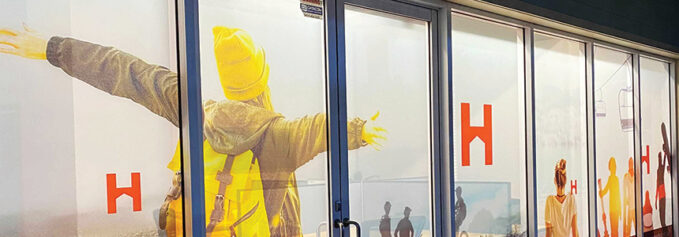
Above: Continental Grafix’s panoRama TwoWay Vision solution is engineered to keep graphics looking vibrant day and night.
To Perf or Not to Perf
Many types of unperforated media, including optically clear, opaque, and translucent, support a range of window graphic applications.
Optically clear films allow for portions of the printed graphics to remain fully transparent, creating cutouts without the labor of installing many separate pieces. “It’s perfect for storefronts that want to create a whimsical, playful, or intricate visual theme,” says Antenucci.
Alternatively, opaque films completely block the view behind them. “These films are typically gray or white to create bold, full coverage graphics on walls or windows when the ability to see out is not a factor,” adds Antenucci.
Translucent films can bridge the divide between perforated and opaque. “While you can’t see through them, they allow light to pass through to create a mild amount of privacy when applied to windows,” shares Antenucci.
For first- or second-surface installs and push/pull graphic effects where clarity and color density matter, Jason Maricle, midwest sales manager and product manager, perforated window films, General Formulations, says non-perforated solid or clear films are ideal. “Most large façades end up using a mix of both—perforated film on view-through areas and solid or clear film on unused windows or partition glass.”
Unperforated films are preferred when image quality, opacity, or readability is the priority. For example, when you need dense color, fine detail, or legible text viewed at close range—like interior-facing promotions, privacy graphics, or brand visuals that must look ‘poster quality’ from outside—solid, optically clear, or white films are the better choice. They’re also preferred where privacy or complete block out is required,” comments Dennis Leblanc, senior product and business development manager, Drytac.
Perforated film is ideal when a graphic display is wanted on the outside while preserving see-through visibility from the inside. “It’s perfect for retail front windows, vehicle wraps, and transit shelters. Perforated films make installation easier for large panel window graphic installations such as building wraps,” shares Berg.
Maricle agrees, noting that perforated film is the right choice when you need one way vision, natural light, and a full graphic on active windows with high visibility like storefronts, doors, or vehicle glass.
Dave Hawkes, media product manager, Roland DGA, says perforated film is a media with opposite objectives. “On one hand, we want privacy; on the other, we want visibility. If you are considering perforated vinyl, you know you need it for privacy and visibility.”
Printing Technologies
All major ink systems—UV, latex, and solvent—work well when paired with films designed specifically for the technology, says Maricle. “The bigger difference is not the ink but considerations of the film’s top coating, liner design, as well as how a finished piece is cured, handled, and if it is laminated. Film type and ink compatibility along with finishing matter more than the ink chemistry.”
Hawkes agrees, noting that print performance is based on the manufacturer’s media “recipe.” “The manufacturer should provide ink compatibility, longevity, and color profiles.”
While it is true that all three technologies can be successful on both perforated and unperforated films, Leblanc points out that each has their strengths. For example, “solvent and latex tend to conform well to flexible PVC perforated films and can offer good outdoor durability, especially on vehicles and building exteriors.”
Latex, in particular, has become very popular for perforated window materials due to its balance of flexibility, durability, and relatively quick turnaround.
UV is excellent for speed and surface durability, “but with unperforated clear or highly glossy films, you have to manage ink film thickness and layering to maintain optical clarity. Thicker UV ink can create slight texture or haze, which may be undesirable for ‘view through’ or premium optically clear applications. That said, many modern UV systems and optimized profiles produce very good results when properly tuned,” says Leblanc.
Maricle points out that perforated film without dual-layer liners can create challenges, especially with UV ink, which commonly bridges the holes. “Dual-layer liners will catch excess UV ink so it drops into a recessed channel instead of forming a solid ink sheet across the perforations. Latex and solvent inks don’t usually face these same challenges with perforated film, while UV output benefits most from the upgraded liner.”
White, non-perforated films support UV, solvent, latex, and aqueous inkjet, depending on the coating, shares Berg. These films can generally work with higher ink densities than perforated films. They handle standard orientation, meaning no reverse print is required.
To achieve a comparable visual effect of traditional perforated film with optically clear polyester, UV printing technology is ideal, according to James Halloran, VP sales and marketing, Lintec of America. “UV printing allows for precise, controlled ink layering—utilizing white and black ink layers on opposing sides of the image—to simulate the one way vision effect associated with perforated materials. This level of ink control and opacity management is difficult to achieve consistently with latex or solvent technologies, making UV printing a preferred and the most effective method when producing a perforated-style appearance on clear polyester films.”
Unperforated films tend to behave like standard vinyls or PET films, offers Leblanc. “You have a continuous surface, so color builds and gradients are more predictable. With UV, latex, and solvent, typical curing or drying settings generally apply, but unperforated optically clear films benefit from careful control of ink laydown and heat to avoid orange peel, hazing, or distortion. In all cases, proper curing is key to long-term adhesion to the film and any overlaminate.”
Drying/curing properties apply to all window media types. “UV-curable ink traditionally needs 24 hours post-cure before trimming or laminating; over curing may lead to brittleness. Solvent inkjet must be fully dried—checked via a blocking test—before wrapping or further processing to avoid curling or adhesive failure,” explains Berg.
Hawkes says curing and drying are related to the ink type. “A profiled media should provide the amount of dry time required for the perforated film.”
File Preparation
It is appropriate to consider image density, color compensation, and bleed for window output.
“For unperforated clear films, you may need white ink layers—flood white, selective white, or multi-layer builds—to hold color. That requires careful layer setup in the file and clear communication with the RIP on how those channels are used. On unperforated, you do not need to avoid very fine text or hairline elements that you would on perforated films; they can disappear into the perforation pattern,” comments Leblanc.
With perforated, Maricle suggests avoiding fine text or details that will disappear in the hole pattern. “You may also consider a slight saturation boost to counter the ‘screen door’ effect. Be mindful of how window frames and mullions cut through the artwork, especially on large façades. With solid or clear films, file preparation depends on first- or second-surface printing and whether white ink or an opaque layer is needed to achieve the right viewing effect.”
Berg recommends converters maintain a maximum ink density of 250 percent and leave approximately a quarter-of-an-inch margins to accommodate shrinkage.
“We also recommend printers monitor image density transitions to prevent large dark/light zones that can overheat glass and risk breakage,” adds Berg.
Overlaminating
Overlaminating window media is sometimes recommended, but is not always necessary.
“To laminate or not to laminate, that is the question,” quips Antenucci. She says environmental factors like intense UV rays, freeze/thaw weather cycles, or chemical exposure can challenge a film without overlaminate protection.
“Overlaminates can be critical for applications requiring enhanced durability beyond that of the base film or where additional protection from environmental elements is desired, like water and dirt settling into perf holes and vehicle window applications,” explains Antenucci.
However, for short-term applications like retail campaigns, when the correct base film is chosen, additional protection and the related cost and labor of an overlaminate isn’t a necessity, admits Antenucci.
Vehicle window graphics and longer term perforated window film applications may require an overlaminate to keep water and dust from settling into the holes, which can block vision, creating a hazardous or undesirable view, notes Antenucci.
Specific to perforated films, Berg says overlaminating is required for transit window applications to reduce water build up in the perforation and optimize visibility. “An optically clear cast overlaminate is preferred.”
Overlaminating is optional for all other perforated window applications, but can help extend the life of the graphic if it faces high abrasion or UV exposure. “Choose based on exposure and aesthetic needs,” cautions Berg.
Maricle says exterior or vehicle-mounted perforated window media almost always needs an optically clear laminate to protect the print and keep holes from collecting water and dirt.
Hawkes feels that lamination of perforated film can almost double the life expectancy of a print. “Customers often anticipate a longer life expectancy for perforated film images than they do for typical sign applications. With this in mind, it’s never a bad idea to consider laminating. For outdoor applications especially, lamination is a ‘must’ in most cases.”
Leblanc believes lamination is more situational for unperforated window media. “It’s recommended for high-traffic or long-term installs, or when you need added durability and chemical resistance—cleaning agents, squeegee abrasion, etc. For short-term indoor graphics or where ultra-high optical clarity is required, an unlaminated approach might be chosen—provided the ink system and environment allow it.”
Lamination is generally not recommended if it will introduce haze, reduce transparency, or distort the optics of a specialty clear film, adds Leblanc.
“Optically clear films often do not need a laminate—and using the wrong one can reduce clarity,” cautions Maricle.
For unperforated media, Berg says overlaminating is recommended if the material will be applied outdoors for protection against abrasion, UV, moisture, and chemicals, particularly outdoors. Gloss/matte finishes are common.
“Always consult with the manufacturer and experts to make an educated decision about laminates and other protections for applications,” recommends Antenucci.
Perf Patterns
For perforated media, one may wonder if perforation patterns make an impact on ink usage and color accuracy on press.
Hawkes admits that the perforation of a film impacts the perceived color of the image. “Typically, the image appears ‘lighter’ than an image on an opaque media. The higher the perforation percentage, the lighter the image typically appears. It’s best to review the options and offer samples to demonstrate the difference. If the perforated film requires a modified image to compensate for a color shift, there may be increases in ink usage, but the difference is typically minimal.”
“Print setup doesn’t change much between 80/20 and 60/40 perforated films, but the perceived color density does. The larger the hole area the more a printed graphic will appear lighter as any extra ink will end up in the liner rather than on the film surface. What changes for the viewer is how much printed area remains after installation,” offers Maricle.
Berg feels that lower perforation ratios—for example 60/40—provide less print surface but increased visibility through the printed graphics. “Colors will not be as vibrant or bold as graphics printed on 70/30 or 80/20 films.”
Higher material content—for example 70/30—delivers more image real estate, but light transmission and visibility is reduced, according to Berg.
Installation Techniques
The required skills and tools are the same for installing both perforated and non-perforated media.
Skills include understanding how the adhesive behaves—removable, repositionable, high-tack; readying the surface—glass, frames, fritted areas; and knowing when to use primers, edge sealers, or trimming techniques to ensure a professional finish, suggests Leblanc.
Additionally, the ability to manage liner removal without contaminating the adhesive and maintaining alignment throughout application; skilled razor cutting for clean borders after application; and pressure control—knowing when to apply light versus firm squeegee pressure, especially near edges is important, offers Berg.
In all cases, preparation is essential prior to applying the media to glass surfaces. “Windows are typically framed, which often results in dirt and debris gathering at the corners. It’s best to use an isopropyl cleaner—85 percent—and a lint-less cloth to clean the window before installation. Always avoid ammonia-based cleaners as they leave a residue that can impact adhesion and visibility,” suggests Hawkes.
Maricle notes that perforated films are always dry apply only and require firm, even pressure so the adhesive sits around each hole without distorting the film.
“A dry application method is common, requiring careful liner removal in stages while squeegeeing in rows from the center outward,” comments Berg.
Solid films—especially clear—can be wet applied, but all window graphics demand a pristine clean surface, good alignment, and temperature awareness, adds Maricle.
Unperforated films span a broader range—standard monomeric PVC, high tack, optically clear PET—so techniques vary. “For clear films, dust, fibers, and trapped moisture are much more visible, so meticulous cleaning and sometimes wet application techniques are needed,” notes Leblanc.
Berg points out that vinyl-based material has a “memory,” meaning if stretched during installation, it will relax over time, causing lifting or failure. “Installers must avoid stretching the material,” explains Berg.
Perforated or specialty films often require additional care to maintain optical clarity and alignment. “Borders of one-eighth to one-fourth-of-an inch are suggested to avoid applying right up to moldings, reducing edge failure risk,” shares Berg. For non-precut graphics, lighter squeegee pressure near the edges prevents distortion.
“You should also take surface temperatures into consideration—surface temperatures between 40 and 80 degrees Fahrenheit work the best. For long term and outdoor applications, it is recommended to seal edges with clear tape or liquid edge seal,” says Hawkes.
Installers need sharp blades—never use carbon on glass, dependable squeegees, and for perforated film, edge tape around the perimeter is recommended.
Squeegees are used to apply graphics in overlapping strokes, starting from the center and working outward, explains Berg.
Razor knifes assist in trimming edges after installation.
Tape sometimes helps in positioning before adhesion.
Consumer Shifts
Maricle says window graphics printed on both perforated and non-perforated media are growing in popularity. “Perforated film still dominates large exterior, one way vision applications, while clear and optically clear films continue gaining traction indoors. Designers increasingly choose films based on the experience they want inside the space—not just on the size of the window. As a result, both categories are growing but in different lanes.”
Antenucci sees demand for perforated window media. “It’s a cost-effective and easy-to-install solution for many businesses. It’s the go-to medium for retailers, building wraps, and vehicle window graphics.”
Leblanc believes there is demand for both types of media, but points to a noticeable push toward higher quality unperforated solutions—particularly optically clear and easy-install films—for interior environments and retail where brand presentation and shopper experience are paramount. “Customers are asking for cleaner sightlines, less visual ‘noise,’ and materials that can be installed and removed with minimal disruption.”
“We believe clearer, optically improved unperforated films are influencing market preferences. In particular, unperforated films manufactured from recycled polyester—such as those derived from post-consumer water bottles—are gaining increased attention. For Lintec, this shift is especially significant, as it aligns improved optical clarity and performance with sustainability goals. The combination of enhanced aesthetics, non-PVC construction, and recycled content is resonating strongly with customers and has become an important driver of recent market adoption,” agrees Halloran.
Sustainability does play a role. “There’s an increase in interest for non-vinyl alternatives, driven by brands prioritizing eco-friendly solutions and compliance with sustainability goals. These options often align with corporate ESG initiatives and appeal to environmentally conscious consumers. Non-vinyl films are gaining traction for their recyclability and lighter environmental footprint, without sacrificing print quality or durability,” comments Berg.
Despite this shift, Berg admits perforated films remain a staple for high-impact retail and promotional campaigns where one way visibility and bold graphics are essential. “Their ability to deliver vibrant storefront messaging while maintaining interior visibility keeps demand strong.”
Optically Improved
Are clearer, optically improved unperforated films changing market preferences?
Maricle says the quick answer is, yes. “Modern optically clear PET films are so transparent that unprinted areas can practically disappear, letting designers use white ink selectively instead of defaulting to perforated film or cut vinyl. The optically clear film enables two way visibility where unprinted and crisp, premium graphics are imagined.”
However, it is important to note that they can’t replace the benefits of perforated film. “This is when you need large-scale, continuous one way vision, especially on exterior building façades,” explains Berg.
Antenucci notices rising demand for optically clear films that perform, especially for architectural and retail signage applications. “Optically clear films offer flexibility with unlimited design options to create transparent cutouts, full coverage, or partial coverage graphics. These films create vibrant graphics with depth when white ink is printed behind color.”
Advances in optically clear PET and specialty adhesives have made it possible to deliver window graphics that look almost like direct-to-glass printing when installed correctly. “As these materials become easier to print and install—more end users are willing to move away from perforated solutions when they don’t absolutely need see through. That’s shifting some demand toward high-clarity unperforated films for both short-term campaigns and longer term branding,” comments Leblanc.
Standing Out
Print providers differentiate themselves in the window space with expert knowledge in techniques, materials, and finishing.
“Shops stand out by offering smarter material recommendations—clear ‘good/better/best’ window media options—and pairing them with disciplined finishing, clean panel alignment, and the right lamination. Shops can also ‘level up’ with layered printing techniques, white ink effects, or day/night builds that elevate the design. Strong service, including site surveys, permitting help, and seasonal change-out programs often become the real competitive advantage,” comments Maricle.
Leblanc sees leading providers differentiating themselves through a combination of material expertise and application know-how. “They’re not just offering perforated window or window vinyl; they’re recommending specific constructions—perforated versus optically clear, removable versus high-tack, PVC versus PVC-free—based on dwell time, location, and viewing expectations.”
Options Abound
When it comes to window graphics, unperforated film options offer high impact but lack the ability for one way visibility that a perforated material can provide. Print providers need to be knowledgeable of the benefits of each, as well as the best production and installation techniques for success.
Feb2026, Digital Output