
by Melissa Donovan
Direct to film (DTF) continues to dominate the conversation. With various printer vendors offering some combination of the technology—whether it be a dedicated device or something that works as both a DTF and direct to garment (DTG) printer.
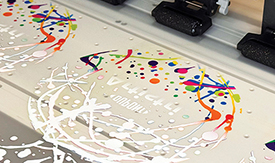
Above: DuPont Artistri P1600 pigment inks are ideal for DTF printing applications. 1) The new Mimaki TxF300-1600 utilizes aqueous pigment ink, PHT50 from Mimaki. It takes DTF to another level with the ability to print up to 63-inch rolls.
“DTF is still fairly new in our industry, but it’s exploded in popularity because it solves problems common in traditional methods. For print service providers (PSPs), it means expanding capabilities without overcomplicating workflow,” shares Emilio Rangel, UV product manager, Mutoh America, Inc.
Key to the DTF process is the ink. There are two main categories—aqueous pigment and UV. The selection depends on what the final transfer is applied to, fabric or rigid/semi-rigid surfaces.
For DTF involving aqueous ink, which is usually textiles, any PSP looking to add or expand fabric decoration as part of their business benefits from DTF output, admits Chien-Yu Lin, senior segment manager, Mimaki USA, Inc. “DTF allows print shops to produce a range of fabrics, including cotton, polyester, and blends that can be used in fashion, promotional, and home goods.”
The appeal for UV DTF, according to Hugo Gonzalez, senior segment specialist, Mimaki USA, Inc., comes from the ability to produce direct to object output for surfaces that other printing processes can’t due to shape, size, or run length requirements. UV DTF also has the advantage of maintaining a similar look and feel to objects printed directly on a UV LED flatbed.
With UV DTF, “there are speed advantages over rotary printing. Instead of mounting each part, you can print bi-directionally on sheets or rolls, then apply to shapes that are tough to hit with a rotary jig. It’s fast, flexible, and opens up more applications with less handling,” notes Rangel.
It’s undeniable, DTF is growing in popularity. Wide format sign shops benefit from adding DTF services whether water-based or UV. The best part, it’s a minimal financial commitment and yields high profitability.
“DTF is an excellent business service extension for wide format PSPs. The same design files used for signage or display graphics can be repurposed for apparel, tote bags, or promotional items. This approach allows businesses to diversify their offerings, enhance customer retention, and tap into customized apparel and promotional products without major workflow disruptions,” says Tim Check, senior product manager, Professional Imaging, Epson America, Inc.
Ink Options
Choosing the correct ink set is pivotal to a successful graphic. This holds true with DTF printing.
According to Karl Tipre, owner, Printer Biz, a DTG-C company, the simplest way to look at DTF ink sets is to split them into two categories—textile and UV.
Textile
Water-based or aqueous pigment inks are commonly used for textiles, which include apparel and soft goods.
Ryan Filip, business development manager AW Specialty Papers, says water-based ink sets are similar to what is found in DTG printing, however “what sets DTF apart is the white ink underbase combined with adhesive powder. The white layer makes CMYK colors pop with full vibrancy, while the powder bonds the ink to the garment fibers for a permanent, durable transfer.”
“Pigment inks are cost effective and fabric friendly, as well as more sustainable due to their water-based nature,” shares Scott Donovan, NA commercial lead, DuPont Artistri Digital Inks.
Mike Davis, application specialist, Roland DGA Corporation admits that “this type of ink is more environmentally friendly than some of the other inks that are commonly used. Additionally, water-based ink can help provide a softer feel to a finished transfer.”
Being pigment based allows for the ink to adhere to the PET film surface while also remaining flexible and durable after transferring to fabric. “This is critical as the inks will need to move and stretch with the fabric so they don’t crack or peel,” notes Lin.
Offering both flexibility and durability when applied to fabrics, Tipre says standard CMYK and white ink sets are available as well as speciality ink sets with extra colors to extend the color gamut.
“The ink’s tackiness allows adhesive powder to stick before heat curing, creating a strong bond that lasts through repeated washes,” adds Filip.
UV
UV inks are primarily used for rigid and semi-rigid items, but emerging formulations can be used for soft goods like textiles.
“UV DTF uses UV-curable inks with a laminate film system. While flexible UV formulations are starting to appear, today the process is still best suited for semi-rigid substrates like tumblers, signage, or promotional hard goods rather than apparel,” says Rob Super, founder/CEO, American Print and Supply.
Tipre agrees that UV DTF inks are designed for hard goods and promotional products. “These inks are a resin cured by UV light. The prints are scratch resistant, waterproof, and can be glossy with raised or textured finishes.”
“These inks cure instantly under UV light, which means no waiting to add the transfer sheet and no issues with cross contamination of colors. UV LED inks have the benefit of curing at a lower temperature as opposed to a standard UV lamp, which can generate more heat, and cause media to contract during printing,” explains Gonzalez.
The strength of UV ink in this scenario is versatility, according to Rangel. “You can print one design and apply it across a range of promotional products without reconfiguring your setup, while still getting all the benefits of UV ink—sharp detail, durability, and instant curing.”
Looking for Features
Specific characteristics are nice-to-have while others are necessary to ensure perfect adhesion between the film, ink, and surface.
“For either UV or textile DTF, users need to make sure the inks are safe, stable, and compatible with both the film and adhesives, as well as the final application,” agree Gonzalez and Lin.
Specific to textile DTF inks, aqueous pigment, they should have strong opacity, consistent pigment dispersion, and proven wash durability, according to Super.
Strong adhesion to film and fabric is a necessity, suggests Tipre. Additionally, a high level of white opacity to cover dark fabrics completely, ink chemistry that is compatible with the adhesive powder and film, and high pigment load for bright and vibrant colors on the finished product are also requirements.
The ink should be compatible with the PET film and adhesive powder being used—and ultimately designed for productivity, notes Donovan.
“Nice-to-haves for textile DTF include expanded gamuts like RGBO or specialty colors for more accurate branding and smoother gradients,” says Super.
Tipre agrees that additional colors to expand the color gamut like orange, green, metallics, and fluorescent are nice but not necessary.
In UV DTF, strong adhesion, reliable curing, durability, abrasion, cleaning, and handling resistance are required, states Rangel.
Strong adhesion is must, especially since UV ink works with non-porous surfaces such as glass, metal, and plastics, concurs Tipre. He also believes UV resistance to avoid fading in sunlight and scratch and chemical resistance to endure rubbing and cleaning are also must haves for a UV DTF ink.
“UV DTF ink must be rigid enough to handle the separation from the film without tearing, but flexible enough to not crack when the final print is applied to a small or sharp curve,” adds Gonzalez.
Super says varnish or foil effects are desirable for UV DTF ink.
These effects include glitter or holographic overlays, as examples, adds Tipre. He also feels flexible inks would be beneficial to prevent cracking on items like leather.
For all DTF ink, a general key feature is ink safety. “Ink safety is of utmost importance for both your employees and your customers, and some retailers require proof of safety by using Oeko-Tex certified inks. It’s also important to be aware of the ink’s shelf life, as some inks may need to be used within 30 days of purchase, while others may have a shelf life of up to two years,” advises Check.
Thoughts on Pricing
Ink is a consumable, and it’s one of the more cost-prohibitive parts of the DTF process. It’s important to have a solid understanding of pricing before engaging in a new service. CMYK, white, and any other specialty options vary in price.
Check says aqueous pigment DTF inks typically range from $60 to $120 per liter, while white ink may cost more, around $80 to $150 per liter, due to the higher pigment load required for opacity. The actual cost can vary depending on the reliability of the supplier, the packaging used, and the region of distribution.
Meanwhile, UV DTF inks average $85 to $95 per liter, depending on whether you’re purchasing CMYK, white, or varnish channels, says Super.
Tipre cautions that DTF ink can be looked at from many different perspectives. While the easiest answer is to look at the cost of the ink per liter from your supplier, an important question to ask is, “how much of the ink you purchase ends up on the film?”
“Many printers utilize bulk ink delivery systems. Because these systems expose the ink to air, the white ink channels require more frequent cleaning. Therefore, much of the ink ends up in the waste tank. It is prudent to choose a printer that reduces waste by delivering the ink with a cartridge-based system, which eliminates air exposure. These printers tend to require less maintenance and significantly reduced waste,” states Tipre.
Based on Tipre’s explanation, the average cost of water-based DTF textile ink by volume is $80 to $120 per liter. The average cost of UV DTF ink is $100 to $150 per liter.
Another cost factor when looking at the overall picture is the adhesive powder, which if printing with UV ink is probably not required. Rangel points out that with some UV DTF printers, like Mutoh’s, ink costs are straightforward. “You’re mainly factoring in the DTF film and adhesive sheets, since no powder or extra steps are needed. Our standard 220 ml UV cartridges MSRP at $99. White ink costs the same, so you don’t have to juggle specialty pricing, just stock what you need and run with it.”
Beware of Scams
It’s the wild west on ink choices for DTF as more vendors debut products to take advantage of the spike in popularity. Sifting through mediocre products to find the quality ones requires some work.
The biggest concern is inconsistency. “Low-grade or re-bottled inks can cause clogs, color shifts, or wash failures. Cheap ink might save dollars up front, but a single ruined printhead can cost thousands,” cautions Super.
“Not all DTF inks are manufactured with the same quality standards. Inexpensive, imported ink tends to differ from batch to batch. This will result in color variance and inconsistent durability. It can also lead to maintenance issues or printer failure,” agrees Tipre.
Unverified suppliers lack quality control, so Donovan recommends choosing reputable brands to ensure consistent performance and reliability.
“PSPs should seek Oeko-Tex certified, batch-tested inks from vendors who provide technical support, not just a bottle on a shelf,” suggests Super.
Turn to reliable vendors. “Certainly, buying from a reputable source is a main consideration. When shopping for a DTF printer, consider if the ink is part of a full system where the ink is produced by the same company that makes the printer. Be sure the manufacturer provides a lot number so the ink stability can be tracked to ensure color and product stability. Also consider if there are multiple manufacturing sources and local warehousing of the inks,” share Gonzalez and Lin.
“The manufacturing process is a key part in making a good ink product. Some inks can be made in less-than-clean environments. They can also have issues with chemistry and pigments. These factors can reduce the performance of an ink or cause issues with the print device or finished product,” says Davis.
“Here’s a crucial point to consider—a single liter of ink can potentially produce approximately 200 full-size t-shirt prints. If you sell each print for $20, you could earn a substantial profit of $4,000. However, saving $10 on the cheapest ink available could have detrimental consequences. It may damage your printer and result in zero prints being produced,” advises Check.
Smart Thinking
Be aware of all the variables when printing DTF. While the process isn’t overly complicated, education on the best inks to use and why can help achieve a final product that is worthy of selling to a customer and earning their repeat business.
“For wide format sign shops and PSPs, DTF is a fast track into a booming market. It’s a natural extension of what they already do, leveraging workflow, artwork prep, and color management to move seamlessly into on demand apparel and transfer printing. Meanwhile, many small and startup businesses that rushed into DTF are struggling to maintain their printers. By offering quick turnarounds, even same day with local pickup options, PSPs can step in as the reliable partner, serving businesses that already have customers but need dependable supply,” explains Filip.
Dec2025, Digital Output Magazine