Out of Cape Town

By Olivia Cahoon

Digital allows print service providers (PSPs) to offer customizable and personalized high-quality printed fabrics. Shops featuring a range of fabrics and providing design help act as one stop for textile buyers to perfect their fabric creations.

Cape Town Cottons
Formed in 1986, Imaterial specializes in fashion and household fabric printing in Cape Town, South Africa. The print shop began with two employees, one of which studied textile design in Cape Town. After purchasing old textile printing equipment on sale, the business offered small runs of custom prints for the fashion and apparel industry in a work area of 2,153 square feet.

Today, Imaterial has a combined work force of 50 employees and a factory of 23,780 square feet. The shop’s largest customer base is located in Cape Town and its surrounding areas. Fashion designers who create apparel, swimwear, and stretch and woven garments are its main clientele. The shop also caters to interior fashion designers for applications like accessories, advertising, curtains, murals, runners, scatter cushions, tablecloths, tea towels, upholstery, and wall hangings.

“Home textile decor accessories have the highest demand, although, we are slowly gaining ground with custom fashion prints,” says Remo Gorlei, owner, Imaterial. For small orders, the shop has a turnaround of one to three days and for larger orders it varies between three to ten days.

The PSP offers textile design services paired with an in-house art studio of qualified designers to assist clients with design creation and color consultation. Imaterial is the first shop in South Africa to introduce direct digital printing for cotton. The shop specializes in print with water-based inks designed for cotton and cotton blends but also offers digital printing for viscose, linen, Lycra, and other fabrics. In fact, 80 percent of the shop’s digital printing is on cotton with no minimum or maximum for runs.

Digital Print
Digital printing allows for customization and personalization using advanced technology. For over ten years Imaterial used two DuPont Artistri 2020 printers. Launched in 2004, the DuPont Artistri 2020 prints up to 71 inches with a maximum resolution of 720 dpi. It is used for a variety of fabrics that range from silk to home furnishings and is compatible with acid dye, reactive dye, disperse dye, and pigment inks.

As its customer base grew, Imaterial searched for a new printer to add to its portfolio. It settled on an MS Printing Solutions device from its JP series in mid-2016. The printer features a resolution of 600×600 dpi and prints up to 125 inches wide.

Imaterial uses only water-based pigment inks to print on textiles. The DuPont machines use Artistri 700 Series pigment inks designed for printing on fabrics with industrial aqueous-compatible, medium-viscosity piezo printheads. The inks require no fabric pretreatment or wet post processing.

Using the MS JP series printer, Imaterial optimizes the full range of pigment and pretreatment products designed specifically for these machines. “The pretreatment has many advantages such as enhancing colors, improving durability, and enabling much faster printing speeds onto most quality fabrics,” says Gorlei.

Several of Imaterial’s basic selections of pretreated fabrics include gentry, hopsack, knits, linens, Lycra, muslin, poplin, Rayon, and twill. Due to the quality of binder content, cotton doesn’t need pretreatments.

Once fabric is digitally printed it goes through a heat cure or stenter process to set the inks onto the fabric fiber. Stenter machines are used for stretching, applying heat settings, and finishing chemicals onto fabrics. Blended, synthetic, and Lycra fabric are commonly dried using a stenter machine. The heat setting time and temperature for printed fabrics differs depending on color depth and fabric quality. Gorlei says years of experience with pigment printing helped him to determine the machine settings for maximum control.

One advantage of digitally printed textiles is the speed and ease of preparing new designs for printing. “It doesn’t matter how many colors need to be printed or how complex the designs are,” says Gorlei.

However, this technology also presents challenges. Gorlei explains that when Imaterial first offered digital printing, it was a whole new world with limited experience and knowledge. The shop underwent operating malfunctions and backup support challenges. “Over the years, this has improved as technology has advanced.”

Print by the Pool
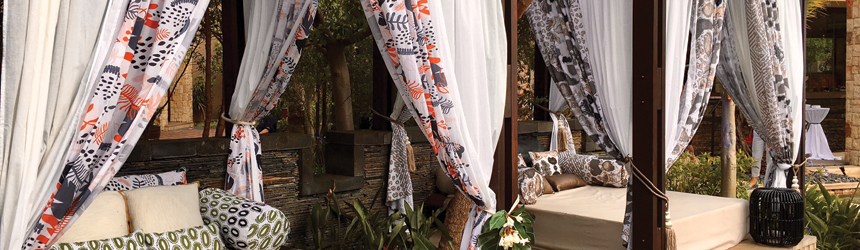
Lalesso, a luxury African fashion and lifestyle brand, is one of Imaterial’s repeat customers. The brand seeks inspiration from East African kanga cloth with printrich designs. The company approached Imaterial to produce a new collection of resort wear and pool lounge furnishings for an upmarket hotel.

Lalesso requested that five designs be produced on a variety of different fabrics. “Timing was critical because we had a week to produce the printed fabrics,” says Gorlei. The client supplied their own cotton fabric base because it gave them the freedom to choose whichever quality they preferred, he explains. Lalesso specifically requested the use of Imaterial’s environmentally friendly production line.

The PSP used the MS JP series printer and water-based pigment inks to deliver five designs. Gorlei shares, “this is ideal for clothing as no solvents or harmful chemicals are used in this system. There is no waste or unnecessary consumables needed, which leads to a sustainable method of printing.”

More than 200 feet of the final prints were completed out of different quality cotton fabrics. For the finishing process, Imaterial used an energy saving eco-dryer from the U.K.

Compared to other jobs completed by the PSP, this one was particularly special. The shop doesn’t always see the finished applications. However, the brand held a fabric launch cocktail party to highlight the new designs. “It was amazing to see the response from all who attended,” says Gorlei. Lalesso is currently focusing on a new range of designs for 2017 and intends to use Imaterial again.

Customized Graphics
Digitally printed garments are used in various applications including apparel and home furnishings. Print shops, like Imaterial, offer several types of fabrics to choose from. They may also feature in-house art studios to aid in the design process. As technology that allows digital printers to handle textiles advances, customers demand faster turnaround times, color brightness, and wash durability

Mar2017, Digital Output
Hybrids for Efficiency

By Olivia Cahoon

Roll-to-roll (R2R) printer/cutters are popular amongst print service providers (PSPs) looking to save space in their shops. These devices provide efficiency and eliminate the process of moving a roll of printed media to a separate table or roll cutter to finish the job. Depending on the needs of a shop owner, a printer/cutter is ideal to make the most out of limited space while still offering service versatility.

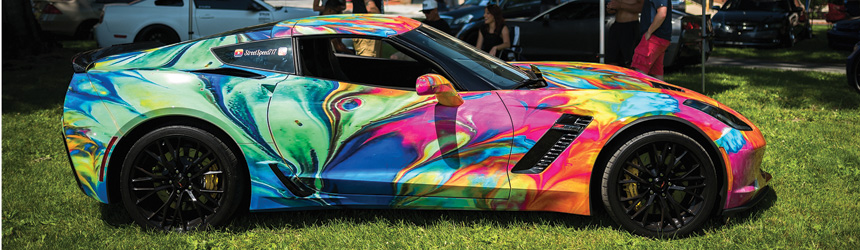
Print-and-Cut Hybrid R2R printers with a cutter function provide hybrid workflows to save time and provide a dual operation for shops to produce a variety of applications on one machine. Printer/cutters produce applications like architectural signage, backlit signage, decals, fine art reproduction, garment decoration, labels, point of purchase, posters, static clings, vehicle wraps, and wayfinding signage.

Michael Maxwell, sign and graphics business development and marketing senior manager, Mimaki USA, Inc., says cut-and-print devices save floor space while ensuring accurate cutting.

These devices function by printing manageable-sized sections, returning to origin for contour cutting, and then feeding to the take-up unit, which automatically winds the material onto a secondary roll, explains Daniel Valade, color printers’ product manager, Roland DGA Corporation. “With advanced features and functionality, these inkjets make the entire print-and-cut workflow virtually automated,” he adds.

R2R printer/cutters eliminate wasted time, additional labor, and allow print providers to begin design work for the next project or even leave the shop overnight while the printer/cutter continues to work unattended.

Matt Gusse, sales and marketing VP, Advanced Color Solutions (ACS), explains that some print-and-cut machines feature RIP software that include color charts and plug-ins for popular graphic programs. “The color charts insure accurate color and the plug-ins included make cutting easy,” he adds.

Minimizing Time and Space
Printer/cutters create a simplified workflow for PSPs, which involves less manual labor. The machines condense space in a print shop by using one device compared to two.

“The benefit of an all-in-one solution is the ability of the print provider to set up a file one time and have the machine perform the functions that would normally take two machines, more space, and additional time,” says Maxwell. These printer/cutters streamline workflow to increase productivity.

Printer/cutters are cost efficient for the appropriate user. “When compared to competitive print-only devices, in most cases, the cost to get started with an integrated printer/cutter is significantly less, since a separate cutter doesn’t have to be purchased,” explains Valade.

Gusse shares that units under 30 inches may be less than $10,000 while larger and faster machines are closer to $30,000. Besides cost, print-and-cut devices also provide ease of use, especially for beginners. “The ability to load a variety of materials for dozens of applications in one machine and learn just one machine is easier to comprehend versus getting multiple machines,” he says.

Maxwell adds that R2R printer/cutters don’t have many challenges unless the material needs another process, for example lamination, applied between the print-and-cut workflows.

The Right Fit
While R2R printers with built-in cutters save on space and cost, they may not be a fit for all types of print shops. Valade shares that some PSPs require large format devices that are wider than the R2R printer/cutters on the market. “Most integrated print-and-cut devices range from 30 to 64 inches in width and some service providers may need grand format machines as wide as 104 inches.”

However, Valade says that these types of shops should still consider purchasing an integrated printer/cutter. R2R printer/ cutters allow print shops to handle jobs complementary to grand format work and a print-and-cut device allows PSPs to become a one-stop shop.

“All PSPs can benefit from a print-andcut device, however, some have utilization or other equipment that need cutting,” explains Maxwell. In a situation where a secondary process is required to finish the job or another printer is present, it may make more sense to have a standalone printer that is utilized while the other print tasks are performed.

R2R printers/cutters feature new advancements to keep up with the rest of the industry like self-functioning features. Maxwell shares that some machines automatically switch the pinch wheel assignments and pressures to eliminate marring printed areas. The machines also have self-diagnosing functions for nozzle checks and recovery.

As users print on thicker and denser substrates, R2R print-and-cut devices need to have increased downforce to handle cutting. Valade says that five years ago, 250 grams of force was sufficient for almost any printable substrate that required contour cutting. R2R devices now handle 500 grams of force and feature functions like overlap and perforated cutting. “They can even generate crop marks for registering applications that require lamination before cutting, which allows the material to be reloaded into the device after lamination for precise contour cutting,” he adds.

The R2R Market
Here, we share printer/cutters available for purchase from various vendors.

ACS
ACS distributes the Roland TrueVIS VG-540 with a 54-inch print width. The device allows a maximum thickness of one millimeter (mm) with liner for printing, and 0.4 mm with liner and 0.22 mm without liner for cutting. The printer/ cutter prints at up to 900×900 dpi at a maximum speed of 141 inches per hour.

The TrueVIS VG-540 features VersaWorks Dual RIP software, a new core engine for processing files like transparencies. The software includes capabilities like a predictive ink calculator, variable data printing, embedded ICC support ink level adjustment tools, advanced cropping, tiling, and nesting options. It supports up to four Roland devices.

CSL Digital
CSL Digital offers the Lightbar VS-I series of printer/cutters. Available in 54 and 64 inches in width, the solvent/UV ink technology is based on Roland printers.

The lightbar unit features stationary, low-energy UV lamps and prints up to 1,440 dpi.

Mimaki
Mimaki features the CJV Series cut-andprint devices with a maximum media width of 63.8 inches and 55 inches in height. The CJV Series features Mimaki piezo printheads and Mimaki eco-solvent and dye-sublimation ink technology. The inks feature a variety of colors including metallic, silver, white, orange, and light black. The cut-and-print functions allow pre-cutting before printing to prevent film separation and problems related to post-cutting thin materials.

The CJV Series has self-diagnosing features such as Mimaki’s Nozzle Check Unit, Nozzle Recovery System, Waveform Control, and Mimaki’s Advance Pass System to eliminate print artifacts. The CJV Series is intended to produce applications from fine art reproductions to outdoor signage. It prints at up to speeds of 1,140 square feet per hour (sf/h) with a resolution of up to 1,440 dpi. Mimaki’s printer/cutters are priced between $15,000 and $30,000.

Roland
Roland offers the TrueVIS VG Series with a maximum width of 64 inches, four Roland FlexFire printheads, and TrueVIS INK. TrueVIS INK is odorless and lasts up to three years outdoors with no lamination. It is also Greenguard Gold certified. The VG Series uses a new carriage and blade that offers 500 grams of force for printing substrates and contour cutting. It also features a built-in control panel that allows functions to be controlled by smartphones or tablets using Bluetooth.

The VG Series is used to create several applications including die-cut labels and decals, banners, signs, vehicle wraps, posters and backlit displays, wall graphics and murals, fine art, and print-andcut heat transfers. Roland offers a take up system and optional drying units to boost performance during high-volume, unattended operation.

Summa
Summa, Inc. provides the Summa DC Series printer-and-cutter available in a maximum width of 54 inches. It is a thermal transfer printer that cuts at 24 inches per second and prints 93 sf/h in standard mode for spot color resin ribbons. The machine also prints by mirror metallic ribbons for indoor use.

The device’s cutting features cut with a drag knife using standard Summa D-Series blades and includes ColorControl RIP and Cut Software. It also supports multiple printers, which enables up to four DC Series machines to be connected to a single computer. The Summa DC Series produces images durable for up to five years outdoors without lamination.

Wide Format Printer/Cutters
R2R printers/cutters allow PSPs to offer wide format creations as a one-stop shop. These devices save on floor space and are cost effective. With the newest technology advancements including the ability to print on thicker substrates and self-diagnostic features, the market is full of great options for PSPs to consider.

Mar2017, Digital Output

In Your Install Kit

By Elizabeth Quirk

New products, tools, and techniques are constantly introduced in the vehicle wrapping segment. It is important for installers to recognize these advancements. Adapting them to their business model can help to save both time and money.

Heat guns or torches, application gloves, squeegees, and magnets are all helpful when it comes time to install a wrap. Gaining popularity is another tool, tape. Tape technologies are often used in vehicle wrapping to either minimize the use of knife cutting, which may cause damage to the vinyl or the car, or to accent a graphic as a design feature.

Evolution of Tools
Ergonomics, practicality, and efficiency are the driving factors of innovation when it comes to vehicle wrap installation tools. Certain techniques were once only found in an experienced installer’s tool box. Now specific products like magnets, squeegees, and heat sources are available for the less experienced and enable higher quality and more profitable installs.

Simple items like magnets and squeegees have become more substrate-specific and user friendly. According to Jason Yard, marketing director, Mactac Distributor Products, there are now magnets with many types of handles and strengths to accommodate varying magnitudes of wrap projects. Squeegees are also user-preference specific with suede, felt, Tefl on, or plastic edges.

Louie Calma, technical services specialist, Arlon Graphics, LLC, says squeegees were once only available in different hardness levels. Today, a number of shapes allow for more ergonomic and detailed installs. Snap-off blades are available in different tip angles. Some are even capable of carrying multiple spares in their housing.

“Many other tools are modified to cater to the ever-evolving graphics industry,” continues Calma, citing heat guns as an example. Once equipped with a simple on-off switch, now these tools feature a digital readout. Heat guns and torches were also once only capable of heating smaller sections of film during application but the emergence of infrared heaters allows for faster and better vehicle wrap installations by evenly heating larger sections.

Ease of Installation
As the market grows more competitive, faster and more effi cient installations are a valuable way to set a shop apart. Realistically, all tools make installation easier. Favorites include tape, application gloves, magnets, and squeegees.

Kimberly Tostrud, product marketer, 3M Commercial Solutions, advocates for 3M Knifeless Tape, stating it provides installers with a way to avoid damage on vehicles and other substrates. “Though many print service providers (PSPs) profess the ability to avoid cutting through vinyl when installing it on a car, sign, boat, or other substrate, using tape offers the peace of mind that no scratches or damage will take place on a customer’s vehicle,” adds Tostrud.

3M Knifeless Tape speeds up challenging vinyl installations such as custom racing and rally stripes. It can also simplify seaming multiple colors and types of vinyl. “Using a tool like tape proves to be much faster than trying to plotter cut and install your vinyl. Th e tape also eliminates the worry of damaging the surface, so you can more eff ectively manage tricky cuts with ease,” explains Tostrud.

“Tape technologies emerged to allow for custom cut designs while not risking cutting over the vehicle’s paint job,” agrees Calma.

Application gloves allow an installer to use finger touch to apply vinyl to the complex contours of vehicles without having to worry about the oily or sweaty fingerprints the installer or some other person interacting with the wrap may have. When stretching a film, the glove can be dampened with water and slides across the media relatively easily.

Magnets act like an extra set of hands for vehicle wrap installers. The great advantage of using a magnet is it doesn’t come undone like tape usually does. Magnets can make positioning the graphic easier.

Molly Waters, senior technical specialist, Avery Dennison Graphics Solutions, notes that the installer can slide the graphic under the magnet without risking pulling the tape free on the other end of the same graphic.

Squeegees remove bubbles in the media without incurring damage. Waters suggests using the Avery Dennison FleXtreme micro-squeegee tucking tool, which features one end that can be used to lift rubber moldings to allow the installer to tuck film underneath. “The other end has a small squeegee with pointed edges that allows the installer to tuck film into tight areas. Another specific car wrap installation tool is the softer Red Squeegee Pro Flex from Avery Dennison, which conforms to contoured surfaces and makes the installation process much easier for the PSP,” says Waters.

Let’s Talk Tape
Tape technologies vary in width and adhesion. Choice of use depends on the specific type of vehicle wrap applied and the media used for the wrap.

According to Yard, the most common tape width for vehicle wrapping is one to two inches.

Tostrud argues that the most commonly used widths come in ⅛, ¼, and ½ inches, and that each one is designed for a specific application. The ⅛-inch tape is primarily used for a finished cut, while the ¼-inch sets an even distance between a cut and substrate edge. The ½-inch tape is ideal for spanning between panels, as the tape attaches to the two panels that have a gap with the filament being placed in the center, allowing for a perfect cut.

The width sizes mentioned above can be divided into further categories. Per Calma, ⅛-inch tape can be flexible semirigid or equipped with a metal filament. Flexible tape allows for a tighter turning radius; however, because of a thin construction, it only cuts one to two layers of film without snapping.

“Semi-rigid tapes do not turn as tight as flexible ones, but can cut multiple layers of film for multi-color designs. Metal filament tapes are designed for thick and stiffer materials like chrome and paint protection films. The wider tapes allow for cutting between the gaps of vehicle panels, perforated window films, and multiple filaments for pinstripes or overlaps,” continues Calma.

Tape removes as effectively as it adheres. The only thing to keep in mind with removal is that if you have a wrap design that requires you to cross or intersect the tapes, the tape put down last must be the first removed.

“Repositionability is an important aspect of tape,” shares Tostrud, “because it is common to take more than one attempt to get the perfect straight line or achieve a smooth transition.” Sometimes installers simply change their mind of where they want the cut made, and repositionability gives installers that design freedom.

Calma says the adhesive of a tape must be repositionable, even multiple times, to allow for corrections and re-alignment. It should remove cleanly, easily, and without damaging the vehicle’s paint. “These are crucial factors to get right because trimming, even though it is the tail end of the installation process, is still one hundred percent of the project. In the graphics industry, visual appeal is a big factor,” continues Calma.

“Some installers have different tapes in their tool kit, one for ultra-smooth applications like a glossy car or windows, and one that’s more aggressive for a hard-to-stick wall or worn out trailer,” explains Yard.

Tips and Tricks
When it comes to the tips and tricks users should be aware of before working with tape technologies or any other installation tool, Yard states that the general rules still apply.

It is recommended that PSPs follow the manufacturer’s user guide to avoid costly mistakes. Resources like training courses, online video tutorials, and trade shows are great options as well.

Specific tips to keep in mind before using tape include learning how to start the tape, knowing how to lay the cutting tape down, and how to use tension without stretching the tape.

According to Tostrud, once the basics are mastered, creative installers will go as far as the imagination allows.

Other tricks focus on the type of vehicle being wrapped and the structure of its surface. Foam rollers are now common practice for applying riveted panels compared to the traditional pinwheel-and-rivet brush method. “It’s faster, requires less elbow grease, and the graphic does not have these swirls and scratches that a rivet brush leaves,” says Calma.

Many commercial printers wrap or install graphics on Sprinter vans. “For this work, I like using the application gloves better than the rollers that are also available on the market because I have better control over the pressure I’m using to push the film into place. The glove is also much less expensive than the roller is and can be used in other areas of installation,” adds Waters.

Roll Tape
Media manufacturers familiar with vehicle wrapping techniques offer multiple installation tools to support PSPs. This includes heat guns or torches, application gloves, squeegees, magnets, and tape technologies. Tape technologies are particularly growing in popularity thanks to their ease of use. Not only do they minimize the utilization of a knife to cut vinyl, they are also a design aesthetic in a wrap. Vendors involved with vehicle wrapping provide these installation products in addition to a full range of printable and non-printable wide format substrates to print providers interested in the whole vehicle wrap process from start to finish.

Mar2017, Digital Output

Keeping The Flow of Things

By Melissa Donovan

Communication on a human level is imperative in successful business dealings. Th e same can be said on a machine level. Workfl ow solutions are designed to handle communication between different processes in the print shop environment while automating a number of points in the entire design-to-print-to-finish chain of events. Many workflow products include features or tools specific to wide format, which are shared in a product roundup in this article.

Trending in Workflow
Communication and automation are two of the biggest trends in workflow software geared toward wide format print service providers (PSPs). Together they off er productivity advancements.

“Productivity is about letting software communicate. Print standards are penetrating wide format, JDF is the most common where a clear and standard definition of a job will give the digital production workflow more productivity, efficiency, and reliability,” explains Sebastien Hanssens, VP marketing and communication, Caldera.

Bart Fret, director of sales – large format, GMG Americas, finds that print shops are not just looking for a workflow, but really full XML- or JDF-enabled automation.

According to David Lindsay, PR manager, EFI, “as wide format print shops grow and expand both their digital production volumes and the types of applications they produce, they are increasingly seeking out workflow solutions that help them drive efficiency while managing a growing number of production variables.”

Print providers rely on workflow to automate traditionally manual tasks. Many of these are in the prepress process, adding marks, trims, live areas, and bleeds. “Th e latest version of workflow software from most vendors includes new banner finishing features and JDF connectivity to reduce steps in the workflow or eliminate them all together,” shares Dean Derhak, director of product management, SA International (SAi).

“Businesses are looking for workflow solutions aimed at eliminating redundant manual touch points, with the goal of increasing efficiency and profits in their shop,” agrees Therese McGady, marketing associate, Aleyant.

Bryan Manwaring, director, product marketing, Onyx Graphics, Inc., suggests that PSPs are looking for better ways to reduce material waste, minimize errors in the print shop, and maintain or lower costs. “We find they are looking for automation to accomplish this.”

“More customers are taking advantage of existing workflow automation tools even in smaller shops in order to maximize production and gain a competitive advantage. Things like automated print condition selection via hot folders and template-based workflows are great ways to gain incremental increases in productivity that really add up over time,” adds Josh Hope, senior manager, industrial printing business development and marketing, Mimaki USA, Inc.

Workflow automation is important because of its effect on the physical print process. “Wide format digital printers are faster and more efficient, and more customer projects require faster turnaround times. Also, the RIPs are much better and faster for wide format printing. It is not acceptable to have jobs sit while manually reformatting an incoming file rather than running an automated preflight system,” says Greg Stewart, product marketing and strategy manager – digital finishing business, Esko.

Workflow Roundup
Here we share a selection of workflow solutions designed for wide format print shops. Standout features, why each is a fit for wide format in particular, and product cost are included.

Agfa Graphics’ Asanti Production is designed for wide and grand format printing. It offers full automation capabilities through hot tickets, layout, and ticket templates. A patent-pending Calibrated Printing Mode makes color management easy and predictable. Integrated Image Editor offers automated or interactive tiling, grommet and pocket creation, and bleed extension. Asanti Production is designed for five users, with additional seats available in packs of one, five, or ten.

Aleyant tFLOW is a digital proofing and prepress automation workflow. It integrates with management information systems (MIS), web to print (W2P), enterprise resource planning (ERP), and output systems. An automatic proofing tool allows users to automatically create proofs based on pre-designed templates that include elements such as marks, trim, live area indicators, and finishing parameters like grommets, pull pockets, and bleeds. Three pricing packages are available for tFLOW.

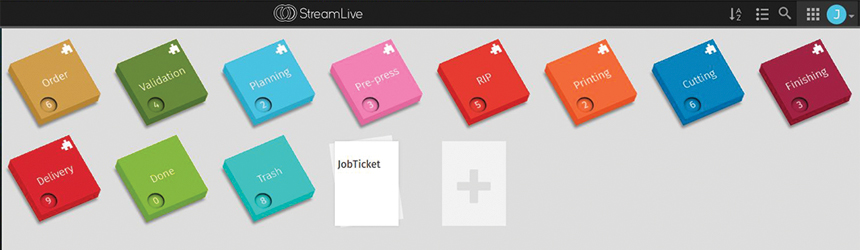
Caldera recently launched StreamLive, a cloud-based application that allows different players of the production workflow to collaborate and work together. With connectors and plug-ins StreamLive connects to MIS, ERP, prepress, and RIPs. Options include a calendar-based planning module, custom document generation, and preflight. It starts at $49 per user per month.

Dalim Software GmbH’s Dalim ES is a device independent collaborative web portal and production automation solution. It works with all forms of media content, not just print, including packaging, three dimensional, and video. For wide format specifically, the program provides a collaborative workflow and asset management environment that serves all marketing content channels. Dalim ES is available in both buy to own and subscription options.

EFI Midmarket Print Suite includes a full range of technologies to handle W2P, cross media marketing, estimating, scheduling, accounting, and fulfillment. It addresses product-specific applications unique to superwide format such as fleet and vehicle wraps, point of purchase signage, and outdoor graphics.

Esko offers Automation Engine Avant. The workflow is built from Esko Automation Engine base technology, allowing it to connect into any system. It bundles with Esko Device Manager, this software is used to communicate job status and help manage jobs based on cutting time and material. Automation Engine Avant is modular based on customer needs and pricing is flexible.

EstiMate Software’s most popular workflow product according to the company is EstiMate Desktop, a desktop pricing and shop management software. Pricing features are available for both wide format roll stock and fl atbed digital printing. Th e software accurately estimates waste from each job and charges appropriately for additional material. Available through monthly and annual plans, EstiMate Desktop’s cost ranges from $39 to $139 per month.

Estimator Corp. introduced Estimator Cloud WF in December 2016. Th e program features unlimited finishing services including sewing, welding, and laminating. Detailed internal reports show the costs of each production item and analyzes the costs and profit of each job. Th e program allows for unlimited users and is based on number of printers. For wide format, users are offered an installation and setup charge of $350.

PrintFactory, powered by GMG, works as a single platform—allowing anyone to print to any printer from any workstation. Th e software gives print providers the ability to off er the same quality product repeatedly with advanced color management tools. PrintFactory, powered by GMG, starts at $3,500 for one user.

InkSoft’s online, interactive Sign & Banner Design Studio features a simple interface allowing any customer to create production-ready graphics. A built-in e-commerce function allows for checking out and paying online. Th e program is available for a one time activation fee of $1,999 and then $199 a month for hosting.

Mimaki added several new features to its RasterLink RIP product in the last year. These include Artista Textile Collection for fluorescent ink workflow, Pantone color libraries for spot color work, and the Artista UV Texture Collection for automation of texture and gloss effects. Tools such as these can be used with hot folder automation or jig features on flatbed printers for accurate piece job placement. RasterLink is included with all Mimaki printers.

Onyx’s ONYX Th rive version 12.1 features increased speeds for file processing. According to the company, processing times in ONYX 12.1 are three times faster than in ONYX 12 for halftone processing. Other tools ideal for wide format include bleed and grommet marks and automating finishing functions with Quick Sets 2.0. Th e base price for ONYX Th rive is $4,995.

The Ordant workflow solution includes features like approving quotes through email, online proofing, business to business and business to consumer storefronts, and connections with QuickBooks, FedEx, and UPS. Its newest feature is a calendar, which integrated into the software allows users to create, assign, and track various tasks. Pricing for Ordant starts at $295 a month.

Pixta, Inc. offers pixtaFlow. This cloudbased service includes an estimating engine specifically designed for large format with modules for price breaks based on quantity of square footage used, square footage based pricing with markup, as well as product-based pricing. pixtaFlow now offers an API that can be used to drive the estimating engine remotely from a customer’s application or their web store. It costs $165 for the first three users and $25 for each additional per month.

Racad Tech Inc. sells Online Sign Studio, which is available as a plug-in to existing content management systems. For wide format, the system is designed to detect uploaded files and either accept or deny based on the file format size and/ or resolution. Pricing is scaled based on features required, set up costs go up to $5,000.

In early 2016, Red Tie Inc. introduced its Pay As You Go W2P solution, with no upfront costs or monthly fees—users only pay for what is downloaded. Th e program allows the print provider to control the size of files being uploaded by the end user. In addition, warning and stop icons are available for low-quality user images. Pricing varies based on what is downloaded. For example, $150 entitles a user to 50 print-ready PDFs with the solution.

Version 12 of SAi’s FlexiSIGN & Print includes a new Artwork Approval Tool. Th e wide format design through production workflow software incorporates a web-based tool so print providers can manage the customer approval process inside of Flexi. Print buyers view artwork on a secure web page, annotate changes on the design, and the system tracks them automatically. FlexiSIGN & Print allows users to add cut contour and perforation paths to designs, allowing for print-and-cut in the same production workflow suite. Th e program is available by subscription starting at $49.95 a month or at full purchase of $3,295.

Smartsoft Inc. offers PressWise, a cloudbased end-to-end print MIS and workflow solution. In Fall 2016 it debuted several new features. A kitting functionality allows jobs that contain multiple components to form a single product for simplified quoting and invoicing. Other enhancements include a multi-ship functionality, sales tax flexibility, and new customer reporting.

The Automated Flow
Workflow solutions are available in a range of options. Many communicate well with multiple systems such as MIS, ERP, and the like; some are hosted in the cloud while others are available for install on site.

Most of today’s software programs share the common trait that all are designed to streamline print, specifically to automate manual processes to speed up production times and increase efficiency in the print shop.

Mar2017, Digital Output

Printhead Principles

By Cassandra Balentine

Quality and speed advancements for wide format digital printers are driven by improvements in printhead technology.

“Competition at the print shop level has led to a need for expanded product offerings, which has in turn led to a higher demand in the performance of the printheads in wide format printers,” says Matt McCausland, product manager, professional imaging, Epson.

From drop placement and variability to automated maintenance functions, printheads continually evolve to drive better quality and productivity for print service providers (PSPs).

Driving Development
Improvements in both wide format hardware and ink depend on printhead engineering for success. “As printer manufacturers begin the hardware design process, many decisions are made based upon the capabilities of the included printhead,” shares McCausland.

New ink formulations drive market growth and expansion as well as innovation in printhead design. “It is impossible to consider advances in one without the other,” explains Dr. Ross R. Allen, senior technology specialist, inkjet technology platforms, HP, Inc. He says, for example, improvement in durability requires pigments, polymers, and other ink components that make these inks more difficult to eject reliably than simpler dye-based formulations. “Printheads and their service stations must handle these inks properly to produce consistent quality and reduce the impact on productivity from printhead maintenance.”

John Harman, business development manager, Ricoh Company Ltd., suggests that offering enhanced features such as including an ink recirculating structure in the printhead facilitates significant improvements in production uptime. This feature is also becoming increasingly critical with the use of heavier pigmentloaded inks and fast drying ink types including water and solvent.

Enabling the Future
Today’s PSPs are looking for speed, quality, and dependability. Printheads evolve to raise the bar on many of these demands.

“The evolution of single-pass printhead technology drives extreme advances and gains in productivity, efficiency, and profitability by increasing print speeds up to ten times over traditional inkjet print technology,” shares Kevin Shimamoto, GM, wide format, Memjet.

In fact, he explains that the productivity of a wide format printer with single-pass printhead technology rivals that of wide format LED printers. “Reprographic houses can now offer four-color printing without having to sacrifice the turnaround time for customer requests. This also leads to new revenue streams from market segments they cannot address with monochrome printing,” he offers. Applications like posters for retail environments is one example.

McCausland admits that every PSP wants high-speed, band-free printing. “Each iteration of printhead technology pushes that envelope in terms of what is possible. Innovations like variable-sized droplet technology and improvements to microweaves allow PSPs greater flexibility in product offerings and differentiation,” he offers.

Harman says increasing both the printhead resolution and the amount of ink the printhead can deliver efficiently, accurately, and consistently are key determinates in achieving higher resolution and speed. Also utilizing printheads with smaller drop volume have a significant impact on achieving high resolution and print quality.

Allen comments that virtually all large format inkjet printers offer printing resolutions of 1,200 dpi, which produces sharp text and smooth colors in graphics and images on a range of substrates. “Pushing resolution to higher levels doesn’t really improve quality, because 1,200 dpi already exceeds the resolving power of the human eye at a normal reading distance.”

He continues that what is more important to image quality is dot placement accuracy, dot size consistency, and precise color-to-color alignment to suppress artifacts such as banding and color fringing. “This requires a printhead with a robust and consistent drop ejection mechanism that delivers uniform-sized drop at uniform speeds across thousands of nozzles.”

“Once a printhead/ink combination meets an application’s needs for quality and productivity, it is the reliability of the inkjet writing system that has the greatest impact on a PSP’s day-to-day ability to deliver jobs profitability and on schedule,” explains Allen. It is important that printheads and their inks provide robust, high-quality printing or the PSP’s time and materials are wasted when jobs must be reworked due to streaks and banding. Furthermore, the cost of ink used to service the printheads affects cost per copy and service stations must be designed to use ink very sparingly. Inks, printheads, and the printhead service station work together as a system to ensure reliable printing performance, he adds.

Prolonged Lifespan
Printhead malfunctions affect both productivity and operation costs. Proper maintenance is critical to ensuring they live up to their expected lifespan.

“The industrial inkjet printer market requires stable printing qualities—even under harsh environments—as inkjet printheads in the field are exposed to physical shock, chemical impact from various inks, and excessive heat cycles,” says Sumio Arima, senior manager, PD2 sales department, corporate printing device group, Kyocera Corporation. Printhead manufacturers must continually work to enhance robustness and long-term durability features to support these conditions.

According to Shimamoto, printhead life is influenced by factors such as maintenance, environmental cleanliness, ink formulations, and environmental factors like temperature and humidity.

McCausland sees continued maintenance as the single biggest factor in the life of a printhead. “For printheads that don’t burn out over time, it is important to make sure they are clean of any fibers, hairs, or debris. Oftentimes, print shops are not the cleanest environments, so I would recommend users be conscious of where they are placing the machine in their shop to limit external dust/debris generated from finishing equipment,” he says.

“All inkjet printheads—both piezo and thermal—have some wear-out process that requires printhead replacement after time in-service or liters of ink printed. Early failures may occur due to dry out, improper operating conditions in the printer, and mechanical damage from mishandling and paper misfeeds,” offers Allen.

Nozzle failures due to clogs, dried ink on the nozzle plate, and paper dust can often be recovered by printhead service cycles initiated by the operator or automatically. “Ideally, the printer manages the printheads to obtain the longest practical life,” suggests Allen. “A well-designed inkjet printer assures long life by calibrating energy to individual printheads and implementing automatic testing and servicing.”

According to Harman, the surest way to prolong the life of a printhead is to ensure that you look for features that include an ink recirculating structure in the printhead. “This built-in feature will go a long way to prolong the life of the printhead as well as improving daily operating performance. Following the OEM recommended cleaning and maintenance printer schedule will also ensure prolonged printhead life.

Ink is another important choice to preserving the life of a printhead. “Highquality inks jet better and are important for preventing printhead blockages. Using an improved ink can significantly extend the life of a printhead,” offers Greg Arnot, product manager, Xaar plc.

Product Advancements
Print manufacturers in the wide format space continue to advance products to offer better quality, faster speeds, and more durability.

From a solvent perspective, McCausland says Epson printheads have gained notoriety for their ability to produce variable sized droplets, accurate fine text, and incredible image quality.

“Our new PrecisionCore TFP printheads are the latest in printhead technology from Epson,” says McCausland. They include 360 nozzles per channel and variable-sized droplet technology as small as 4.2 picoliters. Combined with Epson’s new Precision Dot microweave, the PrecisionCore TFP printheads included with the new Epson SureColor S-Series printers produce sellable quality prints at up to 550 square feet per hour, says McCausland.

In its latest line of SureColor S-Series solvent printers, Epson introduced an air filtration system and fabric wiping system to automate the maintenance process sand ensure reliable performance of printheads.

HP Thermal Inkjet printhead technology scales from scanning printheads less than an inch wide to deliver a single color of ink to four-color printheads 5.08 inches wide that are stacked together to make a 40-inch print bar. The company has the ability to tailor printhead and ink options to meet the specific needs of a large format printing application.

Allen explains that scanning printheads support a variety of large format applications, printing materials, and media sizes. Within its HP DesignJet line, PSPs can choose among a range of substrates including plain papers, photo glossy and matte papers, backlit films, canvas, heavyweight coated papers, vellums, and self-adhesive vinyl.

Stationary printheads span the width of the print medium using HP PageWide Technology, offering breakthrough levels of productivity and reduced printing costs— compared to LED printers—that allow a PSP to produce long runs on single, multiple roll machines that can potentially replace several scanning inkjet printers and LED electrophotographic printers, says Allen. HP PageWide XL printers print on rolls of bond paper, matte and satin poster papers, heavy weight coated paper, and matte polypropylene at speeds of up to 30 A1/ANSI D pages per minute.

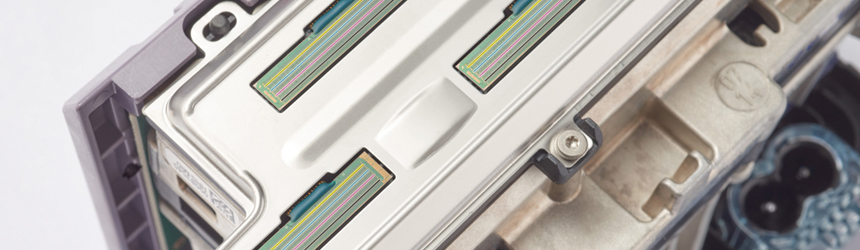
With HP PageWide Technology, a stationary printhead with 202,672 total nozzles spans the width of the print and the print medium moves under the printhead at speeds of up to 75 feet per minute. A 5.08-inch HP 841 PageWide XL Printhead prints with four colors of HP PageWide XL pigment ink at 1,200 dpi with 6,336 nozzles per color. Eight of these printheads are used in the 40-inch, four-color printbar used in HP PageWide XL printers. They are individually launched into a printbar providing mechanical alignment and electrical and ink connections. Individually used printheads are easily removed and replaced by the operator within about a minute without tools, handling of ink, electrical connections, or manual alignment.

Kyocera offers a ceramic piezo-actuator, a core technology enabling the company to offer inkjet printheads with “worldclass” features, according to Arima. “Despite their long presence in the market, conventional wide format printers using solvent ink have not fully satisfied users. They require higher performance such as higher printing speeds and printing quality. They also need printers to achieve higher productivity. These needs are what Kyocera is focusing on. Achieving both enhanced printing performance and higher productivity would be the key for an inkjet printhead manufacturer like Kyocera to be a leader in the industrial market.”

“Memjet single-pass printing technology enables high resolutions at 1,600×1,600 dpi and fast printhead speeds with the most competitive total cost of ownership,” shares Shimamoto. He says Memjet continues to invest in its single-pass printhead technology with the intentions of advancing the market. He predicts future generations will increase print speeds, improve image quality, have better durability, and provide a better total cost of ownership.

Ricoh’s most recent developments are focused on incorporating an ink recirculating structure in its latest generation printheads. This feature facilitates easy priming, self-recovery from missing jets by injected air bubbles, prevention of ink particle sedimentation resulting in blocked nozzles, and prevention of drying out of water- and solvent-based inks in the nozzles.

“These benefits contribute to enhancing wide format printers’ productivity and increasing wide format printers’ confidence in consistently delivering highquality graphics,” explains Harman.

Arnot says printhead performance is improving across a number of areas. “At the high end, new devices like the Xaar 5601 offer high productivity with more than 5,000 nozzles in one printhead; in addition more than one color per printhead aids integration ease and printer setup. The Xaar 1201 printhead can use four colors per printhead.”

For the mid-range, Arnot points to eight-level grayscale, which allows RIPs to achieve much greater apparent resolution than the native resolution of the printhead. “Grayscale also allows better control of drop volume to help better tune ink volume to the media requirements.”

“Newer devices from Xaar offer much more flexibility and have the ability to jet more types of fluid. For example, the Xaar 1201 jets both solvent and aqueous inks. This allows it to fulfill the need for solvents in emerging global markets, but also allows the use of textile inks for soft signage graphics applications,” offers Arnot.

Continued Innovation
Demand for better, faster, and less expensive printheads never wavers, which means manufacturers continually innovate to propel markets forward.

The latest advancements in printhead technology enable PSPs to meet client needs and introduce new applications.

Mar2017, Digital Output

Let’s Get Graphic

By Digital Output Staff

The International Sign Association’s (ISA’s) ISA International Sign Expo 2017 takes place April 20 to 22 at the Mandalay Bay Convention Center in Las Vegas, NV. As of February, the show was set to play host to nearly 600 exhibitors in a 193,000 square foot venue. Similar to years past, ISA continues to keep its marketing fresh and trendy, encouraging attendees to “get graphic.”

At the ISA Sign Expo
Here, we include a roundup of vendors exhibiting at the show. Our April issue includes content profiling additional companies planning on attending the event. Visit us at booth 5368 and pick up copies of both issues.

3M, booth 1345, re-energizes its flagship IJ180 Print Wrap Film with the incorporation of Comply Adhesive with Micro Technology. Featuring advanced slideability and initial tack optimized for wraps, improved liner release, the ability to stretch 130 percent without primer, and a non-visible comply pattern, 3M Print Wrap Film IJ180mC products provide installers with go-to films that move effortlessly across any surface and ensure smooth, bubble-free finishes on any completed wrap.

AGL, booth 2750, displays its Patriot and Compadre laminators. This is augmented with AGL’s Digital Imaging Division’s array of Cover-Rite, Mount-Smart, Shadow-Block, and Print-Smart Media private label brands of wide format finishing films and media. AGL partners with OKI and its ColorPainter to showcase workflow between printing and finishing in wide format.

Argotec LLC, booth 5567, showcases its Polyurethane Graphic Film System. It combines ArgoGraph-White, a premium white printable TPU film with ArgoGraph-Clear, a tough TPU overlaminate film for protecting graphics printed on ArgoGraph-White or cast vinyl films. These durable, UV resistant films are highly conformable, abrasion resistant, non-yellowing, and self-healing; contain no PVC, halogens, or phthalates; and are ideal for outdoor applications, especially automotive advertising wraps, exterior signage, fleet graphics, and building wraps.

Britten Studios, booth 2868, highlights BannerSaver, a wind-spilling light pole banner bracket, shown to spill 87 percent of the wind compared to less than 25 percent for standard brackets. It is now specified in six continents. BannerSaver is made in the U.S.

Catalina, booth 1975, demonstrates two products compatible with offset, screen, eco-solvent, solvent, latex, UV-curable printing, and other emerging inkjet technologies. Permovable is a 2-mil 100 percent biodegradable, non-PVC pressure-sensitive film, developed for short-term, outdoor advertising used for street and concrete graphics in under used, promotional spaces. Augusta Wall Graphics is a 6-mil white, embossed vinyl, coated with clear acrylic pressure-activated, ultra-removable adhesive intended for high-quality interior wall applications requiring durability, flexibility, low shrinkage, and reduced edge curl.

CET Color, booth 5992, invites attendees to come see its new 5×10-foot flatbed UV printer. It features Kyocera printhead technology with 2,656 nozzles per printhead and ultra-fine dots from as small as five to ten and 15 picoliters. The printer is configurable from two to six printheads and achieves speeds of up to 1,000 square feet per hour. An optional static suppression kit reduces static on the substrate.

Chemica US, booth 753, manufactures heat transfer films for both plotters and printers. For plotters, it offers HotMark Revolution, a thin and stretchy HTV that is applied to cotton, polyester, or nylon. Additionally, Galaxy glitter is layerable and stretchy. For printers, it has EasyPrint and HotMarkPrint, the company’s thinnest, stretchiest, and softest opaque printable film.

Continental Grafix USA, booth 353, displays Innova Clear—an insidemount clear self-adhesive vinyl film with 80/20 perforation pattern. With only 20 percent open area users get the ultimate color pop, maximum privacy, and sunscreen while maintaining an excellent see-through level. Inside-mount graphics are easier to install and remove. It is ideal for printers with white ink. Reverse print the image, then flood white and flood black.

Digital Graphics Incorporation (DGI), booth 2782, exhibits the 1.6-meter dye-sublimation (dye-sub) textile printer FT-1608, 1.9-meter high-speed dye-sub textile printer HS FTII, 3.2-meter hybrid textile printer FT-3204X, and 1.9-meter direct textile printer FD-1904. Th e FT-1608 and FT-3204X are powered by eight Panasonic printheads, while HS FTII and FD-1904 are powered by four Kyocera printheads.

Drytac, booth 3998, encourages attendees to stop by and pick up a free sample of the company’s unique media, including SpotOn, ReTac, and ViziPrint printable films. Designed specifically for window, wall, and other specialty applications, they make graphic application and removal effortless. Watch how easy they are to install, ask questions of Drytac product experts, and take advantage of solutions that can resolve pressing graphic challenges.

Epson, booth 724, showcases the 64-inch SureColor S80600 solvent production printer. Touting fourth-generation Epson UltraChrome GS3 ten-cartridge solvent ink chemistry, the SureColor S80600 also incorporates new GS3 Red ink to provide an expansive color gamut. Leveraging a new precision media feed system and high-performance Dual-Array PrecisionCore TFP printhead, the SureColor S80600 allows for same-day lamination to provide productivity and image quality to signage, vehicle graphics, and fine art reproduction.

FDC Graphic Films, Inc., booth 1050, features its service package. Attendees can stop by the booth, have a cup of coffee, and speak with an FDC team member about FDC’s quick ship times, wide selection, and reliable offering of brands. FDC is a master distributor and converter of wide format digital media, digital overlaminating films, digital banner, textile media, sign films, and heat transfer films. The company sells 3M, Aslan, FDC, HEYtex, and RTape branded products exclusively through U.S. and Canadian sign and graphics distribution.

Foster, booth 1757, shows On-a-Roll Lifter to handle rolls of print media, fabric, flooring, or any other roll material. Lifters can simplify workflow and make a shop a safer place for employees. Also on display, a complete line of precision cutters and trimmers for wide format, signmaking, and display graphics production.

Gandy Digital, booth 344, grows its portfolio with the Fascin8tor UV RTR printer, which delivers superwide format graphics with very low ink consumption and outputs exceptional quality regardless of speed. With high-speed quality prints at 2,583 square feet per hour, crash sensors, and up to 16.5-foot wide, the company guarantees print makers will be impressed.

ImageOne Impact, booth 1980, exhibits its P.O.D. Pressure On Demand Steamer—the ultimate tool for both application and removal of all vehicle films including wrap films, window tint, PPF, sign vinyl, and transit films. Th ere is no safer or easier way to install and remove vehicle films of all types without damaging the vehicle/substrate a film is applied to. The seamer is safe enough that even a beginner can unwrap a vehicle without risk of damage to any part of the vehicle itself.

LexJet, booth 4493, invites attendees to discover its newest products including the innovative Print-N-Stick Fabric, Gloss Blockout ThriftyBanner, Simple Grip Backlit, and EnduraFab digitally printable textiles, designed specifically for latex inks. Th e company also features the latest in thermal laminates as well as wide format printers from partners at Canon, Epson, and HP. Learn about LexJet Blue, its annual shipping membership program and more.

Mohawk, booth 5161, expands it Wide Format Inkjet portfolio to include media from Aurora Textiles—true canvas products, wall covers/murals, backlit, and indoor/outdoor banners. With over 150 substrates optimized for latex, eco-solvent, solvent, UV-cured, aqueous dye/pigment, and aqueous single-pass inkjet print applications, there is something for everyone—textiles, canvas, backlit, light block, adhesives, films, and unique substrates such as DuPont Tyvek, lightweight tear-resistant fabric, silver gloss film, textured black film, clear film, and magnetics.

Mutoh America, Inc., booth 3980, launches the ValueJet 1948WX 75-inch dye-sublimation printer. With its staggered four-head design, the VJ1948WX prints at speeds up to 2,199 square feet per hour. Th e printer features a heavy-duty take-up system and one or two liter—with optional bulk in case—ink options. Mutoh also displays the never-before-seen ValueJet 626UH flatbed printer in its booth.

Onyx Graphics, Inc., booth 2375, demonstrates ONYX 12.1 software, the latest version of the company’s wide
format print workflow and RIP products. ONYX 12.1 software features accelerated speed and performance, a simplified user interface, enhanced automation, and advanced finishing tools to do more in less time. Users can process more files in less time with a full 64-bit platform for RIP and applications, with speeds that can improve a service provider’s profit margin by as much as 30 percent.

ORAFOL Americas, booth 1168, encourages attendees to check out recently launched graphic solutions. Have
unwanted glare on your wall graphics? Try one of 20 new matte ORACAL 631 Exhibition Cal colors. Or, if overlaminate silvering of UV printed graphics is what ails you, ask about ORAGUARD 215DU Laminating Film. Come on by and watch daily vehicle wrap demonstrations of ORACAL 970RA UNIQUE Colors by Will Castro Designs. Three new colors add a little pizazz to your ride.

Orbus, booth 750, showcases Embrace stacking and inline configurations, and Modulate mix-and-match and reconfigurable fabric banner systems. Also in the booth, learn more about Orbus’ extensive state-of-the-art production, graphic finishing and printing services, and how you can build your business with the help of Orbus.

Royal Sovereign International, booth 4168, celebrates over 30 years of being a leader in the manufacturing and distribution of narrow and wide format laminators and pressure-sensitive film. In recent years, Royal Sovereign responded to the needs of the print industry by introducing wide format trimmers, banner welders, dye-sublimation calenders and transfer paper, and flatbed multi-applicators.

swissQprint, booth 5175, highlights the flagship Nyala 2 showing a large variety of applications. Come look at the new 1,080×1,080 dpi print mode, which is ideal for fine art and backlit applications as well as for droptix, the swissQprint threedimensional eff ect. Th is mode offers the best quality ever created on a swissQprint UV inkjet system.

Top Value Fabrics, booth 4764, debuts the latest in media especially for the retail market. Its new DigiPanorama is a frontlit fabric optimized for HP Latex Technology. DigiCompetition is a lightweight fabric with the performance of traditional heavier weight fabrics. Supernova is featured on backlit displays at the show. Th e company delivers a wide selection of frontlit, backlit, blockout, PET, mesh, and textiles engineered for printing excellence.

Vision Engraving & Routing System, booth 1320, exhibits the affordable, 2525 industrial grade CNC router. Made in America for over 34 years, the 2525’s graphically advanced software and many available options allows for a variety of custom signs to be expertly manufactured in house, such as ADA compliant braille signs, dimensional letters, and print-to-cut.

Mar2017, Digital Output

Simplifying Print

By Elizabeth Quirk

Many print service providers (PSPs) look for versatile media products, not only when it comes to ink compatibility, but usage in general. Keeping a robust stock of specialty media in house can be difficult, especially if certain types of jobs aren’t frequent. A print provider runs the risk of media failing or becoming damaged while in storage. Many substrates are available for multi-application use to help avoid these challenges.

Ideal Benefits
Multi-application products enhance efficiency, reduce costs, and minimize inventory. Certain PSPs benefit from having multi-application substrates on hand. Even if a shop tends to perform one type of service, a new project could come along, and having a multi-use product would ultimately save the time and expense of ordering special media.

Multi-use products off er a PSP the flexibility to use one product for many applications such as counter signage, wallcoverings, window graphics, or floor graphics. According to Yvonne Okerberg, marketing communications representative, FLEXcon, these types of substrates are engineered with high-performance adhesive systems that meet a range of end use requirements for both permanent and removal applications. Not only does this reduce the number of SKUs, it offers improved inventory turns and efficiencies for PSPs. “With the utility of these products, PSPs can more quickly turnaround sameday print requests,” adds Okerberg.

Print providers receive requests for vehicle advertising applications and wall graphics to window wraps and point of purchase (POP) displays. According to Joshua Barnard, project manager, digital print media, Avery Dennison Graphics Solutions, multiapplication products are extremely useful in accomplishing daily tasks and help reduce costs and in some cases labor.

When considering multi-use media, one benefit is the ability to consolidate inventories. According to Holly Coleman, market development manager, 3M Commercial Solutions, shops cut costs when separate rolls are not needed. “Because these films can be utilized for many different jobs, shops can keep the same roll in their printers with fewer swap outs, leading to an increase in productivity,” expresses Coleman.

Jason Yard, marketing director, Mactac Distributor Products, believes that a multi-use and multi-print product is ideal for simplifying a print provider’s inventory. “Many print shops are strapped for floor and shelf space and manufacturers can help by creating just a few products that meet 90 percent of their application needs.” says Yard. “Multi-use media also helps reduce picking errors when it comes time to print the job,” he adds.

PSPs who sell directly to the consumer find multi-use films to be beneficial, according to Jessica Blevins, product specialist, S-One Holdings Corporation, as their multi-function attributes appeal across a range of the consumer population.

Similar Characteristics
Durability and removability characteristics can be very specific to an application, thus making it difficult to engineer a media product that works well across a range of surfaces. Though each intended surface differs, media manufacturers have come up with a base line that serves multiple applications.

Take for example a substrate designed for a window versus a wall. Glass is a uniform, high surface energy substrate with little variation. The challenge, according to Coleman, is to achieve removability with no adhesive left behind. Walls are challenging from an adhesion perspective due to the wide variations in paint chemistries. Coleman explains, that paints with low volatile organic compounds affect a substrate’s adhesive properties.

“It’s not an easy undertaking, but because of 3M’s rooted expertise in adhesives and micro replication, we identified that common ground and create versatile, multi-use films with a pressure-activated adhesive and Comply technology. This successfully adheres to a variety of surfaces, including both windows and walls,” says Coleman.

Multi-use products feature adhesives that have been tested on multiple surfaces, such as glass or brick, and under different environmental conditions. When it comes to media designated for multiple surfaces, according to Okerberg, one application requires certain characteristics over the other, however, “by working with a media manufacturer that can conduct the proper testing to insure application success this will expand the use of the media.”

“It is true,” Yard adds, “that some applications have specific requirements resulting in a very specific print media. One media doesn’t do everything, however, one good media can cover many different applications.”

Blevins states that materials with a base construction of PET film or fabric offer a more stable and durable product while reducing the risk of shrinkage post installation.

Multi-Media Roundup
Here we share some of the multi-use media products offered by vendors interviewed for this article.

3M Controltac Print Film 40C-114R is a removable intermediate vinyl film with advanced repositionability and Comply adhesive for easier, bubble-free application. Available in an opaque white gloss, opaque white matte, or transparent finish, it is suggested for use as general signage, POP, walls, trucks, partial vehicle graphics, and indoor floor and carpet graphics. 3M Envision Print Film 48C is a PVCfree printable film, optimal for promotional applications. Controltac keeps the adhesive film repositionable on the application surface up to final installation. The Comply feature allows trapped air to escape through micro air channels in the adhesive. 3M Envision Print Film 48C is dimensionally stable at high temperatures and stretchable at low temperatures.

Avery Dennison MPI 1105 Supercast digital cast films seamlessly transition from flat surfaces like walls and floors to vehicles with challenging curves. It is also customizable with outstanding printability across all platforms—latex, eco-solvent, solvent, and UV. It turns any image or design into a vinyl wrap. MPI 2105 Easy Apply digital calendared film also offers versatility with uses in signage applications, large fleet graphics, and floors. It offers the benefits of reduced wrinkling and air entrapment inherent in the application of decals.

FLEXcon’s FLEXmark Promotional Advertising Films adhere to a variety of surfaces, including acrylic, aluminum, stainless steel, painted metal and wood, glass, and indoor floor surfaces. The films are printable via UV and solvent screen, UV/UV offset, and solvent inkjet plus HP Latex. In addition, FLEXcon’s FLEXmark Promotional Advertising Films are designed for versatility and serve as a complement to FLEXcon’s application-specific products.

Mactac’s REBEL is the company’s most popular multi-application and multi-print media, specifically REBEL H High Tack. It is available in both white and clear. The REBEL H series, including RB528H and RB599H, features a high-performance adhesive designed to bond to most surfaces, including low-energy surfaces such as powder-coated paints, UV screen and UV inkjet, and other plastic surfaces. REBEL H is intended to be used for all intermediate- to long-term signage on flat to moderately curved surfaces. As an added benefit, it can be printed on multiple print platforms including UV and solvent screen, solvent, eco-solvent, UV, and latex inkjet printers. The REBEL H product line features a SuperFlat liner.

S-One’s LexJet Corporation brand offers Print-N-Stick Fabric. The multi-application product is designed for window graphics, wall murals, decals, and POP signage and displays. Its unique adhesive properties and durable, terylene fabric allow for easy install, repositioning, and removal without tearing, wrinkling, or stretching. The base fabric is top coated to produce photographic-quality prints. It can also be used in backlit applications as an alternative to traditional films.

Used in All Applications
Many PSPs look for versatile media products, not only when it comes to ink compatibility, but usage in general. Many substrates are designed for multi-application use. These substrates help a print provider keep inventory costs down by eliminating the need for separate media for each application offered. Specialty substrates are ideal for a number of reasons, but multi-use products are a fit for any PSP offering a number of services. Media manufacturers continue to perfect technology and offer tried-and-true multiuse products that succeed on windows to walls.

Feb2017, Digital Output